Crypto markets make extremes impossible to ignore. Prices can accelerate, narratives can spread, leverage can build, and fear or greed can become visible in real time—but dramatic movement is not the same thing as a trading edge.
Volatility makes the move larger. It does not automatically make the decision easier.
Crypto is useful as a case study because several forces can interact at once: narrative, speculation, leverage, liquidity, crowd behavior, and emotion. Those forces can push price rapidly away from a familiar reference, but a larger move does not automatically mean larger mispricing or an imminent reversal.
That is why this lesson belongs inside [The Market](/learn/the-market). The practical question is not simply, “How far did price move?” It is, “What is driving the move, has the behavior begun to change, and has the market actually earned my risk?”
Why Crypto Makes Extremes Impossible to Ignore
Crypto does not invent fear and greed. It can make them easier to see because markets trade around the clock, prices are highly visible, participation is global, social media reacts instantly, and leveraged products can magnify the consequences of being wrong. The result can be an unusually vivid feedback loop between price, attention, positioning, and emotion.
Those same forces exist in stocks, futures, commodities, and options, so the lesson is transferable. Crypto simply concentrates them in a way that is hard to miss. A market that moves 10%, 20%, or more can feel as though it must be offering exceptional opportunity, even when the main thing that changed is the size of the uncertainty.
That distinction matters because an extreme amount of movement can create two opposite mistakes. The mean-reversion trader sees distance and thinks, “Too far; it must come back,” while the momentum trader sees acceleration and thinks, “Too strong; it must keep going.” Both may be reacting to the drama of the move before proving that the trade itself is qualified.
Fear, Greed, and the Feedback Loop Between Price and Emotion
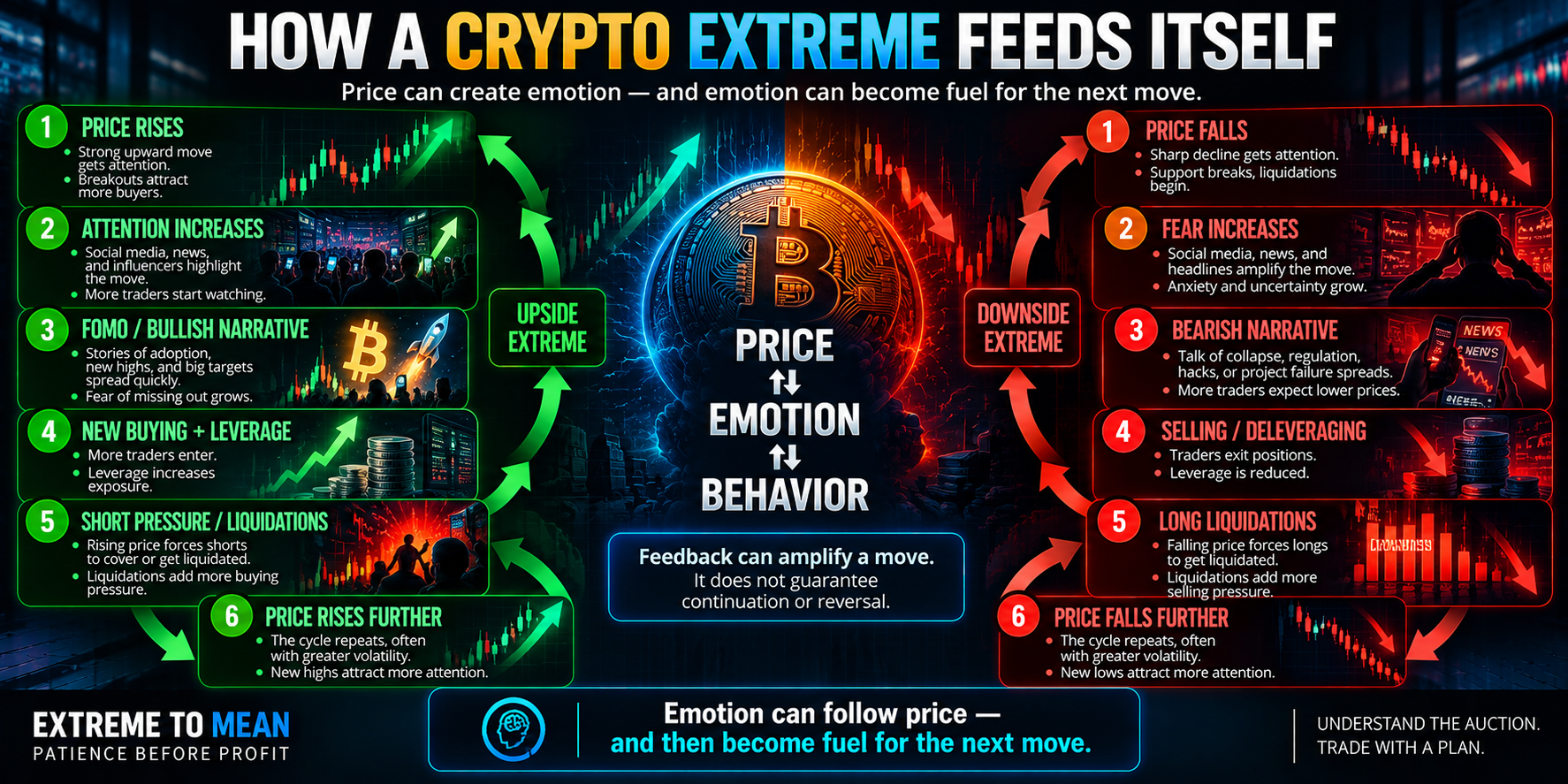
Traders often imagine emotion as something that appears after price moves, but the relationship can run both directions. Price rises, attention increases, fear of missing out grows, more traders buy, and the additional demand can push price higher again. On the downside, falling price can increase fear, trigger exits, attract negative attention, and create still more selling.
When price and narrative reinforce each other, movement can become self-feeding. A strong bullish story can become more convincing because price is already rising, while a negative story can feel more credible because price is already falling. In speculative markets, the move itself can become the advertisement for the move.
This helps explain why an extreme can attract participation precisely because it is already extreme. Social proof feels strongest when screenshots, headlines, predictions, and conversations all point in the same direction. Crowd agreement can feel like confirmation even when it is actually part of the condition making the market unusually stretched.
How Leverage Turns Volatility Into Forced Trading
Leverage changes the character of a move because not every transaction remains voluntary. A trader who is unleveraged can often choose to wait through an adverse move, but a leveraged participant may face margin pressure, liquidation, or an exchange risk mechanism that forces the position to close. Leverage can turn an opinion into an obligation to transact.
That matters because forced activity can push price farther than discretionary trading alone might have. If price falls and leveraged longs are liquidated, those liquidations can add selling pressure, which pushes price lower and threatens another layer of leveraged longs. The upside mirror can happen when rising price forces shorts to cover or liquidate.
In leveraged markets, price movement can therefore force the next round of price movement. The trader looking at the chart may see a dramatic extension and assume exhaustion, while the mechanical pressure causing the extension is still active. A liquidation cascade can eventually end, but the size of the move alone does not reveal where that ending point is.
Why Liquidity Matters More During Extreme Moves
Liquidity determines how much price must move to find the next willing counterparty. In a deep market, urgent buying or selling may be absorbed relatively efficiently; when liquidity thins, the same urgency can move price much farther. A violent move can reflect stronger conviction, fewer willing counterparties, or both.
That is why [how markets move through auction, liquidity, and emotion](/articles/how-stock-market-actually-moves-auction-liquidity-emotion) matters even when the asset is crypto rather than an equity index. Price is still responding to transactions occurring where buyers and sellers can actually meet. When one side becomes urgent and the other side becomes scarce, the distance traveled can expand quickly.
The word “crypto” also hides important differences. Bitcoin generally has a different level of market depth, institutional participation, history, and liquidity from a small or thinly traded token. A claim that is reasonable for one part of the asset class should not automatically be generalized to every coin.
Extreme Does Not Mean Exhausted—or Mispriced
One of the most dangerous mean-reversion assumptions is that a market becomes more attractive to fade simply because it has traveled farther. A crypto asset can be overextended, emotional, and speculative while continuing in the same direction. An emotional extreme can become a larger emotional extreme before it becomes a reversal.
Distance also does not prove mispricing. If genuinely important information changes expectations about adoption, regulation, technology, liquidity, or risk, price may move dramatically because the old price is no longer the correct reference. A large move tells you price changed dramatically; it does not tell you the old price was still right.
This is why [not every extreme is a trade](/articles/not-every-extreme-is-a-trade). Overreaction is a useful hypothesis to investigate, but it should not be declared simply because a chart looks dramatic. More extreme does not automatically mean more reversible.
The Mean-Reversion Trap: “It Can’t Go Any Farther”
Imagine Bitcoin has rallied sharply over several sessions and social media is filled with bullish narratives, screenshots, predictions, and fear of missing out. Trader A says, “This is way too extended,” and shorts simply because the move looks extreme. Price accelerates again, and the trader adds to the thesis: “Now it is even more overextended.”
Trader B sees the same extreme but asks different questions. Is momentum still expanding, has price actually stabilized, has structure changed, has a valid setup formed, and where would the idea be wrong? Until the behavior changes, the conclusion is watch—not trade.
Trader A trades the magnitude of the move; Trader B waits for the behavior of the move to change. That distinction is essential because [reversion is not reversal](/articles/reversion-is-not-reversal). Even if the long-term directional idea eventually proves correct, the path can travel much farther before any tradable reversal begins.
Movement Is Not Edge
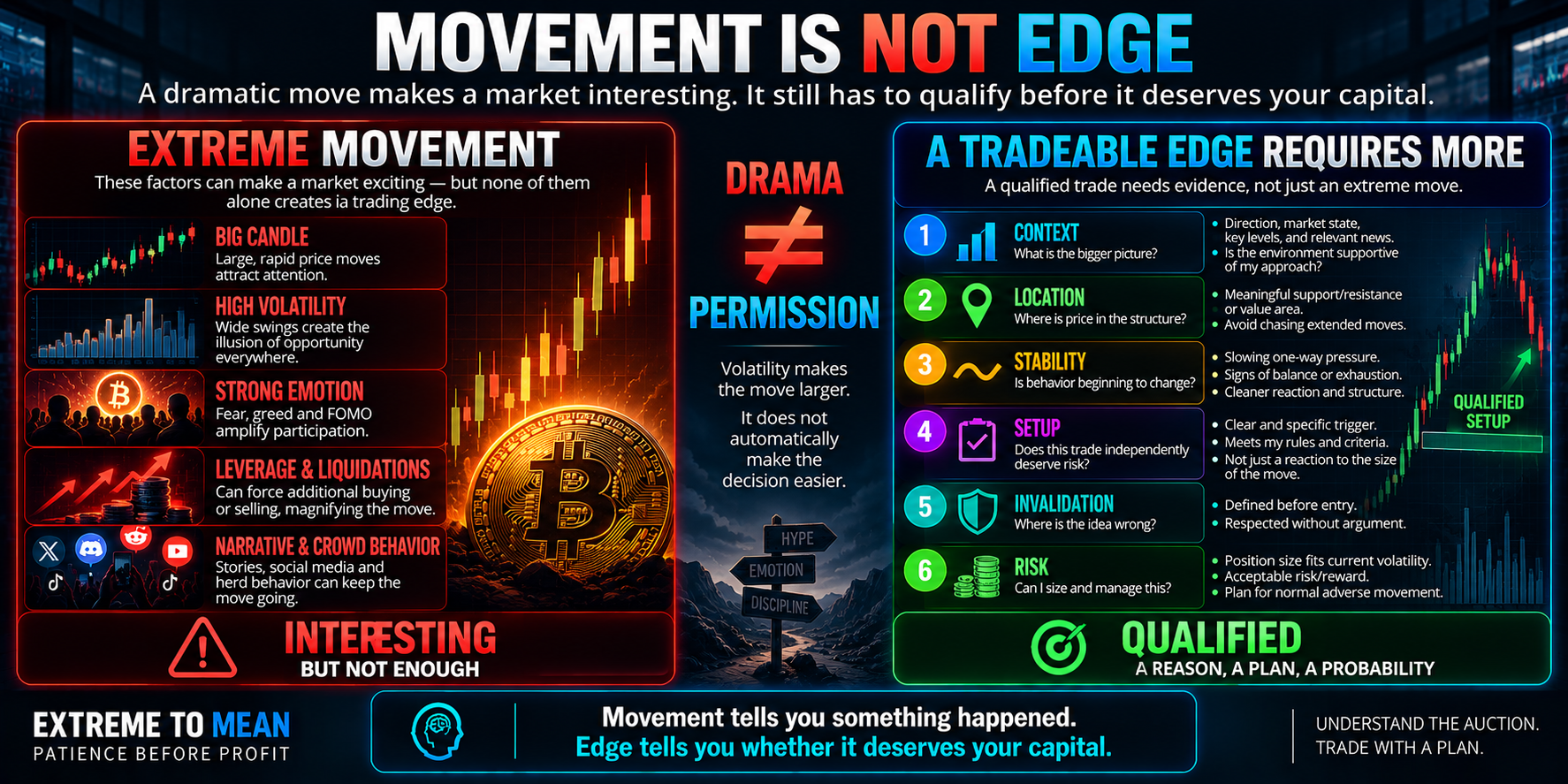
Extreme movement is interesting because something unusual is happening. Price traveled far, volatility expanded, emotion increased, and the market may be attracting more attention than usual. None of those facts, by themselves, define a trade.
Edge requires more. The trader still needs context, location, stability, a setup, invalidation, and risk that can be defined before entry. [What an edge actually is](/articles/what-an-edge-actually-is) matters most precisely when the market is dramatic enough to tempt the trader into replacing evidence with excitement.
Movement tells you something happened. Edge tells you whether what happened deserves your capital. Volatility can make the opportunity larger, but it can also make normal adverse movement larger, make liquidity less predictable, and make a poorly timed entry more expensive.
The Crypto Extreme Check
Before treating a dramatic crypto move as an opportunity, ask:
- What is actually extreme: price, volatility, sentiment, leverage, or some combination?
- Extreme relative to what: recent history, normal volatility, or a meaningful market reference?
- Is the move still accelerating?
- Could leverage or liquidations still be amplifying it?
- Is liquidity supporting normal price discovery, or is movement becoming disorderly?
- Am I reacting to fear, greed, FOMO, or crowd agreement?
- Has the market actually shown stabilization?
- Has a valid setup formed?
- Where is the idea invalid?
- Am I calling this “opportunity” because the move is large, or because the evidence improved?
The purpose of the checklist is not to make crypto safe or predictable. It is to slow down the translation from “dramatic” to “tradable.” The more emotional the move feels, the more important it becomes to separate observation from permission.
The ETM Extreme → Driver → Stability → Qualification → Risk Framework
Use EXTREME → DRIVER → STABILITY → QUALIFICATION → RISK. First identify what has actually become unusual, then ask what may be producing it: narrative, leverage, liquidity, crowd behavior, or genuinely new information. Next ask whether one-way pressure has begun to slow before deciding whether a qualified setup exists.
Only then does risk enter the decision. Can invalidation be defined, can size be responsible for the current volatility, and does the trade still make sense if the expected reversal or continuation does not arrive immediately? The final choices remain trade, wait, or pass.
This is the same discipline behind the broader [Extreme to Mean system](/system): location can create interest without creating permission. Volatility creates movement, but the process still has to find the edge. The stronger the emotion and the larger the move, the more valuable it becomes to slow the decision down.
Final Thought
Crypto markets make extremes easy to see because volatility, narrative, leverage, liquidity, fear, and greed can interact at the same time. A rising market can attract buyers because it is rising, while a falling market can force sellers because it is falling. Liquidations can amplify both directions, and thin liquidity can make each new order move price farther than expected.
That makes crypto a powerful lesson for every trader, not because every extreme should be faded or chased, but because extreme movement is seductive. A market that has moved far is worth studying; it has not automatically earned your risk. Ask what is driving the move, whether one-way pressure has actually changed, whether a setup exists, and where the idea becomes wrong.
Volatility makes the move larger. Your process still has to find the edge.
Educational content only. Trading involves substantial risk and is not suitable for everyone.