A trader can feel sharp, patient, and completely in control on Monday, then question everything about their ability by Tuesday. Sometimes the difference is not the trader. It is the market environment.
Sometimes losing confidence in the trade is the correct response. Losing confidence in yourself is not automatically justified.
Choppy markets are psychologically difficult because they repeatedly offer enough movement to invite a decision without enough persistence to reward certainty. A breakout starts, stalls, reverses, then the opposite side appears to take control before failing too. When confidence depends on the market quickly proving the trader right, that kind of contradictory feedback can make a sound process feel broken.
That is why this lesson belongs inside [The Trader](/learn/the-trader). The market can deserve less confidence without the trader deserving less confidence. The job is to separate confidence in yourself, confidence in the environment, and confidence in the specific setup instead of allowing one failed trade to collapse all three.
Why Chop Makes Good Traders Feel Suddenly Bad
Chop is best understood here as movement without durable progress. Price can travel back and forth aggressively, overlap previous movement, break obvious levels, and reverse repeatedly while neither buyers nor sellers sustain control. It can move a lot without actually going very far.
That distinction matters because a clean directional market gives feedback that is easy to interpret. The trader sees context, location, and setup, enters, and price either follows through or clearly invalidates the idea. Even a loss can make sense because the behavior around it remains coherent.
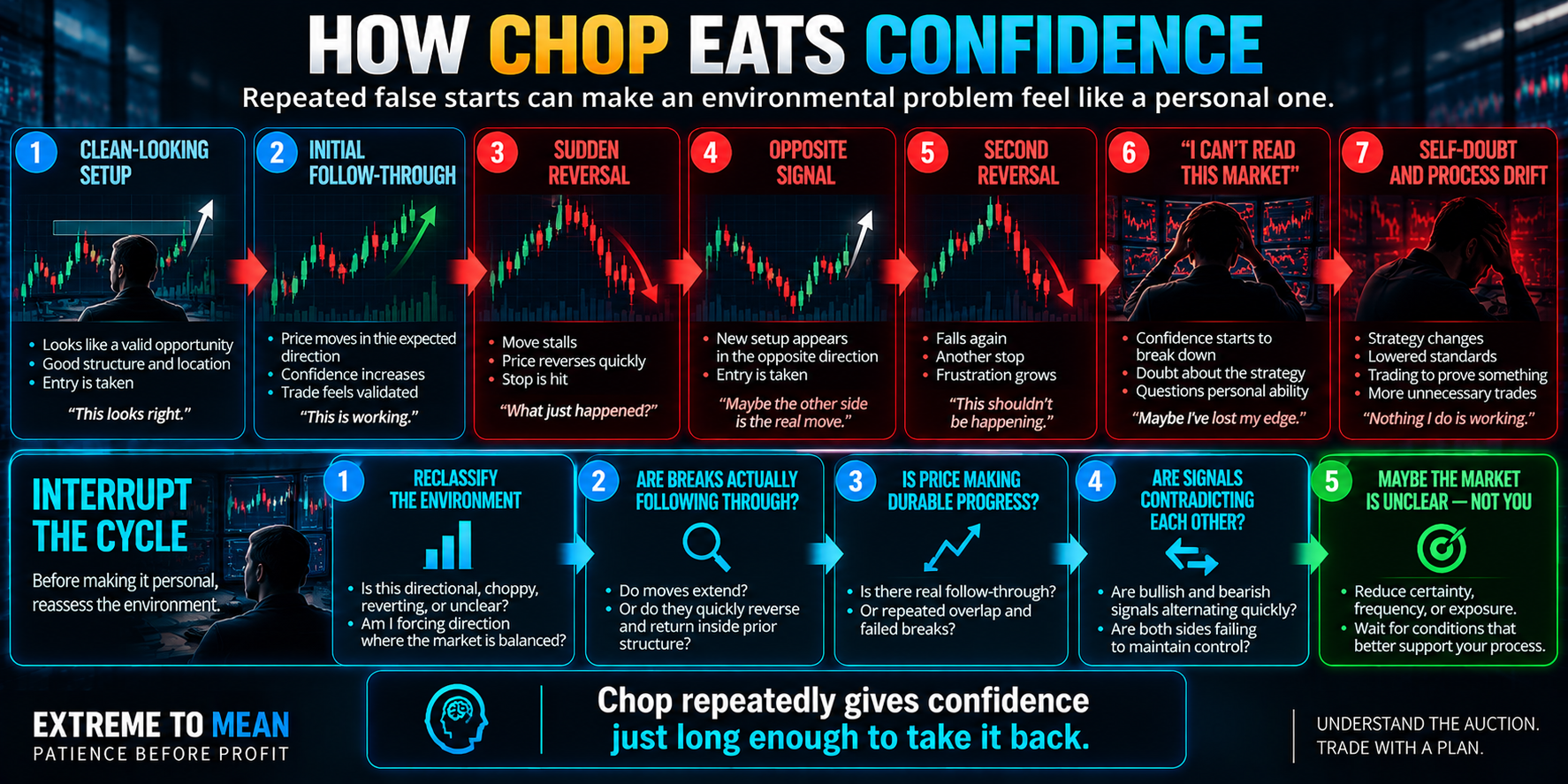
Chop produces a different sequence. A clean-looking setup appears, price moves just far enough to create confidence, then reverses; the opposite setup appears, then it reverses too. Clean conditions make good decisions easier to recognize, while chop can make good and bad decisions look confusingly similar in the short term.
False Starts Give Confidence—Then Take It Away
A false start is emotionally expensive because the trade initially feels validated. Price begins moving in the expected direction, the trader relaxes, and the market seems to confirm the read. Then the move loses follow-through and returns through the area that had just looked convincing.
That can feel worse than a setup that simply fails immediately. The trader is not only dealing with a loss; they are dealing with a brief moment of certainty that was just taken away. Chop repeatedly gives the trader just enough confirmation to create confidence and just enough reversal to remove it.
The mistake is concluding that every failed continuation means the original analysis was foolish. A market can confirm part of your read without delivering enough continuation to make the trade work. Sometimes the more accurate review is not “my analysis was wrong,” but “the environment did not support sustained movement.”
Chop Punishes the Desire for Certainty
Direction becomes seductive when the market keeps changing its mind. The trader says, “Bullish,” sees a rally, then watches it collapse; they switch to “bearish,” only to see the market reclaim the same area. The problem may not be poor directional skill as much as the market’s refusal to sustain directional control.
Chop does not always remove information. It can produce too much conflicting information in a compressed period: breakout, failed breakout, support hold, resistance rejection, reclaim, and reversal. When every signal has an opposing signal nearby, certainty becomes expensive.
This is where [the three market states](/articles/three-market-states) matter as context rather than as a prediction. A trader does not need to force every session into bullish or bearish when the evidence is better described as chop, balance, or unclear. Uncertainty is not always a failure of analysis; sometimes it is the analysis.
Did Your Process Deteriorate—or Did the Environment Change?
Three clean sessions can make a trader feel highly skilled, while one difficult chop session can create the thought, “I do not know how to trade anymore.” But trading knowledge rarely disappears overnight. Market conditions can change far faster than the trader’s underlying ability.
The correct review is not to protect the ego or blame every loss on the environment. Ask first whether the setup qualified, the location made sense, risk was appropriate, and the rules were followed. Use environment to explain evidence, not excuse poor decisions.
If the process was weak, own the execution problem. If the process was sound but multiple qualified-looking trades repeatedly lost follow-through, the environment deserves more scrutiny. [Market conditions change the quality of a setup](/articles/how-market-conditions-change-the-quality-of-a-setup), and a valid pattern can still become a poor opportunity when the surrounding market refuses to extend.
Confidence Has Three Different Layers
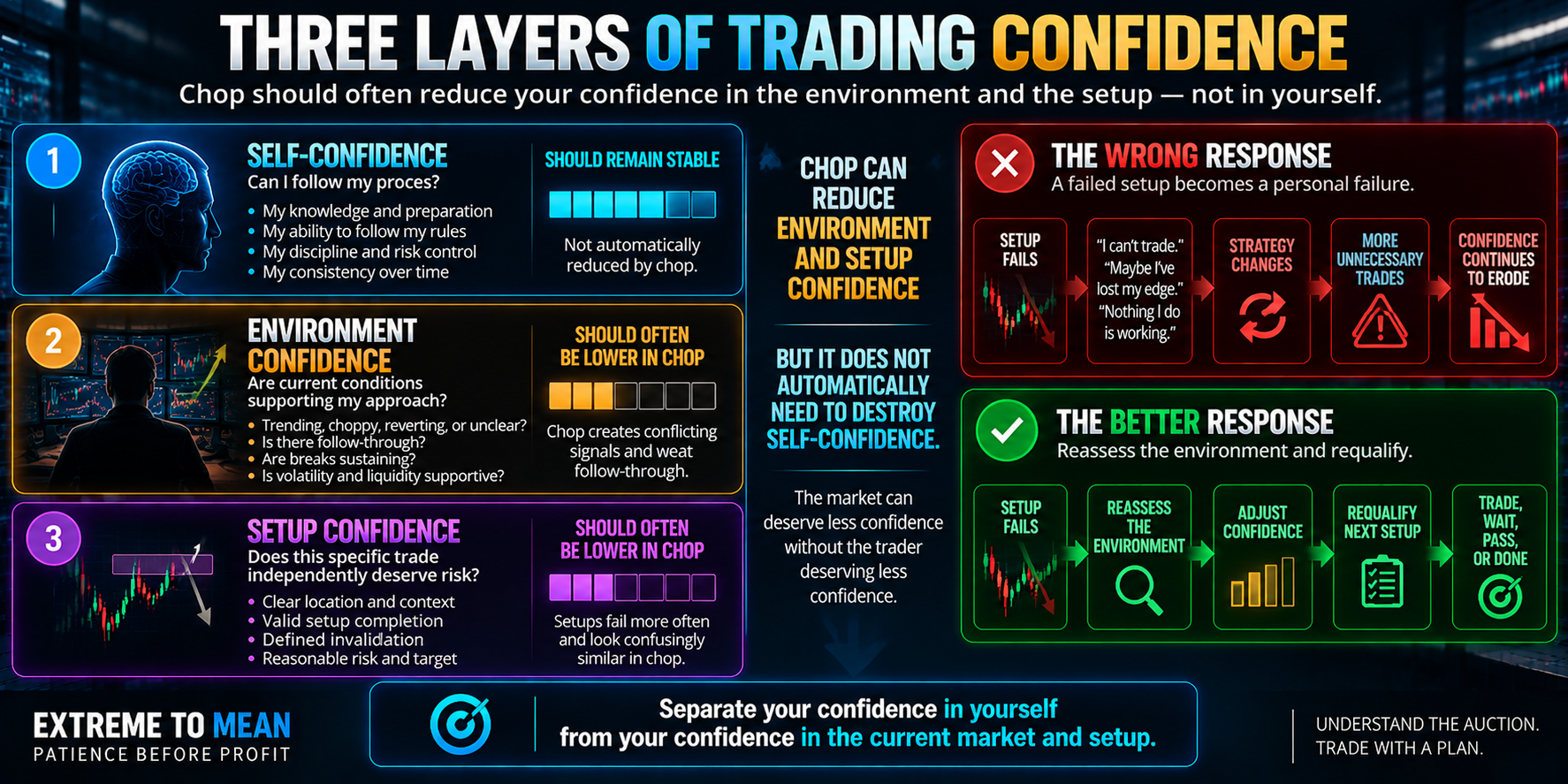
Trading confidence becomes more useful when it is separated into three questions. Self-confidence asks, “Can I follow my process?” Environment confidence asks, “Are current conditions supporting the kind of decisions I am trying to make?” Setup confidence asks, “Does this specific trade independently deserve risk?”
Those questions should not rise and fall together. Chop may justify lower environment confidence and lower setup confidence without requiring self-confidence to collapse. The market can deserve less confidence without the trader deserving less confidence.
Real trading confidence therefore is not “my trades work.” A more durable definition is, “I can identify when conditions support my process and when they do not.” Confidence in yourself can remain stable while confidence in the current opportunity falls.
How Chop Turns Self-Doubt Into Process Drift
After several false starts, some traders begin changing strategies inside the session. A breakout fails, so they switch to reversal trading; that fails, so they scalp; then they return to mean reversion or add another indicator. A bad environment can make a good strategy look broken long enough for the trader to abandon it.
Other traders respond by demanding more confirmation. They wait for another candle, another indicator, another structural sign, and another push because they want certainty before acting again. Chop can turn reasonable caution into a demand for certainty the market can never provide.
The opposite response is just as possible. Frustrated by repeated reversals, another trader begins entering before qualification is complete because they want to “beat” the next move. The same loss of confidence can make one trader wait too long and another act too soon.
“I Don’t Know” Can Be a High-Quality Market Read
Traders often assume competence means always having an opinion about direction. In reality, “I do not have a clean read here” can be a more accurate conclusion than forcing bullish or bearish certainty onto contradictory evidence. Recognizing poor conditions is itself a successful market read.
That is not the same as passivity. The trader can still monitor structure, location, follow-through, failed breaks, and whether the environment is improving. The goal is to remain available for better information without pretending the current information is cleaner than it is.
This is where [protecting the next decision](/articles/protect-your-next-decision) becomes practical. The next trade should not be asked to restore confidence, prove the strategy still works, or erase the frustration of the previous stop. It should qualify because the market finally provides evidence worth risking capital on.
One NQ Morning, Two Different Conclusions
Imagine NQ breaks the opening range with apparent bullish strength, and a trader enters a reasonable continuation setup. Price moves favorably for a moment, reverses into the range, and stops the trade; shortly afterward, price breaks lower, the trader reads the failed breakout as bearish, shorts, and then watches the market reclaim again. Two directional ideas have now failed without either side establishing control.
Trader A makes the sequence personal. “I am completely off today,” becomes the new thesis, so they analyze harder, change bias repeatedly, add confirmation, and take another trade mainly because they need a clean result. Confidence falls further because every new decision is now partly trying to repair the last one.
Trader B reclassifies the environment. Are breaks following through, is price making durable progress, or are signals alternating and returning inside prior structure? Trader A interprets chop as evidence that skill disappeared; Trader B interprets chop as evidence that certainty deserves less risk.
The Chop Confidence Check
When confidence begins falling during a difficult session, ask:
- Are my losses coming from rule-breaking or qualified trades?
- Are breakouts and breakdowns following through, or failing quickly?
- Is price making durable progress, or repeatedly overlapping?
- Are bullish and bearish signals alternating quickly?
- Am I changing bias because evidence changed, or because the last trade lost?
- Have I started modifying my strategy inside the session?
- Am I demanding more confirmation because conditions require it, or because confidence is shaken?
- Would “unclear” describe the market more accurately than “bullish” or “bearish”?
- Can I accept that passing may be the highest-confidence decision available?
The point is not to label every losing sequence as chop. Market conditions and trader mistakes can coexist, and range-bound conditions may still be tradable for approaches designed for them. The check asks whether the current environment is supporting *your* process, not whether the market is objectively “bad.”
For traders who keep getting pulled into false breaks and rapid reversals, the [trading-the-chop problem guide](/problems/trading-the-chop) is the natural next step. Sometimes the cleanest confidence-building decision is not another entry but correctly recognizing that the current environment deserves less participation. A pass can provide stronger evidence of process control than a forced winner.
The ETM Observe → Classify → Separate → Reduce → Requalify Framework
Use OBSERVE → CLASSIFY → SEPARATE → REDUCE → REQUALIFY. Observe what the market is actually doing, classify whether the environment looks directional, choppy, reverting, or unclear, and separate self-confidence from confidence in the environment. Then reduce certainty, trade frequency, or exposure as appropriate to the plan before requiring every new setup to qualify independently.
The final choices remain trade, wait, pass, or done. Confidence should follow evidence rather than demand that the evidence follow confidence. Sometimes losing confidence in the current trade is exactly what disciplined market reading should produce.
Final Thought
Choppy markets can make competent traders feel suddenly incompetent because they repeatedly offer enough movement to invite decisions without enough follow-through to reward certainty. Breakouts fail, direction changes, and legitimate-looking setups can stall, so the trader begins wondering whether the strategy—or the trader—has stopped working.
Before reaching that conclusion, separate three questions: Can I still follow my process? Are current conditions supporting my approach? Does this specific setup deserve risk? Your confidence in the market and the setup should absolutely fall when the evidence becomes weak; your confidence in your ability to recognize that weakness does not have to fall with it.
Sometimes “this market is unclear, and I am not going to force it” is one of the most confident decisions a trader can make. Confidence does not mean always knowing what happens next. It means knowing when the evidence is strong enough to act and when it is not.
Educational content only. Trading involves substantial risk and is not suitable for everyone.