
What the Mean Actually Is
In plain English, the mean is the area price tends to rotate around. Think of it as the chart's center of gravity. It can be shown by a moving average, a balance zone, a prior value area, or any tool that marks where price has recently been accepted. It does not need to be complicated. Its job is simple: give you a practical center to measure from.
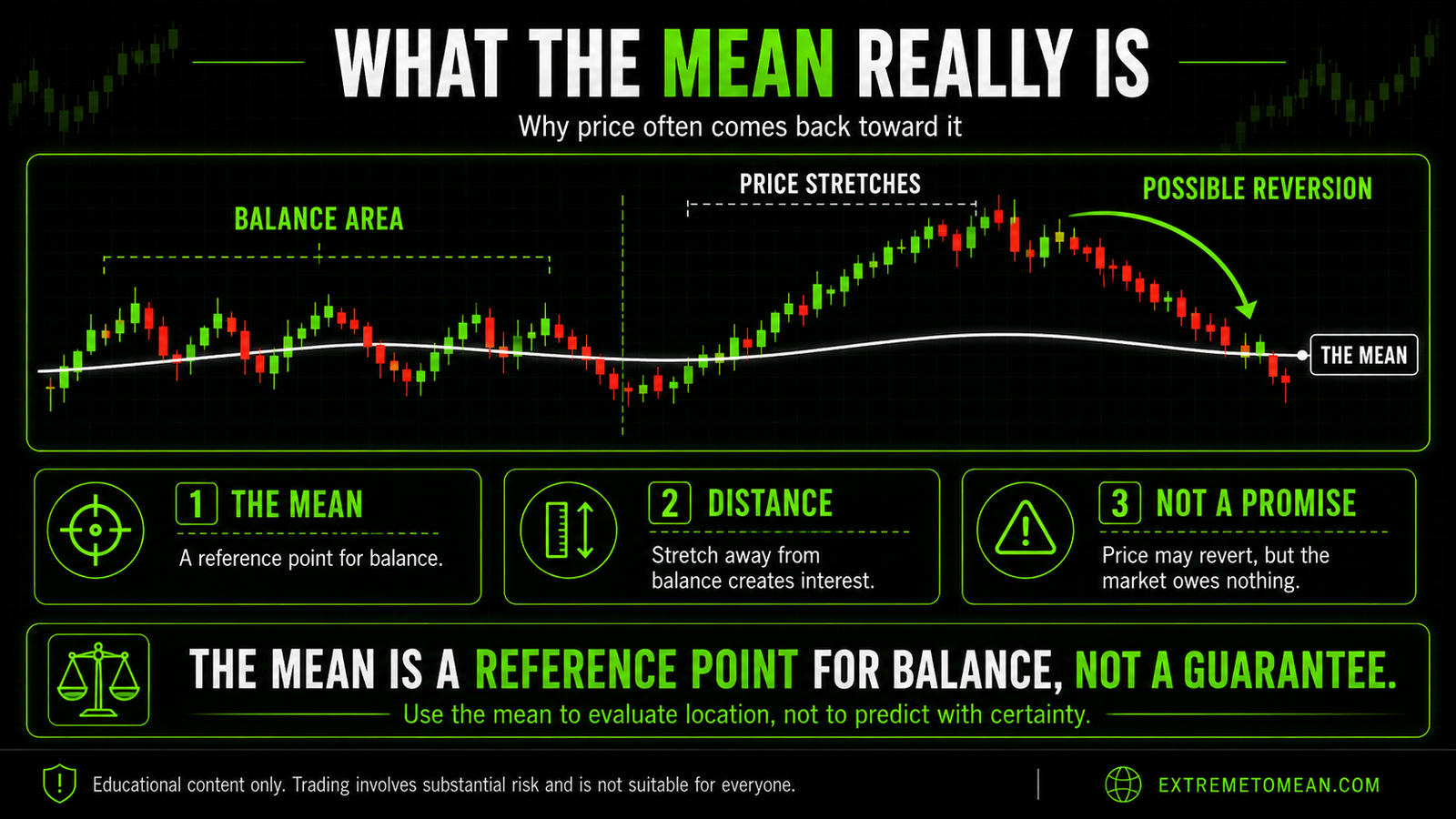
Picture price as a rubber band anchored to that center. Most of the time price drifts near the anchor. Then a push comes, and price stretches away. The farther it stretches, the more noticeable the distance becomes, because the market has moved away from a balanced area.
That stretch is what makes the mean useful. It lets you answer three questions at a glance: where is price right now, how far is it from balance, and is there room for it to move back. At Extreme to Mean, that is what we mean by price location. Price is always doing one of three things: moving away from balance, moving back toward balance, or hovering around it.
Why Price Comes Back Toward It
Markets move because buyers and sellers are constantly repricing value. When one side pushes hard, price stretches away from the area where most recent business has been done. That push can come from news, momentum, trend pressure, or simple short-term imbalance.
Eventually the push runs out of fuel. Buyers hesitate to keep paying higher prices. Sellers hesitate to keep pressing lower. Late entrants start to exit, and other traders who saw the stretch begin to lean the other way. When that happens, price can rotate back toward the mean.
This pull toward balance is real. It is a genuine tendency, and it is exactly why reversion-to-mean trading works. But a tendency is not a rule. In a strong trend, price can stay stretched far from the mean for a long time, and what looks stretched on one candle can stretch further on the next. The mean is a reference point, not a magnet that pulls on command. That is the whole point — so we say it once and move on.
Interest Is Not Permission
Here is the distinction that separates a patient trader from an impatient one: distance from the mean creates interest, not permission.
A stretched market is worth watching. It is not automatically a trade. When a beginner forgets that, the same two mistakes show up every time.
The first is entering too early. The trader confuses distance with confirmation, sees price far from the mean, and assumes the move is done. The second is holding too long. The trader believes price "has to" reach the mean, so they stay in a losing position waiting for a return that was never owed to them. Both mistakes come from the same root error: treating a reference point like a prediction.
The market does not owe price a clean trip back to the mean. Your job is not to assume the return. Your job is to evaluate whether the conditions support it.
What a Better Trader Looks For
A better trader separates interest from permission before risking anything. Distance gets the chart on your radar. Context, location, structure, and risk decide whether it earns a trade.
The same distance means different things in different conditions. Price stretched during a strong trend is not the same as price stretched on a tired move into an extreme zone. Price stretched into major news is not the same as price stretched during a slow rotation. Price returning toward the mean after structure shifts is not the same as price drifting in the middle with no clear decision point.
That is the real value of the mean. It does not hand you the trade. It organizes the chart so you can see when price is extended, when it is near balance, and whether there is room left in the move. A clean read sounds like this: "Price is stretched from the mean, the location is meaningful, the context supports watching for reversion, structure is starting to shift, and my risk is clear." That is a very different statement from "Price is far from the moving average, so I'm taking it."
A Simple Mean-Based Decision Filter
Before acting on a reversion idea, ask one better question:
Am I using the mean as a reference point, or treating it like a promise?
That question forces you to slow down and check the actual setup instead of reacting to distance alone. A short filter helps:
- Is price meaningfully stretched from the mean, or only slightly away?
- Is the market trending strongly, rotating, or unclear?
- Is there enough room for price to move back toward the mean?
- Has structure started to shift, or am I trying to catch the move too early?
- Is my risk clear before entry, including where the idea is wrong?
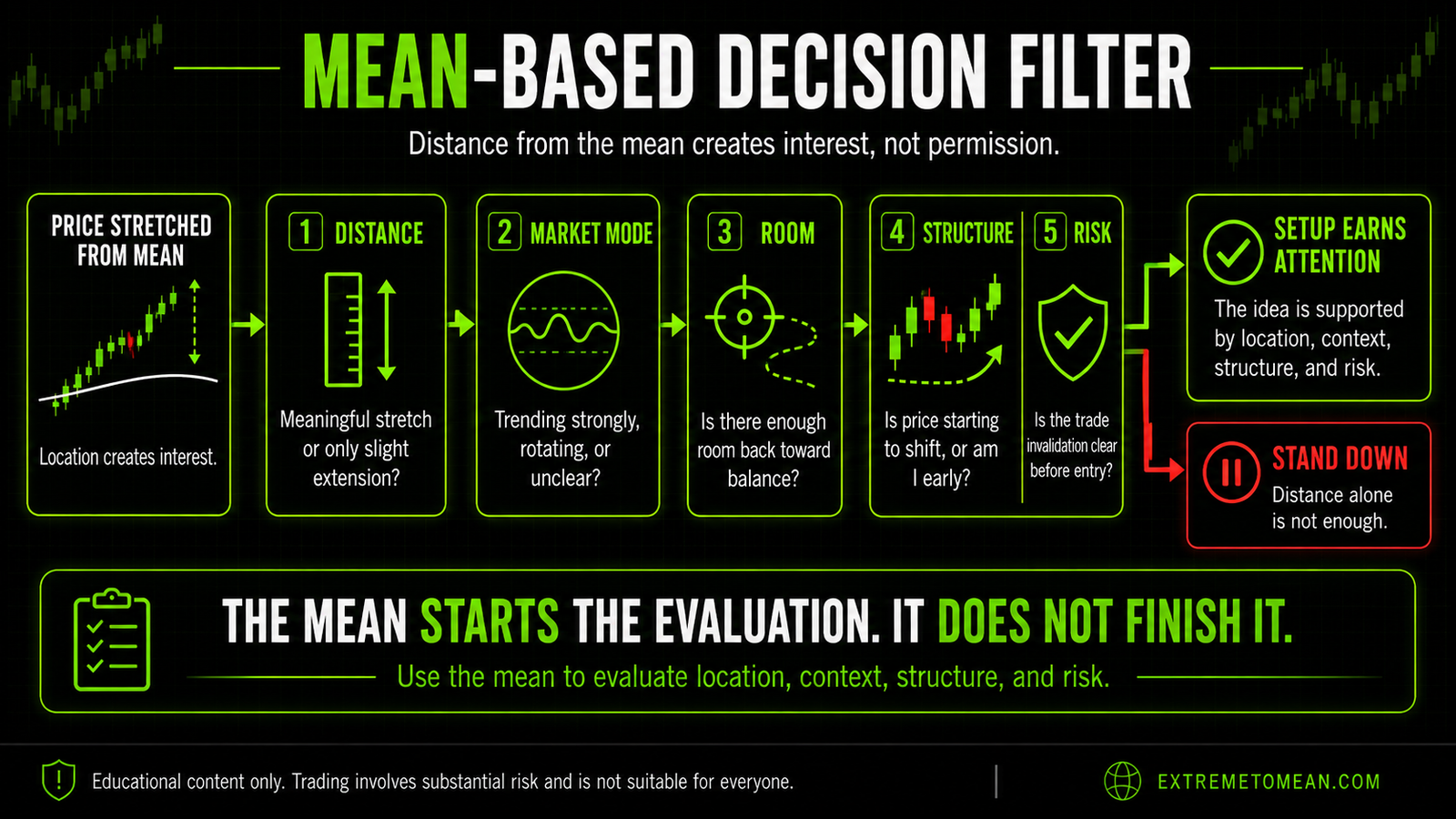
These questions do not remove uncertainty. They sharpen the decision before you take risk. That is the real point of the mean: not to predict perfectly, but to evaluate clearly.
Final Thought
The mean is not magic. It is a practical reference point that helps you read distance, balance, and the odds of reversion. Price comes back toward it often because markets move between imbalance and balance. Often is not always, and the patient trader builds a process around that difference instead of betting against it.
Once you can see how far price has stretched from the mean, the next question is where that distance actually becomes a trade. That is a question of location — and it is where we go next.
Patience Before Profit means we do not trade the mean blindly. We use it to ask better questions, build a cleaner process, and decide whether a setup has truly earned attention.
Educational content only. Trading involves substantial risk and is not suitable for everyone.