
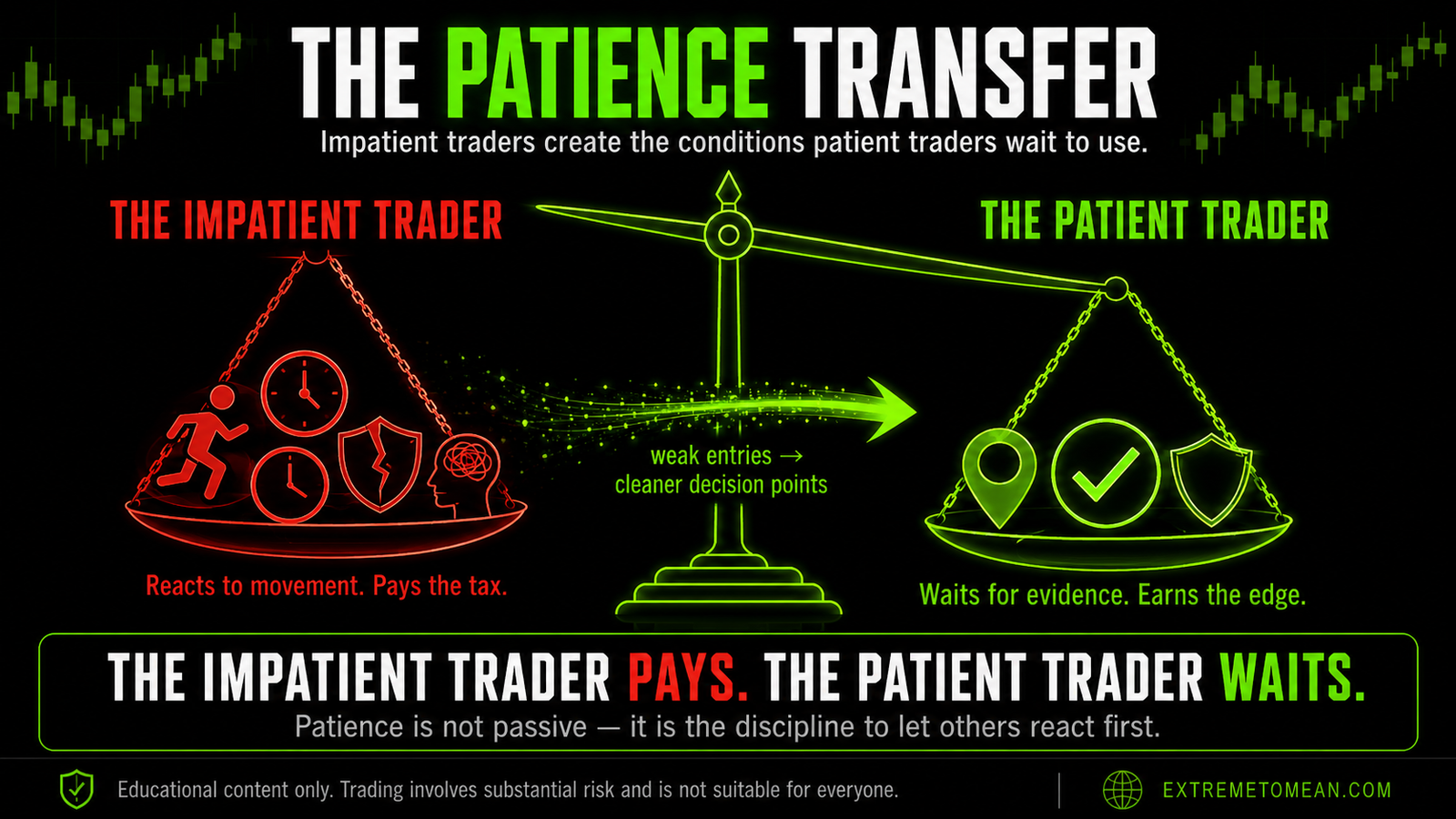
Every trader eventually learns that patience is not just a nice trait. It is part of the process. The trader who cannot wait is more likely to chase, enter early, exit emotionally, and turn movement into urgency. The trader who can wait gets to evaluate the market from a cleaner position.
That is the idea behind "the patient trader gets paid by the impatient one." It does not mean patience guarantees profit. It means impatience leaves evidence on the chart — late entries, emotional buying, panic selling, overextension, failed chases — and that evidence creates the conditions a patient trader can evaluate.
This is one of the central ideas behind The Patience Principle. Patience is not passive. It is not sitting around hoping something works. It is the discipline to wait until the market, the setup, the location, and the risk are clear enough to deserve attention.
Impatience Creates Poor Locations
Most impatient trading starts with discomfort. The trader sees price moving and feels late. They missed the cleaner entry, but the move is still going, so they tell themselves there is still time. The chart looks active, the candle looks strong, and sitting out feels like losing.
That is how a weak location becomes acceptable. The trader is no longer entering because the setup is clean. They are entering because the market is moving without them. The decision has shifted from evaluation to participation.
This matters because location shapes the entire trade. A late entry usually has less room to target, less margin for error, and no obvious place to define risk. Even when the direction is right, the trade can still be poor because it began from the wrong place.
Patient traders are not immune to urgency. They simply refuse to let urgency become the reason for risk. They wait for the setup to come to them, or they stand down.
Why the Impatient Trader Feels Right in the Moment
Impatience rarely feels like impatience while it is happening. It feels like logic. Price is moving higher, so the trader buys. Price is breaking lower, so the trader shorts. The market looks obvious, and action feels justified.
The trap is that obvious movement usually appears after the clean decision point has passed. By the time everyone can see the move, the better location is often gone. The move may still continue — but now the trader has to be far more careful about risk, room, and context.
That is what makes chasing so seductive. The movement is real. The trader is not imagining it. But real movement is not the same as a clean setup. A candle can be strong and still be a poor entry. A breakout can be real and still be late. A selloff can keep going and still offer a weak short.
The better question is: Am I responding to a setup, or to the discomfort of missing one?
The Patient Trader Waits for Evidence
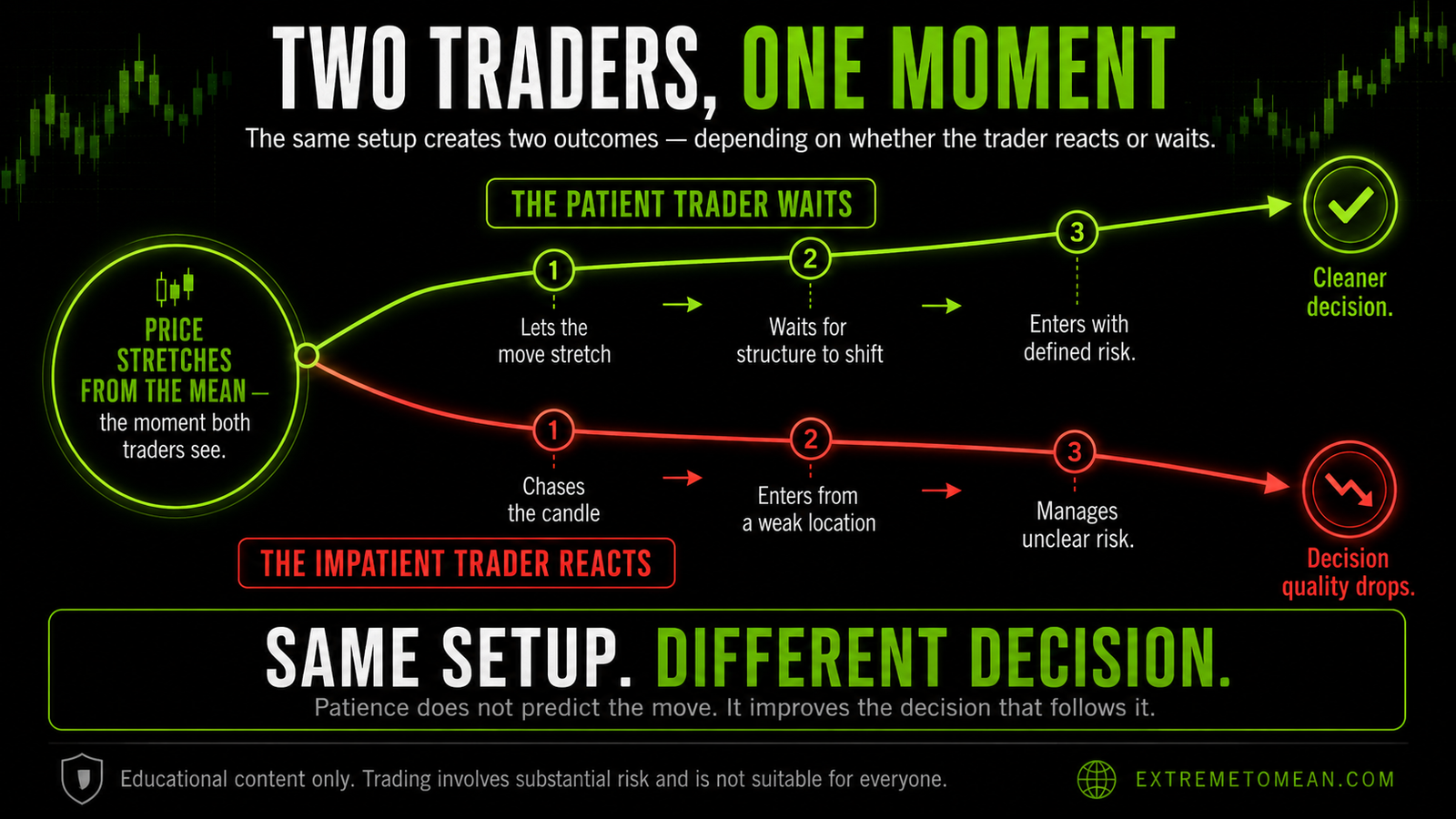
Patience does not mean doing nothing forever. It means waiting with a purpose. The patient trader is not frozen by fear — they are waiting because the trade has not yet earned risk.
In Extreme to Mean terms, that means judging price through location, context, structure, and risk. Has price stretched into a meaningful area? Is there room back toward the mean? Do conditions support the idea? Is structure beginning to shift? Can risk be defined before entry?
That process gives patience something to do. It turns waiting into evaluation. The trader is not staring at candles hoping — they are watching for evidence that the setup is getting cleaner, or evidence that it should be avoided. That is the real split: the impatient trader wants the market to hurry up and confirm their opinion; the patient trader waits to see whether the market confirms anything at all.
The Real Payment Is Decision Quality
"Gets paid" needs to be read carefully. Patience does not magically produce winners. It produces cleaner decisions, better-defined risk, and fewer trades taken under emotional pressure. The real payment is decision quality.
That matters because a bad decision costs more than one trade. A forced trade damages confidence. A chase drains focus. A revenge entry bleeds into the next setup. A trader who spends their emotional capital on weak trades may not be ready when a clean one finally appears.
So patience protects more than money — it protects your ability to keep evaluating clearly. When you pass on a low-quality setup, you are not just avoiding one bad decision. You are preserving the next one.
The impatient trader pays in three ways: weaker location, unclear risk, and damaged discipline. The patient trader avoids that tax by waiting for a setup clear enough to judge.
A Patience-Based Decision Filter
Before entering, ask one question:
Has the market created a real opportunity, or am I trying to create one because I want action?
That question slows the decision down and moves you from urgency back to evaluation. You do not need to catch every move. You need to know which moves fit your process. A short filter helps:
- Am I entering from a meaningful location, or chasing late movement?
- Does the current context support the idea?
- Is there enough room for the trade to make sense?
- Has structure confirmed enough to earn attention?
- Is the risk clear before entry?
- Would I still take this trade if I had not missed the earlier move?
That last question is the honest one. It separates a setup you actually want from a trade you only want because you feel behind.
Final Thought
The patient trader gets paid by the impatient one because impatience creates the very conditions patience is waiting to evaluate. Emotional buying pushes price too far. Panic selling stretches it away from balance. Late chasers build poor locations. The patient trader's job is not to predict all of that perfectly — it is to recognize when impatience has created a cleaner decision point.
That takes discipline: the willingness to sit out while others react, and to accept that doing less is sometimes the better process. This is the behavior that makes the market read (the mean, location) and the setup process actually pay off — because none of it works if you cannot wait for it.
Patience Before Profit means you do not get paid for activity. You earn the right to participate by waiting for better conditions, clearer structure, and risk that can be defined before the entry.
Educational content only. Trading involves substantial risk and is not suitable for everyone.