The Extreme
An extended move where emotion, momentum, or imbalance may be pulling traders away from better decision-making.

About RTM
RTM stands for reversion to the mean: the idea that stretched price moves often return toward balance. Extreme to Mean uses RTM as a framework for patience, location, context, and decision quality — not as a prediction, signal, or guarantee.
"The edge is not chasing the move. It is waiting for the location that deserves a decision."
— Extreme to Mean
The Core Idea
When price moves too far, too fast, traders often feel pressure to chase. RTM thinking slows that reaction down. It asks where price is, how stretched the move has become, and whether the next decision is supported by context or driven by emotion.
An extended move where emotion, momentum, or imbalance may be pulling traders away from better decision-making.
A reference area of balance, value, or structure that helps traders understand where price may be extended from.
The process of deciding whether the environment supports action, patience, or no trade at all.
The Visual Idea
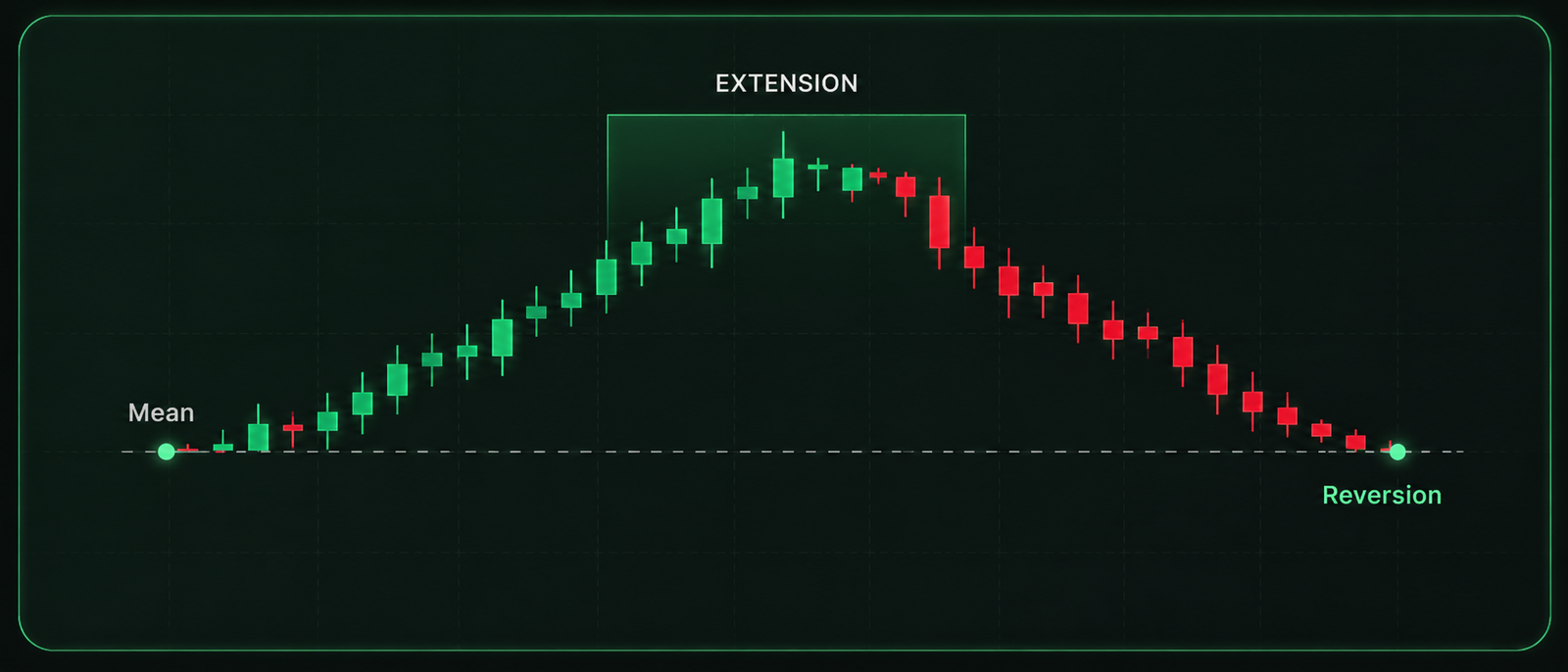
Price does not move in a straight line forever. It often stretches away from balance, becomes extended, and then rotates back toward the mean. RTM is not about predicting every reversal — it is about understanding location and recognizing when price is no longer in a clean or efficient area.
The Bell Curve
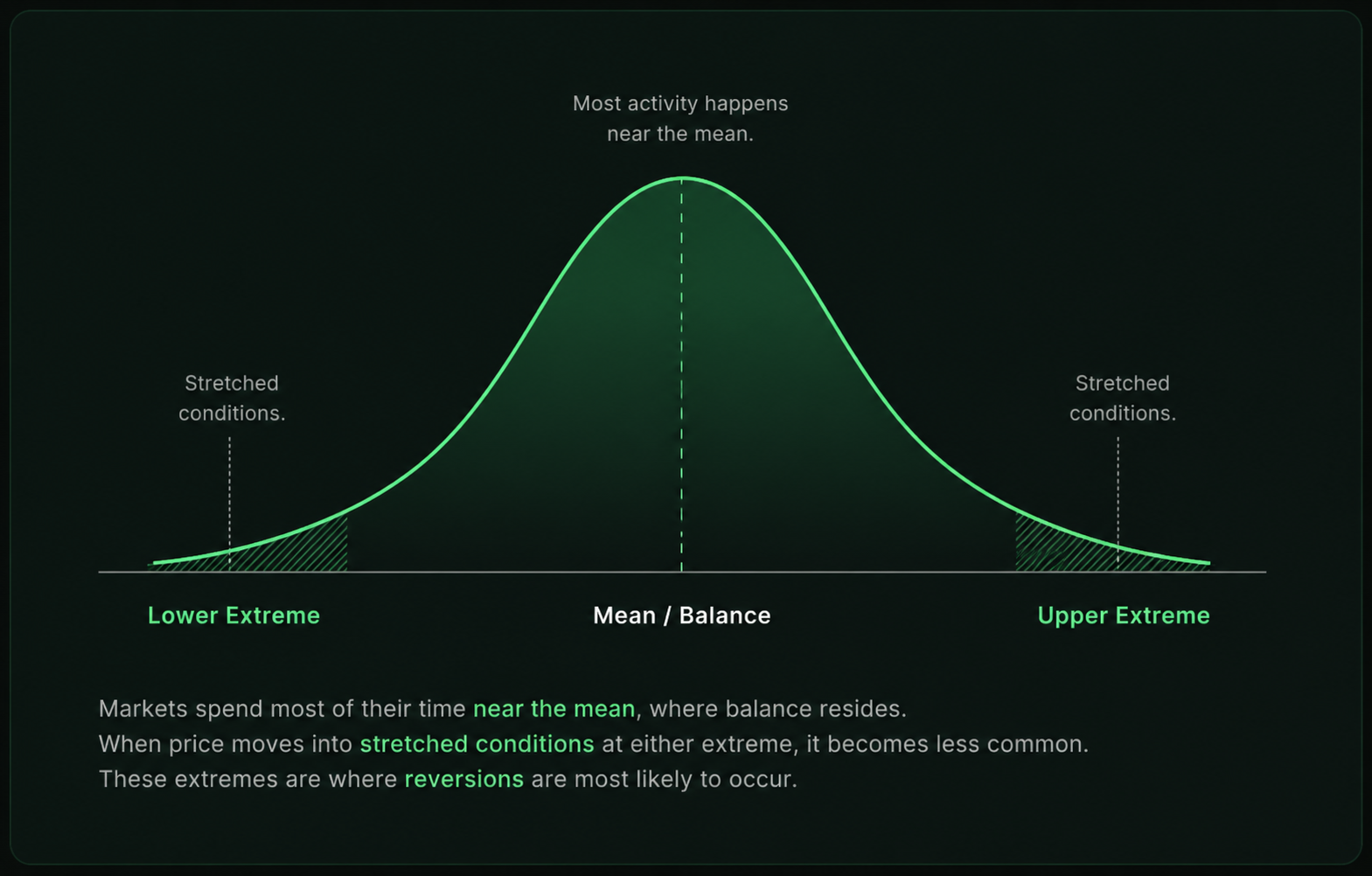
Most activity clusters around the middle. The center represents balance, or a normal trade location. The outer edges represent less common, more stretched conditions. RTM focuses attention on those stretched locations because that is where context starts to matter more.
The bell curve does not mean every move snaps back instantly. It helps traders think in probabilities, location, and process instead of emotion.
Why Location Matters
RTM is not about buying every dip or fading every rally. It is about understanding when price is stretched, when the middle is dangerous, and when a setup has enough structure to deserve attention.
How Extreme to Mean Uses RTM
The goal is not to predict every reversal. The goal is to slow the decision down, identify better locations, and avoid forcing trades when the setup is not ready.
Read the market environment before trusting one signal.
Know where price is before deciding whether action makes sense.
Use rules, review, and patience to reduce emotional decision-making.
Important Distinction
Reversion-to-the-mean thinking can help traders organize context, but it does not remove risk. Every trade still requires planning, position sizing, risk management, and personal judgment.
Keep Building the Process
Start with the basics, study the lessons, explore the books, use the free tools, and see how the TMT System connects market context to execution.