
Comparisons between Bitcoin and gold often begin with a conclusion already chosen. Supporters highlight the properties that favor their preferred asset and minimize the tradeoffs. That turns a monetary question into a debate about identity or short-term price performance. A serious comparison should apply the same standards to both assets.
The lessons in The Market category treat monetary assets as parts of a broader system rather than automatic trades. Scarcity can matter without guaranteeing appreciation, and portability can matter without eliminating custody risk. Historical acceptance can create confidence without making an asset immune to drawdowns. The trader’s job is to evaluate the complete structure rather than react to a slogan.
Two Monetary Assets With Different Foundations
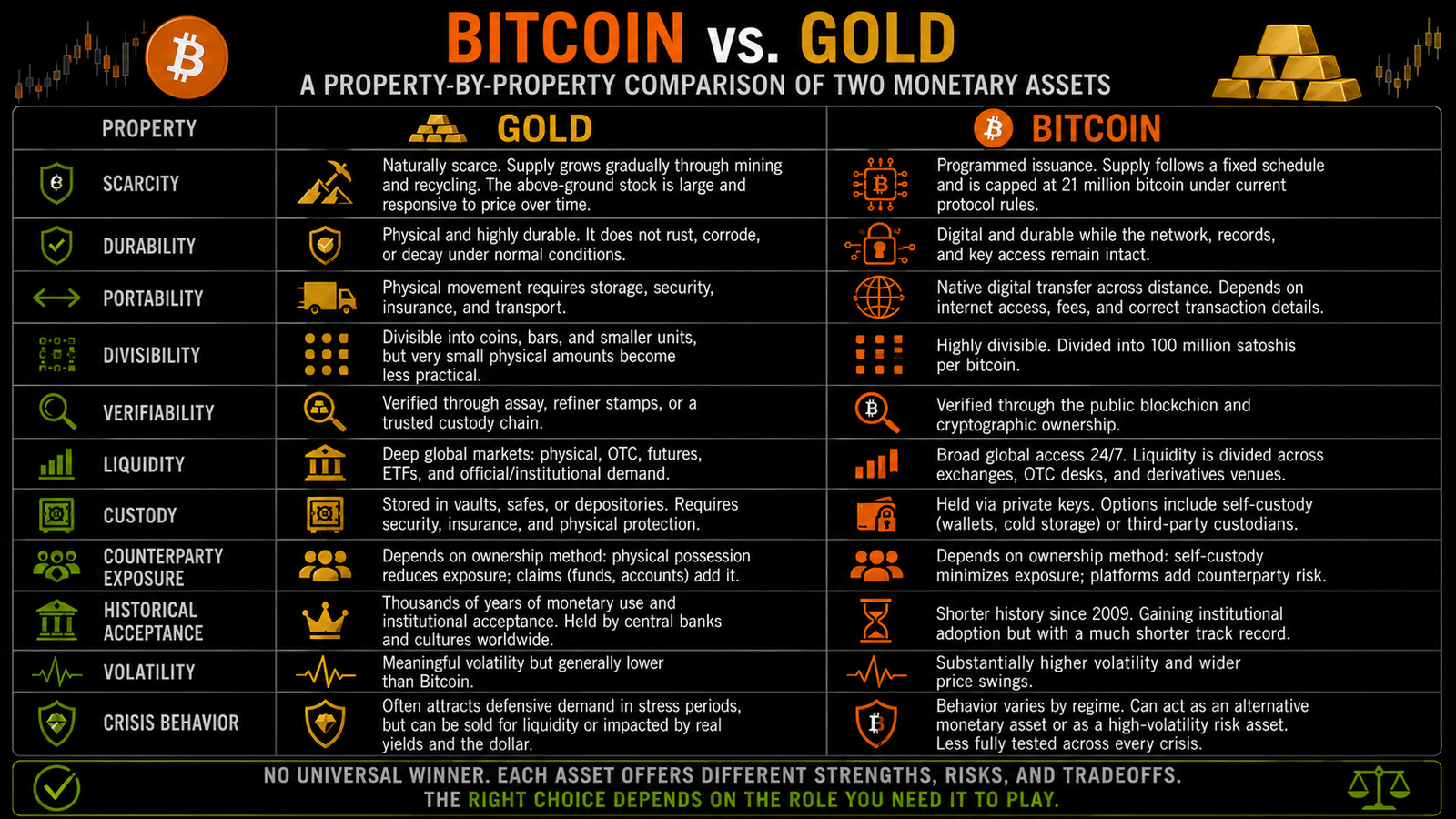
Gold is a physical element whose monetary role developed through scarcity, durability, recognizability, and long-standing acceptance. Most gold produced remains potentially available because the metal is highly durable, while new mine production expands the stock gradually. Its supply is not fixed, and increasing production requires time and capital. Gold’s monetary credibility therefore begins with physical properties.
Bitcoin is a digital monetary network whose supply rules are enforced through software and independent validation. Its issuance declines over time, and the current protocol rules limit total issuance to 21 million bitcoin. It does not depend on a mine, central bank, or corporate balance sheet for creation. Its credibility depends on network participation, cryptography, validation, and continued agreement around those rules.
Scarcity Is Real in Both Assets, but It Works Differently
Gold is naturally scarce, yet its available supply is responsive rather than perfectly fixed. Higher prices can encourage mining, recycling, and sales from existing holders. Because the above-ground stock is large and durable, supply includes far more than newly mined metal. Gold’s scarcity is geological and economic rather than mathematically capped.
Bitcoin offers more predictable issuance under its current consensus rules. New supply follows a programmed schedule, and validating nodes reject blocks that violate the monetary rules. That makes the issuance path easier to estimate than future mine production. The tradeoff is that Bitcoin’s scarcity exists inside a functioning technical and social network.
Portability, Divisibility, and Verifiability
Bitcoin has a clear advantage when the comparison is limited to moving the native asset across distance. A transfer does not require shipping, guarding, weighing, or physically dividing metal. Small fractions can be sent through the network. That portability still depends on network access, correct transaction details, fees, and secure control of the relevant keys.
Gold can be divided into bars, coins, jewellery, or financial claims, but very small physical transfers become less practical. Digital gold products improve portability and divisibility, although they add issuers, custodians, or settlement systems. Gold authenticity may require refiners, assays, or a trusted chain of custody. Bitcoin transactions are digitally verifiable, but users must still verify addresses and key control.
Liquidity, Custody, and Counterparty Exposure
Gold has an established global market spanning physical dealing, over-the-counter trading, futures, exchange-traded products, and official reserves. That structure supports many types of transactions and holders. Access, settlement, spreads, and custody still vary by product and jurisdiction. Owning a coin directly is not operationally identical to owning a fund share or unallocated balance.
Bitcoin also has broad market access, but liquidity can be divided among trading platforms, custodians, derivatives venues, and the underlying network. Direct ownership permits transfer outside a traditional securities account. Platform-based ownership may be simpler, but it introduces venue-specific withdrawal, legal, and counterparty risks. The asset and the method used to access it should be evaluated separately.
Custody creates one of the clearest differences. Physical gold requires secure storage and protection from theft, loss, substitution, and access problems. Bitcoin ownership depends on private keys, so lost or compromised keys can remove access to the asset. Self-custody can reduce reliance on an intermediary while transferring operational responsibility to the owner.
Neither asset automatically eliminates counterparty risk. Direct physical gold and self-custodied Bitcoin can reduce dependence on an issuer. Funds, accounts, exchanges, lenders, and custodians reintroduce institutional exposure. The better question is not whether counterparty risk exists, but where it sits and who must manage it.
History, Volatility, and Crisis Behavior
Gold has a far longer record of monetary, cultural, institutional, and reserve acceptance. That history supports established infrastructure across households, financial institutions, and central banks. Bitcoin’s record is much shorter, so its behavior across every inflation, recession, banking, and geopolitical regime remains less tested. A shorter history does not invalidate the asset, but it limits the evidence available.
Bitcoin has generally displayed much greater price volatility than established traditional assets. That can create rapid gains and equally rapid losses, complicating its use as a stable short-term store of purchasing power. Gold also experiences drawdowns and sharp moves, but its market behavior is usually less extreme. The two should not be treated as equivalent simply because both are scarce.
Crisis behavior depends on the type and stage of the crisis. Gold may attract defensive demand, yet it can also be sold when investors need liquidity or when real yields and the dollar move against it. Bitcoin may behave as an alternative monetary asset in one period and a high-volatility risk asset in another. Neither should be assumed to rise automatically whenever fear or instability increases.
“Bitcoin as Digital Gold”: Where the Analogy Works
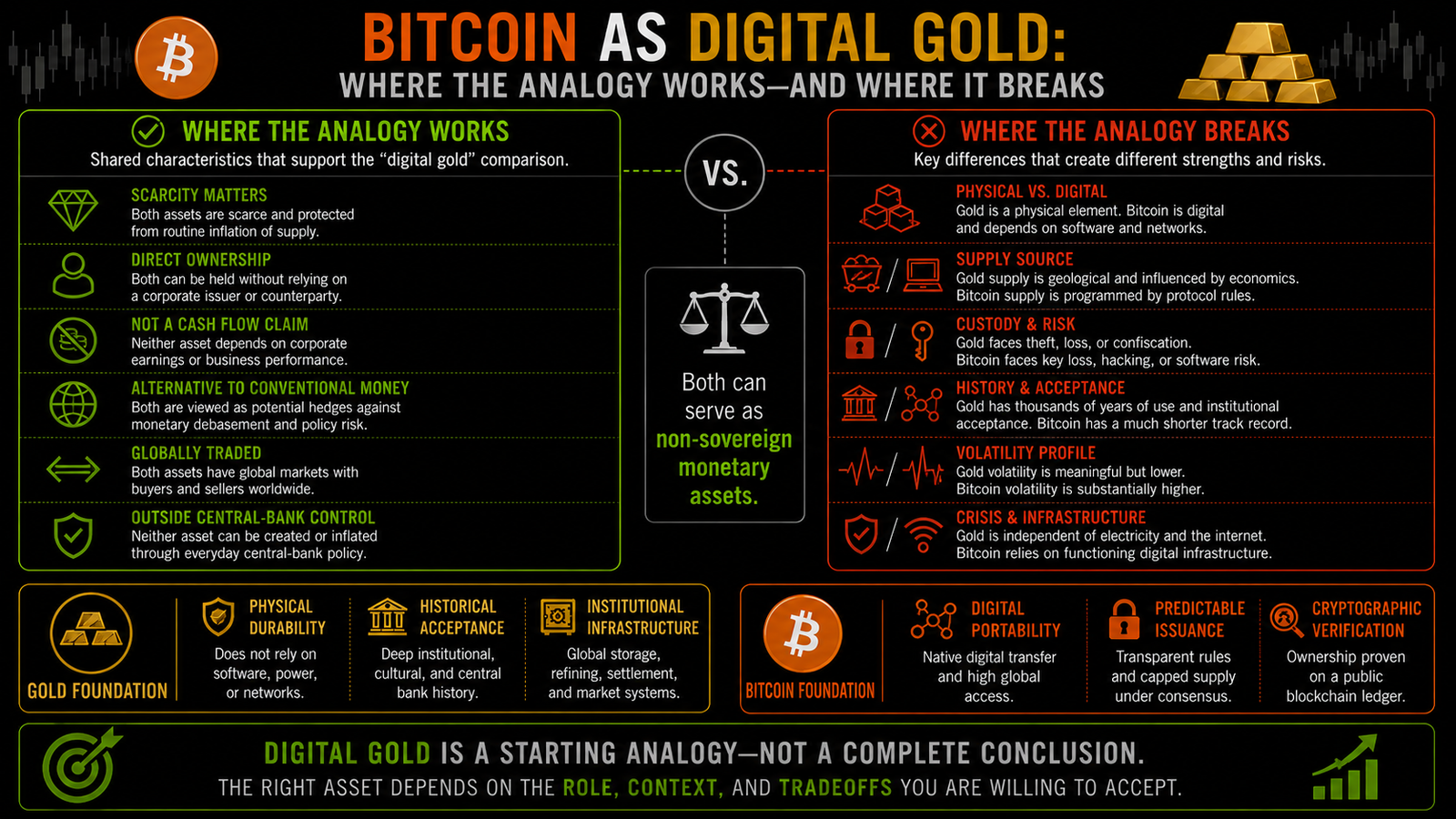
The digital-gold analogy works best at the level of monetary design. Both assets exist outside the ordinary cash flows of a company, can be held directly, and are discussed as scarce alternatives to conventional money. Neither depends on corporate earnings to justify its monetary thesis. Both can attract attention when confidence in established monetary arrangements weakens.
The analogy also works when comparing portable digital scarcity with durable physical scarcity. Bitcoin provides high divisibility, direct network transfer, and predictable issuance rules. Gold provides physical durability, independence from software, and supply constrained by geology and economics. The shared category is monetary asset, but the supporting mechanism is different.
Where the Digital-Gold Analogy Breaks Down
Gold does not need electricity, internet access, cryptographic software, or a functioning digital network to remain gold. Bitcoin does not require vault space, physical transport, assay, or protection from counterfeit bars. Those differences affect custody, transfer, recovery, and failure planning. Calling Bitcoin digital gold should clarify the comparison rather than hide the operational differences.
The analogy also breaks down when history and volatility are treated as interchangeable. Gold has operated across changing political and monetary systems for far longer. Bitcoin’s fixed issuance rules do not guarantee stable demand or stable price. Gold’s long history does not guarantee that it will preserve purchasing power over every timeframe.
There Is No Universal Winner
The comparison changes according to the job the asset is expected to perform. Physical independence, established acceptance, digital portability, supply predictability, and volatility tolerance do not carry the same importance for every user. Jurisdiction, custody skill, time horizon, and market access also change the conclusion. The assets can compete in some roles while remaining complementary in others.
The surrounding monetary environment matters as well. Dollar strength, real yields, liquidity, regulation, and risk appetite can affect Bitcoin and gold differently. The article on DXY and the stock market explains why the currency environment matters.
The lesson on the 10-year Treasury yield adds the opportunity-cost and financial-conditions side.
A Practical Property-by-Property Review
A cleaner evaluation begins by defining the intended function before selecting the preferred asset. The comparison should use the same questions for both and separate the native asset from the product or custodian used to access it. One attractive property should not erase a serious weakness elsewhere. The review can be organized through these questions:
- How is scarcity created, and what could change the supply path?
- What makes the asset durable over the intended holding period?
- How easily can it be transported and divided?
- How is authenticity or ownership verified?
- Where is reliable liquidity available?
- What custody knowledge, equipment, or institution is required?
- Which counterparty risks remain after the ownership method is chosen?
- How long and varied is the record of acceptance?
- How much volatility can the intended use tolerate?
- How has the asset behaved across different types of stress?
- Does the ownership structure create legal or operational risk?
- Is the argument monetary, tactical, or mainly a price forecast?
The better question is not, “Which asset is better?” It is, “Which properties matter for the role being evaluated, and what tradeoffs must be accepted?” That allows the conclusion to change when the objective changes. It also prevents a monetary thesis from becoming an excuse to ignore custody, liquidity, price, or risk.
Separate the Monetary Thesis From the Price Forecast
An asset can have credible monetary properties and still be purchased at an unfavorable price or held through severe volatility. Scarcity does not determine short-term demand, and a long-term narrative does not identify the next market move. Traders should separate the property comparison from timing, location, and exposure. The monetary thesis earns study before any trade earns risk.
The same separation applies to personalized portfolio decisions. This article compares characteristics rather than recommending an allocation, entry price, or holding period. Legal protections, custody ability, financial obligations, and tolerance for loss vary widely. Readers seeking a deeper framework can continue through The Monetary Revolution.
Final Thought
Bitcoin and gold share enough monetary properties to make the comparison useful. Both are scarce, durable in different ways, widely traded, and capable of direct ownership. They differ sharply in physical form, network dependence, history, volatility, custody, and crisis behavior. Those differences matter more than the slogan used to describe either asset.
The goal is not to crown a permanent winner. It is to understand what each asset can provide, which risks accompany those benefits, and whether the ownership method preserves the property being sought. “Digital gold” is a useful starting analogy when tested property by property. The cleaner conclusion is conditional rather than universal.
Educational content only. Trading involves substantial risk and is not suitable for everyone.