
Many traders learn a simple relationship: rising yields hurt stocks, while falling yields help them. That idea feels reasonable because higher interest rates can increase borrowing costs and reduce the present value assigned to future corporate earnings. The shortcut also appears to work during periods when growth stocks fall as Treasury yields rise. The problem is that yields can increase for several different reasons, and those reasons do not create the same equity environment.
The lessons in The Market category emphasize that cross-market relationships should be interpreted through context rather than memorized as permanent rules. A yield increase caused by stronger growth expectations can coexist with rising stocks, while a yield increase caused by inflation or policy stress may pressure them. Falling yields can support equities when financial conditions ease, but they can also accompany recession concerns and defensive positioning. The trader’s job is to identify the active regime before drawing a conclusion.
What the 10-Year Treasury Yield Represents
The 10-year Treasury yield is the return investors demand to hold a U.S. government security with approximately ten years remaining until maturity. Its market price and yield move in opposite directions: when Treasury prices rise, yields fall, and when Treasury prices fall, yields rise. The yield reflects expectations about growth, inflation, monetary policy, future short-term rates, and compensation for holding longer-duration debt. It is therefore both a market price and a summary of several competing expectations.
The 10-year yield is widely followed because it sits near the center of many financial decisions. Mortgage rates, business borrowing costs, asset valuations, and comparisons between stocks and bonds can all be influenced by it. Traders also use it as a reference for the market’s changing view of inflation and economic conditions. It does not explain those conditions by itself, but it helps show how the bond market is pricing them.
Why the Yield Matters to Stocks
Stocks compete with bonds for investor capital. When Treasury yields rise, investors may receive a more attractive return from an asset generally viewed as carrying less credit risk than equities. That change can make expensive stocks less appealing unless expected earnings growth is strong enough to justify the additional uncertainty. The lesson on how the stock market actually moves helps explain why that adjustment occurs through changing participation, liquidity, and price acceptance rather than through one automatic formula.
The yield also affects the discount rate used to value future cash flows. Companies whose expected earnings sit farther in the future can be more sensitive to higher rates because those distant cash flows receive a lower present value when the discount rate rises. Borrowing costs may increase as well, affecting companies, consumers, and investment decisions. These effects are real, but their importance changes with the reason and speed of the yield move.
Why “Yields Up, Stocks Down” Is Incomplete
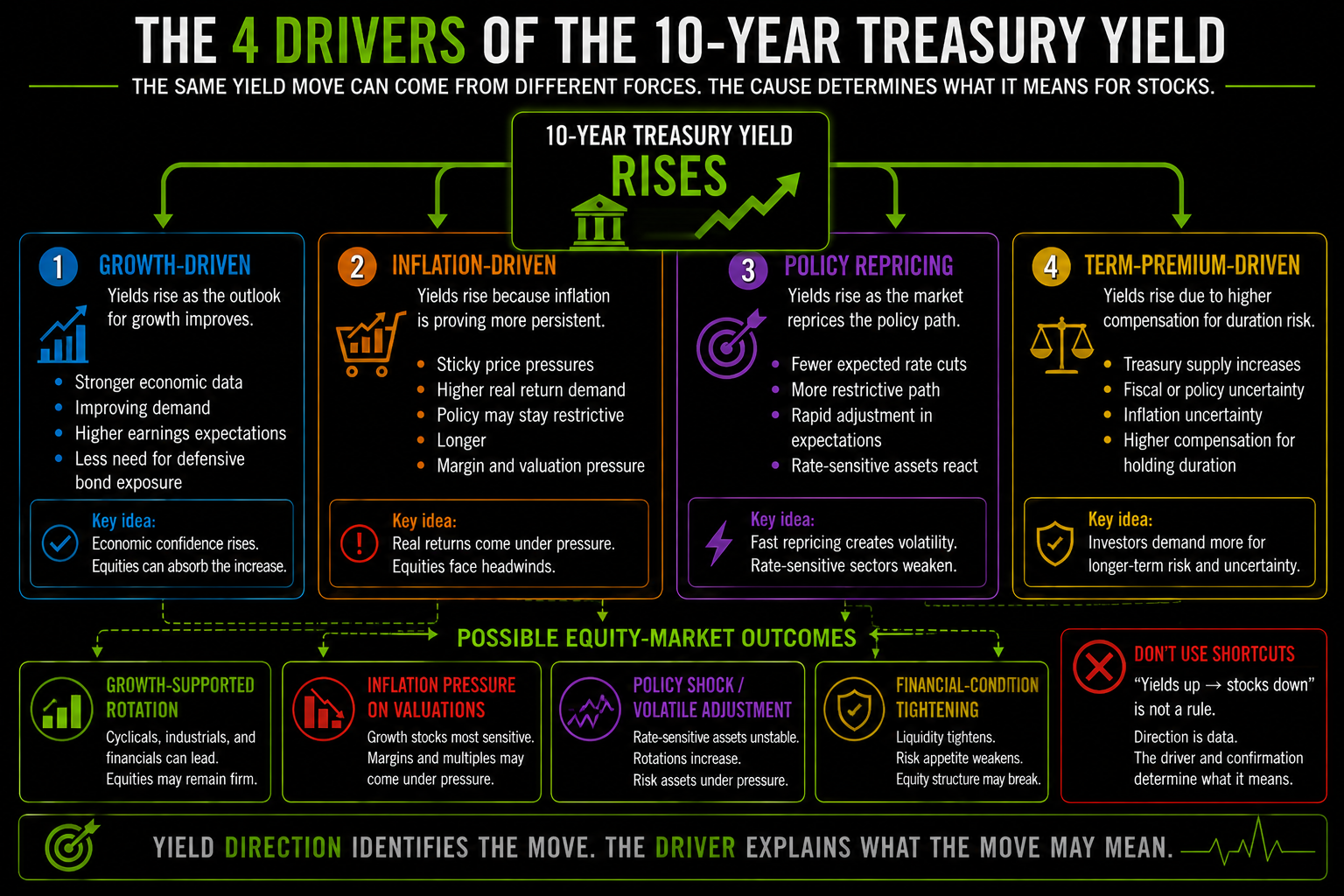
A rising yield can represent improving growth expectations, persistent inflation, central-bank repricing, heavier Treasury supply, or an increase in the term premium. Those forces can create very different reactions across growth stocks, financials, industrials, defensive sectors, and index futures. One regime may support cyclical companies while pressuring long-duration technology shares. Another may weaken nearly every major equity group.
The same problem appears when yields fall. A gradual decline caused by easing inflation pressure may support stocks because financial conditions are becoming less restrictive. A rapid decline caused by recession fear, banking stress, or a flight toward safety may appear alongside falling equities. The direction of the yield identifies what changed, but not why it changed or how the stock market should interpret it.
Regime One: Growth-Driven Yield Increases
A growth-driven increase occurs when investors expect stronger economic activity, healthier demand, or improving corporate conditions. Treasury yields may rise because the market anticipates firmer real growth and less need for defensive bond exposure. In this environment, the increase can reflect economic confidence rather than an immediate threat. Equity indexes may remain supported if earnings expectations and participation improve with the growth outlook.
Cyclical sectors, industrials, consumer companies, and financials may respond more favorably than long-duration growth stocks. Banks can benefit when parts of the yield curve and lending environment become more supportive, although the complete curve and credit conditions still matter. Technology shares may remain strong if growth expectations are powerful enough to offset valuation pressure. The cleaner conclusion is that rising yields are being absorbed because the reason for the move supports earnings and risk appetite.
Regime Two: Inflation-Driven Yield Increases
An inflation-driven increase carries a different message. The bond market may be demanding higher yields because inflation is proving more persistent, reducing the expected real return on fixed payments. Investors may also anticipate that monetary policy will remain restrictive for longer. That combination can create pressure on valuations and financial conditions.
Growth stocks are often more sensitive because higher discount rates affect the value assigned to distant earnings. Companies with weak pricing power may also face pressure if costs rise faster than revenue. Commodity producers or businesses with inflation-sensitive earnings may behave differently, especially when the inflation impulse comes from supply constraints. The stock response depends on whether earnings can absorb the pressure or whether the yield move is beginning to damage market structure.
Regime Three: Central-Bank or Policy Repricing
Yields can rise when traders change their expectations for central-bank policy. Strong economic data, persistent inflation, or official communication may cause markets to remove anticipated rate cuts or price a more restrictive policy path. The FOMC trading guide explains how the policy decision, projections, and press conference can produce that repricing in stages. The move can occur quickly because several months of expectations are being revised at once. Rapid repricing often matters more to equities than a gradual change of similar size.
Index futures may become unstable as traders adjust assumptions about liquidity, borrowing costs, and valuation. Rate-sensitive sectors can weaken even when current economic data remains firm. The market may rotate rather than fall uniformly, producing strength in some groups and pressure in others. Traders should distinguish between an orderly adjustment and a disorderly repricing that is breaking important equity structure.
Regime Four: Term-Premium-Driven Changes
The term premium is the additional compensation investors may demand for holding longer-maturity bonds instead of repeatedly owning shorter-term instruments. It can increase when uncertainty about inflation, fiscal policy, Treasury supply, or future rate volatility becomes more important. In that case, the 10-year yield may rise even without a major improvement in expected growth. The move reflects a higher price for duration and uncertainty.
A term-premium increase can tighten financial conditions because longer-term borrowing references may rise independently of immediate central-bank action. Stocks may struggle if the move is fast, liquidity weakens, and investors demand lower valuations. The related lesson on the MOVE Index becomes useful because higher bond volatility can confirm that the rise in yields is becoming less orderly. A steady move with contained volatility carries a different message from a sharp repricing accompanied by bond-market stress.
Different Equity Groups Respond Differently
Growth stocks are usually discussed first because their valuations often depend heavily on earnings expected farther into the future. A fast increase in the 10-year yield can reduce the valuation investors are willing to assign to those earnings. Value and cyclical stocks may hold up better when yields rise for growth-positive reasons. They can still weaken when the same yield move reflects inflation, policy stress, or deteriorating financial conditions.
Financials require more than the statement that higher yields help banks. The shape of the yield curve, deposit costs, credit quality, lending demand, and liquidity conditions all affect the response. Defensive sectors may attract capital during a risk-off yield decline, but they can also face pressure when yields rise enough to make bond income more competitive. Stock-index futures combine all these sector responses, which is why the underlying reason for the move matters.
Confirmation Makes the Yield Move More Useful
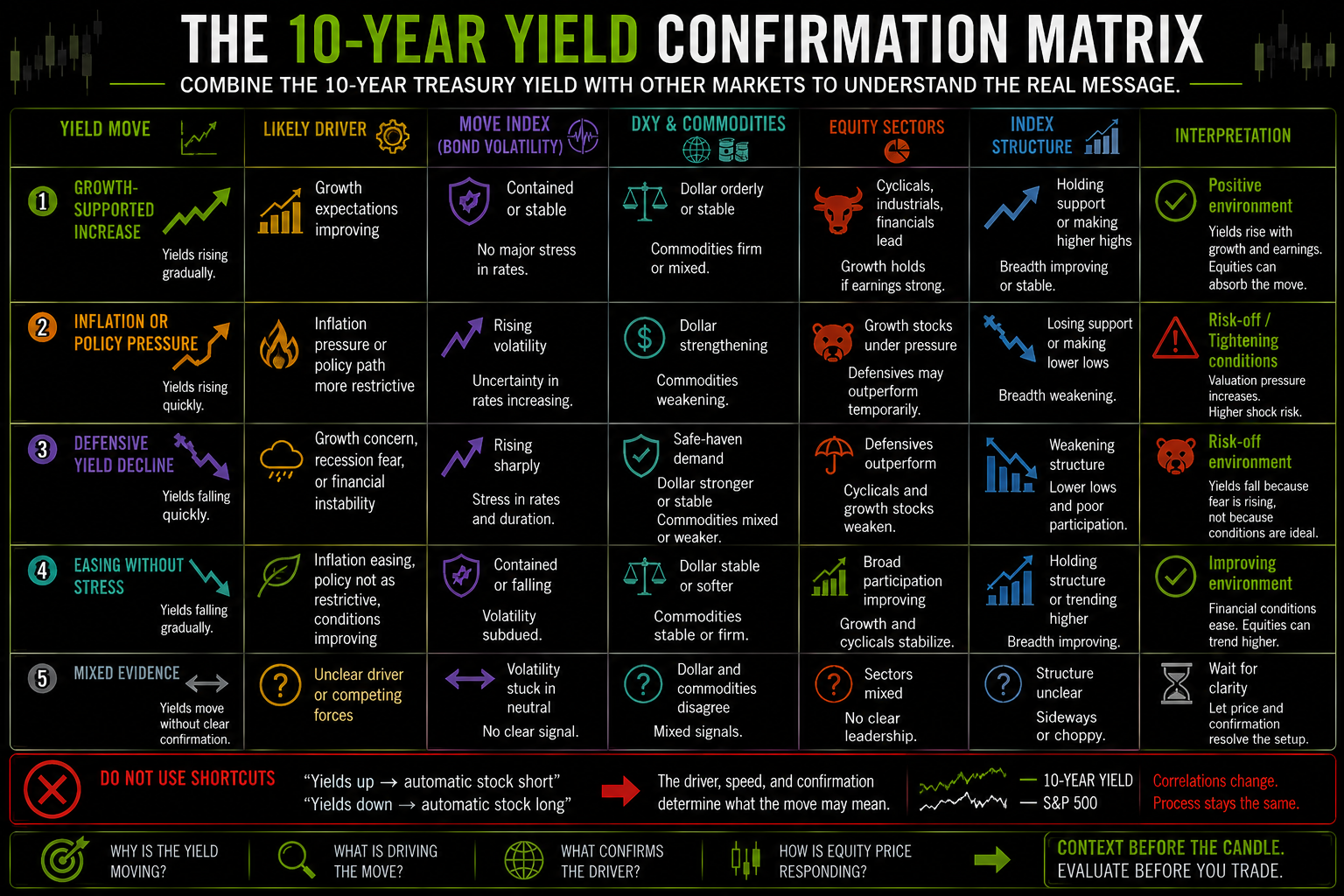
The 10-year yield should be read with the dollar, bond volatility, equity volatility, commodities, credit conditions, and stock-index structure. Each market contributes a different part of the explanation. Agreement can strengthen a conclusion, while disagreement can reveal that the yield move is isolated or being interpreted differently by equities. The goal is to build one coherent market description rather than collect unrelated indicators.
A sharp yield increase combined with a stronger dollar, rising MOVE, rising VIX, weakening commodities, and equity indexes breaking support can confirm a broader tightening warning. The relationship described in DXY and the stock market helps show whether dollar strength is reinforcing the same financial-condition pressure. A yield increase with contained volatility, an orderly dollar, firm commodities, and rising equities may instead reflect resilient growth. Price behavior remains the final test.
A Practical 10-Year Yield Reading Routine
A useful routine begins by identifying the direction and speed of the yield move. The trader should then classify the likely cause and compare that explanation with related markets. The final step is to return to the stock or futures chart and determine whether price accepts or rejects the broader message. The process can be organized through several questions:
- Direction: Is the 10-year yield rising, falling, or remaining inside a range?
- Speed: Is the move gradual, accelerating, or unusually sharp?
- Cause: Does the move appear driven by growth, inflation, policy repricing, or the term premium?
- Volatility: Is MOVE contained, rising gradually, or expanding sharply?
- Confirmation: What are DXY, VIX, commodities, credit conditions, and market breadth doing?
- Sector response: Are growth, value, financial, and defensive sectors reacting differently?
- Index structure: Are stock-index futures holding support, rotating, or accepting lower prices?
- Trade quality: Does the specific setup still have location, room, clear invalidation, and acceptable exposure?
The better question is not, “Are rising yields bearish?” It is, “Why are yields moving, what other markets confirm that explanation, and how is equity price responding?” That sequence separates the macro observation from the specific trade decision. A valid yield interpretation can improve context without creating an entry.
Common Yield-Reading Mistakes
One common mistake is reacting to the yield’s direction without examining the cause. Another is focusing only on the 10-year yield while ignoring the rest of the curve, bond volatility, or the speed of repricing. Traders may also assume that falling yields must help stocks even when the decline reflects fear about growth or financial stability. These shortcuts replace analysis with a fixed correlation.
Another mistake is using the yield as a timing signal. The 10-year can begin rising before equities respond, remain elevated while stocks recover, or fall after much of the equity move has already occurred. The relationship can also change as the market shifts from inflation concerns to growth concerns. The yield provides context, but price determines whether the current setup has qualified.
From Treasury Yields to a Broader Framework
The 10-year yield becomes more useful when it is connected with bond volatility, the dollar, equity volatility, commodities, liquidity, and market structure. The related lesson on the VIX Index shows whether expected equity volatility confirms or disagrees with the bond-market message. When yields, MOVE, VIX, DXY, and equity structure tell a similar story, the market condition becomes clearer. When they disagree, patience is more useful than forcing a directional conclusion.
Readers who want to develop that broader process can continue through Decode the Market. The book connects rates, liquidity, volatility, currencies, and the evidence visible on the chart. The 10-year yield belongs inside that framework as one of the market’s most important cross-asset references. It should not replace location, structure, or risk definition.
Final Thought
The 10-year Treasury yield influences stocks through valuations, borrowing costs, financial conditions, and investor preferences. Rising yields may reflect stronger growth, persistent inflation, central-bank repricing, or a higher term premium, and those regimes do not produce identical market reactions. Falling yields can represent easing pressure or increasing economic concern. Direction alone is not enough.
The goal is not to memorize that yields up means stocks down. Identify the cause, measure the speed, check bond and equity volatility, review the dollar and sector response, and determine whether price agrees. The yield creates context before the setup earns risk. The trader’s job is to understand the regime and then evaluate the actual trade.
Inflation releases can change the rate path quickly, so the comparison of CPI and PPI for traders helps identify which price evidence the market is repricing.
The same yield channel helps explain how CPI moves stock futures through policy expectations and valuation pressure.
Educational content only. Trading involves substantial risk and is not suitable for everyone.