
Some of the weakest trades do not begin with fear or greed. They begin with a trader who has been sitting still long enough to want something—anything—to happen.
Key Idea
Boredom is information about the trader, not information about the market.
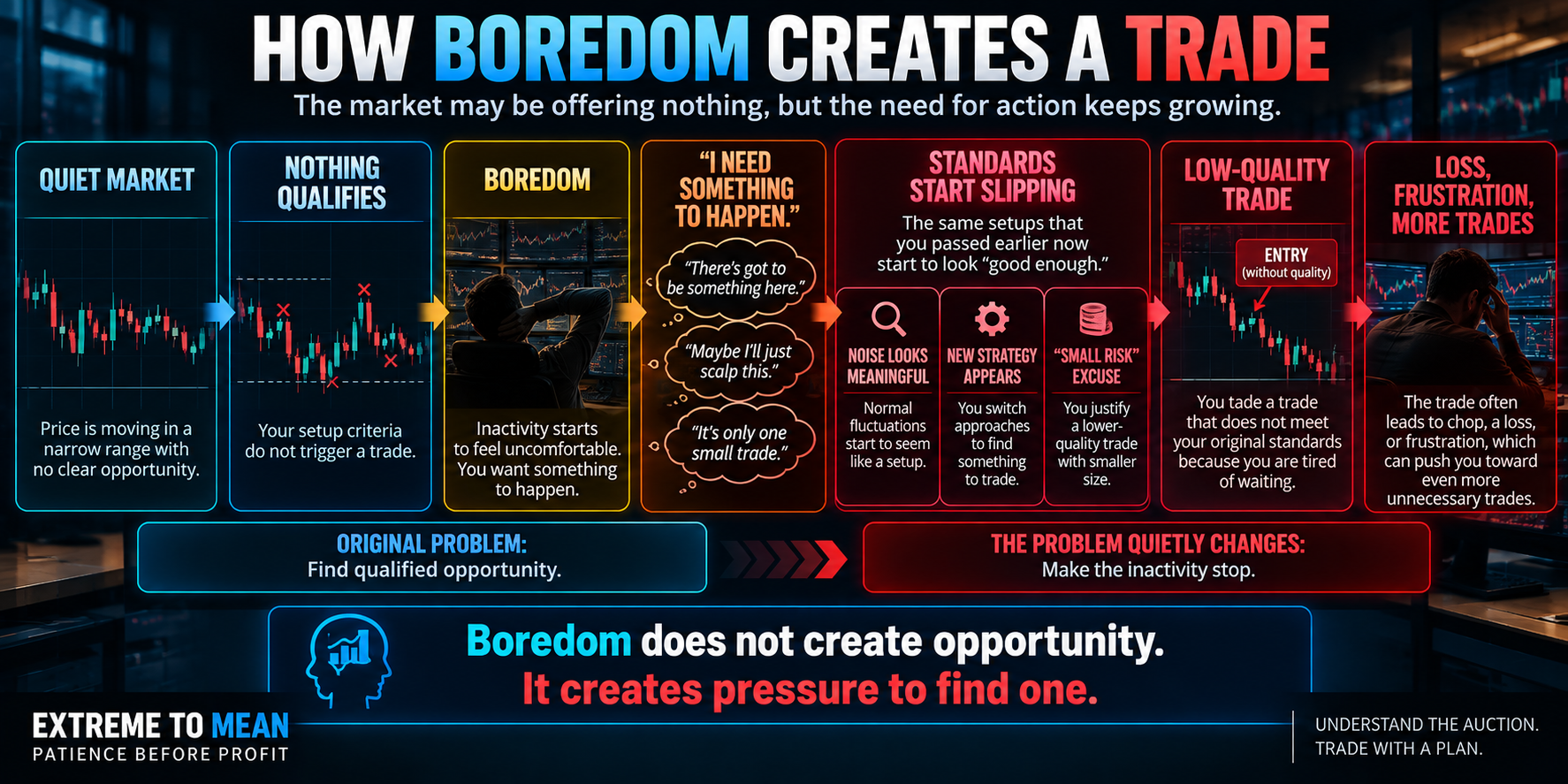
At the start of a session, the problem is usually clear: wait for qualified opportunity. After an hour or two without a setup, that problem can quietly change into something else—make the inactivity stop. Once that shift happens, the trader may lower standards, reinterpret noise as information, or invent a reason to participate even though the market itself has not improved.
That is why boredom belongs inside The Trader, not inside a market-condition lesson. A quiet market and a bored trader are not the same thing. Chop is a condition of the market; boredom is a condition of the person watching it.
Why Boredom Is More Dangerous Than It Looks
Boredom feels harmless because it does not arrive with the intensity of panic, FOMO, or revenge. It often sounds reasonable: “I came here to trade,” “This is probably good enough,” or “It is only one small trade.” The danger is that the trader stops asking whether opportunity exists and starts asking how to make inactivity stop.
A trading opportunity solves a market problem: conditions, location, and setup align well enough to justify risk. A boredom trade solves an emotional problem: the trader wants stimulation, feedback, or proof that the session was worth the time. Those are completely different reasons for placing capital at risk.
This is why doing nothing is still a trading decision. Monitoring structure, rejecting weak locations, comparing scenarios, and preserving capital are all forms of active decision-making. No position does not mean no work is being done.
When Waiting Stops Feeling Like Trading
Waiting is easier when the trader knows exactly what would make the waiting end. If the plan says, “I need price at meaningful location, the right structure, and a setup that qualifies,” then inactivity still has a purpose. The trader is not merely staring at a screen; the trader is monitoring for a defined change.
Waiting becomes much harder when that purpose disappears. The session turns into stare at screen, hope for something, stare longer, and eventually “something has to happen.” Once the trader cannot explain what they are waiting for, boredom gains more influence over the next decision.
That is the difference between patience and passivity. Patience is waiting for something specific; passivity is simply remaining in front of the screen without a clear decision framework. Boredom becomes less dangerous when waiting has a defined job.
How Boredom Quietly Lowers the Setup Standard
Imagine a mediocre setup appears at 9:45 and the trader immediately passes. A nearly identical setup appears at 11:15 and gets a “maybe,” then another appears at 12:30 and suddenly looks “good enough.” The most important question is not what changed on the chart, but whether anything meaningful changed at all.
Boredom does not need to create a new setup. It only needs to make the old standard feel too strict. When nothing material changes in the market but the answer changes from pass to trade, the trader should question whether the setup improved—or sitting still became uncomfortable.
A useful reset is: Would I take this exact setup if it had appeared ten minutes after the open? Another is: If I had just opened the chart five minutes ago, would I see a trade? Those questions remove the sunk time, frustration, and need to make the session feel worthwhile.
Why Activity Starts Feeling Like Productivity
Trading creates visible activity. An entry produces P&L, movement, something to manage, and immediate feedback, while waiting produces very little visible reward. That can make action feel productive even when the action is unnecessary.
The result is a subtle but dangerous equation: if I am trading, I am working. In reality, trading activity is not the same thing as trading progress. A session can contain multiple entries and still reflect poor decision quality, while a zero-trade session can be an example of excellent execution.
This is where boredom can blend with the urge to chase activity that feels like opportunity. FOMO usually says, “It is moving without me,” while boredom says, “Nothing is moving enough for me.” One reacts to an active opportunity; the other may manufacture one where none exists.
The Expensive Habit of Creating Trades From Noise
During a quiet period, normal fluctuations can begin to look more meaningful simply because attention is hungry for something to interpret. Tiny candle formations, weak indicator movements, small breakouts, and insignificant levels can start receiving more weight than they would have earlier. The longer a trader searches for a reason to trade, the easier one becomes to find.
Boredom can also create strategy drift. A trader who planned to trade one approach may suddenly decide to scalp a range, take a breakout, or call a small move a reversal because the original strategy has produced no trade. The market did not demand flexibility; the trader demanded stimulation.
Then comes the “small risk” excuse. Reducing size may reduce the financial consequence, but it does not improve setup quality. Small risk is still unnecessary risk when the trade never qualified.
If the real purpose of the trade is to make the session interesting, the market has become expensive entertainment. The stop is only part of the cost because a weak trade can also create frustration, reduce focus, and make the trader more vulnerable to forcing the next decision. The most expensive part of a boredom trade may be what it does to the trade that follows.
Why Even a Winning Boredom Trade Can Hurt You
A losing boredom trade is easy to criticize because the financial result reinforces the mistake. A winning boredom trade is more dangerous because the market may reward impatience, lowered standards, or improvisation. The trader can walk away thinking the rules were too strict when the actual lesson is simply that a low-quality decision happened to work.
The market can reward the wrong behavior without making the behavior right. A boredom trade does not become valid because price happened to move in the trader’s favor. A losing boredom trade can cost money; a winning boredom trade can cost discipline.
That is one reason patient trading is not the same as inactive trading. The purpose of patience is not to avoid all action; it is to preserve the standard until actual opportunity appears. A profitable exception should not quietly become the new rule.
Give Waiting a Job
When boredom appears, “be more patient” is not enough. Give the waiting state a specific task: recheck context, restate the setup, verify location, and ask whether the market materially changed. Then classify the next decision as trade, wait, pass, or done.
A strong question is: Am I looking for evidence, or am I looking for stimulation? Another is: Can I explain why this trade qualifies without mentioning how long I have been waiting? If waiting time appears in the justification, the decision may be solving an emotional problem rather than responding to a market opportunity.
Consider a slow session in ES or NQ with a narrow range, no meaningful extension, and several weak false starts. A mediocre setup appears early and the trader passes, then a similar one appears later and the trader passes again. By late morning, nothing has improved, but the trader is tired of waiting and decides the third version “looks a little better.”
Trader A takes it, gets chopped out, becomes irritated, and suddenly feels pressure to recover the loss with another weak trade. Trader B feels the same boredom but asks, “Would I take this if I had just opened the chart?” Nothing qualifies, so Trader B finishes flat. Trader A paid the market to make the morning interesting; Trader B let a boring market remain boring.
The Boredom Trade Check
Before taking a trade mainly because the session feels empty, run the decision through a short reset. The goal is not to eliminate boredom; it is to prevent boredom from changing the standard without permission. Ask:
- What actually changed in the market?
- Would this setup have qualified earlier in the session?
- If I had just opened the chart, would I see a trade?
- Am I trying to make money—or make something happen?
- Did my setup standard change?
- Am I inventing a new strategy because my planned one is inactive?
- Would I still take this trade if I had already reached my daily goal?
- Can I explain why this trade qualifies without mentioning how long I have waited?
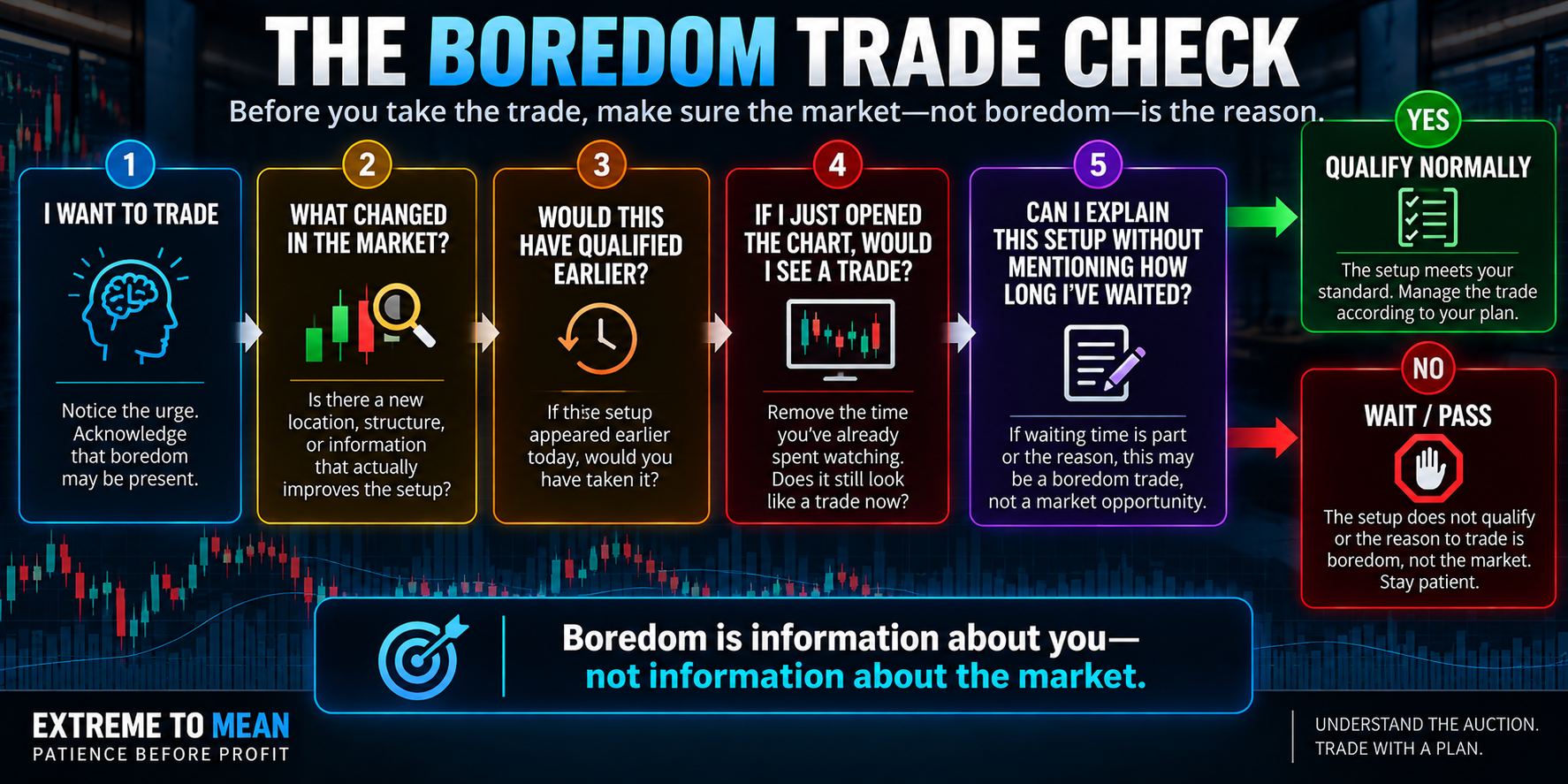
If those questions expose no meaningful market change, the correct decision may still be wait or pass. The market does not become more tradable because inactivity became more uncomfortable. A trading day does not require a trade to count as complete.
For traders who notice boredom turning into repeated unnecessary entries, the trading-too-much problem guide is the natural next step. Boredom is only one cause of overtrading, but it is an important one because it can make weak decisions feel harmless. The goal is to keep the original standard intact even when the session provides very little stimulation.
The ETM Notice → Restate → Recheck Framework
Use NOTICE → RESTATE → RECHECK → QUALIFY → ACT. Notice that boredom has appeared without treating it as a failure, restate exactly what must happen for a trade to qualify, and recheck whether context, location, or structure actually changed. Then apply the same setup standard you would have used before you became tired of waiting.
The framework ends with action, but action does not always mean trade. It can mean trade, wait, pass, or end the session according to the existing plan. The critical rule is simple: boredom is information about the trader—not information about the market.
Final Thought
Boredom becomes expensive when the need for stimulation gets mistaken for evidence of opportunity. Quiet markets, slow sessions, and long stretches without a setup can make normal standards feel unnecessarily strict, even when nothing on the chart has improved.
The solution is not to pretend waiting is always enjoyable. Restate what the setup actually requires, ask what materially changed, and apply the same standard you would have used before you became tired of waiting. Sometimes the best trade in a boring market is the one you never invent.
Educational content only. Trading involves substantial risk and is not suitable for everyone.