
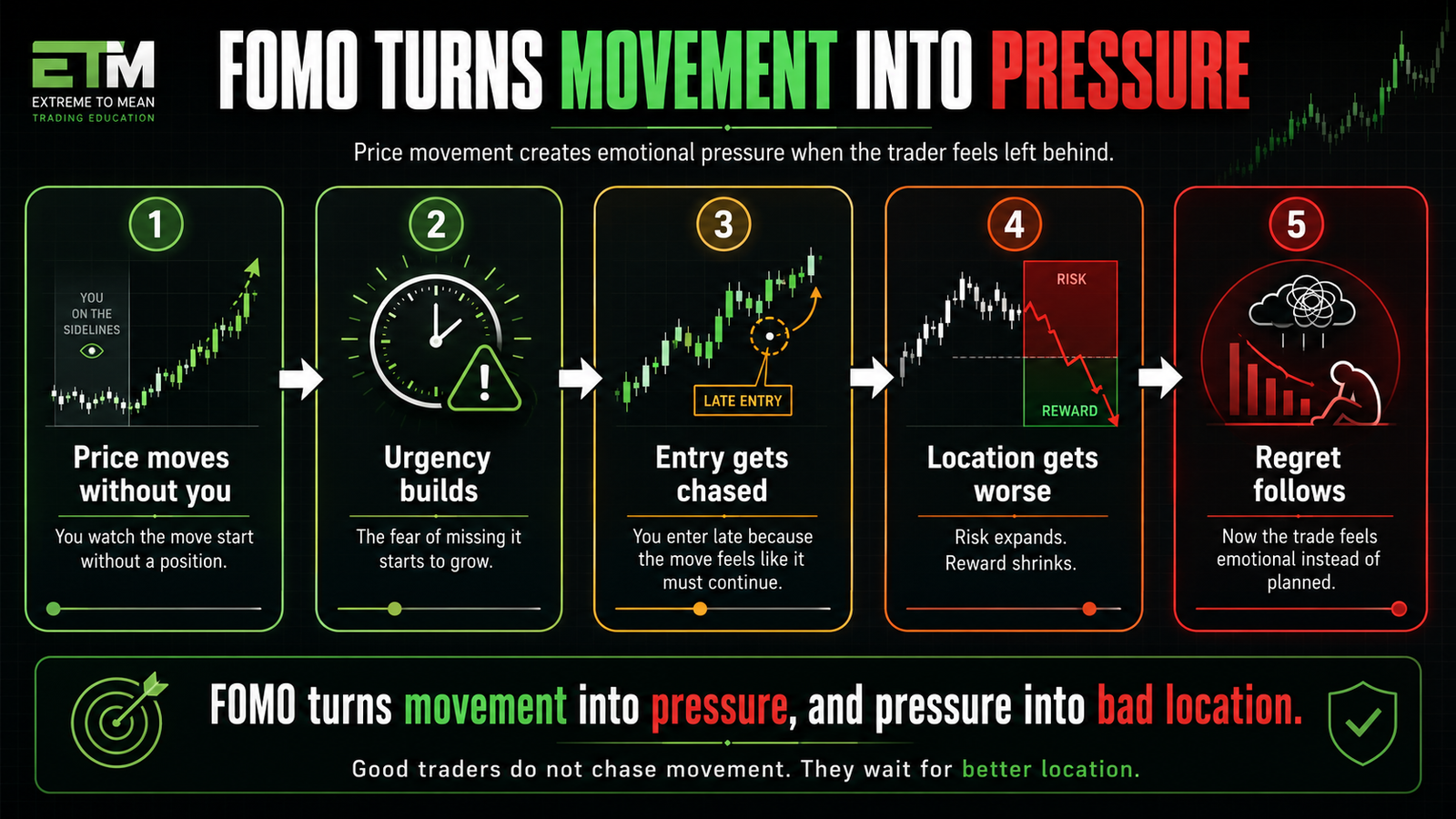
The move starts without you. You watch price climb, and every candle feels like another point you missed. The setup you were watching has already gone, and now you have a choice: stay out or chase in.
The urgency feels real because the market is moving without you. The opportunity feels like it is slipping away because you can still see what would have worked if you had entered earlier.
That feeling is FOMO, and it is one of the most expensive emotions covered in the trader psychology lessons.
What FOMO Actually Feels Like
Fear of missing out does not always announce itself clearly. It does not tap the trader on the shoulder and say, "You are about to make an emotional decision."
It often feels like analysis. It feels like reading the market. It feels like recognizing an opportunity that is still developing.
But underneath that rational-sounding surface is a simple emotional driver: the trader does not want to be left behind. They do not want to watch the move go without them, so they begin looking for a reason to enter.
At that point, the trader is usually not entering because the setup is ready. They are entering because the discomfort of watching the move without them has become greater than the discomfort of taking a poor trade.
That is the moment when FOMO becomes the tax you pay for chasing.
Movement Is Not the Same as Opportunity
This is the core confusion at the heart of most FOMO trades.
A move has already happened. It was a real move. It may even have been a real opportunity for the traders who were positioned before it started.
But the move that already happened is not the same as the opportunity that exists now.
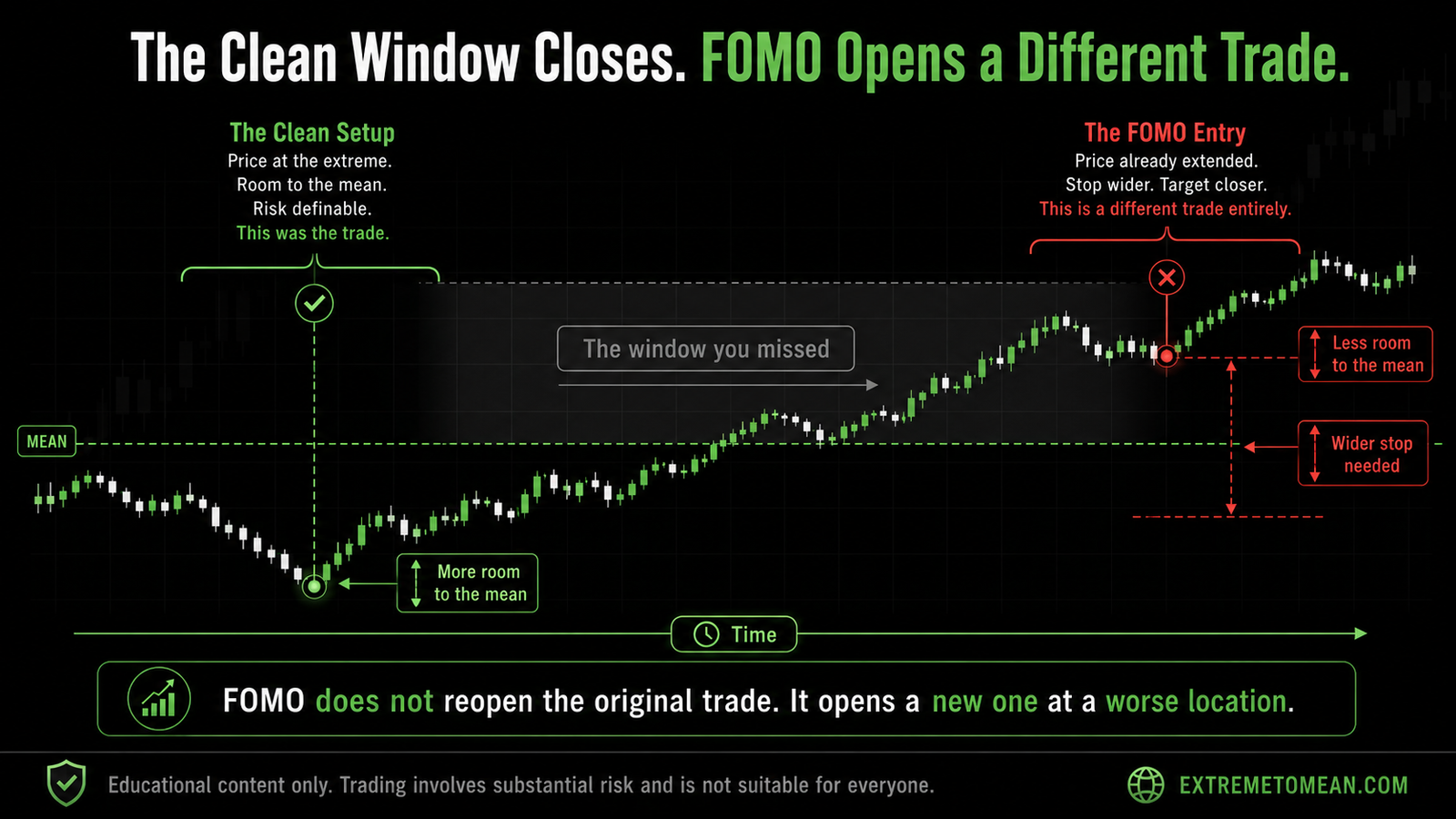
By the time FOMO enters the picture, the best part of the trade may already be gone. The trader was not in the original setup. What they are considering now is a different trade, one that starts at a worse location, with less room to the target and more risk relative to the potential reward.
Movement is not opportunity. Location is opportunity. Chasing movement often means entering after the cleanest part of the decision has already passed. It is also why the middle gets traders chopped up.
The Real Cost of Chasing
The financial cost of a FOMO trade is easy to see. The entry is late, the stop is wider, and the target is closer. The risk-to-reward that made the original setup attractive has already changed.
But the hidden cost is often worse.
FOMO trades often place the trader in a weaker position than setups taken from better location. When the trade fails, the trader has to absorb both the financial loss and the psychological blow of knowing they entered badly.
That combination can be demoralizing. It can lead to the next FOMO trade or the next revenge trade as the trader tries to make back what they lost in a situation they probably should have sat out.
One FOMO trade rarely stays one FOMO trade unless the trader recognizes the pattern and stops the cycle.
Why Urgency Is the Warning Sign
Good setups do not usually feel urgent. They feel ready.
There is a difference between a trade that has arrived at the right location and is setting up cleanly, and a trade that feels like it is running away. The first feels like patience is paying off. The second feels like the trader is being left behind.
Urgency is the warning sign. When entry feels rushed, and the pressure is coming from not wanting to miss rather than from the setup being clear, that is the moment to slow down.
The better question is simple:
Is this trade ready, or am I just responding to movement?
That question can stop a lot of poor decisions before they become trades.
Patience Protects the Next Trade
When a trader sits out a FOMO situation, something important happens. They recognize the feeling, decide not to chase, and remember that doing nothing is still a trading decision.
Their capital is intact. Their confidence is intact. Their ability to think clearly about the next setup is intact.
A trader who chases and loses has to rebuild from a worse starting point. Not just financially, but emotionally. The decision-making after a bad FOMO trade is often worse than it would have been if the trade had never happened.
Protecting yourself from FOMO is not just about avoiding one bad trade. It is how you protect your next decision and preserve the conditions that allow the next good trade to be taken cleanly.
Final Thought
Every trader misses moves. The market is too large and too fast for anyone to catch every opportunity it offers.
The traders who protect their process are not the ones who catch everything. They are the ones who avoid the worst trades, and FOMO trades are often among the worst because they begin from pressure instead of clarity.
The move you missed was not your trade. The trade you chase to replace it usually is not either.
Sit it out. A clean opportunity should not require you to chase it. To make that pause practical, use the free Wait Rules tool.
A useful first step is learning why most price movement is signal or noise rather than an invitation to trade.
Educational content only. Trading involves substantial risk and is not suitable for everyone.