ChatGPT, Claude and other large language models can make trading research dramatically faster. Faster research, however, is not the same thing as stronger evidence.
Last updated: November 2026
Editorial note: AI capabilities evolve quickly. This article focuses on durable research principles rather than ranking particular models or assuming today's capabilities will remain fixed.
AI can propose an edge candidate. The market data still has to validate it.
A trader can now describe a rough idea in plain English and ask an AI assistant to formalize the rules, write the backtest, inspect the results, suggest improvements and design additional tests. That is a meaningful change in how accessible quantitative research has become. It does not change what qualifies as evidence.
The useful question inside The Setup is therefore not “Can AI find an edge?” as though the answer must be yes or no. The better question is: Did AI discover something durable—or did it simply make it much faster to generate something that looks convincing? That distinction should govern the entire research process.
First: An LLM Is Not the Same Thing as a Predictive Trading Model
Artificial intelligence is a much broader category than ChatGPT, Claude and other conversational large language models. A quantitative system trained directly on price, order flow, volatility or other financial data is not the same thing as a general-purpose language model that helps a trader write code or reason about an experiment. An LLM that writes a trading algorithm is not automatically the trading algorithm itself.
This matters because the phrase “AI strategy” can hide several different arrangements. AI may have written ordinary deterministic rules, analyzed supplied data, generated a forecast directly, or helped build a separate machine-learning model. Before evaluating the result, identify what role the AI actually played.
Where AI Is Already Genuinely Useful
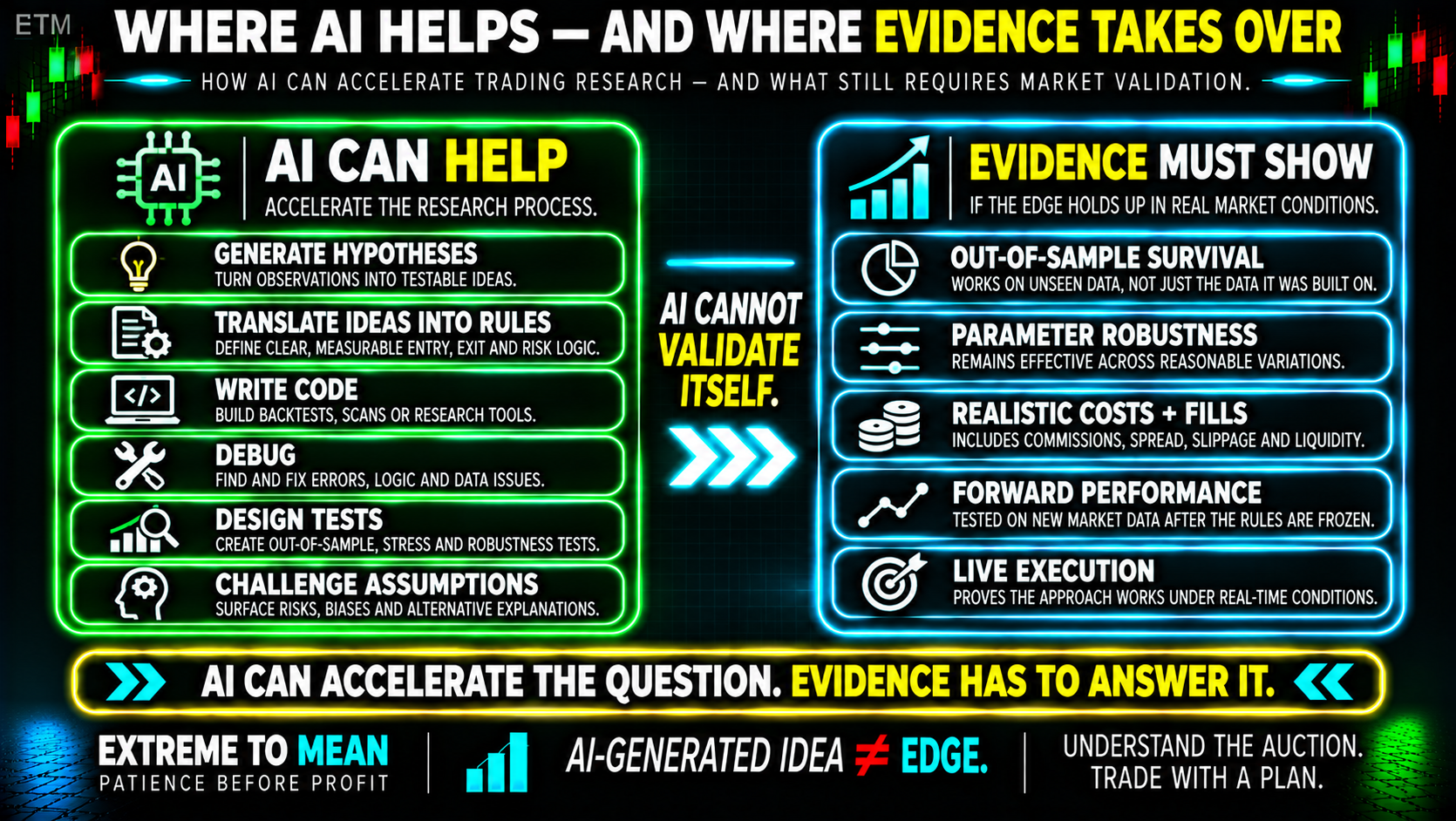
One of the strongest uses of an LLM is reducing friction between a trading question and an experiment. A trader can move from IDEA → CODE, ask for tests of a suspected bug, compare expectancy across regimes, or request an adversarial review of assumptions. Tasks that once required substantial programming effort can now be prototyped much faster.
Suppose the observation is, “NQ seems more likely to reverse after an unusually large volatility-adjusted extension.” An AI assistant can help define extension, suggest measurable variables, translate the rule into Python and construct tests across time of day or volatility regimes. AI can turn an observation into a question the data can answer.
It can also explain unfamiliar code, translate between languages, reproduce equations from research papers, generate unit tests and surface edge cases the trader did not think to inspect. Those are substantial research advantages. AI can make implementation cheaper without making validation optional.
A Plausible AI Strategy Is Still Only a Hypothesis
Ask an LLM, “Find me a profitable ES strategy,” and it may produce a coherent combination of moving averages, momentum filters, stops and targets. The rules may sound sensible and the code may run perfectly. Neither fact establishes that the strategy contains an edge.
A plausible explanation is not statistical evidence. If the model says mean reversion should work because markets often normalize after extreme moves, that statement may be a reasonable research hypothesis, but what an edge actually is must ultimately be established through the distribution of outcomes. AI-GENERATED IDEA ≠ EDGE.
The same caution applies to polished analysis. An LLM can produce equations, professional code and confident reasoning while still being wrong about a contract multiplier, timezone, formula, API behavior, data alignment or indicator definition. The confidence of the prose tells you nothing about the confidence of the trading evidence.
The Hidden Historical Problem: AI May Already Know the Future
Historical LLM tests have an additional problem that ordinary backtests do not necessarily share. If you ask a modern language model to “pretend it is January 2020” and select stocks using only information available then, the model may still contain knowledge derived from material written after January 2020. Telling it to forget later information does not prove that later information has been removed from its learned parameters.
Researchers now describe this as parametric look-ahead bias. A normal point-in-time backtest can restrict the dataset so that the program sees only records available before each historical date; an LLM may have another information source in its pretrained knowledge. A historical date in the prompt is not the same thing as a historical information boundary.
That does not mean every historical LLM experiment is useless. It means the integrity of the point-in-time information set needs to be demonstrated rather than assumed. HISTORICAL AI FORECAST ≠ CLEAN POINT-IN-TIME TEST.
AI Makes Overfitting and Multiple Testing Much Cheaper
A human researcher might once have tested twenty variations because each variation required time to code and analyze. An AI agent can potentially generate hundreds of filters, parameter combinations and strategy variations with far less effort. That is powerful, but the statistical cost of searching does not disappear simply because the programming cost fell.
If 500 strategies are generated and the best-looking one is selected, the winner should not be evaluated as though a single hypothesis was tested once. The discarded attempts are part of the research history behind the surviving backtest. AI lowers the cost of experimentation; it does not lower the statistical cost of multiple testing.
The danger becomes clearer when the instruction is “keep improving this strategy until the Sharpe ratio exceeds 2.” The loop can become CODE → BACKTEST → MODIFY → BACKTEST → MODIFY → REPEAT UNTIL PROFITABLE. If success is defined as continuing to search until the historical record looks good, eventually producing an attractive historical record is exactly what the process was optimized to do.
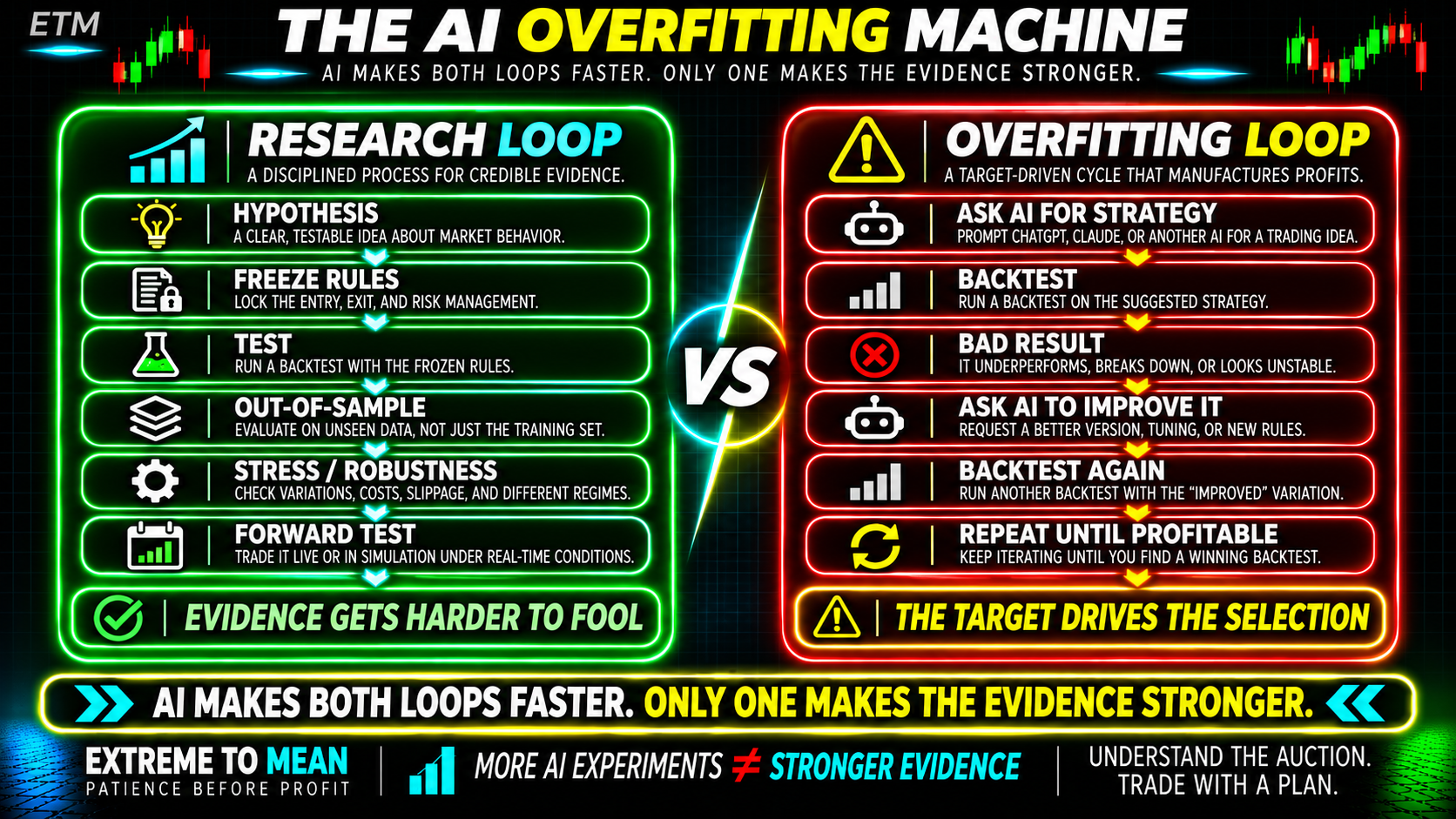
That is why MORE AI EXPERIMENTS ≠ STRONGER EVIDENCE. More experiments can strengthen research when they are preplanned robustness tests, but endless post-result modification can automate curve fitting. An autonomous research loop can become an autonomous overfitting machine.
Ask AI for Experiments—Not Conclusions
A weak prompt is: “Find me a profitable futures strategy.” A stronger prompt is: “Generate five falsifiable hypotheses about when short-term reversal should strengthen or weaken, define measurable variables for each, and specify what result would reject each hypothesis.” The second prompt improves the research question before it asks the data for an answer.
Then pre-specify what can reasonably be fixed before inspecting the result: the hypothesis, rule definition, intended parameter range, evaluation metrics and validation procedure. AI can automate implementation without being allowed to move the goalposts every time the test disappoints. Let AI automate the experiment—not rewrite the hypothesis until history agrees.
This also makes failed experiments valuable. Recording rejected ideas, parameter searches and modifications helps reveal how much searching occurred before the final strategy appeared. PROFITABLE BACKTEST ≠ PROVEN AI ALPHA.
Use AI as Builder, Critic and Tester—but Let Data Judge
AI can work in several useful roles. The builder can implement the strategy, the critic can assume the backtest is misleading and search for leakage or unrealistic assumptions, the tester can design robustness checks, and the documentarian can record rules and results. Separating these roles can improve process discipline even though the agents should not be treated as statistically independent evidence.
One of the best prompts may be: “Assume this strategy is overfit. Find the strongest reasons the result could be wrong.” Ask it to inspect look-ahead, survivorship bias, missing costs, unrealistic fills, parameter instability, regime concentration and data leakage. One of AI's most productive jobs may be trying to destroy the strategy you hope is real.
AI can even help audit AI-written code by generating unit tests and adversarial cases. That is useful, but model-reviewing-model does not create empirical independence. WORKING CODE ≠ VALID RESEARCH, and different AI roles do not change that.
This is where the principle that a trade is not ready until the risk is clear has a research equivalent: a strategy is not ready for capital merely because the code executes. Correct-looking code and correct research are different achievements.
Missing Data Cannot Be Replaced With Better Prompting
If a strategy requires historical bid/ask prices, tick data, queue position, order-book depth or point-in-time fundamentals, those inputs have to exist and be available to the test. A language model cannot reconstruct unavailable market history merely by writing a plausible description of what probably happened. Missing market data cannot be repaired with better prompting.
The correct research output may sometimes be UNKNOWN. That is especially important around historical fills, news availability, consensus expectations and timestamps, where plausible fabricated detail can quietly contaminate the test. A research assistant should expose a missing-information problem rather than hide it with fluent text.
Synthetic data has legitimate uses for software tests, stress scenarios and unusual edge cases. It can test whether the machinery behaves correctly under a constructed scenario. Real market data still has to test the claim about real market behavior.
What Current AI-Trading Research Does—and Does Not—Show
The financial-LLM research base is developing quickly but is not settled. Recent work has identified recurring evaluation problems including look-ahead, survivorship, narrative, objective and cost biases, while separate research has shown how pretrained knowledge can contaminate historical financial LLM tests. Those results strengthen the case for careful validation rather than proving that LLM trading either works or fails universally.
Longer-horizon research has also found that some previously reported LLM investing advantages weakened when tested over broader universes and longer periods. That is exactly what robust research is supposed to discover: an exciting narrow result should face increasingly difficult attempts to break it. The interesting question is not whether AI can produce a profitable backtest; it is whether the result survives honest validation.
The research standard should not change because the logo on the AI assistant changes. ChatGPT, Claude and future tools may vary substantially in capability, but none should be placed above the evidence standard. AI ASSISTANCE ≠ AI AUTHORITY.
The AI-Assisted Research Checklist
Before trusting an AI-generated trading strategy, ask:
- What exactly did the AI do: generate an idea, write code, analyze data, or make trade decisions?
- What data did the system actually have access to?
- Could later information exist inside the model's pretrained knowledge?
- Was the hypothesis defined before the results were seen?
- How many AI-generated variations were tested?
- Was the implementation independently checked?
- Are realistic costs, slippage and fills included?
- Does the result survive nearby parameter choices?
- Does it survive genuinely out-of-sample data?
- Has it been forward tested after the rules were frozen?
- Can I explain why the hypothesized edge might exist without saying merely “the AI found it”?
- Would I accept the same evidence if a human researcher had produced it?
The last question is particularly useful because the presence of AI can create an undeserved aura of sophistication. The evidence should not become stronger merely because the strategy was generated faster or described more elegantly. Apply the same burden of proof to machine-assisted research that you would apply to human research.
The ETM Ask → Specify → Build → Attack → Validate Framework
Use ASK → SPECIFY → BUILD → ATTACK → VALIDATE. ASK a falsifiable question; SPECIFY rules and acceptance criteria before seeing the final result; BUILD with AI where it reduces implementation friction. ATTACK the strategy for bugs, leakage, overfitting and unrealistic assumptions, then VALIDATE with untouched data and eventually forward evidence.
The possible outcomes are REJECT / RETEST / KEEP RESEARCHING / VALIDATE FURTHER. AI belongs inside this process—not above it—and the ETM free tools can help structure research and review. AI can accelerate the question. Evidence has to answer it.
Final Thought
ChatGPT, Claude and other LLMs can materially improve a trading-research workflow. They can turn fuzzy observations into explicit tests, write and debug code, replicate research, expose hidden assumptions, design stress tests and challenge ideas from directions a trader may not have considered.
None of those abilities proves the market contains the edge being researched. LLMs can make factual and coding errors, historical tests can be contaminated by later knowledge, and nearly frictionless experimentation can multiply the same data-snooping and curve-fitting problems traders already faced before generative AI existed. AI can accelerate research. It can also accelerate bad research.
Use AI to formulate better questions, build faster experiments and attack your own assumptions. Freeze the research decisions before validation, count the experiments, include realistic costs, use genuinely unseen data and forward test after the rules stop changing. AI helped build the experiment. The experiment has to produce the evidence.
Educational content only. Trading involves substantial risk and is not suitable for everyone.