
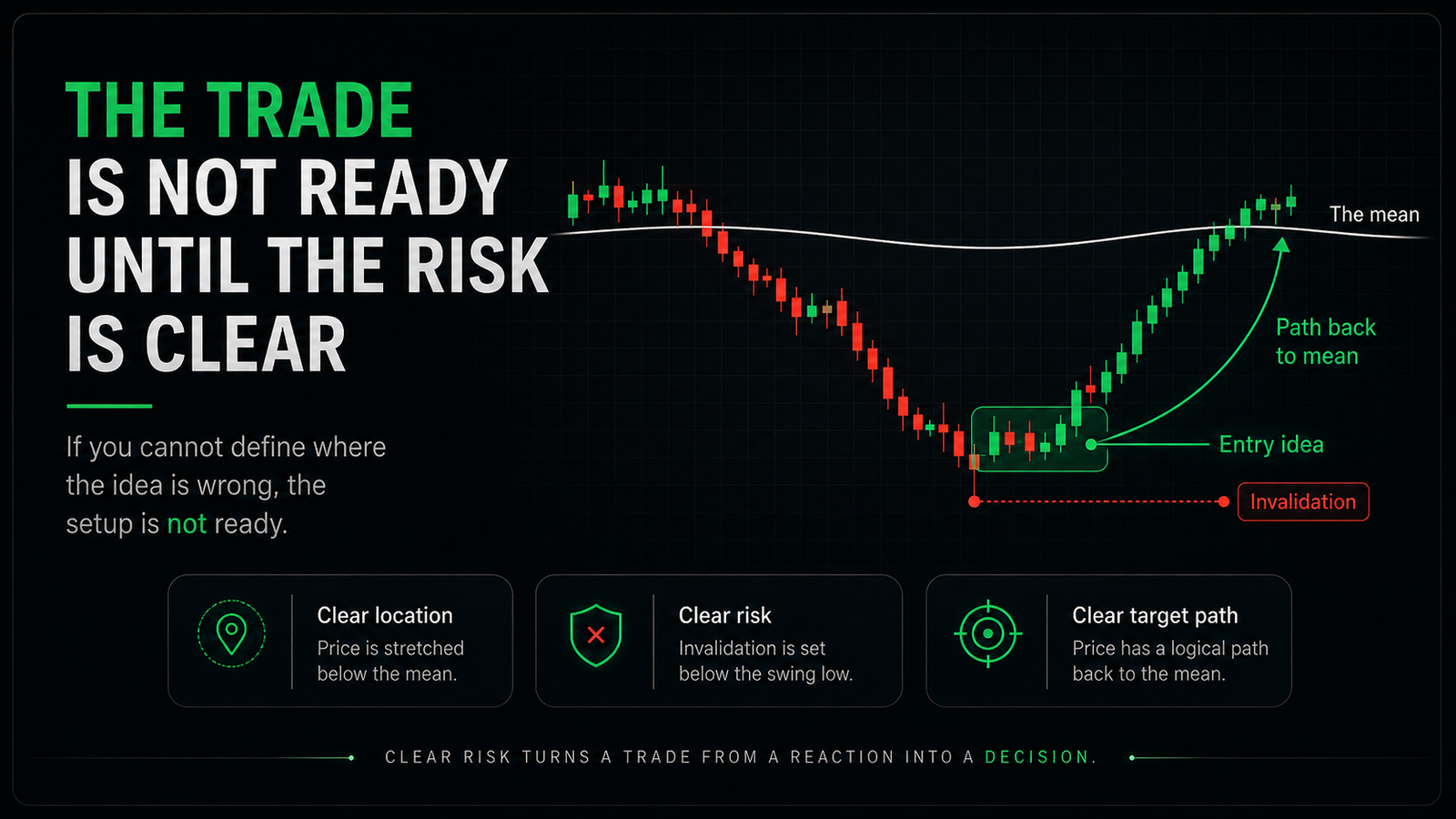
If you cannot explain where the trade is wrong, the trade is not ready. That sounds simple, but many traders skip this step because they are focused on the entry. The setup and risk lessons start by reversing that order before the move gets away.
So they enter first and figure out the risk later.
That is backwards. A trade should not begin with hope. It should begin with a clear idea, a clear location, and a clear place where the idea is invalid.
Risk Is Not Just the Stop
A stop is not just a random number below your entry or above your entry. It should not be placed only because the dollar amount feels comfortable, and it should not be moved around because the trade starts to feel uncomfortable.
A stop should represent the point where the trade idea no longer makes sense. That is what invalidation means, and it is the purpose of using a stop loss as a risk boundary.
If you are long, where would price need to go to prove the setup is failing? If you are short, where would price need to go to prove the market is not rejecting the area? If you cannot answer that before entry, you do not have clear risk.
You may still have a trade idea. You may still have a direction. You may still have a feeling. But setup, location, structure, and risk must align before the trade is complete.
Late Entries Make Risk Messy
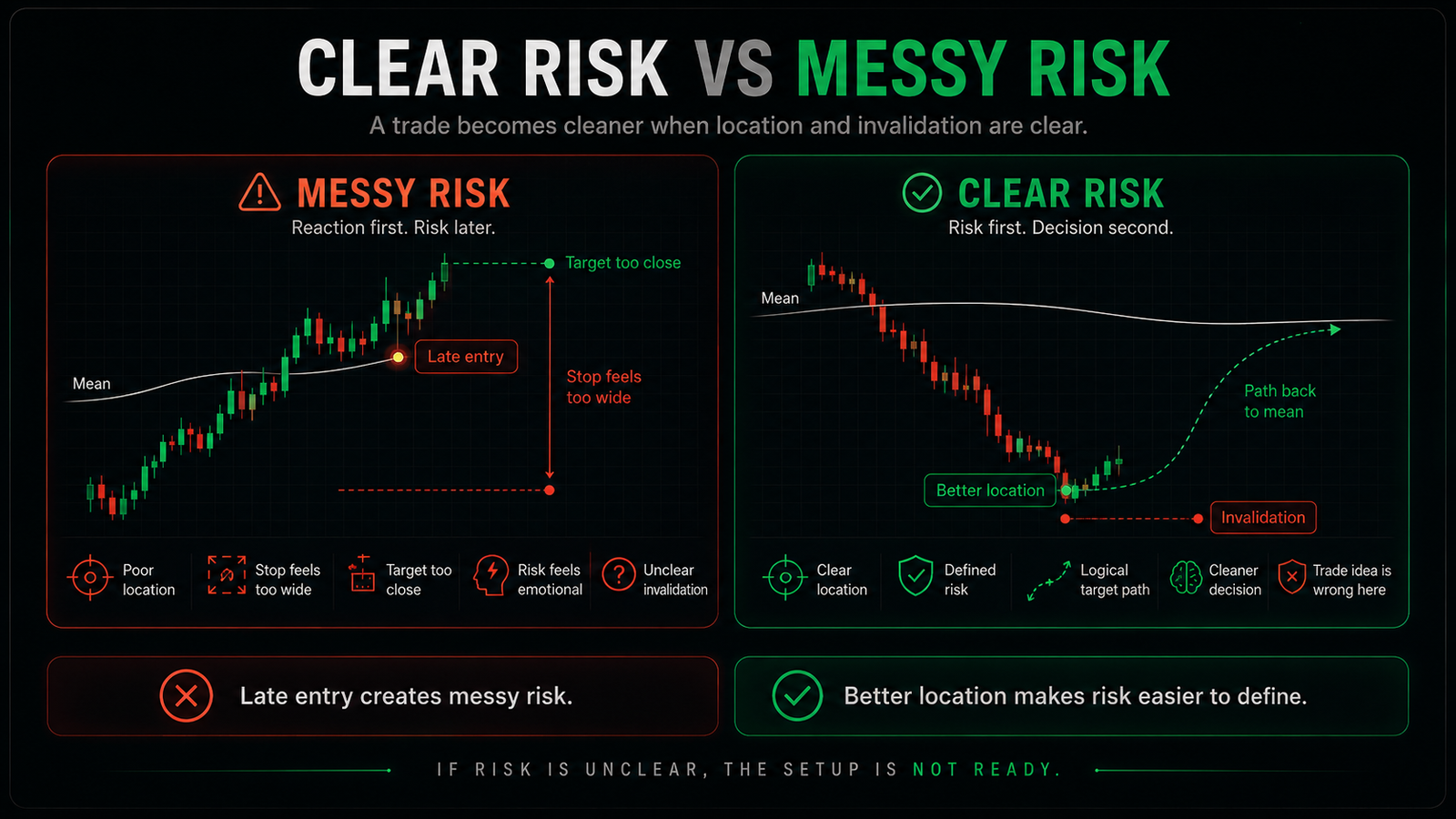
One of the biggest reasons traders struggle with risk is that where they enter matters more than what they predict. They see the move after it has already started, they do not want to miss it, and they jump in somewhere between the original opportunity and the likely target.
Now everything is harder. The stop feels too far away. The target feels too close. The trade needs to work almost immediately to feel comfortable. Every small pullback feels threatening because the entry location is poor.
That is what bad location does. It makes risk feel emotional.
A better location does not guarantee a better outcome, but it can make the decision cleaner. It can give the trader a clearer place to be wrong and a more logical path for the trade to work.
The Middle Creates Unclear Risk
The middle is where risk gets blurry. Price is not stretched enough to create a strong reversion opportunity. It is not cleanly at an edge. It may be moving, but movement alone does not mean the structure is clear.
A trader enters anyway because something looks like it might happen. Then the questions begin:
- Is this pullback normal?
- Is this trade failing?
- Should I cut it?
- Should I give it more room?
- Should I move the stop?
- Should I add?
This is how emotional trading begins. The trader is not managing a defined setup. They are reacting to uncertainty they accepted before entering.
Clear risk should exist before the trade, not after pressure shows up.
Better Location Makes Risk Easier to Define
Extreme to Mean focuses on the edges because location changes the quality of the decision. At a meaningful extreme, the trader can often define risk more clearly. Price has stretched. There may be a logical area where the reversion idea is wrong. There may also be more room to revert toward the mean.
That does not mean every extreme is a trade. It means the question becomes easier to evaluate.
Before acting, the trader can ask:
- Is this stretched enough to matter?
- Is momentum slowing?
- Is there enough room back toward balance?
- Where is the idea wrong?
- Can the risk be defined before entry?
If the answer is yes, the setup may deserve more attention. If the answer is no, the trade is not ready.
Clear Risk Reduces Emotional Pressure
A trader with unclear risk is vulnerable. Every tick feels important. Every candle feels personal. Every small move against the position creates pressure.
That pressure leads to bad decisions. The trader may cut too early, hold too long, move the stop, add to a losing idea, or take another trade just to make back the first one. None of those decisions usually come from a clean process. They come from confusion.
Clear risk does not remove emotion completely, but it reduces the amount of uncertainty the trader has to manage once the trade is live. It gives the trader a plan before the market starts applying pressure.
The trader knows where the idea is wrong. That matters.
The Setup Should Earn the Risk
Before entering, ask a better question:
Does this setup deserve my risk?
Not just, "Can this move?" Not just, "Do I like the direction?" Not just, "Am I afraid of missing it?" A setup deserves risk only when the trader can explain the idea clearly.
That means being able to answer:
- Where is the location?
- What is the context?
- What is the path back toward the mean?
- Where is the trade wrong?
- Is the potential reward worth the risk?
If those answers are not clear, the trade should wait. There will always be another candle. There will always be another move. There will not always be another chance to protect your next decision if you keep forcing trades that were not ready.
Final Thought
The entry is not the most important part of the trade. The decision before the entry is.
If risk is unclear, the setup is incomplete. If invalidation is random, the trade will feel emotional. If the location is poor, the trader is already under pressure before the trade even begins. The same principle applies to position size versus account size, because the same dollar loss can have very different account impacts.
It also helps to understand how stop orders relate to risk management.
Traders should also understand slippage and execution risk.
Risk clarity also includes understanding leverage and account risk.
A cleaner process starts with a simple rule:
Know where the idea is wrong before you risk money on being right.
Because the trade is not ready until the risk is clear. To practice that before entry, use the free risk and trade-review tools.
Execution starts with knowing what bid, ask, and spread mean, especially when a trade needs a precise entry or exit.
The instrument matters too, and an options contract carries different rights and obligations from a simple share purchase.
A complete plan also defines the entry, stop, and target.
Continue with how to define risk as part of the setup.
A broader decision framework shows how a risk manager evaluates the trade before entry.
For the complete walkthrough of invalidation, stop placement, and position size, read the full risk-first trading guide.
Educational content only. Trading involves substantial risk and is not suitable for everyone.