
When people first start trading, "edge" sounds like a hidden thing. A special indicator. A line on the chart that tells you exactly when to click. So they collect tools, stack settings, and keep tweaking, convinced the edge is one discovery away. The setup and risk lessons take a different view: most losses do not come from a bad signal at all, but from acting in the wrong location.
What an Edge Really Means
An edge is a small, repeatable advantage that shows up across many trades — not certainty on any single one. No setup tells us what happens next. What a good process does is tilt the odds slightly in our favor and then repeat that same decision enough times for the tilt to matter. The discipline required to backtest mean reversion without fooling yourself is one way to test whether that apparent advantage survives a broader sample.
That distinction also explains why execution problems can make a reasonable strategy appear broken.
That's an important shift in thinking. We're not trying to be right on the next trade. We're trying to keep putting ourselves in spots where the odds lean our way, with risk we've already defined. The edge doesn't live in the entry button. It lives in location, context, and discipline, which is why location is the first filter.
Extreme vs. Middle
Here's the heart of it. Price spends its life moving between two states. Sometimes it's stretched far away from its average — that's an extreme. Sometimes it's hanging right around its average, undecided and choppy — that's the middle.
These two states are not equal, and they should not be traded the same way.
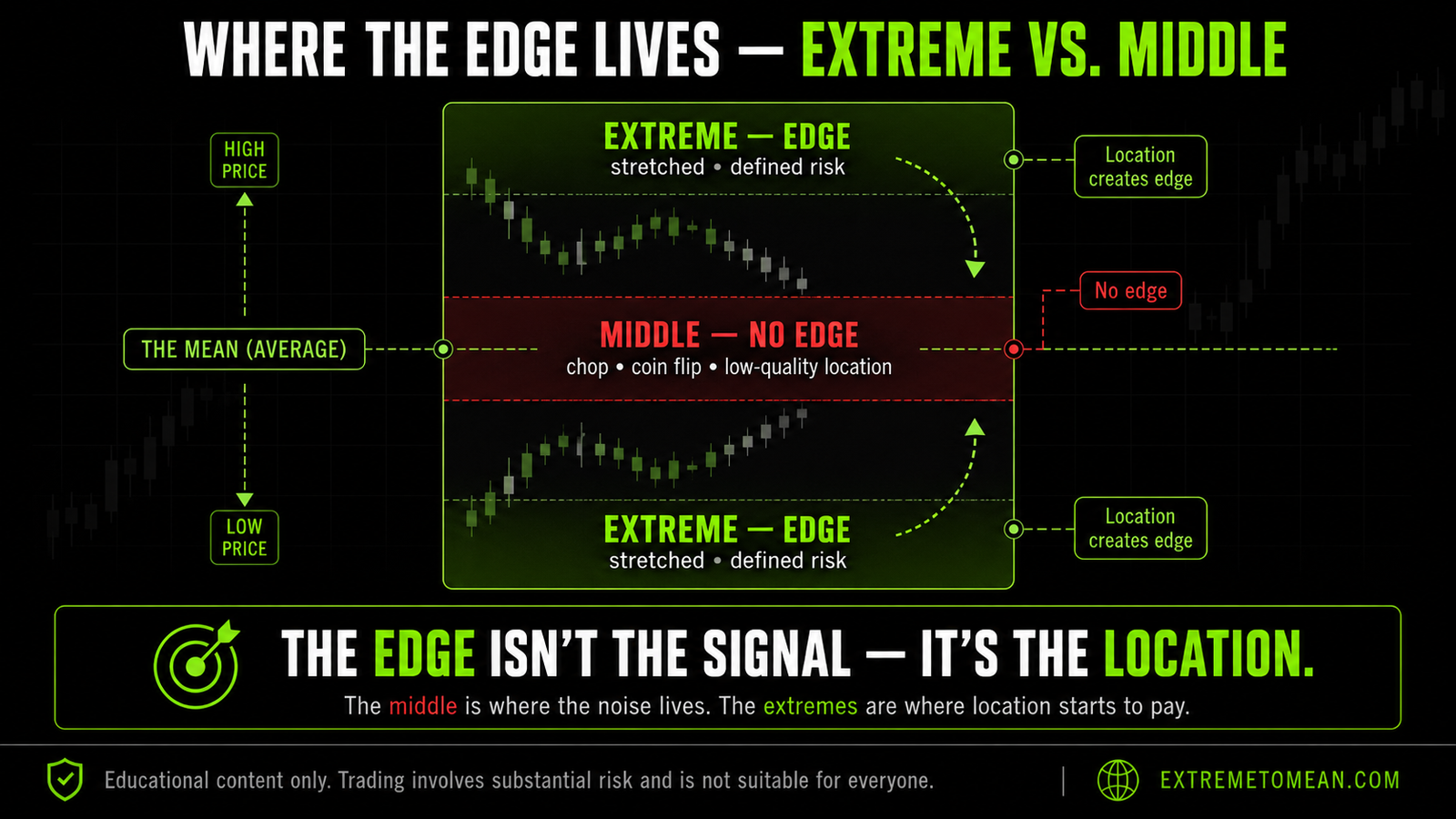
At an extreme, we tend to get cleaner reference points. Price is far from where it usually sits, which means there is measurable room to revert toward the mean. We can place a stop just beyond the stretch, and we have a clear story for why the move might turn. The risk is defined, and the potential travel is real.
In the middle, none of that is true. Price is near its average, so there's no stretch to fade and no clear level to lean against. The candles whip back and forth, invalidation is fuzzy, and the reward-to-risk is usually poor. We're paying full risk for what amounts to a coin flip. The location simply isn't offering us anything.
Why the Middle Tempts Us
If the middle is such a bad place to act, why do so many of us keep trading there? Because it feels like the most active part of the chart.
The middle is where most of the candles print. It's where the movement looks constant, where something always seems to be "about to happen." When we're bored, or afraid of missing out, the middle is right there offering action. So we react to the movement instead of evaluating the location. That is why the middle gets traders chopped up: activity is not the same thing as an edge.
What a Better Trader Looks For
A more patient trader flips the question entirely. Instead of asking "is something happening?" they ask "is price at a location worth my risk?" Because where you enter matters more than what you predict.
We prefer to wait for the stretch. When price pushes to an extreme, away from its average, the setup starts to earn our attention. From there we're looking for a few simple things before we'll commit risk:
- Price is clearly stretched away from the mean, not sitting in the middle.
- There's a reference level or zone to lean against.
- There's a logical reason price might turn back toward the average.
- We can define exactly where we're wrong before we enter.
When those line up, the setup has earned the risk. When they don't, there's nothing to do, and doing nothing is a complete decision. This is what Patience Before Profit actually looks like in practice.
A Decision Filter Before You Act
Before clicking anything, we like running price through one simple question stack. If the answers aren't clean, that's usually the trade telling us to wait.
- Is price at an extreme, or in the middle? If it's in the middle, stop here.
- Where is my reference? If there's no level to lean against, there's no trade.
- Where am I wrong? If I can't define invalidation, my risk is undefined.
- Is the travel worth the risk? If the potential move is small relative to my stop, the location isn't paying me.
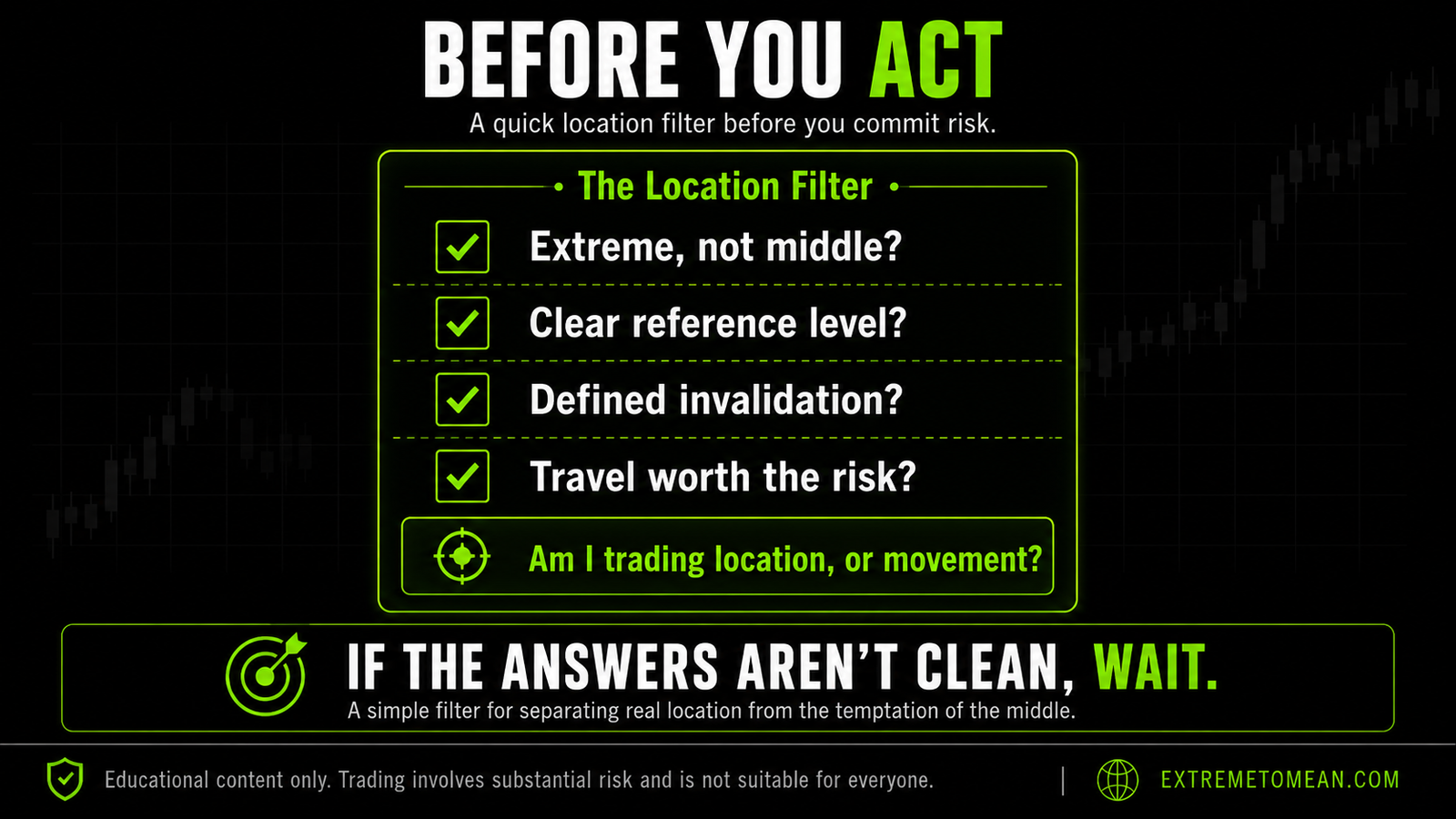
The best single question to build the habit around is this: Am I trading because of location, or because of movement? Movement is everywhere. Good location is rare, and that rarity is exactly what makes it valuable.
Final Thought
An edge isn't a tool you buy or a signal you finally discover. It's the discipline to act where the conditions tilt slightly in our favor — at the extreme — and to sit on our hands in the noisy middle. Our job isn't to predict the next candle. It's to evaluate location, define our risk, and let a small repeatable advantage do its work over many decisions. To connect those decisions, see the process behind the trading tools.
Educational content only. Trading involves substantial risk and is not suitable for everyone.