Making money from trading and building a life that depends on trading income are two very different problems.
Living expenses are scheduled. Trading opportunities are not.
Some traders do earn meaningful money from markets, but that does not make trading income behave like employment income. A salary generally arrives on a schedule, while trading can produce profitable, flat, or losing periods in an unpredictable sequence. The market does not know when your mortgage is due.
That is why this belongs inside The Trader. The sharper question is not, “How much could I make full time?” It is: Can the trading process support the trader without the trader forcing the market to support the process?
Can Trading Make Money? Is Not the Same as Can It Replace a Salary?
The first question is about edge: can a defined trading process produce positive expectancy after realistic costs? The second is about whether variable results can reliably coexist with fixed household expenses, taxes, insurance, drawdowns, and everything else life continues to demand. A profitable trader and a financially independent trader are not automatically the same thing.
That distinction matters because career decisions can be built around the wrong evidence. Three excellent months may be meaningful trading data, but they may also reflect a favorable regime or unusually positive variance. RECENT PROFIT ≠ CAREER EVIDENCE.
This is why understanding what an edge actually is is necessary but insufficient. Positive expectancy can support a trading process without guaranteeing that the distribution of returns will resemble a paycheck.
Start With Runway, Not an Income Target
The common question is, “How much do I need to make every month?” A better starting point is: What does life cost, how variable are trading results, what happens during drawdown, and how long can the household function without asking trading to provide a withdrawal? Before calculating what trading needs to produce, calculate how long life can operate without requiring trading to produce anything.
Conceptually:
Runway = Liquid Living Reserves ÷ Essential Monthly Expenses
If truly separate living reserves were $50,000 and essential expenses were $5,000 per month, the arithmetic would show ten months of runway. That is an illustration of the calculation—not a recommendation that ten months is sufficient, because households differ in dependents, debt, healthcare, other income, employability, and financial obligations.
Runway measures time—not trading skill. There is no universal six-, twelve-, or twenty-four-month number that turns a career transition into a sound decision because there is no universal household.
One Pool of Money Should Not Be Asked to Do Every Job
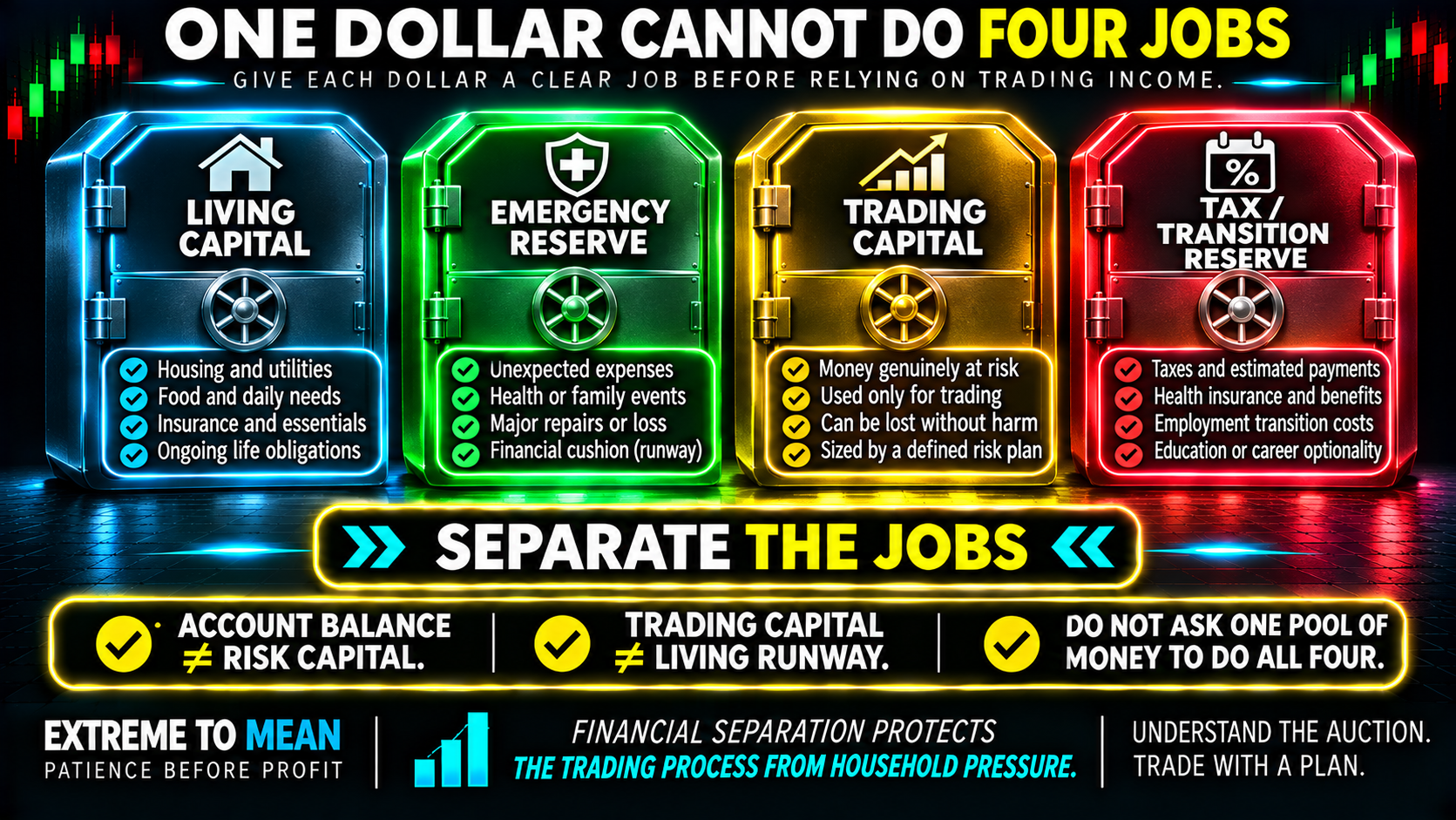
A trader may look at a $100,000 account and think, “I have $100,000 available.” If that same money also has to fund rent, emergencies, taxes, insurance, and future obligations, the trader does not actually have $100,000 of risk capital. ACCOUNT BALANCE ≠ RISK CAPITAL.
It is more useful to think in separate financial jobs: living capital covers ordinary necessities, emergency reserves absorb unexpected life events, trading capital is money genuinely available for market risk, and tax or transition reserves handle obligations that employment or payroll may previously have managed. One dollar should not simultaneously be rent money, emergency money, and trading risk capital.
Current NFA guidance uses essentially the same boundary for futures risk capital: speculative capital should be money a person can afford to lose above what is needed for necessities, emergencies, savings, and long-term objectives. That principle does not decide whether someone should trade full time, but it does tell us that money already needed for life has another job.
Why Needing Trading Income Can Change the Trading
Imagine quitting on Friday and beginning Monday knowing that this month's household expenses now have to come from trading. A quiet session no longer feels neutral; it feels like lost income. A losing day can begin to feel like money that must be recovered rather than a normal outcome inside a distribution.
That pressure can create trades the strategy never asked for. If the trader “needs” $300 today but no qualified setup appears, the household budget has not created a market opportunity. A flat day must remain a valid outcome whenever the strategy has no reason to take risk.
This connects directly with why doing nothing is still a trading decision. When every no-trade day threatens the household budget, patience becomes financially expensive, and trading becomes more dangerous when the market is asked to behave like a paycheck.
The less the market is required to pay you today, the easier it can become to refuse a bad trade today.
Drawdown and Household Withdrawals Can Attack the Same Capital
Trading income is naturally uneven. A strategy might eventually produce $60,000 of net profit over a year without producing $5,000 in each of twelve neat installments; the actual sequence could begin with losing months, flat months, and drawdown before stronger periods arrive. AVERAGE RETURN ≠ MONTHLY CASH FLOW.
That sequence matters because living withdrawals continue while strategy capital may be declining. The trading account can end up performing two conflicting jobs at once: absorbing market drawdown while simultaneously funding household expenses. Trading capital needs room to survive losses, while living expenses continuously remove some of that room.
The dangerous scenario is not merely earning nothing. It is earning nothing while trading capital is shrinking, which can increase pressure precisely when the strategy should be allowed to operate without forced recovery trades.
Do not reverse-engineer position size from household needs. The wrong sequence is “I need $8,000 a month → I need $400 a day → therefore I need X contracts.” The cleaner sequence is EDGE → RISK → POSITION SIZE → RESULTS, followed separately by a financial-planning decision about what those results can responsibly support.
Living expenses should never determine how much market risk a trade is allowed to take.
Career Evidence Should Come From Live Results, Not Hypothetical Income
A backtest showing $150,000 of annual historical profit does not establish $150,000 of dependable household income. Historical simulation still contains assumptions about future market behavior, execution, costs, and strategy stability, while actual withdrawals and taxes did not occur inside the backtest. You cannot pay future bills with historical hypothetical profits.
Current CFTC guidance specifically warns that hypothetical results were not subjected to actual market conditions and may overestimate or underestimate performance. If the career decision depends on the strategy continuing to work live, actual live evidence should carry greater weight than simulated income projections.
That still does not create a magic requirement such as “twelve profitable live months” or “two profitable years.” The quality of the evidence matters: different market conditions, actual execution, genuine drawdowns, realized costs, and enough live history to understand how the strategy behaves when conditions are not ideal.
A few excellent live months may be encouraging without being sufficient evidence for a major irreversible decision. PROFITABLE TRADING ≠ RELIABLE SALARY.
Employment Provides More Than the Number on the Paycheck
Salary is only one component of employment. Depending on the situation, employment may also provide health insurance, retirement contributions, paid leave, disability coverage, predictable withholding, professional development, credentials, and a career path. Comparing salary directly with gross trading P&L can therefore omit meaningful parts of the transition.
Taxes matter for the same reason. Trading P&L is not automatically spendable P&L, and U.S. taxpayers receiving income without enough withholding may need estimated-tax payments during the year. For many regulated futures contracts, Section 1256 can also involve mark-to-market treatment and the familiar 60% long-term/40% short-term capital-gain treatment, but actual tax treatment depends on the instrument and the taxpayer's circumstances.
That is a planning issue, not a trading edge, and it should be verified with an appropriate tax professional rather than reduced to a slogan about a “60/40 tax rate.” Taxes, insurance, and lost employment benefits should be included in the transition structure before headline trading P&L is compared with a paycheck.
The Decision Does Not Have to Be Job or Trading
Career transition is often framed as a binary choice: keep the job or become a full-time trader. Real life may permit intermediate arrangements such as continuing employment while trading, reducing hours where feasible, maintaining another source of flexible income, continuing education while researching markets, or delaying a transition while evidence accumulates. A transition can be staged rather than jumped.
Reversibility matters because two decisions with the same potential upside can have very different downside costs. Leaving a role that can easily be resumed is structurally different from surrendering credentials, education, or a career path that would be difficult to recover. A career decision should consider not only the upside of being right but the cost of being wrong.
That is especially important for students and early-career traders. A few strong months may be useful trading evidence without proving that long-term educational or career options have lost their value. CAN QUIT ≠ SHOULD QUIT.
Full-time trading also does not mean trading all day. If a strategy produces two qualified opportunities, a trader does not need to manufacture eight more because trading has become the occupation. FULL-TIME TRADER ≠ FULL-TIME MARKET PARTICIPATION.
The Full-Time Trading Readiness Check
Before even considering dependence on trading income, ask:
- Do I have credible live evidence of an edge rather than only backtested results?
- Has that evidence covered more than one narrow market condition?
- Do I know the strategy's net results after real execution costs?
- Do I understand its drawdown and income variability in both percentages and dollars?
- Is trading capital separate from living and emergency funds?
- Can the household operate without requiring trading withdrawals for a meaningful period?
- Have taxes, insurance, benefits, and transition costs been considered?
- Would I still follow the same risk rules if trading produced no income this month?
- What career or educational options am I giving up, and how reversible is the decision?
- Am I considering the transition because evidence supports it—or because I want to escape the current job?
No answer on that list is a universal permission slip. The goal is to expose structural weaknesses before fixed household needs are placed on top of variable market income.
Stress-Test the Runway Before Depending on It
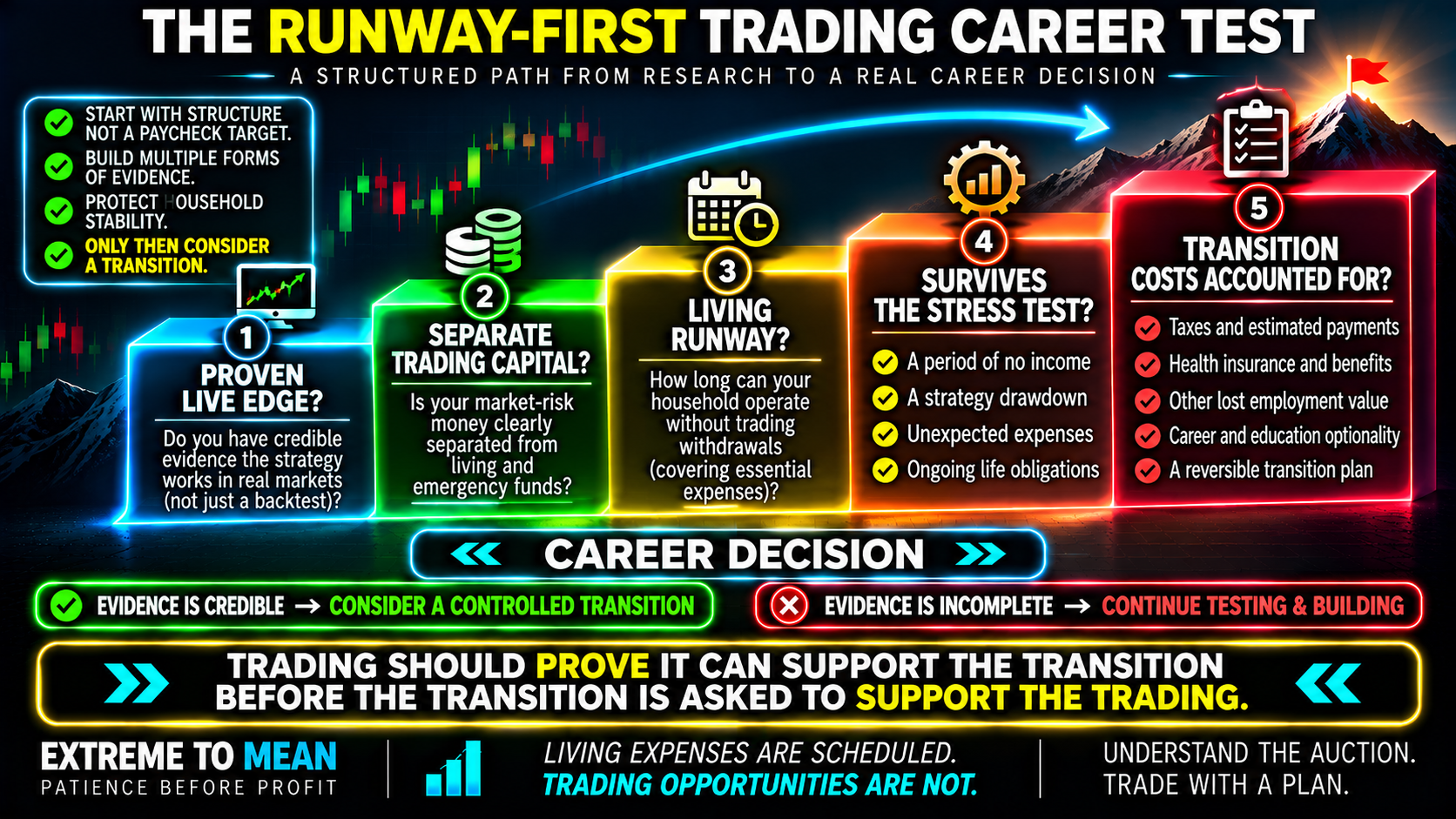
First model a period in which trading produces no income. Can ordinary expenses still be met while the trading account remains available only for planned strategy risk? Runway should be tested against the possibility that the market pays nothing for longer than hoped.
Then make the scenario harder: living expenses continue while the trading strategy is also in drawdown. Add an unexpected repair, healthcare expense, or family obligation and ask whether the separation still works without pulling essential money from the trading account. A runway that works only when life and markets behave perfectly is not much of a runway.
Career planning should therefore rely on ranges and stress scenarios rather than the best recent monthly average. Do not build fixed life obligations around the best part of a variable equity curve. A career plan should survive disappointing trading performance rather than require the forecast to come true.
The ETM Prove → Separate → Runway → Stress → Transition Framework
Use PROVE → SEPARATE → RUNWAY → STRESS → TRANSITION. PROVE means establish credible live trading evidence rather than projecting hypothetical profits. SEPARATE means keeping living needs, emergency reserves, market risk capital, and transition obligations conceptually and financially distinct.
RUNWAY asks how long life can operate without relying on trading withdrawals, while STRESS tests flat periods, drawdowns, taxes, unexpected expenses, and lost employment benefits. Only after those questions have credible answers does TRANSITION become something worth evaluating—and even then it remains an individual life decision rather than a formula produced by an article.
A trading plan made before the session protects individual trading decisions from improvisation, and the same principle applies here: define the financial boundaries before recent profits begin arguing for a lifestyle change. The market should not be asked to finance a decision that removed the trader's ability to wait.
The ETM free tools can help organize the trading side of the review, but no spreadsheet can decide a career transition automatically. Trading should prove it can support the transition before the transition is asked to support the trading.
Final Thought
It is possible for trading to produce meaningful income. That does not mean several profitable months, a large account balance, or a strong backtest automatically make variable market returns a reliable substitute for scheduled employment income.
Separate the money required for life from the money genuinely available for risk. Evaluate live evidence across good and difficult periods, understand what drawdown means in dollars, account for taxes and benefits, stress-test zero-income periods, and consider the value and reversibility of whatever career or educational options would be surrendered.
Most importantly, never make trading risk answer to a household income target. A household budget can tell you what life costs; it cannot tell the market how many good trades to provide. Trading should prove it can support the transition before the transition is asked to support the trading.
Educational content only. Trading involves substantial risk and is not suitable for everyone.