
Almost everyone who trades has written some version of a plan. The setups they'll take, the levels they care about, the size they'll use, the point where they're wrong. Writing it down feels productive, and it should — clarity before the open is a real advantage. But here's the part nobody likes to say out loud: building a trading plan from scratch is the easy part. Sticking to it is the hard part. That gap, between knowing the plan and following the plan, is where most accounts quietly bleed out.
The trader psychology lessons focus on closing that gap.
A Plan Is a Decision Made in Advance
Think about when you write your plan. Usually it's before the open, or the night before, when nothing is moving against you and no money is on the line. Your heart rate is normal. You can think clearly about location, context, and risk. In that state, you make good decisions — wait for the setup, respect the level, size sensibly, cut it if you're wrong.
That calm version of you is the smartest trader you have.
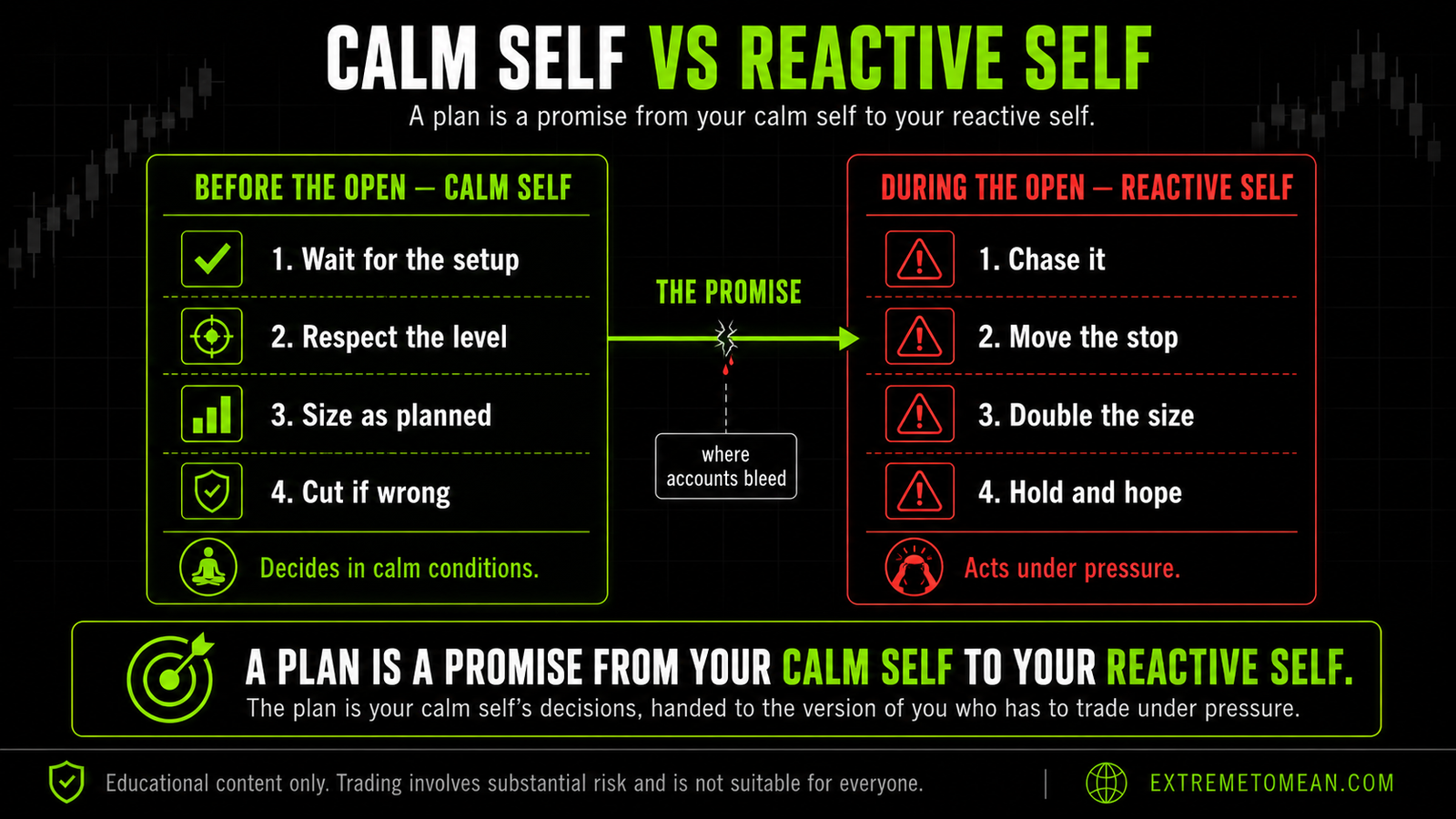
The plan is simply that trader's decisions, written down and handed to the version of you who will be sitting in front of a fast tape with adrenaline in the system. So a plan isn't a prediction about the market. It's a promise from your calm self to your reactive self. The promise says: here is what we agreed to do, here is what we agreed not to do, and the trade is not ready until the risk is clear.
How the Promise Gets Broken
The market doesn't break your plan. You do, and it almost always feels reasonable in the moment. That's what makes it dangerous.
You planned to wait for price to reach your level, but it's running without you and the fear of missing out feels louder than the rule. You planned to risk one unit, but this one "looks too good," so you double it. You planned to be out at your stop, but you move it lower because surely it comes back. Every one of those choices feels justified while it's happening. The reactive version of you is very good at building a quick, convincing case for why today is the exception.
This is the core problem. In the moment, breaking the plan doesn't feel like breaking the plan. It feels like adapting, like being decisive, like catching an opportunity. Only later, in the calm of review, do you see it for what it was: the smart version of you got overruled by the impulsive one.
Why "Just Follow Your Plan" Is Harder Than It Sounds
If discipline were only about knowledge, no one would struggle. We all know we should wait for the setup and honor the stop. The difficulty isn't information — it's that live conditions actively work against the calm decision.
A few forces are always pulling on you in real time:
- Speed. The market moves faster than careful thought, so reaction beats reflection unless you've decided in advance.
- Emotion. Fear of missing out and fear of losing both push you to act, not to evaluate.
- Recency. The last trade colors the next one. A loss makes you hesitate; a win makes you reckless.
- Ego. Admitting the trade is wrong feels like admitting you're wrong, so you hold instead of cut.
None of these are character flaws. They're just what it feels like to have money on the line. The point isn't to pretend they don't exist. The point is to make your decisions before they show up, when they have no grip on you.
What a Disciplined Trader Looks For Instead
A more disciplined trader isn't someone with more willpower. It's someone who has shrunk the number of decisions they have to make while the market is moving. The work is done up front, so the live job becomes simple: does this match the promise, yes or no?
That trader treats the plan as a filter, not a suggestion. The setup has to earn attention. The location has to be right. The context has to fit. If it doesn't, there's nothing to decide — doing nothing is still a trading decision.
Patience here isn't passive waiting. It's actively refusing trades that don't match what your calm self already approved. A written plan helps traders use preparation to make patience repeatable.
This is also where reversion-to-mean thinking helps, because our whole approach is built on waiting for price to reach a location worth acting on rather than chasing it in the middle. The plan and the method point in the same direction: let the condition come to you. That is purposeful preparation while waiting.
A Filter You Can Use Before You Click
You don't need more motivation. You need a small gate to pass through before every entry — one that lets your calm self veto your reactive self. Run these questions, in order:
- Did this setup match my written plan, or am I reshaping the plan to fit the trade? If you're editing the rule mid-flight, stop.
- Is the location actually here, or am I chasing because I'm afraid of missing it?
- Is my size the size I agreed to, or did this one "feel" big enough to justify more?
- Do I know exactly where I'm wrong before I'm in? If not, you don't have a trade, you have a hope.
- If my calm pre-market self watched me take this, would they nod or wince?
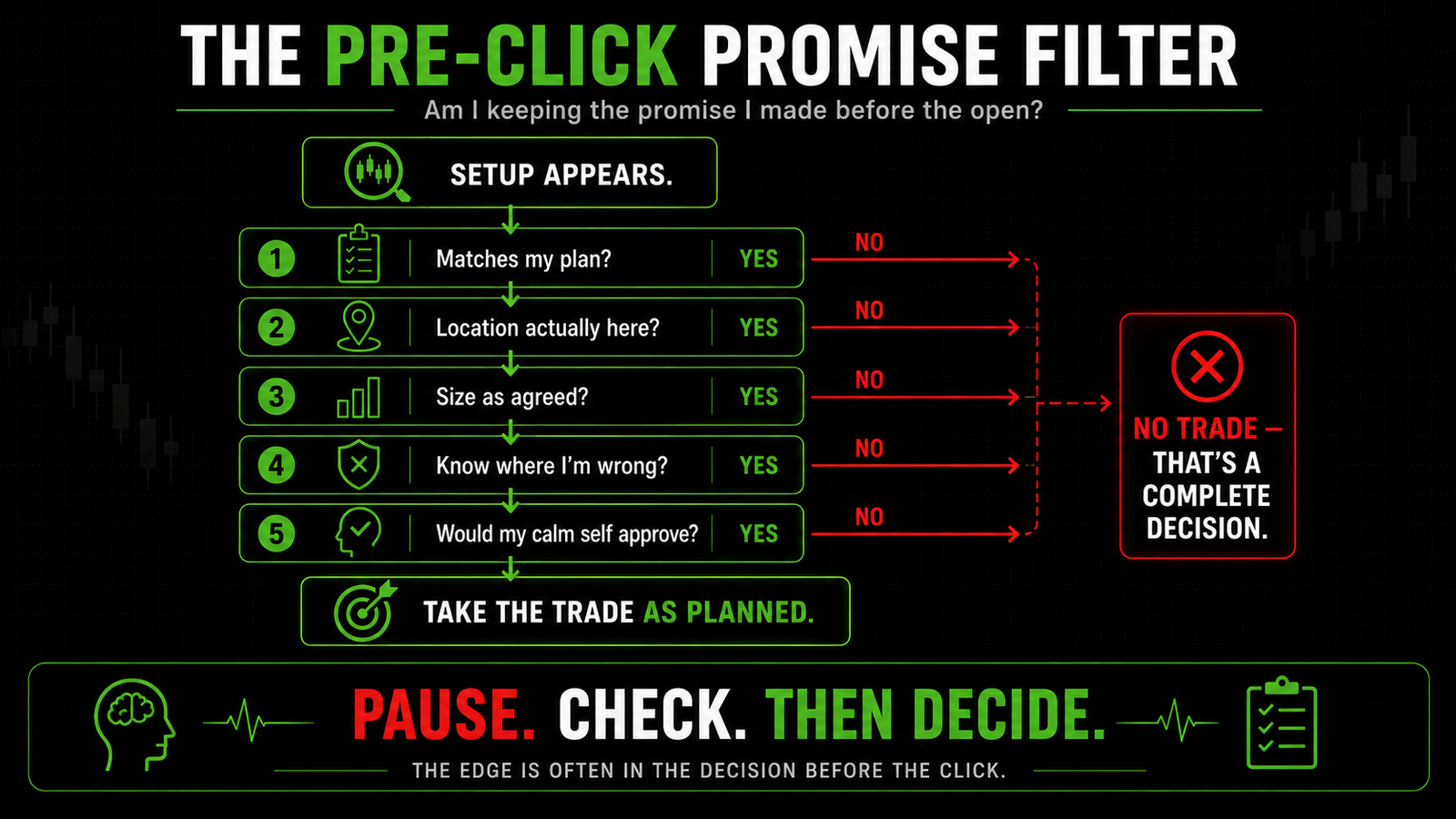
That last question is the most useful one we know. It puts the decision back in the hands of the trader who made the promise. The single best question a struggling trader can ask isn't "Will this work?" — nobody knows that. It's: "Am I keeping the promise I made before the open?" You can make that gate tangible when you use the free trading routine tools.
Final Thought
Writing a plan will never be your problem. Following it under pressure is the whole game. The market is not predictable, and no plan makes it so — a plan doesn't guarantee a good outcome on any single trade, and it isn't supposed to. What it does is keep your best thinking in charge when your worst instincts show up. That is how you protect your next decision.
So make the promise when you're calm, in writing, with clear conditions for location, context, size, and risk. Then treat the open as one long test of a single question: did I keep my word to myself? The traders who improve aren't the ones with the fanciest plans. They're the ones who made an honest promise and kept it. Patience before profit starts there.
That is why process beats prediction when the rules are clear.
The promise also has to fit the day you are trading, so it helps to know what a trading session actually is.
A complete plan must also define exposure before the session creates pressure.
Educational content only. Trading involves substantial risk and is not suitable for everyone.