
CPI and PPI are often described as though one is simply the retail version of the other. That shortcut helps with the basic distinction, but it becomes misleading when traders assume producer prices must flow directly into consumer prices. The indexes cover different transactions and can move in different directions for legitimate reasons. A cleaner process treats them as related evidence rather than interchangeable inflation readings. (bls.gov)
Inside The Market, traders are not evaluating the words “consumer inflation” or “producer inflation” in isolation. They are asking what each report changes about inflation persistence, Federal Reserve expectations, Treasury yields, the dollar, company margins, and the economic environment. The trader does not need to decide which report is permanently more important. The better question is which report is adding useful information to the inflation story markets are pricing now.
CPI Looks at Prices Paid by Consumers
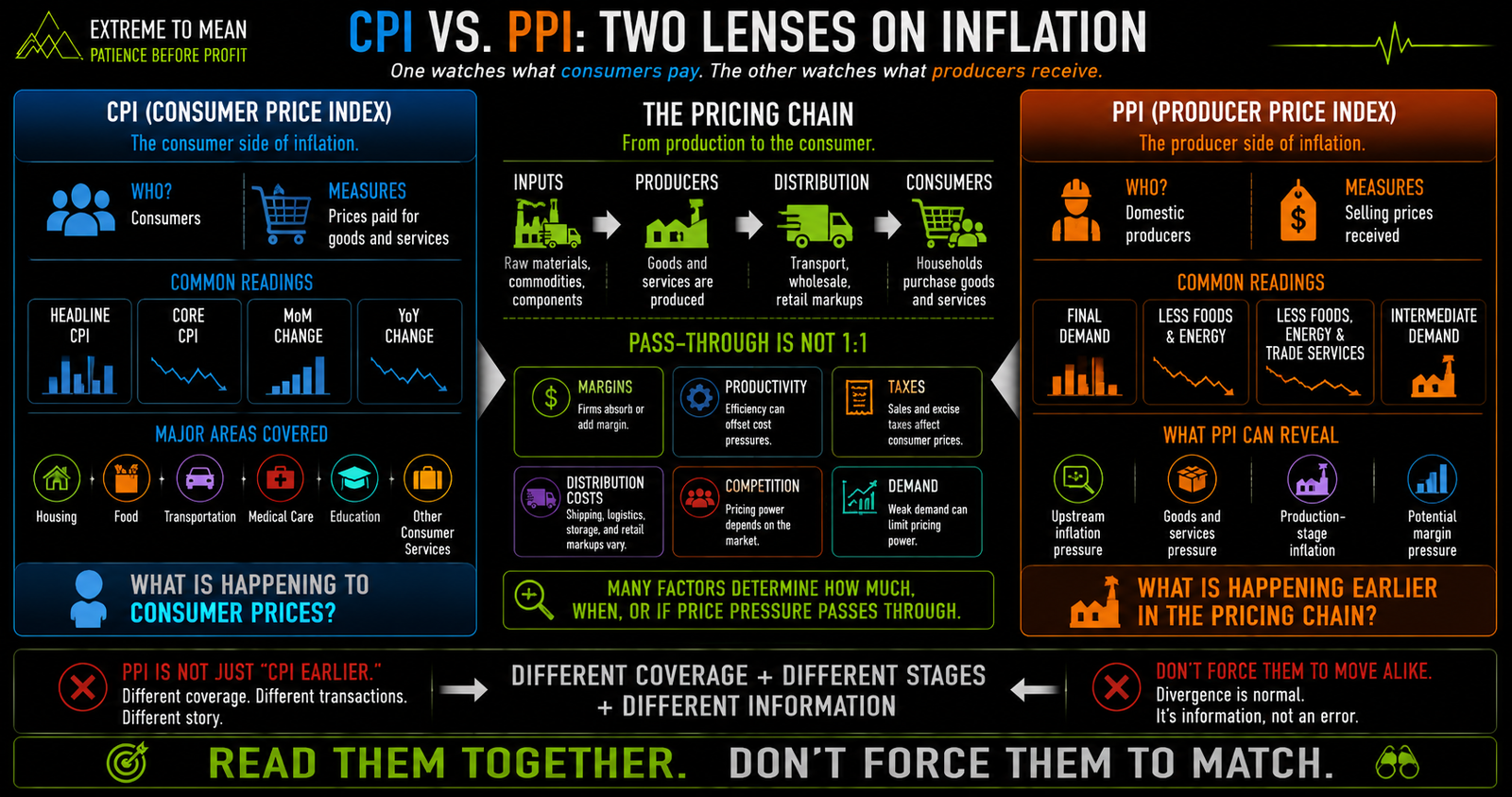
The Consumer Price Index measures the average change over time in prices paid by urban consumers for a representative basket of goods and services. It includes categories such as housing, food, transportation, and medical care. CPI therefore describes inflation from the purchaser’s side of the economy. That makes it intuitive because it connects closely with prices households experience. (bls.gov)
Headline CPI includes the full basket, while core CPI excludes food and energy to provide another view of underlying inflation pressure. Traders also compare month-over-month and year-over-year readings because one emphasizes recent movement while the other describes the broader 12-month change. Neither measure is automatically more useful in every environment. The practical question is which component is changing the market’s view of inflation persistence. (bls.gov)
PPI Looks at Prices Received by Producers
The Producer Price Index is a family of indexes measuring the average change over time in selling prices received by domestic producers for their output. BLS describes PPI as the seller-side perspective, in contrast with CPI’s purchaser-side perspective. The PPI system covers final demand and intermediate demand, allowing analysts to observe price changes at different stages of production. That makes it useful for studying inflation pressure before the consumer level. (bls.gov)
PPI has headline and underlying measures of its own. The widely followed headline is PPI for final demand, while BLS also publishes final demand excluding foods and energy and another measure excluding foods, energy, and trade services. Food, energy, and trade services have historically been volatile, which is why exclusion measures receive attention. Traders should therefore check which measure a source means when it casually says “core PPI.” (bls.gov)
Why CPI and PPI Can Diverge
CPI and PPI can move differently without either report being wrong. They cover different transactions and measure different points in the pricing chain. BLS notes that seller and purchaser prices can differ because of factors such as distribution costs, taxes, and subsidies. A change in prices received by producers therefore does not have to appear one-for-one in prices paid by consumers. (bls.gov)
Their baskets also differ materially. CPI includes consumer-facing categories such as rent, while PPI includes producer and intermediate-demand categories that do not map directly into the consumer basket. Commodity or energy moves can therefore push producer prices sharply while housing or consumer services dominate CPI. Divergence is not a contradiction to solve; it tells the trader where inflation pressure is concentrated. (bls.gov)
Producer Pressure Can Reach Consumers—or Margins
PPI is useful partly because its intermediate-demand system tracks price changes through stages of production. BLS says those measures can help assess whether inflation faced by producers at earlier stages is transmitted toward later stages and final demand. That does not mean higher PPI guarantees higher CPI later. Pass-through depends on demand, competition, contracts, productivity, inventories, and firms’ ability to absorb or pass along pressure. (bls.gov)
That creates an important margin question. If business input costs rise faster than the prices a company can charge, margins can come under pressure; if firms can pass more of the increase to customers, consumer prices may rise instead. Companies may also offset part of the pressure through efficiency, sourcing, or product mix. For equity traders, producer inflation can therefore matter through both the inflation channel and the earnings channel. This is a practical inference from the producer-to-final-demand transmission process rather than a claim that PPI mechanically determines margins. (bls.gov)
Why CPI Usually Gets More Immediate Attention
For stock-index futures, CPI generally gets more immediate focus because markets connect consumer inflation directly with the policy and inflation debate. Federal Reserve research has documented periods when investor attention to CPI surged and reactions in bond yields and other assets became much stronger. CME research on economic releases also shows substantial equity-index futures activity around inflation surprises, with core CPI particularly influential in its sample. CPI is therefore a major event even though the Fed’s formal 2% inflation objective uses PCE, not CPI. (federalreserve.gov)
PPI is usually secondary evidence, not irrelevant evidence. It can reinforce the CPI story, reveal upstream pressure, or challenge a clean disinflation narrative. Timing matters because PPI may arrive after markets have already built an inflation interpretation from CPI. “CPI matters more” should mean greater immediate attention, not permission to ignore PPI. BLS itself notes that producer-price measures can foreshadow later price changes for businesses and consumers. (bls.gov)
Both Reports Can Reprice Rates, the Dollar, and Equities
A hotter-than-expected CPI or PPI report can push traders toward a more restrictive expected Fed path if the surprise looks relevant to persistent inflation. A cooler report can support the opposite interpretation. Those changes can reach Treasury yields and equity valuations as expectations for future policy and discount rates change. The transmission is probabilistic rather than mechanical because every release lands inside an existing economic and positioning regime. (federalreserve.gov)
The same logic applies across NQ, ES, YM, and RTY. Higher yields can increase valuation pressure, while smaller companies can be sensitive to financing conditions and growth expectations. DXY may strengthen when U.S. rate expectations rise relative to other economies, but the dollar has other drivers. Context comes before the candle, and cross-asset disagreement is a reason to slow the decision down rather than force confirmation. (federalreserve.gov)
Commodities add another layer because energy, metals, and agricultural products can influence producer inflation. A commodity-driven PPI increase does not automatically mean broad consumer inflation is accelerating, especially when the pressure is concentrated. The composition therefore matters as much as the headline direction. Traders should ask what drove the surprise before assuming its policy implication. (bls.gov)
Reading CPI and PPI Together
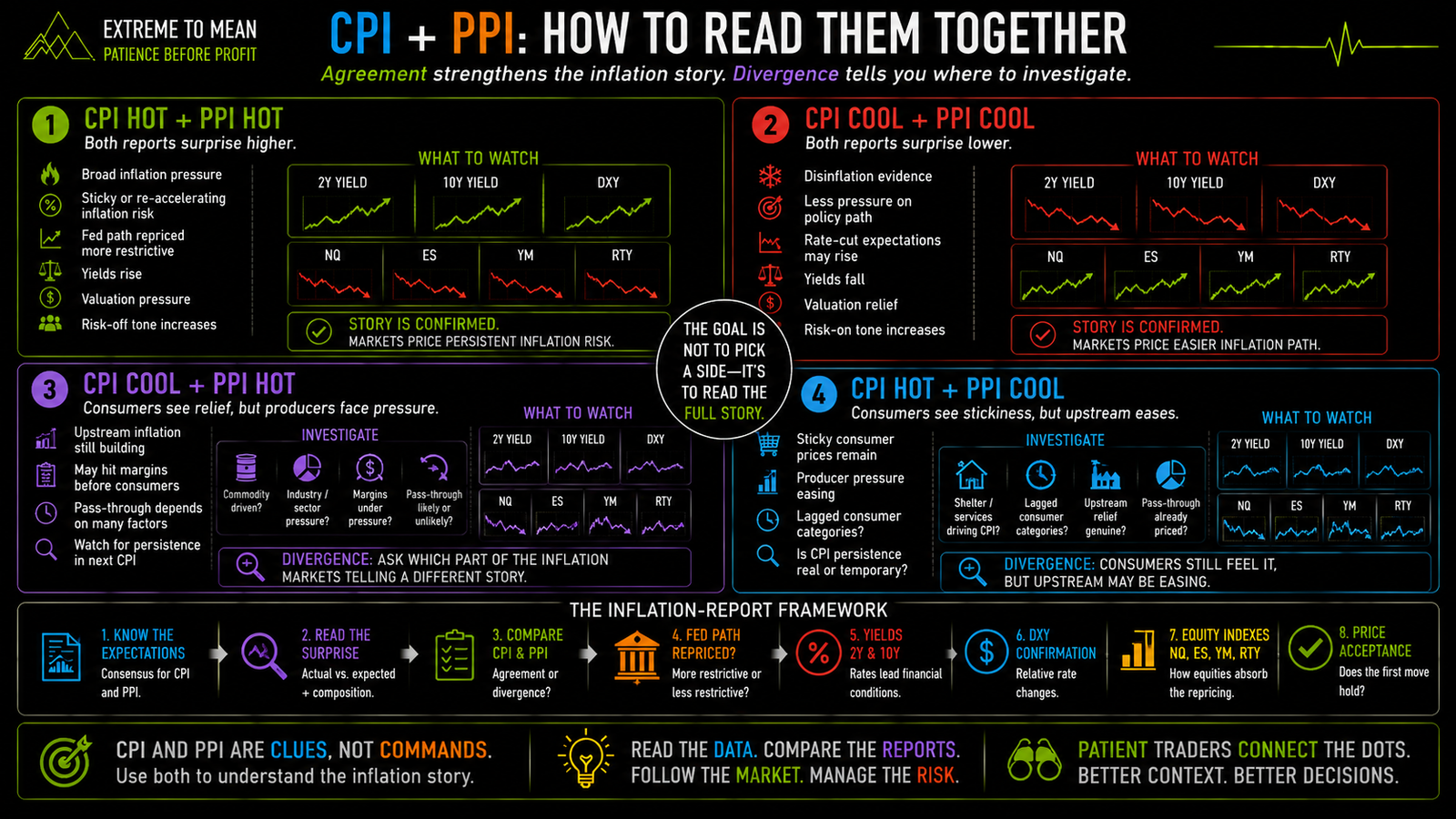
When CPI and PPI surprise in the same direction, the inflation narrative becomes more internally consistent. Hot readings in both can reinforce concern that price pressure remains broad or persistent, while cooler readings in both can strengthen a disinflation interpretation. Even then, yields, DXY, equity structure, and subsequent data still have to confirm the market story. Agreement improves the evidence; it does not guarantee the trade.
The more interesting cases occur when the reports diverge. Cooler CPI with hotter PPI may suggest consumer inflation is easing while producer pressure rebuilds, while hot CPI with cooler PPI may show sticky consumer inflation as upstream pressure moderates. Neither combination predicts the next CPI release automatically. Market conditions change the quality of a setup, so the trader should identify where the disagreement sits and wait for later evidence rather than force a simple forecast. (bls.gov)
A Cleaner Inflation-Report Process
Start with expectations, not the headline. Know consensus for headline and underlying readings, identify whether markets are especially sensitive to inflation or growth, and check the market calendar before the release. Then read the surprise and its composition rather than reducing the report to one hot-or-cool label. Preparation provides structure without requiring a prediction.
After the release, watch what actually reprices. Treasury yields, DXY, NQ, ES, YM, RTY, commodities, and breadth can show whether traders are treating the report as a meaningful change in the inflation path or a noisy data point. If CPI and PPI agree, look for cross-market confirmation; if they conflict, identify which part of the inflation chain is diverging. Patience means allowing the evidence to organize itself before forcing a trade.
Better Questions When CPI and PPI Disagree
A useful comparison begins by asking what each report measured and which components created the surprise. The objective is not to crown one index the winner. It is to determine whether consumer inflation, producer-side pressure, or both are changing in a way that matters to rates and equities. The better question is, “What part of the inflation process changed, and is the market treating that change as persistent?”
- Was CPI above, below, or near consensus?
- Was PPI above, below, or near consensus?
- Were headline and underlying readings telling the same story?
- Was the surprise concentrated in food, energy, trade services, commodities, or broader categories?
- Could producer-side pressure affect margins or later consumer prices?
- Are CPI and PPI confirming each other or diverging?
- Did the expected Fed path change?
- What did the 2-year and 10-year Treasury yields do?
- Did DXY confirm the rate move?
- How did NQ, ES, YM, and RTY absorb the information?
- Did commodities help explain the producer-price move?
- Is price accepting the first interpretation?
- Am I reacting to one inflation label or evaluating the full transmission?
These questions also improve review after the event. Instead of recording only that “inflation was hot,” the trader can document where the pressure appeared, whether CPI and PPI agreed, and whether cross-market behavior confirmed the first interpretation. Over time, that builds a more useful view of inflation regimes than memorizing one report-to-market relationship. The Macro Playbook is a natural next step for organizing inflation with yields, the dollar, labor data, growth, and financial conditions.
Final Thought
CPI and PPI measure different parts of the inflation process. CPI describes prices paid by consumers, while PPI describes selling prices received by domestic producers and provides visibility into final and intermediate demand. They can move together, but their coverage and position in the pricing chain are different enough that divergence is normal. PPI can inform the consumer-inflation story without becoming a guaranteed preview of CPI. (bls.gov)
For traders, CPI usually deserves more immediate attention while PPI adds confirmation, contradiction, and information about upstream pressure and margins. Read both relative to expectations, identify what drove the surprise, then watch Fed expectations, Treasury yields, DXY, equities, commodities, and price acceptance. The objective is not to decide which report always matters more. The trader’s job is to understand what each report adds to the inflation story markets are pricing now.
Educational content only. Trading involves substantial risk and is not suitable for everyone.