
One candle can look convincing. It can close strong, reject a level, break above a short-term line, or make the trade feel obvious in the moment. The Market lessons help traders step back before reacting to that apparent confirmation.
But one candle is not the market. It is only one moment inside a larger environment. Without context, a candle is just movement, and a setup is not a signal by itself.
A Candle Is Only One Piece of the Story
Every candle shows what happened during a specific period of time. Understanding what a candle actually represents matters, but it does not tell the whole story by itself.
A candle does not tell you whether the market is trending cleanly or chopping sideways. Understanding the three market states helps reveal whether price is stretched, balanced, or sitting in the middle and whether momentum is expanding, fading, or unstable.
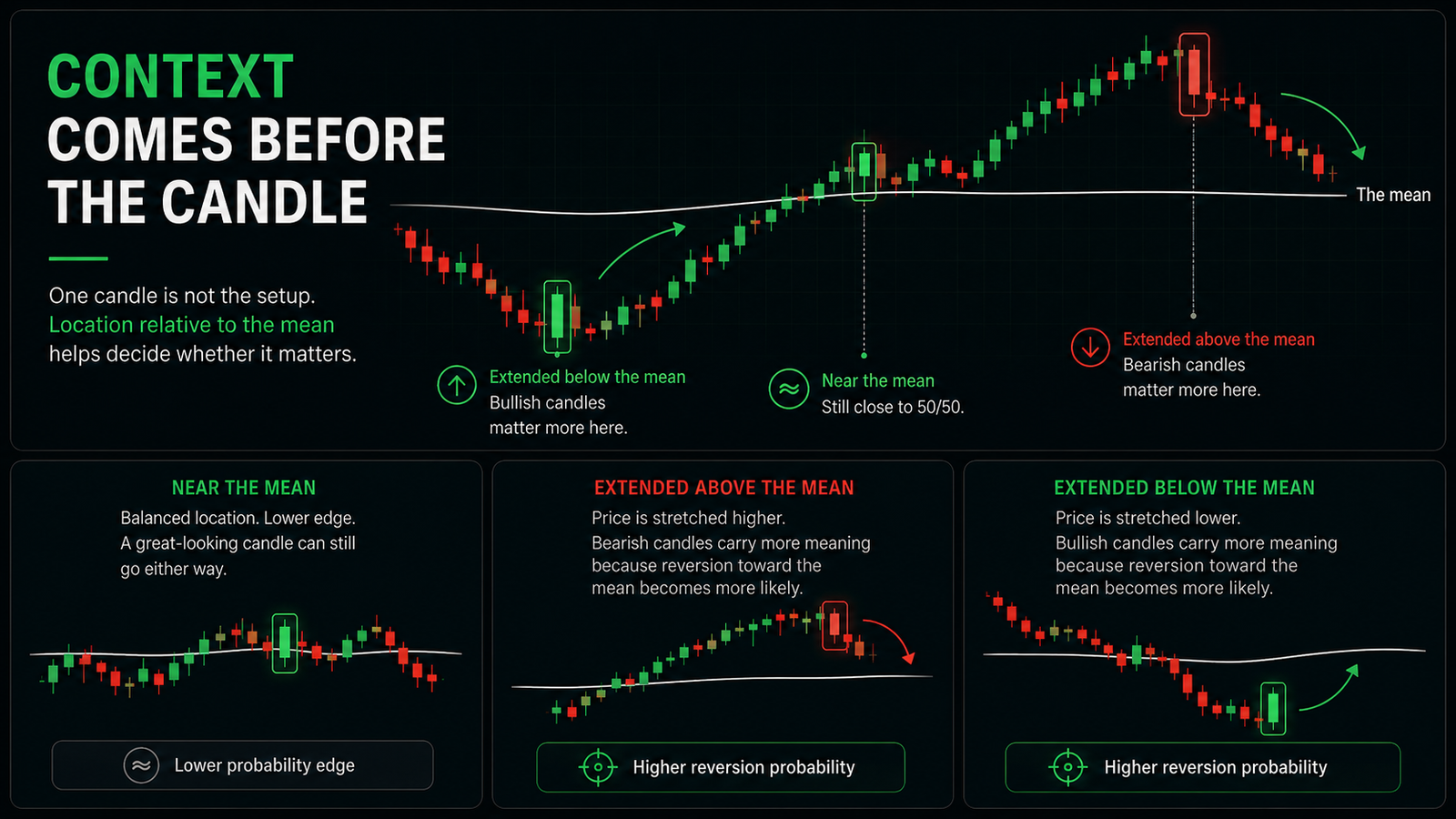
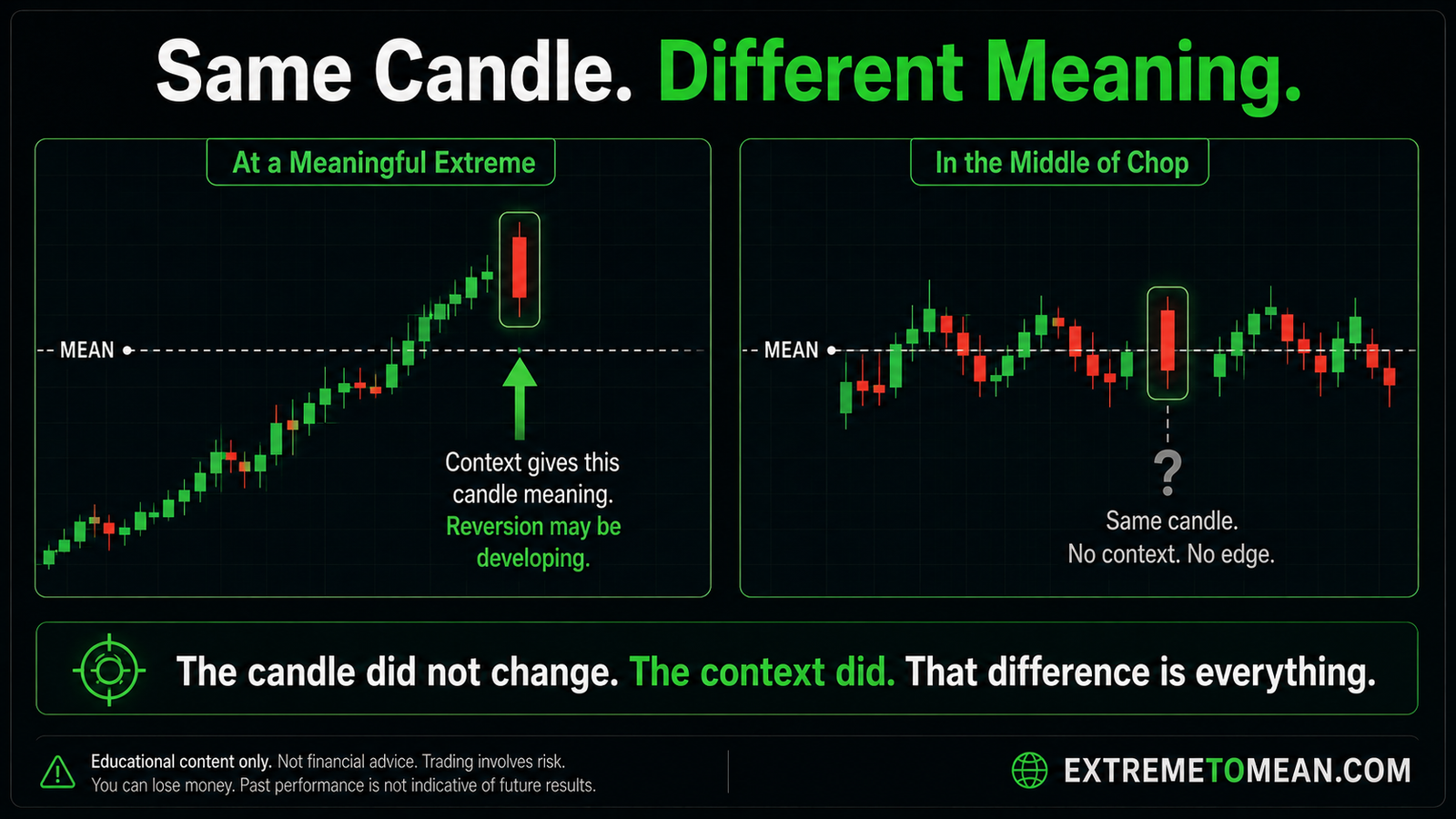
A strong candle near the beginning of a clean move may suggest pressure. The same type of candle after a long emotional push may suggest exhaustion. A rejection candle at a meaningful extreme may matter, while the same rejection candle in the middle of chop may mean very little. In other words, timeframe changes the context of a candle.
The candle did not change. The context did.
Why Traders React Too Quickly
Most traders want certainty. They want the market to give them one clean signal, one candle, one break, one rejection, or one pattern that tells them what to do.
That desire creates impatience. The trader sees movement and feels pressure to act before the opportunity disappears. The candle becomes the excuse. Instead of asking whether the setup is clean, the trader says, "That looks good enough."
That is usually where trouble starts. The entry may be late, the risk may be unclear, the target may be too close, or the trade may be sitting right in the middle where price has no real edge. At that point, the trader is no longer reading the market. They are reacting to one moment inside it.
Context Tells You Whether the Candle Matters
Before reacting to a candle, step back and remember that the market comes first.
Ask questions like:
- Is price stretched or balanced?
- Is the move extended or just beginning?
- Is momentum still pushing, or is it starting to fade?
- Is volatility calm, expanding, or erratic?
- Is the market trending, ranging, or chopping?
- Is price near an extreme, or sitting in the middle?
These questions help determine whether the candle deserves attention. At Extreme to Mean, the candle is never the starting point by itself. The starting point is context.
The candle may be the trigger, but context decides whether the trigger matters.
The Middle Creates False Signals
The middle is where candles become the most misleading. Price can bounce, reject, break, and reverse again, all while remaining inside a low-quality location. Every small move can look like it might be the start of something, but much of it is just noise.
That is why traders get chopped up in the middle. They mistake candles for confirmation when the location is not strong enough to support the trade. A candle in the middle may create activity, but that does not mean it creates opportunity.
The trader still needs a clear reason. Better location. Clearer risk. A logical path for the trade to work. A setup that fits the broader environment. Without those pieces, one candle is not enough.
Context Protects You From Bad Location
Bad trades often start with bad location. A trader sees a candle move fast and enters after the clean opportunity has already passed. The move may still continue, but the risk profile has already changed.
Now the stop feels too wide, the target feels too close, and every pullback feels threatening. That pressure does not come from the candle. It comes from entering without enough context.
When you read context first, you are less likely to chase. You are less likely to enter late. You are less likely to take a trade just because the market moved without you. Instead of asking, "Did that candle look good?" you begin asking, "Does this candle matter here?"
The Better Question
Before you take the next trade, ask one better question:
What is the context around this candle?
That question can slow down a lot of bad decisions because market conditions change the quality of a setup. A candle at a meaningful extreme with fading momentum may deserve attention, while one in the middle of chop may simply be noise.
The goal is not to ignore candles. The goal is to stop giving every candle the same importance, because the same candle does not create the same trade in every environment. A candle needs context before it becomes useful.
Final Thought
The market is always moving. There will always be a candle that looks interesting, a quick push that looks urgent, or a sharp rejection that tries to pull you in. But not every candle deserves your risk.
Context comes first. Location comes first. Risk comes first.
The candle can help confirm the idea, but it should not create the idea by itself. Read the environment first, then see how the TMT System organizes market context before deciding whether the candle matters.
That order is easier to keep when you remember that price action is not prediction.
Before interpreting a move, newer traders can also learn how a price chart organizes price over time.
That context becomes clearer when traders can recognize higher highs, lower lows, and broken trends.
The same framework explains why a break through liquidity still needs context.
Educational content only. Trading involves substantial risk and is not suitable for everyone.