A holiday session can be open, tradable and completely different from the market environment your normal strategy was built around.
“Open” is a trading status. It is not a promise of normal market conditions.
Futures traders often discover holiday schedules backward. The chart looks strange, volume disappears, price gaps, or the session ends early, and only then does the trader check the calendar. A better process begins by asking: before diagnosing strange price behavior, am I looking at a strange trading day? This belongs inside The Market because the trading calendar is part of market context, and a shortened session can change participation, depth, spreads and execution quality.
Holiday Futures Hours: Why “Open” Does Not Mean Normal
There is no single holiday closing time for “futures.” CME Group lists many product families, and holiday treatment can differ by product, venue, date and trade date. HOLIDAY DATE ≠ UNIVERSAL FUTURES CLOSE, so a holiday name alone is not enough to build the plan.
That is why “What time does CME close for Thanksgiving?” is still too broad. The useful question is “What are the official holiday hours for the exact product I trade?” ES, NQ, CL, GC, ZN and agricultural contracts can have different holiday treatment, so verify the product rather than the holiday in general.
Holiday schedules also use specific time zones. CME states that its Globex trading-hours information is in U.S. Central Time unless otherwise stated, which matters for traders planning in Eastern Time. A correct closing time in the wrong time zone is still the wrong trading plan.
Start With the Official Exchange Calendar
Search results and broker notices can alert you that a holiday schedule exists, but the exchange should confirm the schedule for an exchange-listed contract. CME's holiday page provides the product-level Globex schedule and notes that holiday hours are subject to change and are usually finalized roughly two weeks before the holiday. The checking process should therefore remain evergreen even when the exact calendar changes.
This is one reason context comes before the candle. If the calendar says the session is shortened or otherwise modified, the trader already knows that ordinary volume, opening-range, session-range and time-of-day comparisons may need context. An indicator can look statistically unusual while the calendar makes the behavior unsurprising.
Trading, Cash-Market and Settlement Times Are Different Clocks
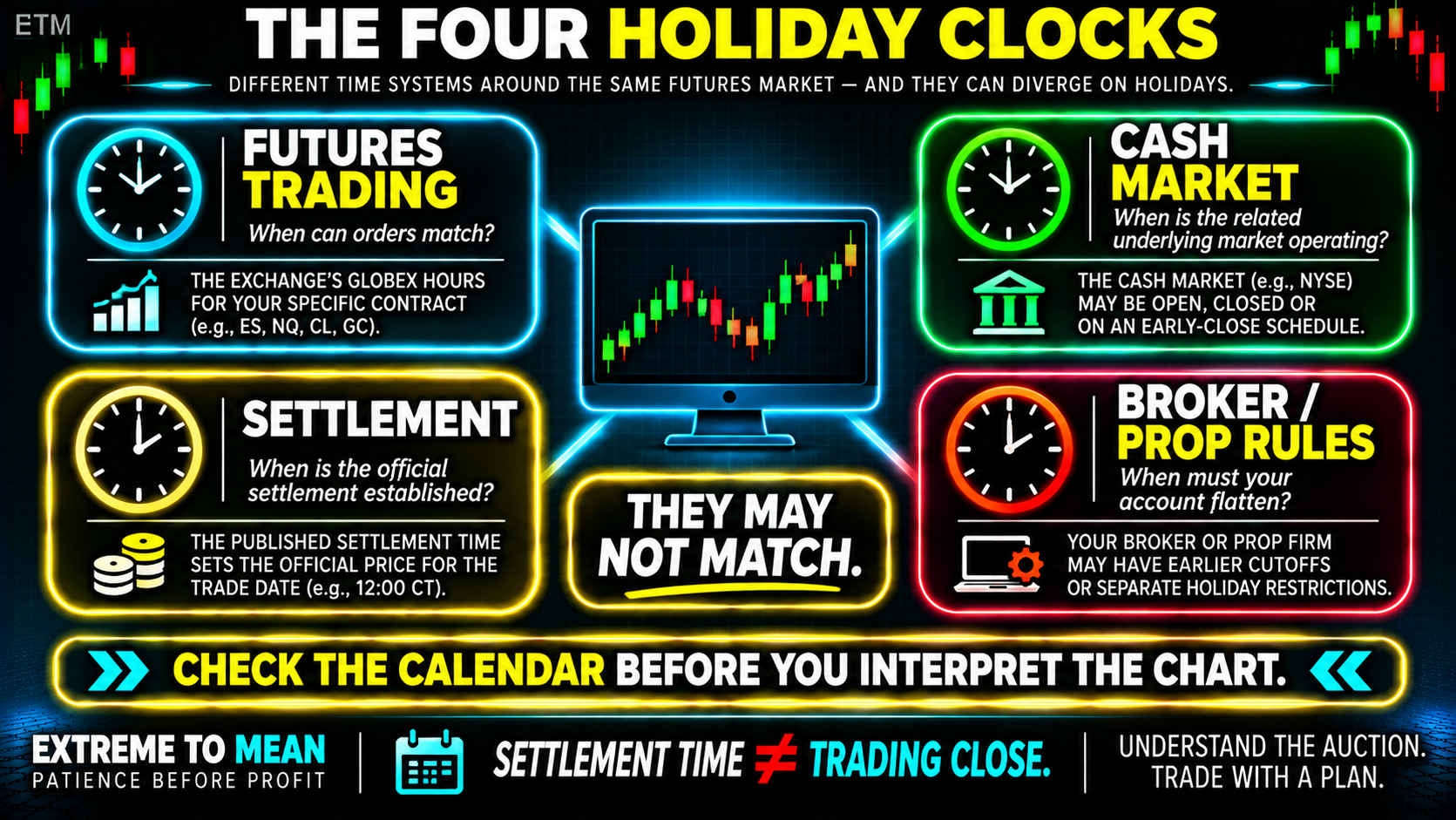
Holiday schedules become confusing when traders treat every published time as though it means “the market closes here.” It does not. Futures trading hours tell you when orders can match, cash-market hours tell you when a related underlying market is operating, and settlement time tells you when an official settlement is established.
For equity-index traders, those clocks can diverge. ES or NQ may be trading while the NYSE cash market is closed or shortened, which changes the participation ecosystem without making the futures price invalid. SETTLEMENT TIME ≠ TRADING CLOSE. There is often a fourth clock as well: the broker or prop firm's own rules, which may impose earlier flattening deadlines or separate holiday restrictions. EXCHANGE HOURS ≠ BROKER / PROP RULES.
Thanksgiving 2026: What We Know and What Still Needs Checking
For the upcoming U.S. Thanksgiving period, Thanksgiving Day is Thursday, November 26, 2026, and CME currently identifies a Globex holiday window spanning November 26 through November 28. CME says holiday hours remain subject to change and are usually finalized near the holiday. That is why this page should teach a verification process rather than freeze one number into the article.
CME's current Thanksgiving settlement notice says that on Friday, November 27, equity and crypto, interest-rate and FX products have a 12:00 p.m. CT settlement time, while metals and energy retain normal settlement schedules. That 12:00 CT figure is a settlement time, not permission to assume every related futures contract has a 12:00 CT Globex close. The product-level Globex table remains the source for the actual trading close and reopen.
The cash market has its own schedule: NYSE currently lists Friday, November 27 as an early-close day, with core markets closing at 1:00 p.m. ET. CME's holiday notes also show that day orders entered after the relevant pre-open on Wednesday, November 25 are for the Friday trade date and can continue until that product's Friday Globex close. Holiday preparation is therefore a calendar problem before it becomes a chart problem.
What Holiday Sessions Can Change About Liquidity and Execution
Holiday sessions should not be described as automatically illiquid, quiet or volatile. Participation is often different around major holidays, but the actual condition still has to be observed in the product and time window being traded. MARKET OPEN ≠ NORMAL PARTICIPATION. When depth declines or spreads widen, the same order can face worse slippage or materially different economics. A familiar setup can produce unfamiliar execution when the liquidity behind it changes.
Lower participation can also create opposite-looking effects. The market may move slowly inside a narrow range, or relatively modest flow may move price abruptly because there is less depth available. LOW ACTIVITY ≠ LOW RISK, and quiet is not the same thing as safe.
This is why market conditions change the quality of a setup. The level can be identical to yesterday's level while the participation defending, attacking or trading through it is very different. The setup must earn risk again inside the actual holiday environment.
Normal Setups Need Fresh Qualification
A shortened session can distort normal statistics before it changes the visual pattern itself. Comparing total holiday volume with a full normal session, for example, may simply compare fewer available trading hours with more available trading hours. Compare like with like before labeling holiday activity abnormal.
The same applies to support, resistance, opening ranges and time-of-day expectations. A level may look identical while attracting fewer participants in the holiday session. SAME CHART ≠ SAME MARKET ENVIRONMENT. Do not respond by arbitrarily widening stops or automatically cutting size in half; if volatility, depth or execution quality has changed, possible decisions include reducing exposure, demanding stronger qualification, waiting, or passing. Adjust the decision to the environment rather than forcing the environment to fit the normal plan.
Gaps and Holiday Closures
A chart gap around a holiday can occur because matching stopped or paused while information and price discovery continued elsewhere. News, related markets or changing expectations can move while the futures contract is unavailable, allowing the next tradable price to appear somewhere different from the prior close. A chart gap can reflect missing tradable time—not missing market information.
That explanation says how the gap may have formed; it does not predict what happens next. A holiday reopen can fill, partially fill or continue away, so HOLIDAY GAP ≠ GUARANTEED GAP FILL. The trader still has to evaluate current structure and conditions rather than converting the existence of a gap into a mean-reversion signal.
A position held through a closure or long pause also carries a different risk profile from continuously tradable exposure. Stops cannot execute at prices where the market is not matching, so the eventual exit may occur after reopening at another price. That risk should be considered before the closure, not discovered afterward.
Early Closes Can Create Artificial Urgency
Knowing that the session ends early can create an emotional deadline that does not exist in the setup. A trader may think, “This is my last chance today,” even while the market is offering less opportunity and worse execution. That pressure is exactly where three market states and broader context work matter: the trader still has to identify what environment actually exists. A shortened schedule does not lower the standard required for a trade, so AVAILABLE SESSION ≠ REQUIRED TRADE.
The Holiday Trading Checklist
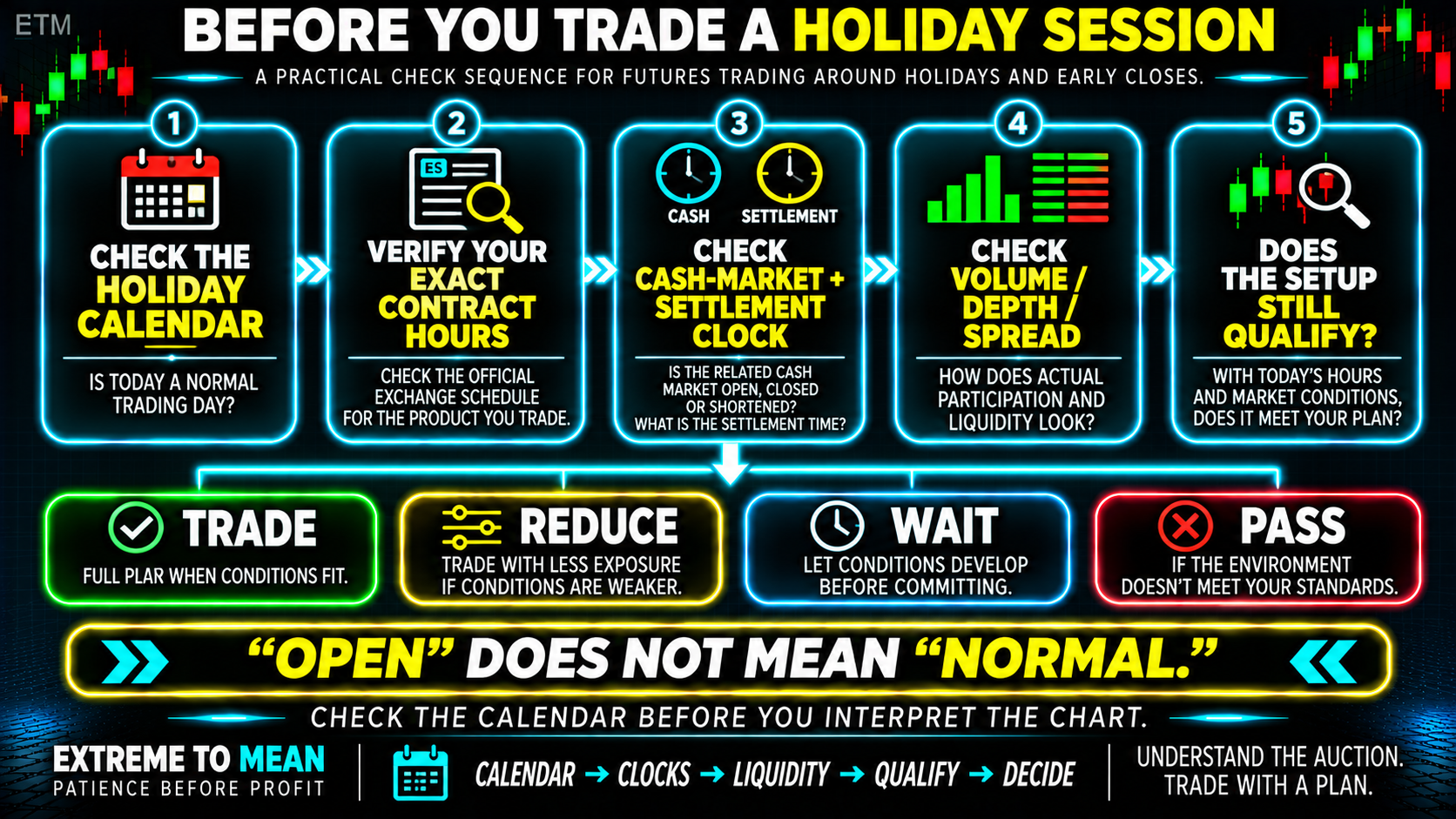
Before trading around a major holiday, run the calendar and market-quality checks before looking for entries. The goal is not to predict that the session will be poor; it is to verify whether the environment still deserves normal risk. Ask:
- Is this a normal trading day?
- What are the official exchange hours for my exact contract?
- Which time zone is the exchange schedule using?
- Am I looking at a trading close or a settlement time?
- Is the related cash market open, closed or shortened?
- What do actual volume, depth and spread look like?
- Does my setup have evidence in this type of session?
- Will the position remain open through a closure or long pause?
- Does my broker or prop provider impose a separate flattening rule?
- If the session is abnormal, do I have a compelling reason to trade at all?
The checklist prevents the trader from treating a calendar exception as though it were merely a shorter normal day. It also makes PASS an explicit outcome rather than a failure to participate. The holiday calendar creates a session; it does not create an obligation to trade it.
The ETM Calendar → Clocks → Liquidity → Qualify → Decide Framework
Use CALENDAR → CLOCKS → LIQUIDITY → QUALIFY → DECIDE. CALENDAR asks whether today is operating normally; CLOCKS separates futures trading, the related cash market, settlement and any broker or prop deadline. LIQUIDITY checks actual market quality, QUALIFY asks whether the setup still meets the normal evidence standard, and DECIDE means TRADE / REDUCE / WAIT / PASS. The ETM market calendar can support preparation, but the exchange remains the source of truth for exact contract holiday hours. Adjust the decision to the environment—do not force the environment to fit the normal plan.
Final Thought
Holiday futures sessions are not simply ordinary trading days with a different closing bell. Exact schedules vary by product and date, settlement times are not necessarily trading closes, related cash-market schedules can change, and brokers or prop firms may add their own restrictions. Start with the exchange calendar and verify the exact product, time zone and clocks that matter.
Then inspect the market itself. Participation, depth, volume, spreads and execution quality may differ, so a familiar pattern does not automatically deserve normal-session confidence. If a position will remain open through a closure, account for the possibility that price reopens elsewhere rather than trading through every level. The point is not that holiday trading is always bad or that traders should always reduce size; it is that an abnormal calendar deserves a fresh qualification decision. Verify the clocks, inspect the liquidity, and let the market earn the risk again.
Educational content only. Trading involves substantial risk and is not suitable for everyone.