
Markets move, pause, and pull back. That cycle repeats endlessly across every timeframe and every instrument. But many traders approach the market with a single strategy and expect it to work regardless of conditions. That is where the breakdown begins because market conditions change the quality of a setup. A trend-following approach that works well in a strong directional move will get cut apart in a sideways, noisy market. A reversion trade that makes sense after a large move looks reckless if the market is actually building momentum in one direction.
Tide, Waves, and Ripples explains why a state can look different across nested trading horizons.
Understanding the three market states is not about predicting what comes next. The Market lessons help traders describe what is happening right now so they can decide whether their approach belongs in this environment.
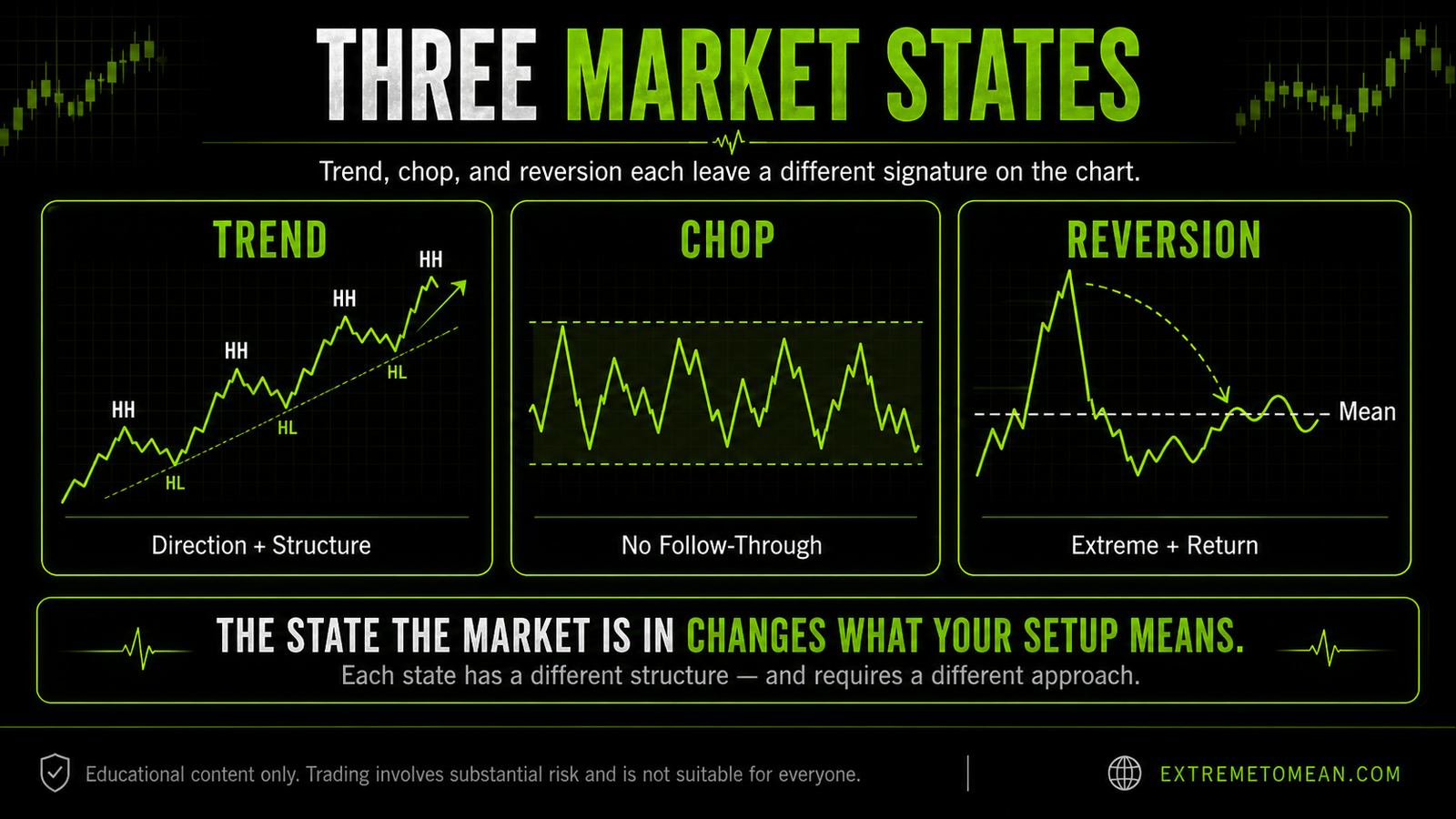
What a Trending Market Looks Like
A trending market has direction and momentum. Price makes a series of higher highs and higher lows in an uptrend, or lower lows and lower highs in a downtrend. Pullbacks are relatively contained, and the dominant side consistently reasserts control after each pause.
What makes trend tricky is that it feels obvious in hindsight and ambiguous in real time. Midway through a trend, many moves look like reversals before resuming. This is why patience matters and why reversion is not reversal. A trend is confirmed by structure — not just by the fact that price moved quickly in one direction.
In a trending market, the trader's job is to identify the dominant direction and look for opportunities to participate with that trend, not against it. Countertrend trades in a strong trend are lower-probability and carry more exposure to being wrong in a hurry.
What Chop Looks Like
Chop is a range-bound, back-and-forth market with no clear directional bias. In the language of Auction Market Theory, the market is repeatedly returning toward balance instead of sustaining imbalance. Price moves up, fails to hold, drops, fails to hold lower, and repeats. There is no follow-through in either direction. Volume is often inconsistent, signals flip frequently, and both buyers and sellers get stopped out.
Chop is the most dangerous state for active traders because it generates the most setups while delivering the least follow-through. It looks like opportunity from the outside. Entries trigger. Targets don't hit. Stops get clipped. The market is not building anything — it is burning time and capital.
The honest diagnosis when you are in a choppy market is this: there is no edge right now. The guide to recognizing conditions that are not worth trading turns that observation into a structured stand-aside decision. The correct decision is often to do nothing. That requires a different kind of discipline than pulling the trigger — it requires the patience to wait for a state that favors your approach.
What Reversion Looks Like
Reversion — or reversion to mean — describes a market that has moved to an extreme in one direction and begins to return toward a central zone of value. Price has stretched. Momentum often shows signs of exhaustion. The move may not be fully over, but the risk-to-reward of continuing in the original direction starts to deteriorate.
Reversion setups require two things to be present: location and context. Location means price has actually reached a meaningful extreme — not just pulled back a little, but moved far enough from equilibrium that a return is logical. Context means the broader market structure supports the idea that this extreme is temporary.
Without both, you are not trading reversion. You are guessing at a turning point.
Why Traders Get the State Wrong
The most common error is applying a strategy to a mismatched state. This happens for a predictable reason: each state tends to look like a different state at the edge.
A trending market after a sharp move looks extended — traders expect reversion and miss continuation. A choppy market that makes one clean directional push looks like the start of a trend — traders buy or sell the breakout and get whipsawed when it fades. A reversion setup loading at an extreme looks like the beginning of a larger breakdown — traders hesitate, or worse, trade with the extreme move just as the reversal begins.
The state you see also depends on the timeframe you are looking at and how much of the structure is visible. Zooming out often resolves the ambiguity because context comes before the candle. A market that looks like a trend on a 3-minute chart may be clearly in chop on a 15-minute chart.
The Better Question to Ask Before You Act
Before placing any trade, remember that the market comes first. Ask: what state is this market in right now, and does my setup belong here?
A few questions that help answer it:
- Is price making a clear series of directional highs and lows, or bouncing back and forth without follow-through?
- Has price reached a meaningful extreme, or is it just "off the recent high by a little"?
- Do moves in one direction hold, or does each push fade quickly?
- What does the higher timeframe structure say about the current environment?
- Does my strategy type — trend participation, range trading, or reversion — match what I am seeing?
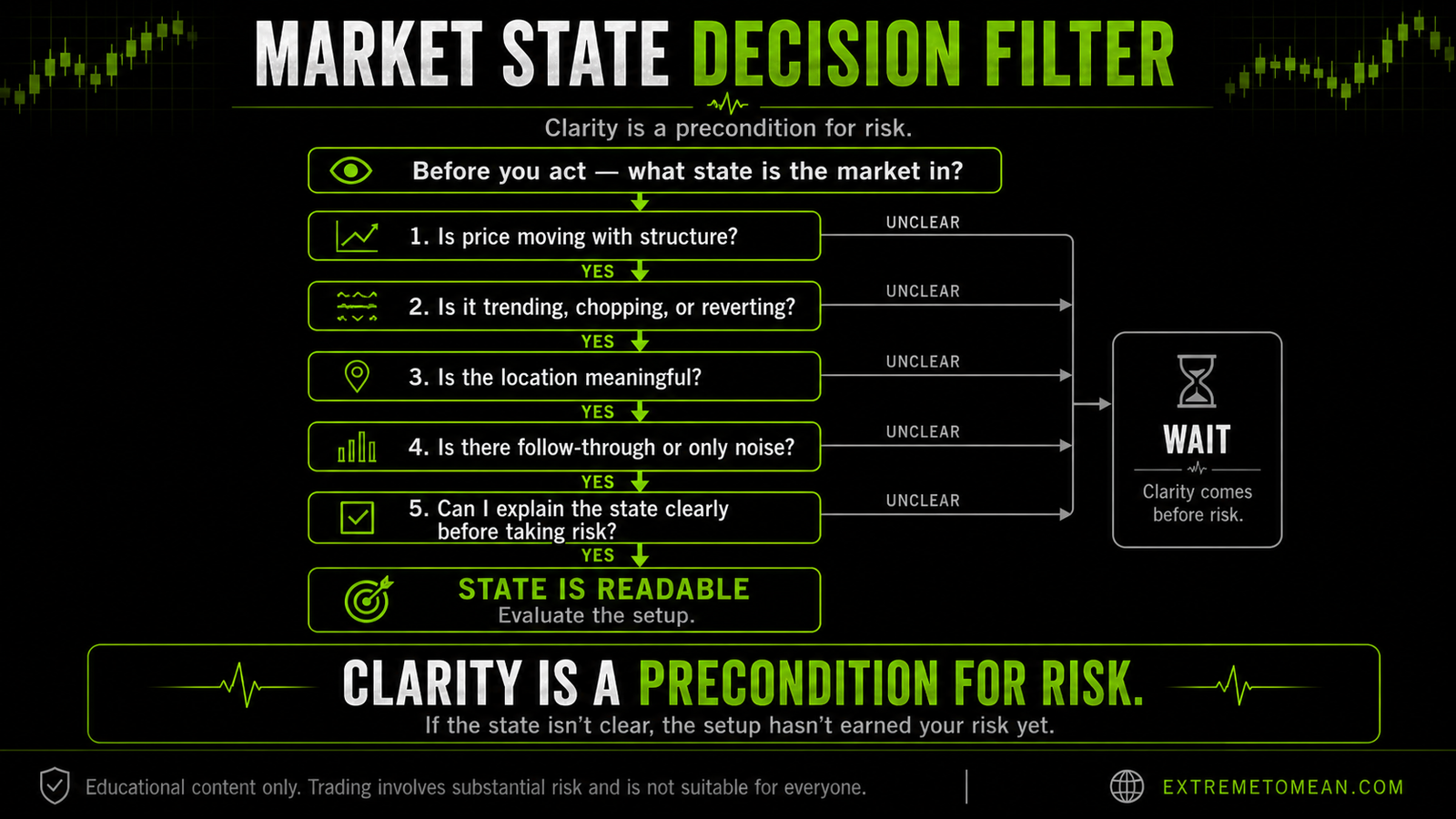
If the answers are unclear or contradictory, that is information, not a signal. Clarity is a precondition for risk. If you cannot describe the current market state with reasonable confidence, the right response is to wait — not to act on the uncertainty.
Final Thought
The market is always doing something. Your job is not to predict what it will do next — it is to read what it is doing now and decide whether your approach fits that environment. Trend, chop, and reversion are not just academic labels. They are the first filter. Before a setup earns your attention, the state has to make sense for the strategy. Traders can prepare with the Macro Playbook when broader context is needed.
The distinction between a market state and a directional style is clearer when you understand mean reversion versus momentum across different horizons.
It is also clearer when you understand why the same setup means something different in each market state.
In chop especially, it helps to understand how volume and liquidity shape trading conditions.
Start with how structure helps identify trend behavior.
Then learn how support and resistance behave differently across market states.
For a closer look at how these states connect to a repeatable cycle, see accumulation, markup, distribution, and markdown.
The behaviors underneath trend, chop, and reversion are broken down further in trend, momentum, exhaustion, and range expansion.
At the session level, the distinction becomes more concrete in the comparison between trend days and range days.
Traders who want to study continuation in more depth can follow with the structure-first introduction to trend trading.
Educational content only. Trading involves substantial risk and is not suitable for everyone.