
A no-trade checklist is not about becoming afraid of the market or finding excuses to sit out. It is a way to identify conditions you already know make clean execution less likely or make your strategy poorly suited to what is happening. The decision to stand aside becomes part of the process instead of a vague feeling you negotiate with after the market gets interesting.
That makes P080 a natural part of the broader Trader curriculum. The goal is not to eliminate judgment but to define enough boundaries that poor readiness, bad conditions, or an absent setup do not have to become live arguments. Define the reasons not to trade before you start looking for reasons to trade.
Most Traders Have Entry Rules but No Rules for Standing Aside
A trader might have detailed entry criteria, risk rules, and a favorite setup but nothing that answers a more basic question: should I participate at all? When there is no negative filter, opening the chart effectively makes trading the default. The trader may still need to find an entry, but psychologically the search has already begun.
That matters because enough screen time can make mediocre opportunities look better. If you stare at a slow, overlapping market for twenty minutes while expecting to trade, something that was clearly uninteresting at the open can gradually become “good enough.” The standards did not improve; exposure to the chart changed how badly you wanted something to happen.
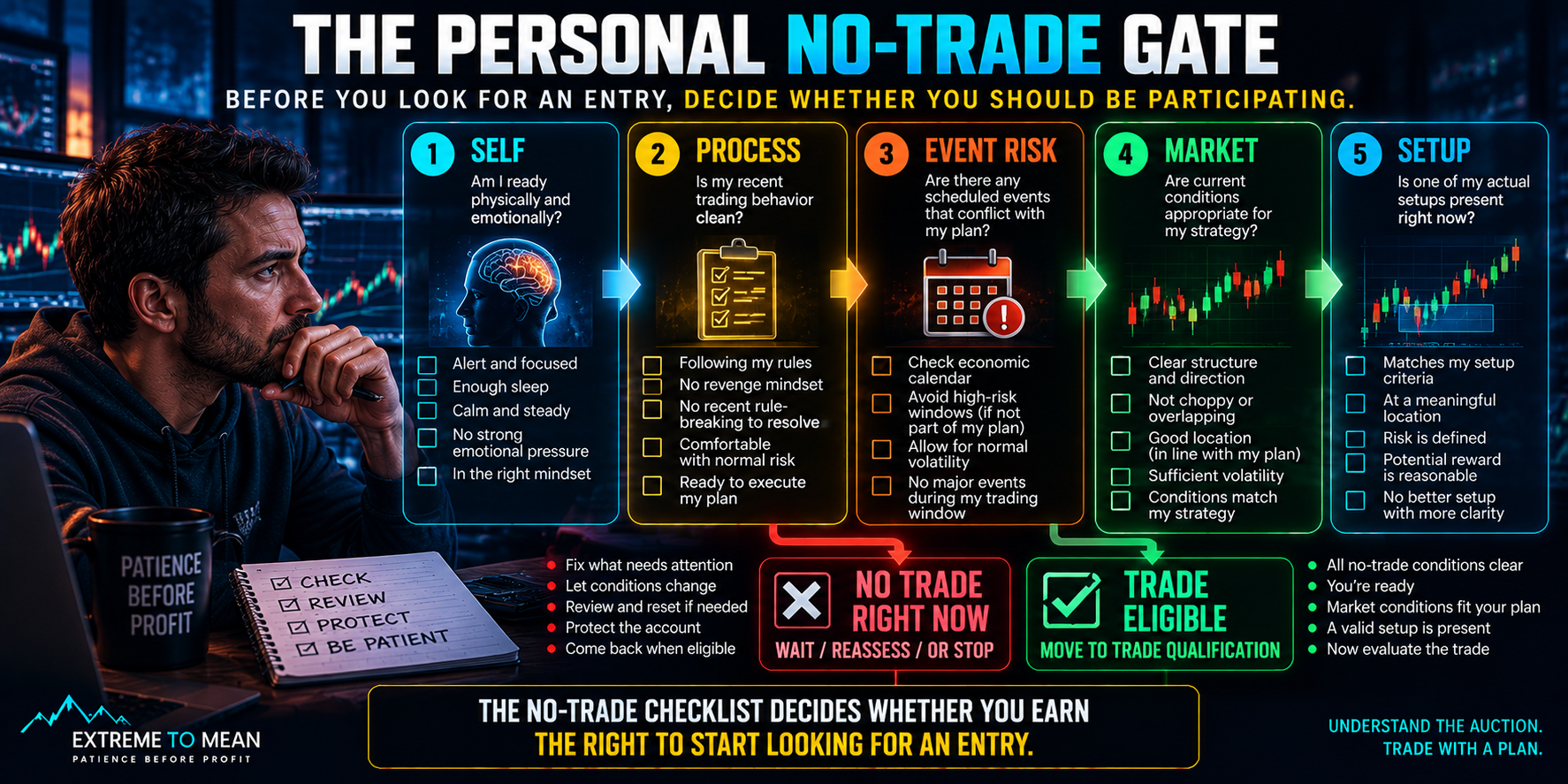
A no-trade checklist changes the default. Instead of assuming participation and then searching for permission to enter, you first determine whether anything currently removes or delays trading eligibility. Only after that gate is passed do you begin normal trade qualification.
A No-Trade Checklist Comes Before the Trade Checklist
A normal trade checklist asks whether a specific opportunity qualifies. Does the setup match the plan, is the location meaningful, is risk defined, and is there enough room for the idea to work? Those are important questions, but they assume you have already earned the right to evaluate an entry.
A no-trade checklist asks an earlier question: Should I even be looking for an opportunity right now? That makes it different from a checklist designed to approve a setup. One filters participation; the other filters trades.
This also extends the principle that a trading plan should govern decisions before pressure arrives. You should not have to invent the reasons to stand aside after FOMO, frustration, or boredom has already made participation feel important. The no-trade standard should exist before you need permission to ignore it.
Start With the Trader: Am I Ready to Make Clean Decisions?
The first filter is not the chart. It is the person operating it. A perfectly tradable market can still be a poor environment for you personally if you are not capable of executing your normal process today.
That does not require universal rules such as a fixed number of hours of sleep or a blanket ban after a losing day. The practical question is simpler: Am I alert and steady enough to execute the process I normally expect from myself? Fatigue, unusual personal stress, intense frustration, or strong emotional pressure can all be personal warning signs without becoming universal trading laws.
Pay particular attention to the objective inside your head. Thoughts such as “I need to make back yesterday,” “I need a green day,” “I missed the last move,” or “I need to prove I can do this” are not market information. They are signals that a trade may be getting assigned the job of producing emotional relief.
Then Check the Market: Are Conditions Worth Trading?
A trader can be completely ready while the market offers nothing useful. That is why the second half of the checklist has to evaluate the environment rather than only the trader. Personal readiness cannot rescue conditions that do not fit what you trade.
You do not need to recreate an entire market-state lesson inside the checklist. Instead, define the environments you already know your strategy handles poorly: perhaps repeated failed breaks, heavy overlap, weak follow-through, unclear structure, price sitting in the middle, or conflicting evidence. Market conditions change the quality of a setup, so the same visual pattern may deserve different treatment depending on the environment around it.
Scheduled event risk belongs here as well, but it should remain personal to the strategy. Some approaches deliberately operate around high volatility while others intentionally avoid it. The correct question is not “Is news dangerous?” but “Does this event create conditions outside what my plan is designed to trade?”
Recent Rule-Breaking Is a Reason to Reset
Yesterday ending does not automatically erase yesterday’s behavior. If you chased, ignored a stop, exceeded a personal risk boundary, revenge traded, or repeatedly violated your plan, simply waking up the next morning does not prove the issue has been addressed. A new session should not automatically become permission to repeat an unresolved process problem.
This does not mean every mistake requires a mandatory day off. A cleaner rule may be that normal participation does not resume until the trader has reviewed what happened and can clearly state what needs to change. The principle is reset before repetition, not punishment after an error.
This is one reason written standards matter. If recent behavior shows that you are currently unable or unwilling to operate inside your process, the no-trade checklist can make that visible before another setup appears. The purpose is not shame; it is protecting the next decision from a problem that is still active.
No Setup Is a Complete Reason Not to Trade
One of the most important no-trade conditions requires no fatigue, emotional problem, recent mistake, ugly market, or scheduled event. Sometimes you are ready, the platform works, risk is clear, and the market is functioning normally. Your setup simply is not there.
That should be enough. The absence of your setup does not require another reason to stand aside, yet traders often feel as though they need a stronger justification for doing nothing. They keep watching until familiarity with the price action begins turning a mediocre idea into something they can rationalize.
This is where doing nothing is still a trading decision becomes operational rather than philosophical. No qualified setup means there is currently nothing to execute. You do not need to replace the missing setup with a weaker one simply because you came prepared to trade.
Consider a trader who wakes up feeling normal, has no unresolved emotional issue, has reviewed recent behavior, and sees no problematic event risk. Trader readiness passes, but price is sitting near the middle of an established range, movement is overlapping, several breaks have failed, and no approved setup is present. Without a no-trade gate the trader thinks, “I’ll watch for a few minutes,” but with the checklist the answer is simply NO TRADE YET.
Hard Stops vs. Wait-and-Reassess Conditions
This distinction keeps a no-trade checklist from becoming unnecessarily rigid. Not every failed item should mean shutting the platform for the rest of the day. Some conditions remove eligibility for the session, while others simply mean conditions have not earned participation yet.
A hard stop is a personally defined condition that ends or prevents participation for that session. Examples might include a personal risk limit already being reached, inability to focus well enough to execute normally, a serious unresolved rule violation, an account or platform restriction, or another condition your own plan explicitly defines as disqualifying. These are boundaries you decide in advance rather than improvise after you want another trade.
A wait-and-reassess condition is different because it can change. Chop can resolve, price can leave the middle, an event window can pass, a meaningful location can develop, or your setup can finally appear. The answer is NO TRADE NOW, not necessarily NO TRADE TODAY.
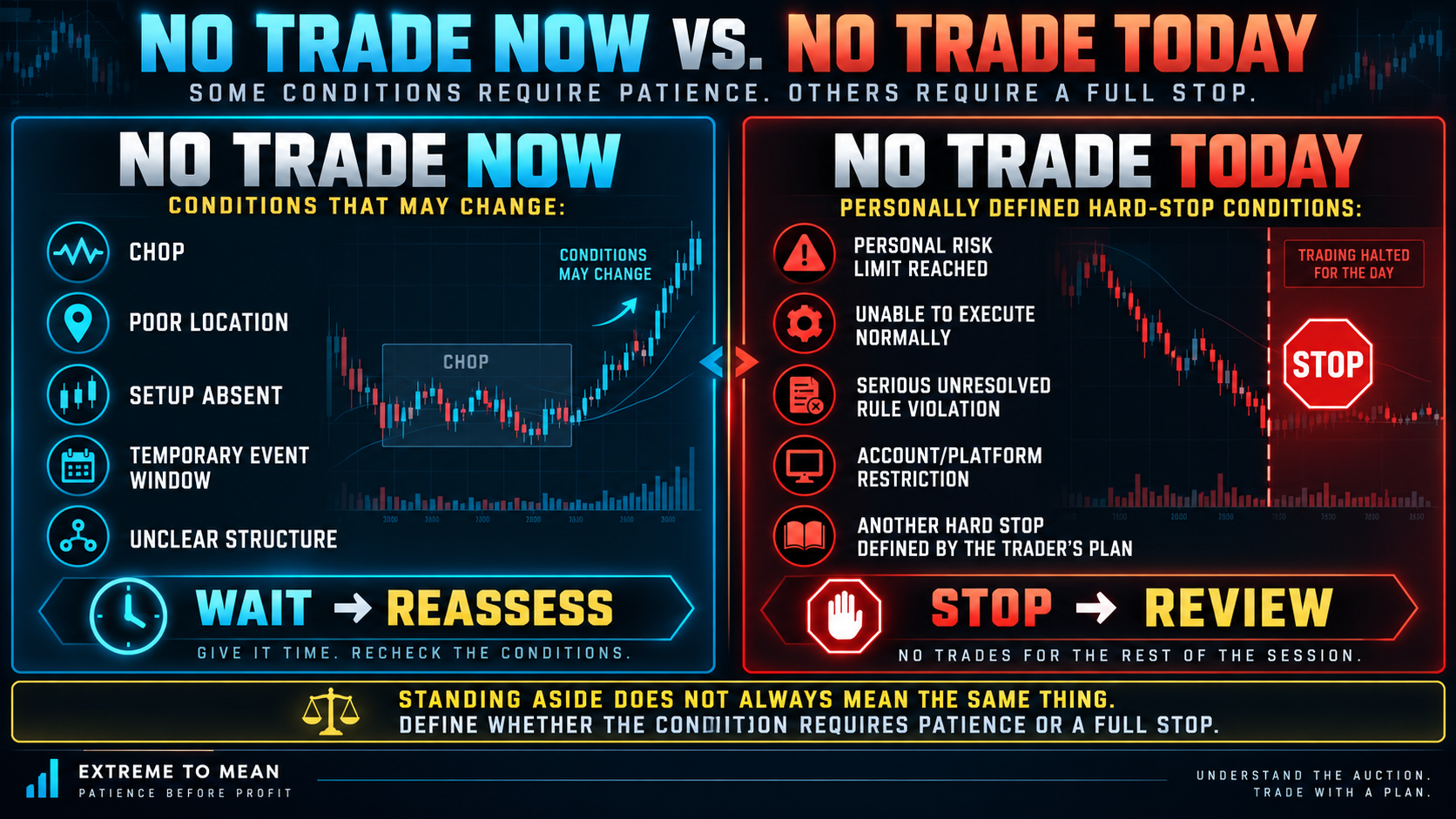
This distinction matters because patience is not the same as banning yourself from participation. If the market later changes enough to satisfy the conditions you defined in advance, eligibility can change with it. What matters is that the checklist tells you what must improve before another decision is considered.
Build Your Personal ETM No-Trade Checklist
A useful checklist should be personal enough to reflect the way you actually trade and specific enough that you can follow it consistently. Generic rules such as “avoid bad markets” or “do not trade emotional” sound sensible but provide little guidance when the live situation becomes ambiguous. Define your own failure points in language you can recognize while they are happening.
Use this sequence:
- SELF — Am I physically and emotionally capable of executing my normal process?
- RULES — Am I currently operating cleanly, or is recent rule-breaking still unresolved?
- EVENTS — Is known event risk compatible with my plan?
- MARKET — Can I clearly describe the condition, and does my strategy belong in it?
- SETUP — Is one of my actual setups present?
- ELIGIBILITY — Am I trade eligible, should I wait and reassess, or has a hard-stop condition ended participation?
The checklist should also contain practical questions that challenge urgency. Am I trying to execute a strategy or repair an emotion? If nothing changed for the next hour, would I still feel a need to trade? Is the current opportunity genuinely qualified, or have I simply been watching long enough for it to feel familiar?
Then define the response before the pressure arrives. Some answers should send you back to waiting; others should trigger review or a session stop; and a clean pass only means you are now eligible to evaluate an actual trade. Passing the no-trade checklist is not an entry signal.
If the recurring problem is that overlapping, directionless conditions keep pulling you into marginal trades, trading the chop may be the next issue to examine. The checklist can identify that the environment is wrong for your process without having to predict exactly when the market will improve. Your job is simply to wait until the conditions you require actually return.
Final Thought
A trader should not have to invent the reasons to stand aside while already feeling pressure to participate. Decide those reasons in advance, write them down, and separate the conditions that mean wait from the conditions that mean stop. That turns non-participation from a mood into a repeatable part of the process.
Your first checklist question should not always be, “Does this trade qualify?” Sometimes it should be, “Do I qualify to trade, and has the market earned my participation?” When the answer is no, patience is not what you do instead of trading; patience is the trade decision the process required.
Educational content only. Trading involves substantial risk and is not suitable for everyone.