
Why Swing Trading Needs a Different Checklist
An intraday trader can often close the position before the session ends and avoid carrying the trade through the night. A swing trader intentionally accepts exposure across multiple sessions, which means price can move while the trader is away from the screen and new information can arrive before the next regular session. The checklist therefore has to account for more than what the setup looks like right now.
That does not mean swing trading is automatically riskier or that overnight positions should be avoided. It means the type of risk changes, and the planning process has to acknowledge those differences before capital is committed. Inside the Setup curriculum, that makes holding-period risk part of trade qualification rather than something to think about after entry.
A simple swing checklist should answer a larger question than “Does this setup look good?” It should ask whether the idea can reasonably survive the time, volatility, scheduled events, normal counter-moves, and changing conditions that may occur before the target is reached. A good-looking chart is not yet a complete swing trade.
Start With the Higher-Timeframe Story
Swing trades need context larger than the entry candle. Before focusing on a lower-timeframe trigger, the trader should understand the dominant structure on the timeframe that actually represents the multi-session idea. That does not mean the higher timeframe tells you what must happen next; it tells you what larger market structure you are trading inside.
A constructive daily trend, for example, may make a pullback setup easier to understand because the trader can see how the current retracement fits into the broader directional structure. A range-bound market, on the other hand, may require a very different interpretation of the same bullish-looking candle. The larger context gives meaning to the setup without turning into a prediction.
This is why market conditions change the quality of a setup. A swing trader should know whether the market is trending, balancing, expanding, or becoming unstable before deciding that an entry pattern deserves attention. Higher timeframe gives context; it does not issue the trade.
Location and Setup: Why This Trade, Here?
After context, the next question is location. A swing trader needs a reason to care about the area where price is trading, whether that is meaningful support or resistance, prior structure, a pullback zone, a breakout area, or another reference justified by the strategy. The checklist should force the trader to answer why here? before why now?
That is the practical meaning of why location is the first filter. A bullish reaction in the middle of nowhere may be visually appealing while offering little structural reason for a multi-day thesis. The same reaction near meaningful support inside a constructive larger structure gives the trader something more specific to evaluate.
The trader also needs to know exactly what setup is being attempted. Is the idea trend continuation, pullback, breakout, reversal, or another defined setup within the trading plan? “This looks like it could go up” is not specific enough because the setup type determines which evidence, invalidation, and target make sense.
Check What Can Happen While You Are Holding
This is where swing trading becomes different from a purely intraday decision. If the trade may remain open for several days, the trader should know which scheduled events may occur during that window: earnings, major economic releases, central-bank decisions, company announcements, or other known catalysts. The objective is not to automatically avoid those events but to make the exposure intentional.
A trader buying a stock on Monday and discovering Tuesday night that earnings are Wednesday morning has not uncovered an unpredictable surprise. The event may have been known before entry, which means it belonged in the original trade decision. If the trader chooses to hold through it, that should be a deliberate part of the plan rather than an accidental discovery.
The same logic applies to broader macro risk in ETFs and index-linked trades. An economic release can create a gap or rapid repricing that behaves differently from ordinary intraday movement, and the trader should understand that possibility before entering. Overnight risk is part of the trade, not a surprise that happens after entry.
Define Invalidation Before Position Size
A swing trader should define where the idea is actually wrong before deciding how much to own. The sequence matters because position size should be based on the real distance between the entry and valid invalidation, not the other way around. Choosing the desired share or contract count first and then squeezing the stop closer simply to make the math fit distorts the trade.
That is why the trade is not ready until the risk is clear. A logical swing invalidation may sit below meaningful structure, beyond a failed breakout, or at another point where the original thesis no longer makes sense. The exact method depends on the strategy, but the principle remains the same: define failure before sizing the position.
This becomes especially important because a stop does not guarantee an exact exit price when the market gaps. A swing trader can define risk responsibly and still experience slippage or a larger-than-planned move when new information arrives outside normal hours. The checklist should make the trader acknowledge that exposure rather than pretending the stop removes it.
Make Sure the Target Has Enough Room and Time
A valid setup and logical stop do not automatically create an attractive swing trade. The trader also needs a realistic destination based on the market structure rather than the amount of money they want to make. A nearby resistance zone can turn an otherwise clean bullish setup into a trade with very little useful room.
Consider a stock in a constructive daily trend pulling back into support. The bullish reaction looks strong, invalidation below the structural low is clear, and position size can be calculated responsibly, but the prior high sits only a short distance above the intended entry. The chart can still be attractive while the trade itself deserves a pass.
Swing trades also need time to develop. A multi-session move may pause, retrace, gap, consolidate, or temporarily move against the position without invalidating the thesis, which means the trader has to distinguish reversion from reversal and normal movement from actual failure. Holding longer is not permission to tolerate a broken thesis, but a swing trader cannot expect every valid idea to work immediately.
A Simple Swing Trade Example
Imagine an ETF has been trending higher on the daily chart and pulls back toward an area that previously acted as support. The trader sees a bullish reaction and initially thinks, “Good setup—buy.” The checklist forces the trader to slow down and build the entire trade instead of stopping at the attractive reaction.
The higher-timeframe structure is still constructive, the location is meaningful, and the setup is a trend-continuation pullback. A major scheduled economic event occurs two days later, invalidation sits below the structural low, and position size is calculated from that actual distance. The realistic target is the prior high or next meaningful resistance, and enough room remains for the trade to make sense.
Now change only one detail: major resistance sits almost immediately above the entry. The trend, location, setup, stop, size, and catalyst awareness can all remain acceptable while the opportunity itself becomes weak because very little room is left. Same attractive setup, different decision: pass.
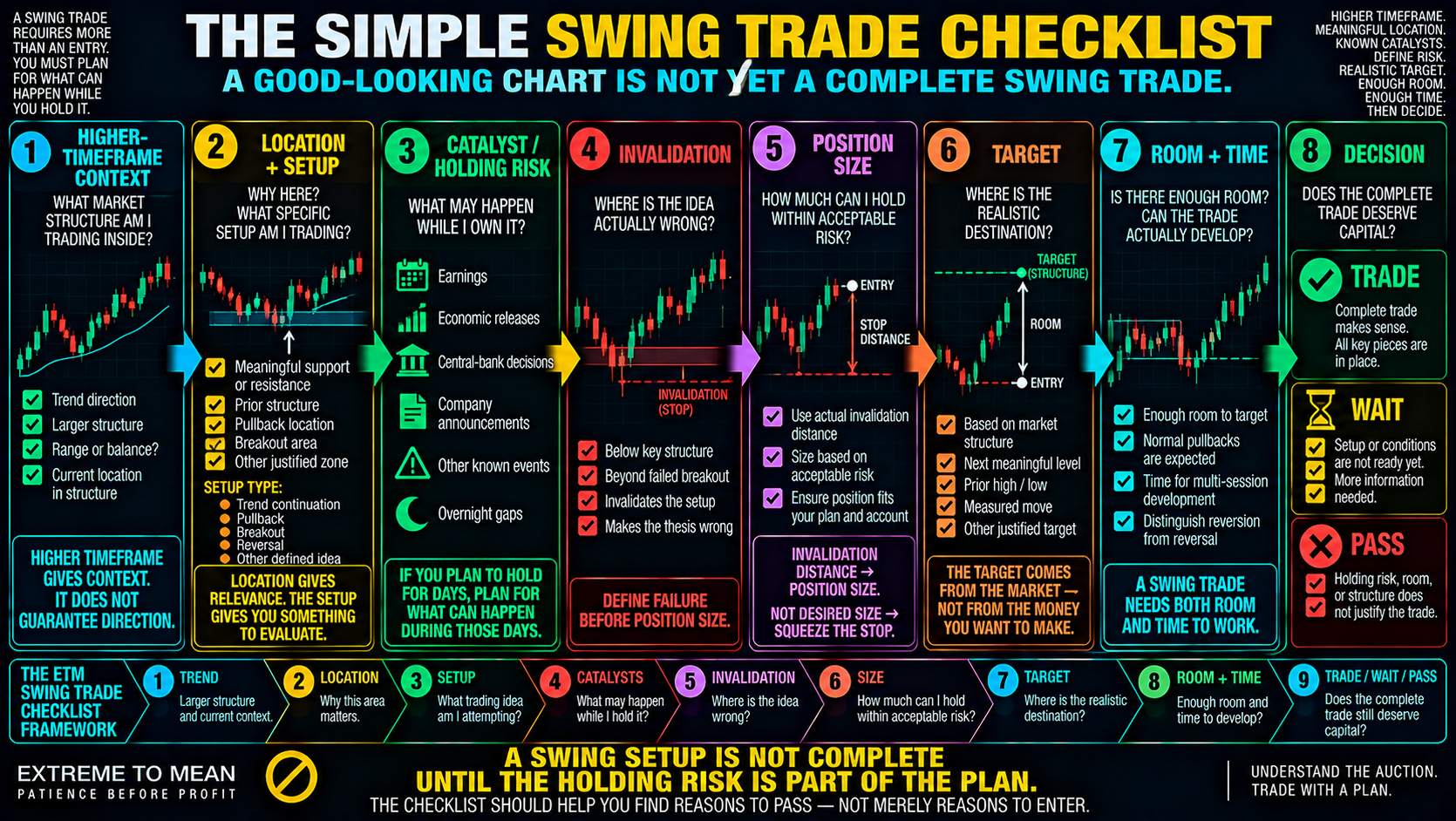
The Simple ETM Swing Trading Checklist
A swing checklist should remain short enough to use consistently while still forcing the trader to evaluate the features that make multi-session risk different. The goal is not to create a wall of twenty-five boxes; it is to make sure the trade has been thought through from the larger structure all the way to the holding period. Each item should answer a real decision question.
- Higher-timeframe context — What larger market structure am I trading inside?
- Location — Why does this specific area matter?
- Setup — What defined trading idea am I actually attempting?
- Catalysts — What known event or release could occur during the expected holding period?
- Invalidation — Where is the thesis genuinely wrong?
- Position size — How much size fits that actual invalidation distance and acceptable risk?
- Target — Where is the realistic destination based on market structure?
- Room — Is there enough useful movement between entry and that destination?
- Time — Can the trade reasonably develop across multiple sessions without normal movement being confused with failure?
- Overnight risk — Am I comfortable intentionally carrying this exposure while the market is closed or new information may arrive?
- Trade / wait / pass — Does the complete trade still deserve capital?
The condensed framework is Trend → Location → Setup → Catalysts → Invalidation → Size → Target → Room + Time → Trade / Wait / Pass. The checklist does not guarantee that the trade will work, and it should never be treated as automatic permission to enter. Its job is to expose whether the trader has actually planned the complete multi-session decision.
The better question is not simply, “Do I like this chart?” Ask, “Can this idea reasonably survive the time, volatility, events, and normal movement that may occur before the target is reached?” That is the question that turns an attractive setup into a properly considered swing trade.
Final Thought
Swing trading gives a trade more time, but time is not free. Every additional session creates the possibility of gaps, scheduled events, changes in volatility, evolving market conditions, and ordinary price movement that has to be interpreted correctly. Those realities belong in the trade plan before entry.
A good swing checklist therefore begins well before the trigger. It starts with higher-timeframe context and meaningful location, defines the setup, checks the calendar, establishes invalidation, sizes from that risk, identifies a realistic target, and makes sure the trade has enough room and enough time to develop. Sometimes that process will confirm the idea, and sometimes it will reveal that an attractive chart is not worth taking.
A swing setup is not complete until the holding risk is part of the plan. The checklist should help you find reasons to pass just as readily as reasons to enter, because the goal of the broader Extreme to Mean system is not to manufacture more trades—it is to make the trades you consider more clearly defined before risk is committed.
Educational content only. Trading involves substantial risk and is not suitable for everyone.