
Why Traders Pick Targets Backward
Choosing the target backward feels efficient because the arithmetic is easy. If the stop represents one unit of risk and the trader wants three units of reward, the target can simply be placed three times farther away. The spreadsheet looks clean, but the market structure may have no reason to support that destination.
This is where the Setup curriculum demands a different order of operations. The trader first has to define what the setup is trying to accomplish, where it is wrong, and what the path ahead actually looks like. Only after those pieces are established does the potential reward become meaningful.
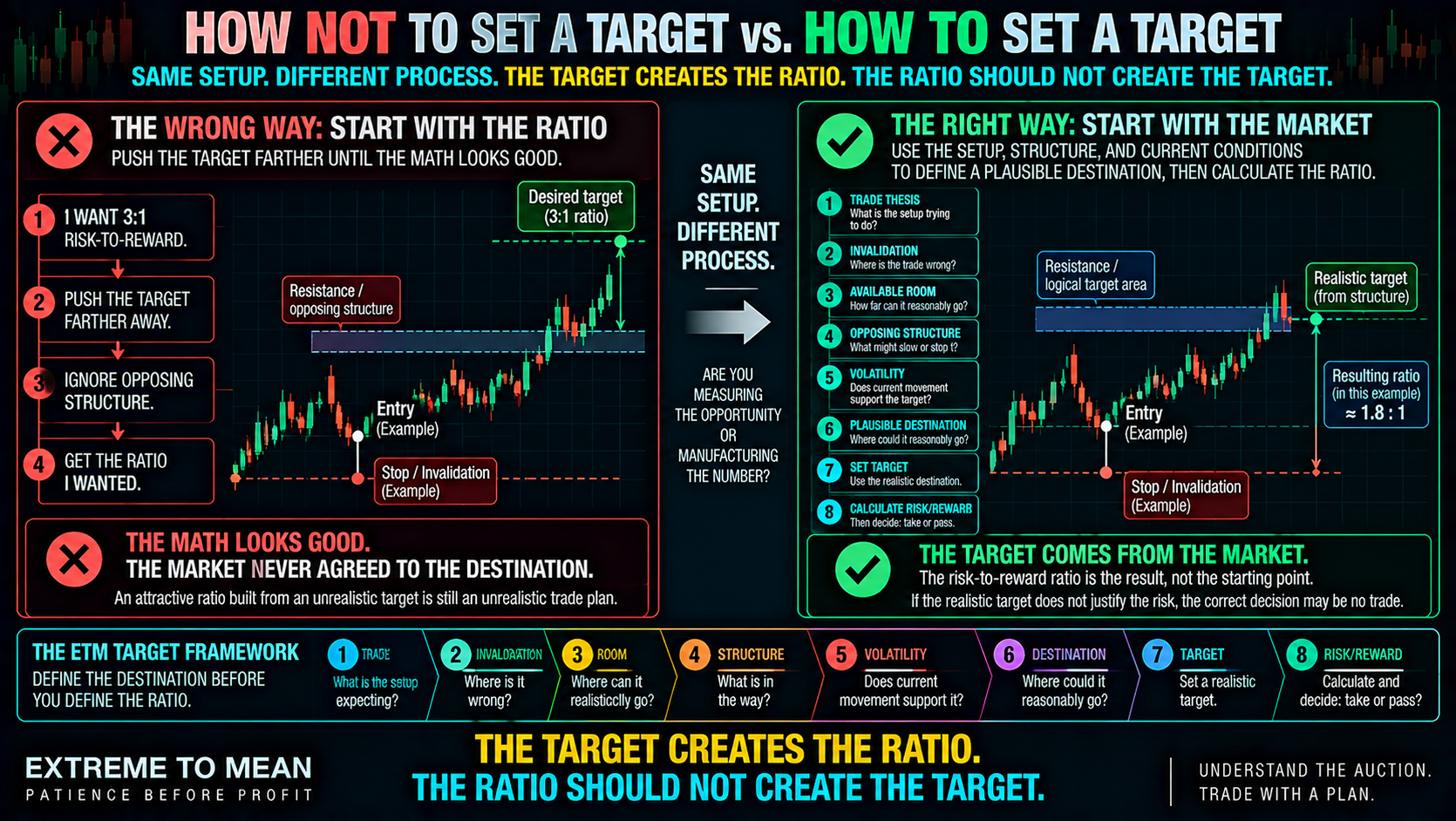
Imagine a hypothetical long setup with clear invalidation below the entry, but significant opposing structure sits well before the price that would create a desired 3:1 ratio. The wish-based approach pushes the target beyond that structure so the math looks better, while the market-based approach accepts the nearer plausible destination and calculates the resulting ratio honestly. If the realistic target does not provide enough reward relative to the risk, the cleaner decision may simply be to pass.
Start With the Trade Thesis
Every target should belong to the trade that is actually being taken. A mean-reversion setup may be looking for rotation back toward a defined area of balance, a breakout may be looking for continuation into open space or the next structural reference, and a pullback may be looking for continuation toward a prior extreme. Those are different theses, so they should not automatically share the same target logic.
The first useful question is, “If my thesis is correct, where does it reasonably suggest price could travel?” That question forces the target to emerge from the setup rather than from the trader’s preferred payout. It also helps prevent a common mistake in which the trader enters one kind of setup and then manages it according to the expectations of another.
This is why a target is not simply a number above or below entry. It is the planned destination implied by the setup, structure, and current market environment if the trade develops normally enough to remain valid. The target does not predict that price will get there; it defines what the trader is planning around before taking risk.
Read the Available Room
A good-looking setup can still be a poor trade if there is not enough useful room between the entry and the next meaningful obstacle. The idea behind room to revert applies beyond mean reversion: price needs both a reason to move and enough space for that movement to matter. A trader who ignores the path ahead can create an attractive thesis with an unattractive opportunity.
Entry location affects that room immediately. If the trader enters just beneath strong opposing structure, much of the potential movement may already be gone before the position is opened. A late entry can therefore reduce the realistic target without changing the underlying directional idea.
The practical question is not whether price could theoretically travel much farther. It is what destination is reasonably supported before the trade runs into structure that could slow, reject, or change the behavior of the move. That is why location is the first filter: the same setup can offer very different target quality depending on where the trader is entering it.
Let Structure Define the Destination
Targets should account for places where further progress may become harder. Depending on the setup, those references might include a prior high or low, a range boundary, a value area, a well-established support or resistance zone, or another clearly defined structural location. The point is not to create a giant checklist of levels; it is to stop pretending the path ahead is empty when meaningful opposition is already visible.
A structural reference is not a promise that price will stop there. Markets can break through prior highs, move through resistance, leave value, and continue farther than a trader expected. The target is therefore a planning reference, not a claim that the market must react at one exact price.
That distinction matters because realistic does not mean timid. A strong setup with open space and supportive conditions may justify a farther destination than a weak setup entering directly into opposition. The goal is not to choose the nearest possible target, but to choose one that actually belongs to the opportunity being offered.
Volatility Changes What Is Plausible
A destination that is ordinary during an active session may be unrealistic during a compressed one. The amount of movement a market is currently producing helps frame what counts as a plausible objective, which is why market conditions change the quality of a setup. Target expectations should fit the environment rather than being copied mechanically from yesterday’s conditions.
The reverse is also true. A target based on a quiet prior session may be unnecessarily conservative after volatility expands and the market begins traveling farther between meaningful references. That does not mean traders should automatically extend targets whenever volatility rises; it means current movement conditions belong in the planning process.
Avoid turning that principle into a formula such as “target two ATR” or any other universal multiplier. Volatility is context, not a substitute for the trade thesis and structure. The better sequence is to identify the plausible destination first, then ask whether the current movement environment makes that destination reasonable.
Risk-to-Reward Comes After the Target
Risk-to-reward is useful only when both sides of the comparison are grounded in the actual trade. The risk side should come from a defensible invalidation, while the reward side should come from a plausible destination. If either number is invented to make the ratio look attractive, the ratio becomes decoration rather than analysis.
This is where target setting and risk planning meet. A trade can have a logical entry, a sensible stop, and a plausible target, then still produce a reward-to-risk relationship that is not attractive enough to justify taking the position. That does not mean the target should be pushed farther away; it means the opportunity may not be worth taking.
A trader who starts with a preferred ratio can always manufacture a better-looking number by moving the target farther away. The market does not become more generous because the spreadsheet says 4:1 instead of 2:1. Risk-to-reward is an output of a properly constructed trade, not a tool for forcing the chart to satisfy a preference.
Fixed Targets, Dynamic Targets, and Changing Conditions
Not every strategy uses a fixed price target. Some trades aim for a dynamic reference such as a moving mean or VWAP, while others may use predefined trailing or exit logic instead of one fixed destination. The important requirement is that the exit logic is understood before entry rather than improvised after the trade begins.
Dynamic references deserve special care because the destination itself may migrate. As what the mean really is makes clear, a reference can change as new price information enters the calculation. A trader planning around a moving target needs to know in advance whether the objective is the reference’s current value, its future moving value, or some other rule defined by the strategy.
Changing market conditions can also alter what happens after entry, but that belongs primarily to trade management rather than target construction. P062 is about defining the expected destination before risk is taken. The pre-entry plan should be clear enough that the trader knows what kind of target or exit logic belongs to the setup before the first fill occurs.
The ETM Target Framework
A realistic target comes from the market before it becomes part of the math. The trader first defines the trade, the invalidation, the available room, and the structure ahead, then considers whether current volatility supports the expected movement. Only after that process does the target become a meaningful input into the reward-to-risk decision.
What is the trade? What behavior is the setup actually expecting?
Where is it wrong? What invalidates the thesis?
Where could it realistically go? What destination follows naturally if the thesis develops?
What is in the way? Which structural references could reasonably interrupt progress?
Does volatility support the move? Is the intended distance plausible in current conditions?
What target follows from that? Is it fixed, dynamic, or governed by another predefined exit rule?
What risk-to-reward results? Calculate the relationship after the target is defined.
Take or pass? Is the actual opportunity worth the risk without moving the target to improve the math?
The condensed framework is Trade → Invalidation → Room → Structure → Volatility → Destination → Target → Risk/Reward → Take or Pass. The key inversion is simple: do not start with the ratio and work backward toward a target. Start with the market and let the resulting ratio tell you whether the trade deserves capital.
Final Thought
A target is not a profit wish, and it is not a prediction that price will reach one exact level. It is a planned destination supported by the setup, the available room, the structure ahead, and the current movement environment. That makes it useful for decision-making without pretending the market owes the trader an outcome.
Sometimes that process will produce a target that looks less exciting than the trader hoped. Sometimes it will show that a perfectly respectable setup does not offer enough room to justify the risk from the available entry. Rejecting that trade is not a failure to be ambitious; it is the consequence of letting the market define the opportunity before the trader decides whether to participate.
The target creates the ratio; the ratio should not create the target. When the realistic destination, invalidation, and resulting reward-to-risk relationship fit together, the trade can be evaluated as a complete plan rather than a collection of desired numbers. That is the kind of pre-entry decision the broader Extreme to Mean system is designed to organize.
Educational content only. Trading involves substantial risk and is not suitable for everyone.