
There is a mistake traders make with reversion-to-mean that does not get discussed enough. They understand the concept — price moves away from average, price returns — but they start evaluating setups before they check whether the move was actually large enough to warrant the trade. The signal looks right. The candle pattern looks right. The indicator lines up. So they take it. But the trade was never set up for a clean risk-to-reward to begin with, because price had not moved far enough from the mean to give the return move any room to work.
This is what we mean by space. It is not a secondary consideration. It is the first filter — the one that determines whether a reversion opportunity even exists. The setup and risk lessons show how that filter fits into the larger decision.
What Space Actually Means
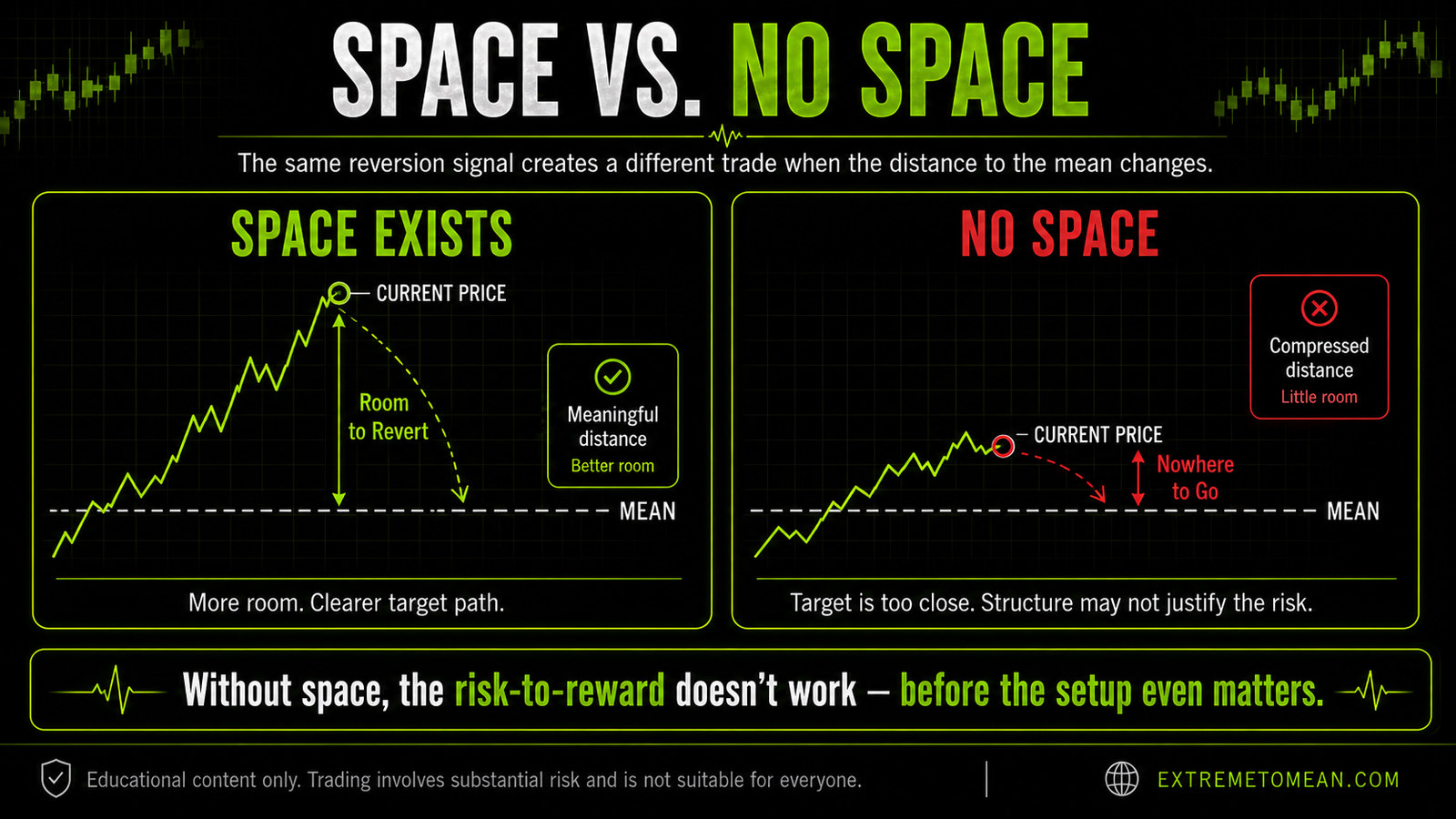
Space is the distance between current price and the mean. In reversion-to-mean trading, the mean is the reference point — the zone price has historically returned to after extended moves in either direction. When price moves far from that zone, space opens up. When price is near the zone, space does not exist.
More space means there is more room for a return move to develop before it reaches its target. That gives the trade structure. It gives the risk-to-reward ratio a foundation. Without that foundation, you are placing a bet on a move that may have nowhere meaningful to go even if you are right about direction.
Think of it this way: if price is already close to the mean, where is the trade going? The target is right there. The stop is below or above the entry. The math is compressed. Even a perfectly executed trade in this environment may not produce a result that justifies the risk taken.
Why Traders Skip the Space Check
The space check gets skipped for a simple reason: traders are pattern-matching instead of process-following. A setup that looks familiar generates a pull toward action, especially if the trader has seen that pattern work before. The familiarity of the signal overrides the discipline of the filter.
There is also a subtler issue. When price is near the mean, it often looks like it is setting up to move away from it — which creates the feeling that a trade in either direction is valid. That feeling is not wrong. It is just not a reversion trade. Reversion is specifically about price returning to the mean after being away from it. If price is already near the mean, the reversion has already happened, or it never fully occurred in the first place.
The result is a trade that was correctly identified as a reversion setup in structure but not in location. That is why location is the first filter: it is what makes the risk-to-reward work.
The Risk When Space Is Missing
When you enter a reversion trade without adequate space, a few things tend to happen. First, the trade may move in your direction, but it does not move far enough to hit a meaningful target before the mean acts as resistance or support and price stalls. You end up managing a trade that went where you thought it would go but did not go far enough to matter. Second, because the stop placement still needs to be outside the structure, the risk-to-reward ratio is compressed. You may be risking a dollar to make sixty cents.
Neither of those outcomes is catastrophic in isolation. But repeated over time, they represent a structural problem with the setup selection process, not just bad luck. You are consistently entering trades where the environment does not support the trade type, and the cumulative effect on your results — and your decision-making — adds up.
The other risk is less obvious: without space, your confidence in the trade becomes disconnected from anything measurable. You start justifying entries based on feel rather than structure. That is a pattern worth breaking before it becomes a habit.
What You Are Actually Looking For
A reversion setup with genuine space has clear characteristics. Price has moved meaningfully away from the mean — not just a small deviation, but a stretch that is notable relative to that instrument's normal range of movement. The mean itself is visible and identifiable, not a vague concept. And there is a reasonable path back toward the mean that does not require the trade to fight through multiple layers of structure just to reach the first target.
You are also looking for a return-to-mean distance that is larger than your risk. That ratio — what you stand to gain on the return move versus what you risk if you are wrong — needs to make sense before anything else in the setup matters. Space is what makes that ratio possible.
It is usually cleaner to treat the extreme as an area rather than one exact reversal price. Space is the first filter, not the only filter. But it is the filter that comes before all the others. If it is not there, the evaluation stops.
The Space Check: Questions to Ask Before You Evaluate
Before you start looking at signals, patterns, or confirmation, run this check:
- Is price meaningfully far from the mean right now, or is it already near it?
- If price reverts to the mean from here, how far does it actually have to travel?
- Is that distance larger than the risk I would need to take on this entry?
- Am I looking at a real extreme, or just a pullback that feels extended?
- Has this instrument actually stretched here, or is this normal movement for it?
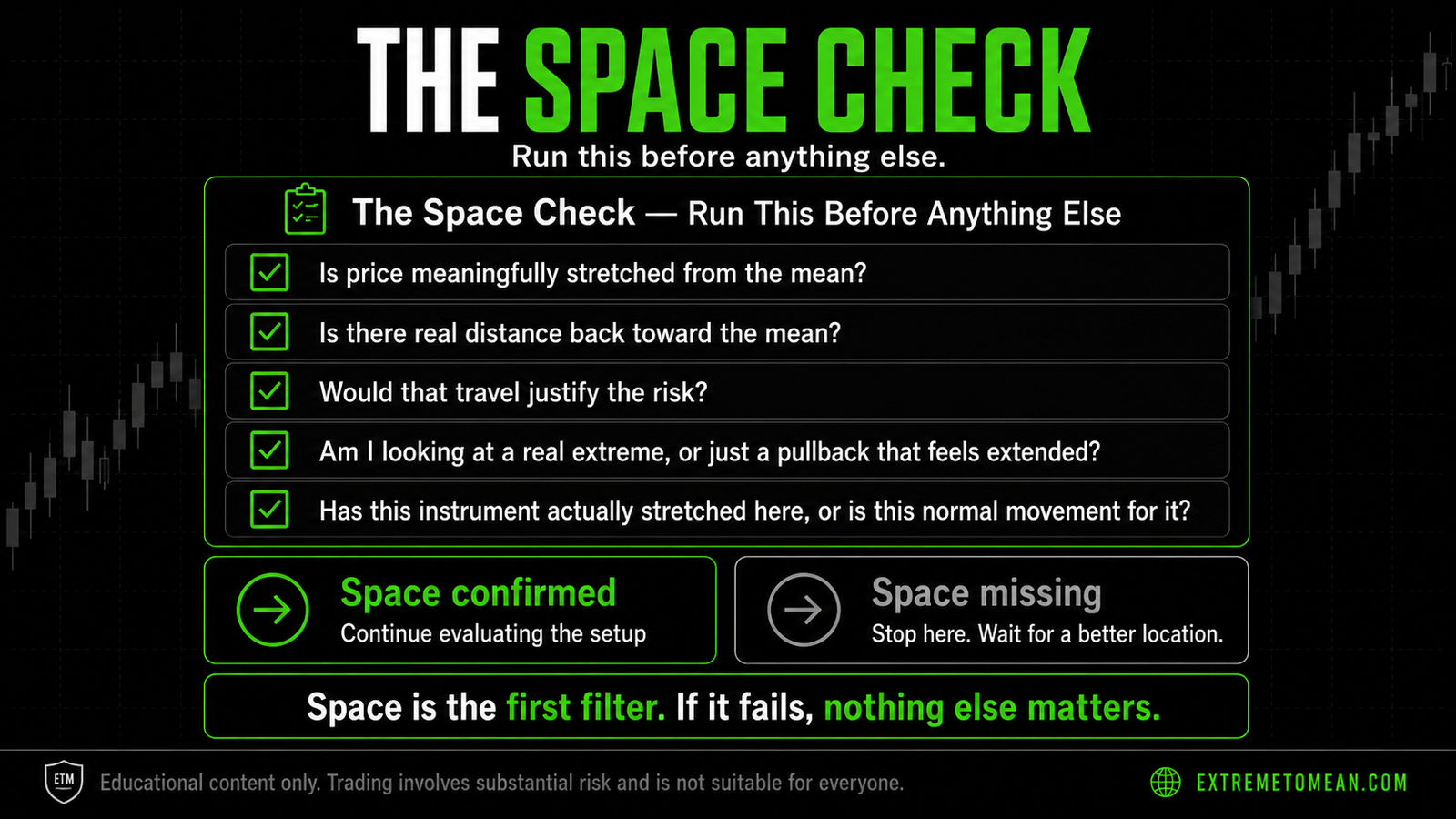
If those questions do not produce clear answers that support the trade, stop there. The setup has not earned further evaluation. The trade is not ready until the risk is clear. That is not a missed opportunity — it is the filter doing its job.
Final Thought
Space is not a preference. It is a precondition. Without meaningful distance between price and the mean, a reversion trade does not have the room it needs to work — and the risk-to-reward math reflects that before you ever enter. The discipline here is not about waiting for a perfect trade. It is about refusing to take a structurally flawed one. Check the space first. Everything else comes after. To practice that decision before the next trade, use the free setup-quality tools.
A fuller view of how stretch, stabilization, confirmation, and a viable path back toward balance fit together appears in the anatomy of a reversion setup.
That available space also determines whether risk-to-reward is meaningful for the actual trade rather than attractive only as a calculation.
When the sequence lacks enough room or confirmation, the related review of why mean reversion fails helps identify what broke down before entry.
Educational content only. Trading involves substantial risk and is not suitable for everyone.