
Yes, you can build a futures trading process around a full-time job. The harder part is not finding a market that is open; it is building a process that fits the hours when you can actually prepare, decide, and manage risk.
Your trading plan has to fit the hours you actually own.
Futures can accommodate nontraditional schedules because many major contracts trade for most of the weekday, but access is only the first constraint. A market being open does not mean your strategy has an edge during that hour, and glancing at a chart does not mean you are genuinely available to trade. The sharper question is: What trading process fits my real life—not the trading day I wish I had?
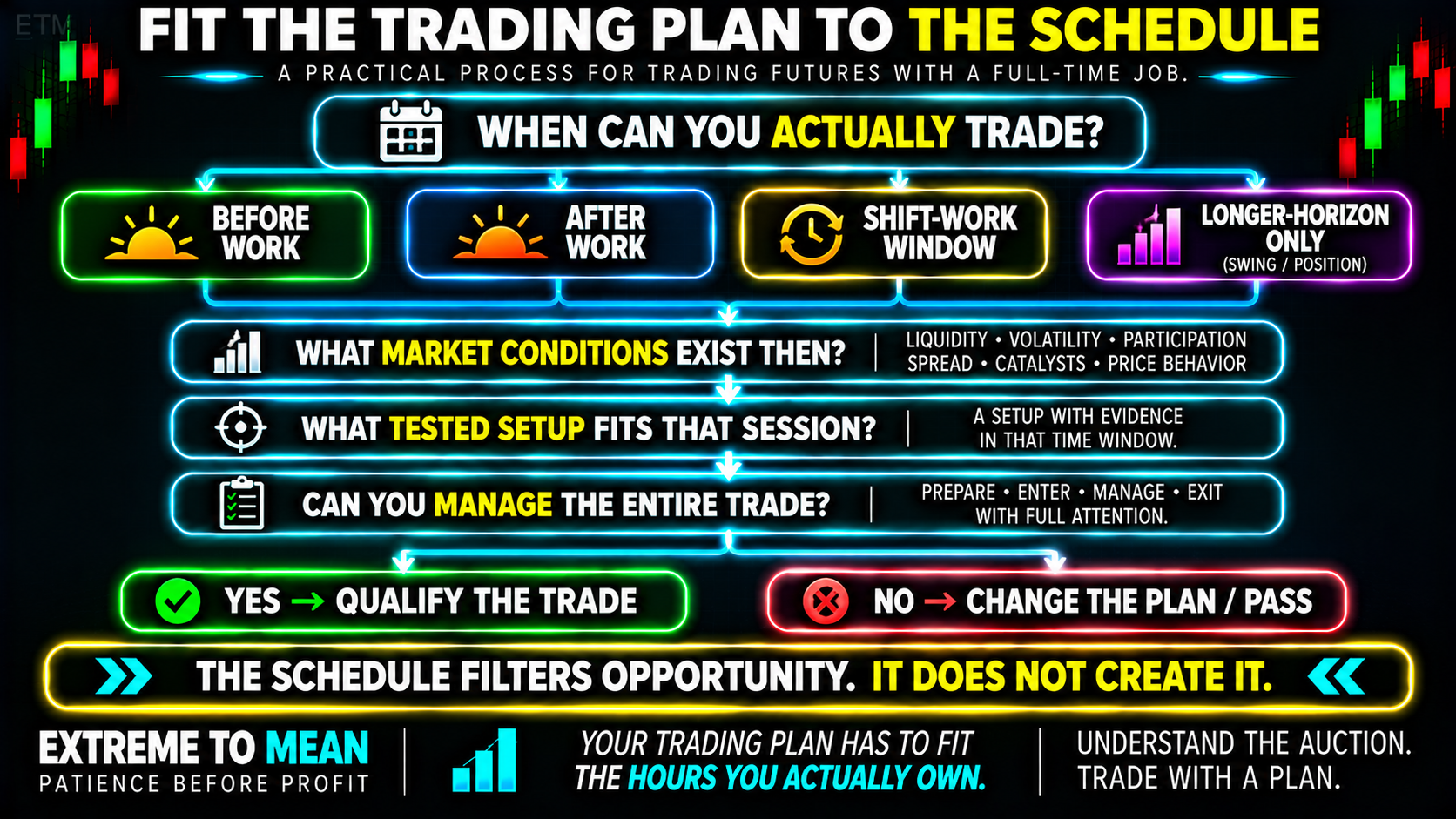
This belongs inside The Trader because time availability should influence the market, session, setup, holding period, management style, and frequency expectations. The cleaner sequence is SCHEDULE → MARKET WINDOW → SETUP → MANAGEMENT → EXPECTATIONS, not STRATEGY FIRST → FORCE IT INTO MY SCHEDULE.
Near-24-Hour Access Solves Access—Not Strategy
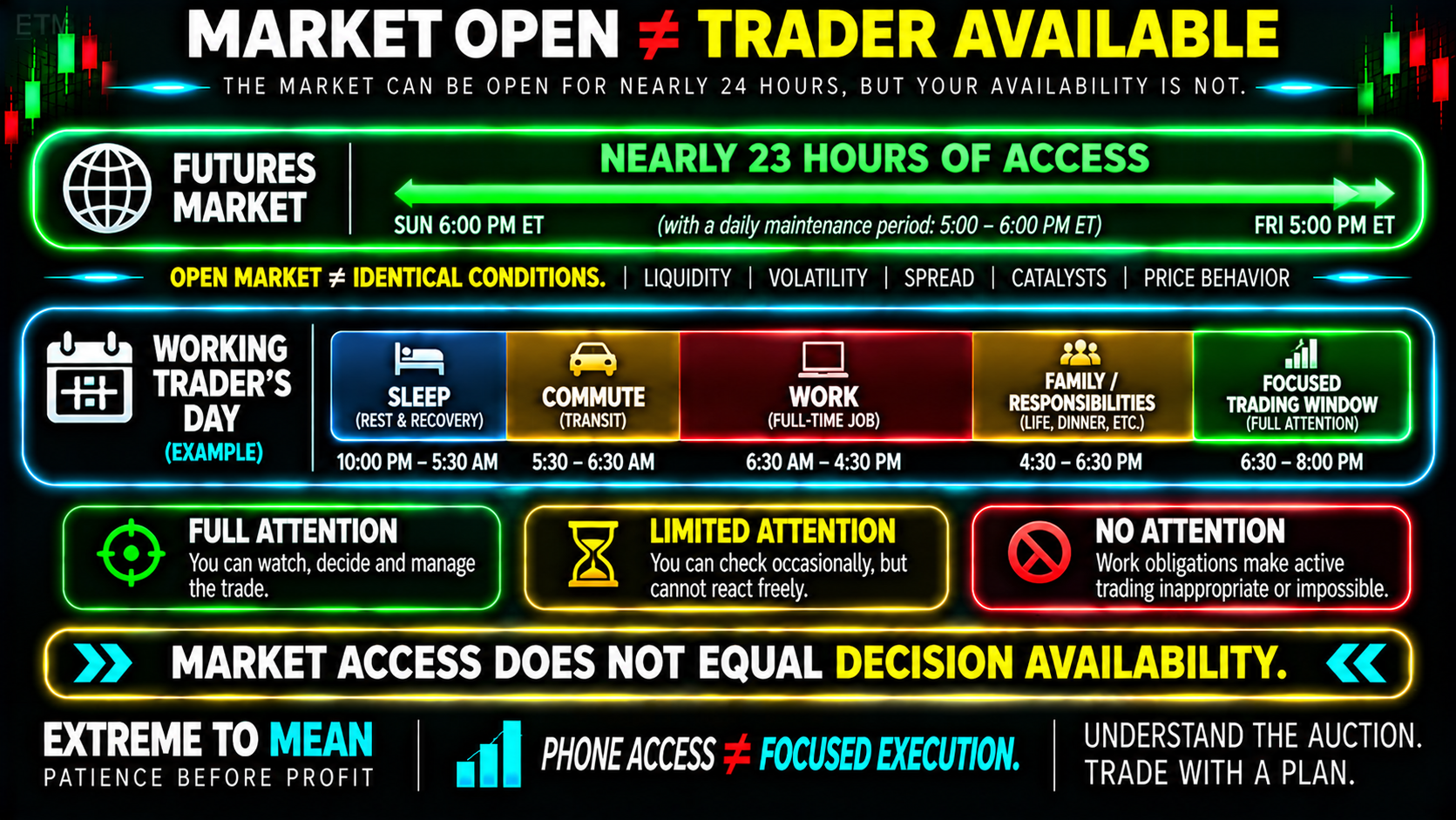
For E-mini S&P 500 futures, CME currently lists Globex trading from Sunday 6:00 p.m. through Friday 5:00 p.m. ET, with a daily maintenance period from 5:00 to 6:00 p.m. ET. That gives a working trader far more possible windows than the U.S. cash session alone, but those windows are not interchangeable. Participation, spread, depth, volatility, catalysts, and price behavior can change through the day.
“I can trade after work” is therefore not yet a strategy decision. CME's liquidity tools compare spread, depth, and cost to trade across global time zones because execution conditions vary. Extended hours create access; they do not make every hour interchangeable.
Start With a Schedule Audit, Not a Chart
Begin by asking when you can consistently give the market uninterrupted decision capacity. Do not ask when you can occasionally sneak a look at your phone between meetings, customers, driving, or other obligations. Availability means having enough control over your attention to prepare, enter, manage, and exit if the strategy requires it.
Think in three states: full attention, limited attention, and no attention. Full attention may support discretionary intraday trading; limited attention may support alerts or preplanned management only if the strategy was designed for that; no attention means active discretionary trading does not belong there. Work availability is a risk constraint—not an inconvenience to ignore.
A trading plan that depends on neglecting the job is not sustainable. If employment requires focus, safety, customer responsibility, or employer-policy compliance, those obligations outrank the desire to participate. The process has to fit around them.
Four Schedule Models
A before-work window can work when the trader has predictable time for preparation and enough room to manage the trade before work begins. It may overlap overnight activity, pre-cash-market trading, or scheduled U.S. releases, but those periods are not automatically suitable for the setup. A trade that requires discretionary management during work does not fit the schedule.
An after-work window can also create access. For a conventional U.S. 9-to-5 ET schedule, equity-index futures reopen after the daily CME maintenance period, but evening participation and catalysts can differ materially from the U.S. cash open. Do not take a strategy developed around 9:30 a.m. volatility and assume it has the same expectancy at 8:00 p.m.
Shift workers may actually be free during the U.S. morning session, so there is no universal “working trader session.” If no intraday window provides enough uninterrupted attention, a longer-horizon approach may fit better, but that changes the management problem and introduces overnight, gap, and event exposure. Changing the holding period may be more rational than forcing intraday trading.
The Session Has to Earn the Setup
The right question is not “Which session should someone with a job trade?” It is “Does my tested setup have evidence during the session I can actually trade?” A convenient window is useful operationally, but convenience is not evidence of a trading advantage.
Changing the session can change the edge even when the chart and indicators look identical. A setup built around cash-open participation or scheduled morning data may behave differently in the evening, which is why market conditions change the quality of a setup. Session is part of the environment that the strategy must survive.
The same caution applies around scheduled economic releases. A short opening in your calendar does not mean the market will be quiet or easy to manage. A short available window is not automatically a low-risk window.
Limited Time Should Mean Fewer Trades, Not Lower Standards
A trader who can observe only part of a session has a smaller opportunity set than someone watching the entire day. If your schedule covers only part of the period in which a setup occurs, expecting the full-session trade count creates pressure the market cannot satisfy. Your available opportunity set is smaller than the market's total opportunity set.
The dangerous response is lowering standards because “this is my only hour.” Limited availability should reduce trade count—not setup quality. The principle in why doing nothing is still a trading decision matters here because “I will observe from 6:30 to 7:30” is very different from “I need a trade between 6:30 and 7:30.”
A narrow window becomes dangerous when the trader believes the window owes them activity. Schedule the opportunity to trade; do not schedule the requirement to trade. Some days the cleanest result will be no trade.
Preparation Matters More When the Window Is Short
If you have only 45 minutes to trade, spending the first 30 minutes deciding what matters leaves little room for patient execution. Preparation can happen outside the live window: scheduled events, relevant levels, market context, preferred scenarios, invalidation, and the conditions that would make you pass. A constrained trading window requires more preparation before the window—not more improvisation inside it.
This is why a written trading plan made before the session can be especially useful for employed traders. The plan can state what must happen before you become interested, what invalidates the idea, and what happens if no setup develops before the cutoff. “No setup before cutoff = no trade” should be accepted before the clock starts creating urgency.
Use a Hard Cutoff
A hard entry cutoff prevents the last few minutes before work from becoming a source of forced trades. The exact cutoff depends on the strategy and management requirements; there is no universal number of minutes. The important part is knowing in advance when a new position would no longer fit the available attention.
A setup that appears after the cutoff belongs to someone else's session. The issue is whether you were still available to execute the process that made it valid. Time pressure can create the same bad decisions as P&L pressure.
Open Positions, Alerts and Limited Attention
An open position becomes a schedule problem when the tested strategy requires decisions during a period when the trader cannot make them. Stops, targets, automation, and alerts can reduce monitoring requirements, but they do not remove slippage, gaps, fills, or execution risk. ALERT ≠ ENTRY, and PHONE ACCESS ≠ FOCUSED EXECUTION.
If the strategy requires discretionary management while you are unavailable, the strategy and schedule are incompatible. Change the plan, holding period, or trading window rather than pretending that technical access solves the availability problem. Market access and decision availability are different resources.
Employment Can Reduce One Major Trading Pressure
A job limits trading time, but it can reduce the pressure to make trading pay the bills today. That can make it easier to wait and pass mediocre setups. A paycheck can reduce the need to turn every market session into a payday.
A job can constrain trading time while simultaneously protecting the trader from income pressure. Whether someone should ever leave employment for trading is a separate decision from whether a part-time process can be built around the job.
The Schedule-Fit Checklist
Before deciding how to trade around work, ask:
- What hours can I consistently control—not occasionally access?
- Can I give the market full attention during that window?
- Which futures products are actually open then?
- What are liquidity, volatility, and event conditions like during that exact window?
- Does my setup have evidence in that session?
- Can the entire trade be managed before I become unavailable?
- What is my hard entry cutoff?
- What happens if no qualified setup appears?
- Am I using alerts and orders to support a tested process, or merely to stay connected to markets all day?
- Does the routine leave my employment, sleep, and other responsibilities functional?
The checklist makes schedule compatibility part of trade qualification rather than an afterthought. The better question is: Can I execute this process during the hours I actually control without lowering the setup standard or neglecting another responsibility?
The ETM Schedule → Session → Setup → Cutoff → Review Framework
Use SCHEDULE → SESSION → SETUP → CUTOFF → REVIEW. SCHEDULE asks what time is genuinely available; SESSION asks what market environment exists then; SETUP asks what tested opportunity fits that environment. CUTOFF defines when trading availability ends, and REVIEW asks whether the routine is producing clean evidence rather than rushed decisions.
The decision is TRADE / WAIT / PASS. The schedule filters the opportunity—it does not create one, and limited time should usually produce fewer decisions rather than faster decisions. The ETM free tools can help structure preparation and review, but some valid trading days will still end with no trade.
Final Thought
A full-time job does not automatically prevent someone from building a futures process. Major futures markets can offer broad access outside normal work hours, but extended hours do not make every session interchangeable, and being able to open a chart is not the same thing as being available to make and manage decisions.
Start with the hours you genuinely control, study the market during that exact window, and test setups specifically in that environment. Prepare before the window begins, establish a hard cutoff, and accept lower opportunity frequency without lowering trade quality.
You do not need access to every opportunity. You need a repeatable process for the opportunities you can actually access—and the willingness to pass when your schedule, the session, or the setup does not align.
Educational content only. Trading involves substantial risk and is not suitable for everyone.