
The Same Distance Can Mean Two Different Things
Mean-reversion traders naturally focus on distance because extension is part of the setup. The mistake is turning a fixed number of points into the definition of “too far” regardless of the session, horizon, or pace of movement. A distance that mattered yesterday may carry far less information today.
That is why the broader Market curriculum treats context as part of the trade rather than decoration around it. Before asking whether price is stretched, the trader needs to know what reference matters and what amount of movement has become normal around that reference. Distance becomes useful only after the environment gives it scale.
This builds on what the mean really is. A mean or value reference gives us something to measure against, but the same raw separation can represent a very different condition when surrounding volatility changes. The reference matters, but so does the ruler used to judge the distance from it.
Volatility Changes the Ruler
For this lesson, volatility means the magnitude and pace of price movement over a relevant period. Higher-volatility markets tend to produce larger fluctuations, while lower-volatility markets tend to produce smaller ones. Volatility does not tell us direction; it tells us something about the scale of movement.
The trading horizon matters because volatility is relative. A five-minute chart can be unusually active while the daily market remains calm, just as a volatile daily regime can contain a temporarily quiet intraday period. “Volatility is high” is incomplete until we add: high relative to which horizon and compared with what recent behavior?
Quiet Markets Shrink the Definition of Extreme
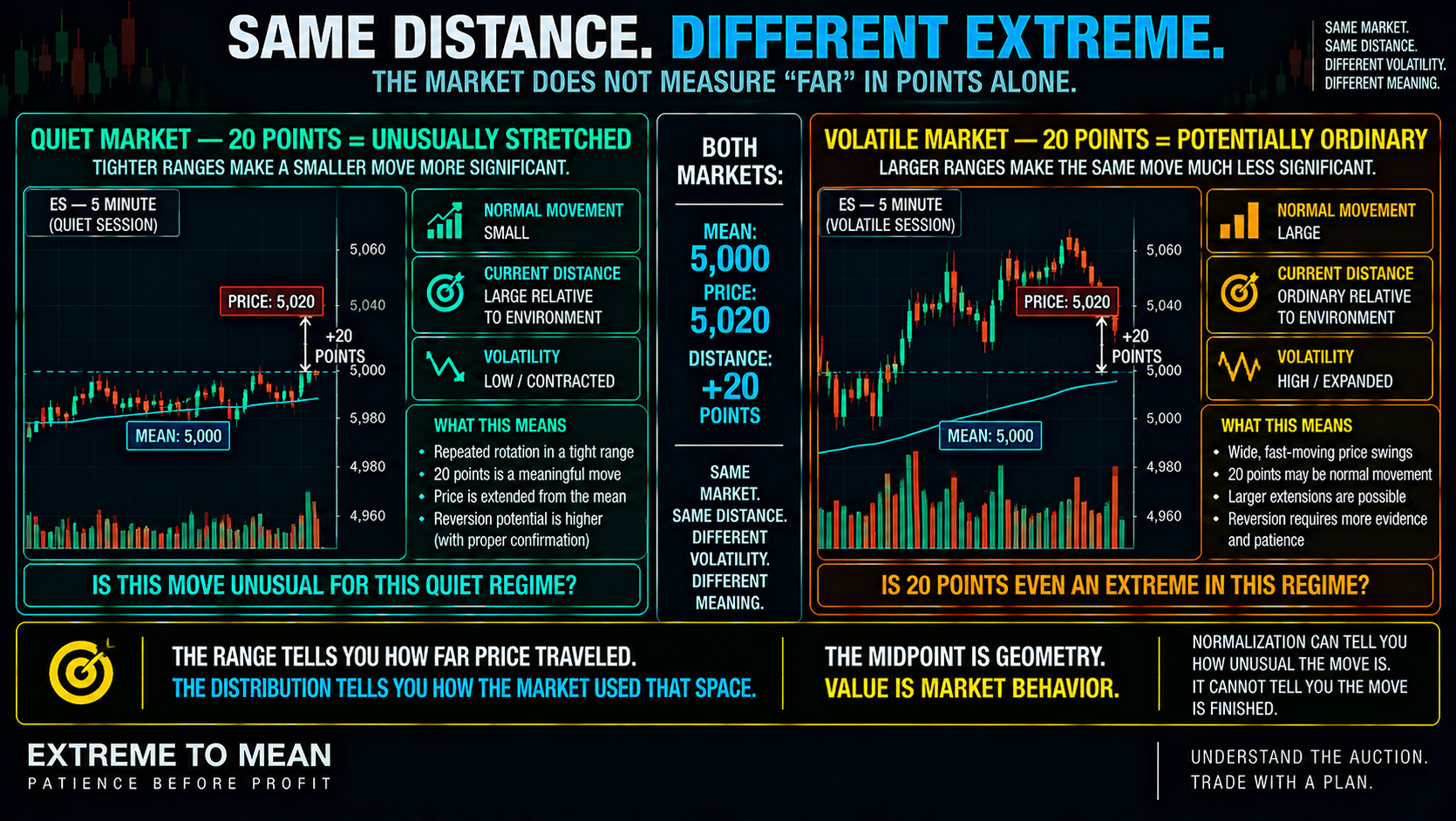
When the market gets quieter, the distance required to become unusual can shrink with it. A modest move away from VWAP, a moving mean, recent balance, or another defined reference may matter if the market has spent hours producing much smaller movement. The raw point count can look unimpressive while the relative departure is significant.
That does not make quiet markets automatically better for mean reversion. A smaller move can be statistically meaningful and still be economically uninteresting if the target is small, nearby structure limits room, or costs consume too much of the potential move. Low volatility can compress both the definition of extreme and the amount of opportunity available after the setup appears, which is why room to revert remains a separate trade-quality question.
Quiet also does not mean weak. A low-volatility market can grind steadily in one direction, produce shallow pullbacks, and keep moving away from an earlier mean without ever looking dramatic. The absence of violent candles is not proof that directional pressure is failing.
High Volatility Expands Normal Movement
When volatility rises, larger movement becomes normal. Yesterday’s extreme can become today’s ordinary pullback, which is why traders get into trouble when they keep fading at distances calibrated to a quieter regime. The market is not honoring a permanent yardstick; the yardstick changed.
Higher volatility can also produce much larger extensions before meaningful reversion begins. The first apparent stretch may simply be the early part of a broader move, especially when trend, momentum, and acceptance remain strong. The largest visual extension can occur in the environment least willing to revert immediately.
This is where market conditions change the quality of a setup. The same rejection pattern can carry very different meaning when bar size, pace, liquidity, and normal range have all changed. A familiar-looking chart does not guarantee familiar behavior.
Bigger Snapbacks Do Not Mean Easier Trades
High-volatility sessions can create spectacular counter-moves. A 70-point extension can snap back 40 points in minutes, but the same environment also created the larger overshoot, faster adverse excursion, and greater cost of being early. Opportunity and danger expanded together.
Higher volatility increases the cost of being early. A trader can be right that price will eventually revert and still be wrong about when the trade is qualified, because price may travel much farther first. Correct destination does not rescue bad timing.
That is also why reversion is not reversal. A large counter-move can still be ordinary relative to the expansion that came before it, and it does not automatically prove that the broader directional structure changed. A pullback only means something relative to the movement and structure surrounding it.
Volatility Changes the Whole Trade
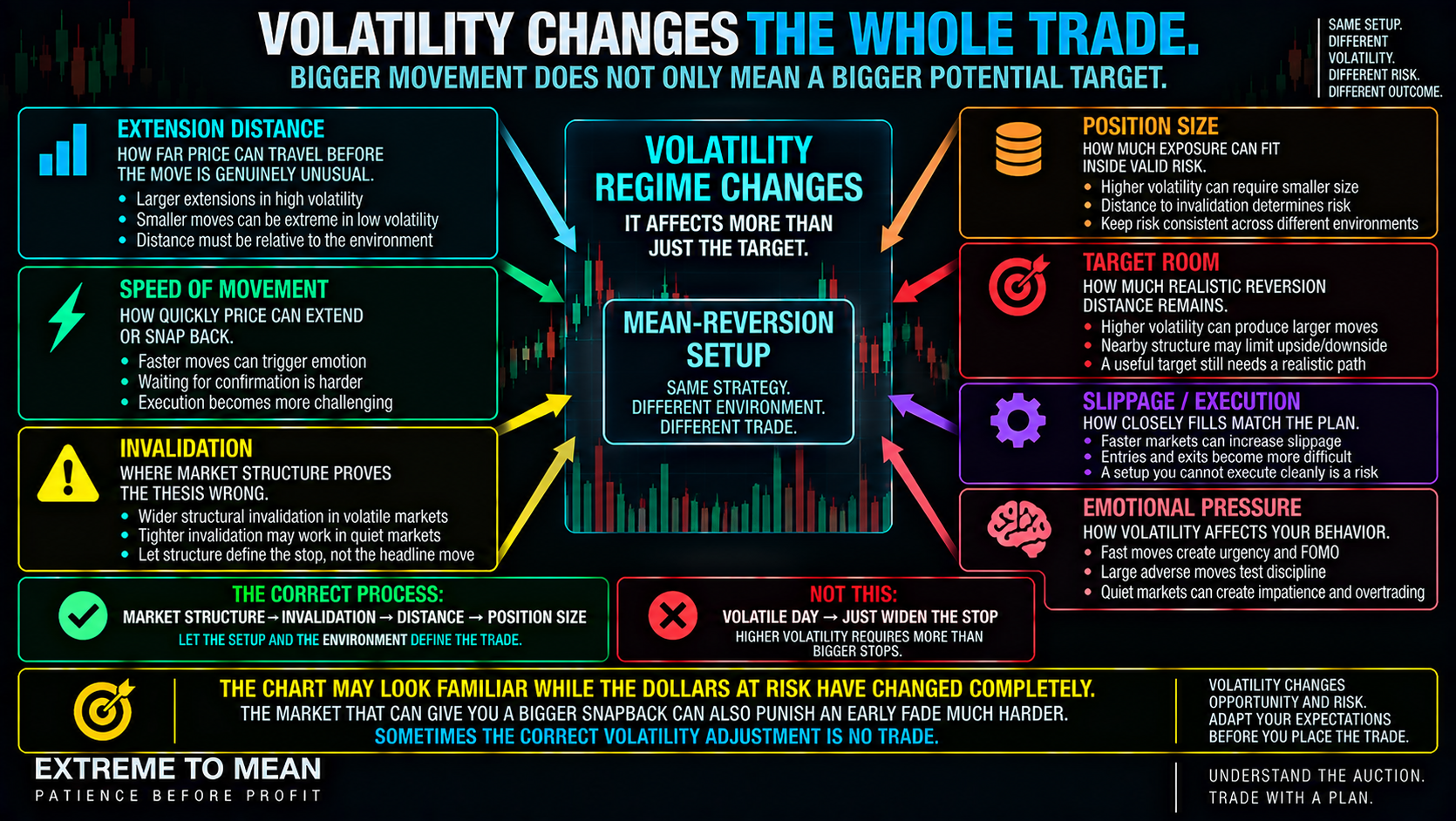
Volatility does not only affect potential reward. It can change extension distance, entry timing, adverse excursion, structural invalidation, target room, trade duration, slippage, and emotional pressure. Saying “volatility is higher, so I will aim for a bigger target” adjusts only the exciting side of the trade.
The chart may look familiar while the dollars at risk have changed completely. If the current structure requires a wider valid invalidation, using the same contract quantity can materially increase financial risk. The setup determines where the thesis is wrong; the account determines how much exposure can fit inside that distance.
Volatility can change how far away valid invalidation sits, but it does not make an arbitrary wider stop more intelligent. The sequence remains market structure → invalidation → distance → position size, not volatile day → add extra points to every stop. Sometimes the proper adjustment is smaller exposure, and sometimes it is no trade.
Trend, Pullbacks, and Market Response Still Matter
A high-volatility market can trend strongly, and a low-volatility market can trend quietly. Volatility describes movement magnitude while trend describes directional persistence, so high volatility does not mean “ready to revert” and low volatility does not mean “safe to fade.” The two dimensions interact, but they are not interchangeable.
In a strong high-volatility trend, price can become visually far from the mean while continuing to make efficient directional progress. In a different high-volatility market, new highs or lows may produce less follow-through and extremes may begin rejecting. Volatility alone cannot decide between those stories; the response still matters.
Regimes Change Faster Than Trader Expectations
The volatility regime is an observation to update—not a label assigned once at the open. A quiet morning can become a different market after scheduled information arrives, while an active opening hour can contract into a slower environment later. A trader using the morning’s ruler all afternoon may be measuring the wrong market.
Regime transitions are especially dangerous because the first large move after a quiet period can look like an extreme when it is actually announcing a new environment. Your memory of what felt extreme yesterday is not a volatility model. One large candle is not enough to prove a new regime either; look for persistence rather than one observation.
ATR can help describe recent range behavior, but it is backward-looking and does not predict the next move. VIX adds options-implied S&P 500 volatility context, but it is not an intraday ES point-distance calculator. A volatility measure can help describe scale without telling the trader whether price will revert.
Execution and Psychology Change Too
Fast markets make execution part of the risk equation. Price can move between decision and fill, stop orders can execute beyond their trigger, and the window for observation, qualification, and manual entry can shrink. A setup you cannot execute cleanly is not improved by the fact that the market is moving more.
Volatility also pushes traders toward opposite mistakes. One trader feels forced to chase a fast move while another feels forced to fade it because it looks impossibly extended; in quiet markets, boredom can make tiny moves seem more meaningful than they are. High volatility creates urgency, low volatility creates impatience, and both can distort judgment when absolute movement replaces context.
The ETM Volatility-Reversion Framework
The goal is not to find one magic volatility threshold. It is to calibrate distance, invalidation, risk, and execution to the environment the trader is actually facing. If volatility matters to the setup, it should eventually become a variable you can test rather than a story you tell afterward.
- Reference — What mean or value reference is the strategy using?
- Horizon — Which trade horizon makes that reference relevant?
- Volatility — Is movement relatively quiet, normal, expanding, or unusually unstable compared with recent behavior?
- Relative stretch — Is the current distance meaningful for this environment, or merely large in raw points?
- Trend and momentum — Is price still making efficient directional progress, or is that progress weakening?
- Response — Is the extreme being accepted, extended, rejected, or worked off sideways?
- Reference movement — Is the mean stable, or is it migrating toward price?
- Invalidation — What market behavior actually proves the reversion thesis wrong?
- Financial risk — Does that structural distance fit the account’s acceptable risk?
- Execution — Can the strategy be executed cleanly at the current speed?
- Target room — Is there enough realistic reversion distance after accounting for structure and the reference?
- Decision — Trade, wait, reduce exposure according to the tested plan, or pass.
The condensed framework is Reference → Volatility → Relative Stretch → Response → Invalidation → Size → Decision. The better question is not, “How many points away from the mean is price?” Ask, “How large is this move relative to the volatility environment I am actually trading?”
Final Thought
Volatility does not tell a mean-reversion trader whether price will come back. It tells the trader how carefully the word extreme needs to be calibrated, because quiet markets can make small deviations meaningful while volatile markets can make large deviations ordinary. The same visual distance can represent completely different trades across regimes.
Higher volatility can create bigger snapbacks, but it can also create deeper overshoots, faster adverse movement, wider structural invalidation, worse execution, and greater emotional pressure. Lower volatility can make smaller deviations unusual while still leaving too little room to make the trade attractive. Bigger potential reward is not the same thing as an easier trade.
Measure the stretch relative to the environment, let structure define invalidation, let risk determine size, and update the ruler when the market changes. The trader’s job remains evaluate → qualify → define risk → decide, which is the process-first logic behind the broader Extreme to Mean system.
Educational content only. Trading involves substantial risk and is not suitable for everyone.