
We are trained to hunt for triggers: a pattern, an indicator cross, a candle that seems to say "go." The trigger feels like the decision because it is the thing that fires. So it gets evaluated first, and the question of where price actually sits gets treated as a footnote.
The result is clean-looking entries taken in poor spots. Right in the middle of a range. Deep into a move that has already run. Back at the average, where there is nothing left to revert toward.
The problem is rarely the signal itself. The problem is that the signal was asked to carry a decision that location should have made first.
This matters because location is where reward and risk are actually set. Get it wrong and even a textbook trigger can hand you a bad trade.
What Location Actually Means
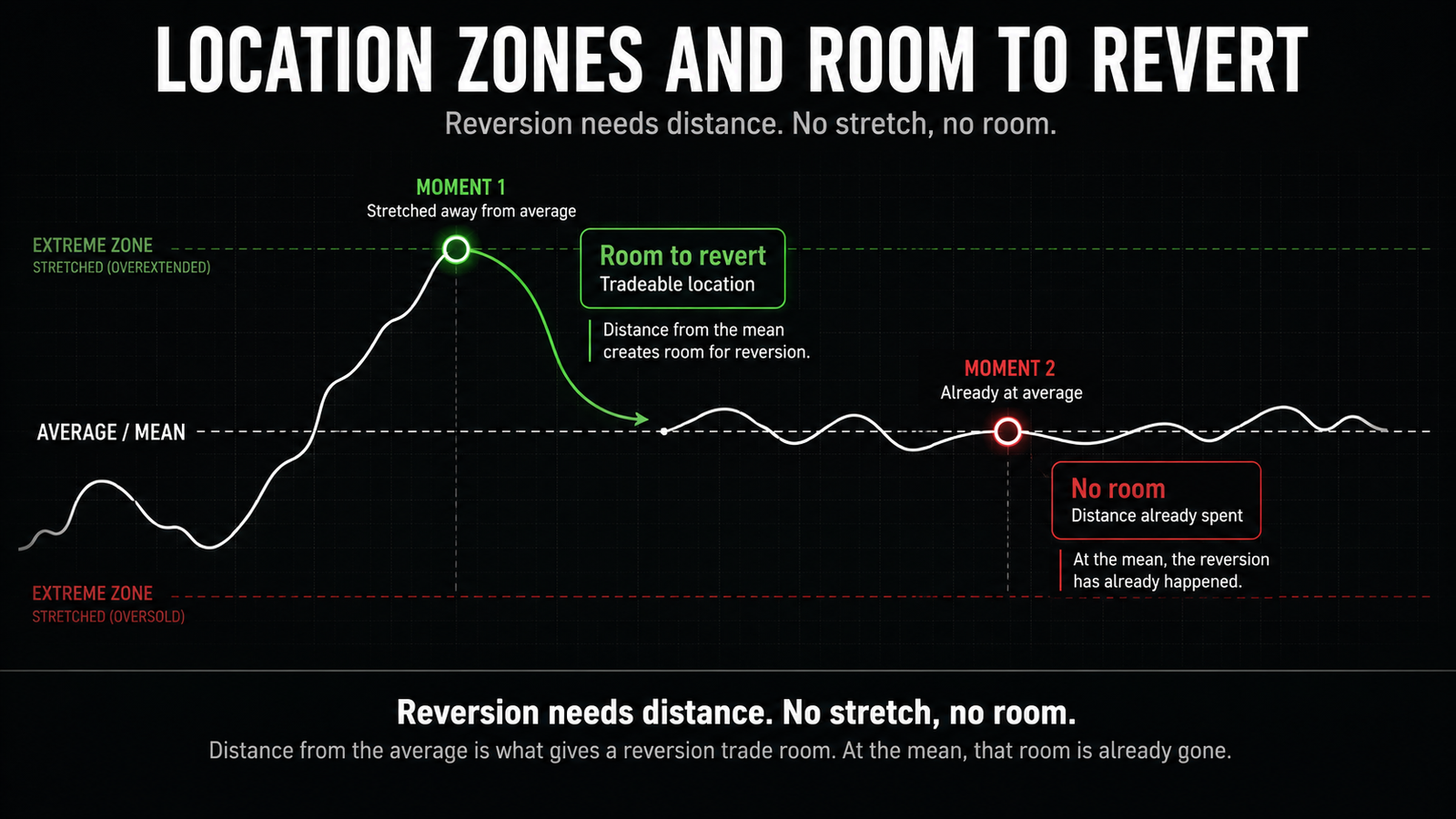
In a reversion-to-mean approach, location describes where price sits relative to its own average and relative to structure. The average is the fair middle that price keeps returning to over time. Structure is the set of levels and turning points price has reacted to before.
Picture three rough zones. Price can be stretched far away from the average, which we call an extreme. It can sit close to the average, in the middle. Or it can be somewhere in between.
The reason this ordering matters is simple: reversion needs distance. A snap back toward the average only has room when price is stretched away from it in the first place. If price is already near the mean, the move we are hoping to catch has nowhere left to go.
How Leading With the Trigger Shows Up
When the trigger comes first, the same mistakes repeat.
A strong move prints a continuation signal, and the trader buys late, far from any edge. A tidy pattern forms in the dead center of a range, where price can drift either direction with equal ease, and the trader takes it anyway because the shape looked right.
Afterward, the note in the journal reads, "The setup looked perfect." It probably did. The trigger was fine. The location was not, and nobody checked the location first.
This is worth being honest about because the trigger is the seductive part. It is visual, it is specific, and it feels like permission. Location is quieter. It asks you to look at the whole picture before you let the signal speak.
Why a Good Trigger in a Bad Location Fails You
The damage shows up in the math.
Your stop still has to sit somewhere logical, so your risk stays a normal size. But in a poor location, your target is short because price is already close to where it was headed. You end up risking a full unit to make a fraction of one.
You are also arriving late, entering where most of the move has already happened and where everyone else is already positioned.
A good trigger does not fix bad reward-to-risk. It just makes a poor trade feel justified on the way in.
What to Look for Instead
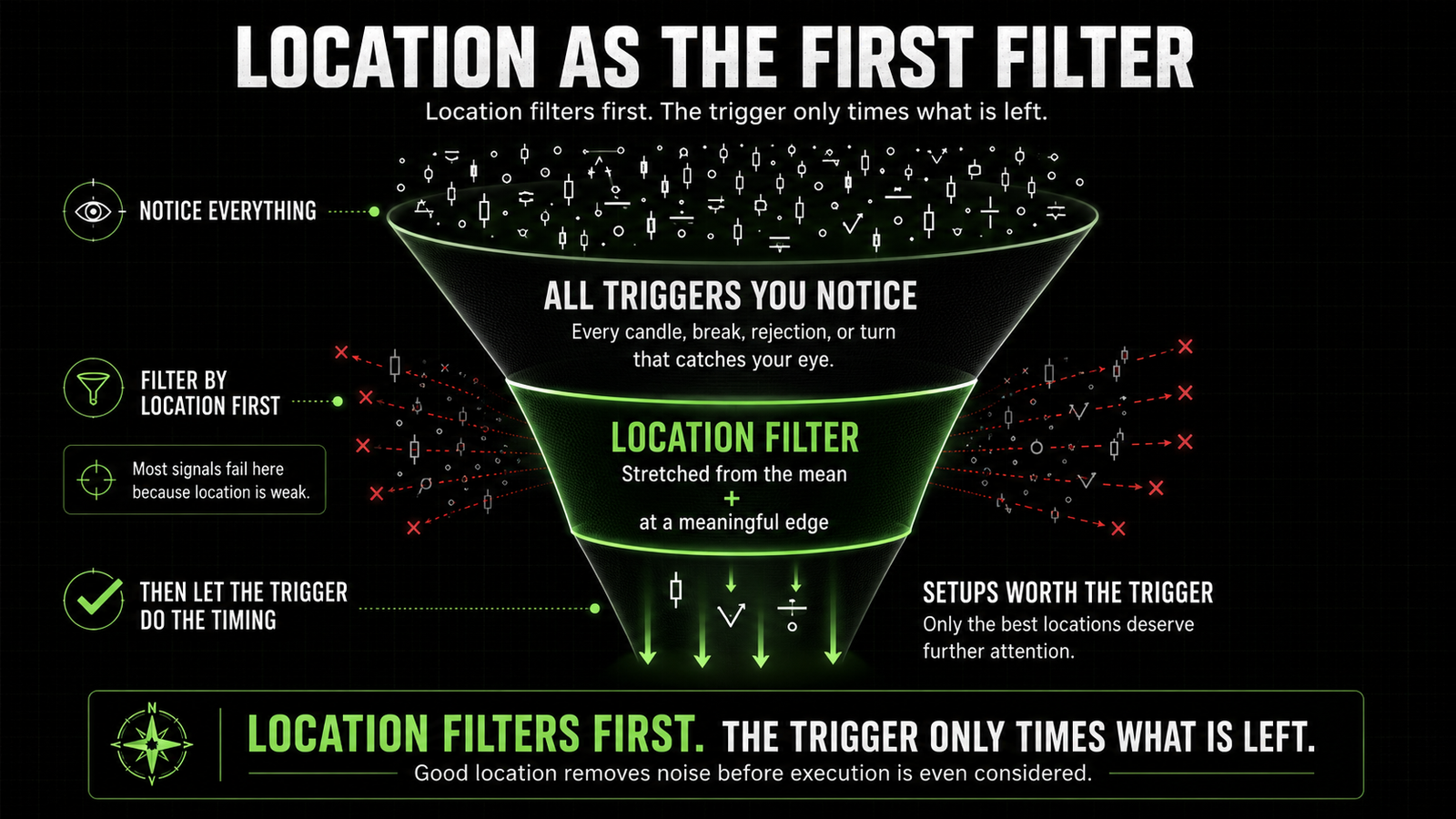
Flip the order. Before you even glance at the trigger, decide where price is.
Is it stretched far enough from the average that a move back has real room? Is it resting at a meaningful edge, a level or a prior reaction point, rather than floating in open space? Only when the location passes do you let the trigger matter at all.
Location decides whether a trade is worth considering. The trigger only decides timing. Those are two different jobs, and most struggles come from asking the trigger to do both.
The Location-First Filter
Run every potential trade through location before anything else. A short checklist keeps the order honest:
- Where is price relative to its average: stretched, middle, or already near the mean?
- Is there room for a move back toward the average, or has that distance already been spent?
- Is price at a meaningful edge, or floating in the open middle of a range?
- If I covered the signal completely, would I still want to be involved here?
That last point is the better question to carry into every setup: ignoring the trigger entirely, is this a location I would want a trade at all?
If the honest answer is no, the trigger does not rescue it. Our job is to evaluate the location, not to react to the signal sitting in front of us.
Final Thought
Strong triggers are everywhere, and they are easy to fall in love with. Location is what decides whether a trigger is worth anything.
Filter for location first and most weak trades quietly disappear before you ever have to talk yourself out of them. Wait for price to reach a place worth acting on, then let the trigger handle the timing.
That is the patient order, and it is the one that protects your decisions.
Educational content only. Trading involves substantial risk and is not suitable for everyone.