
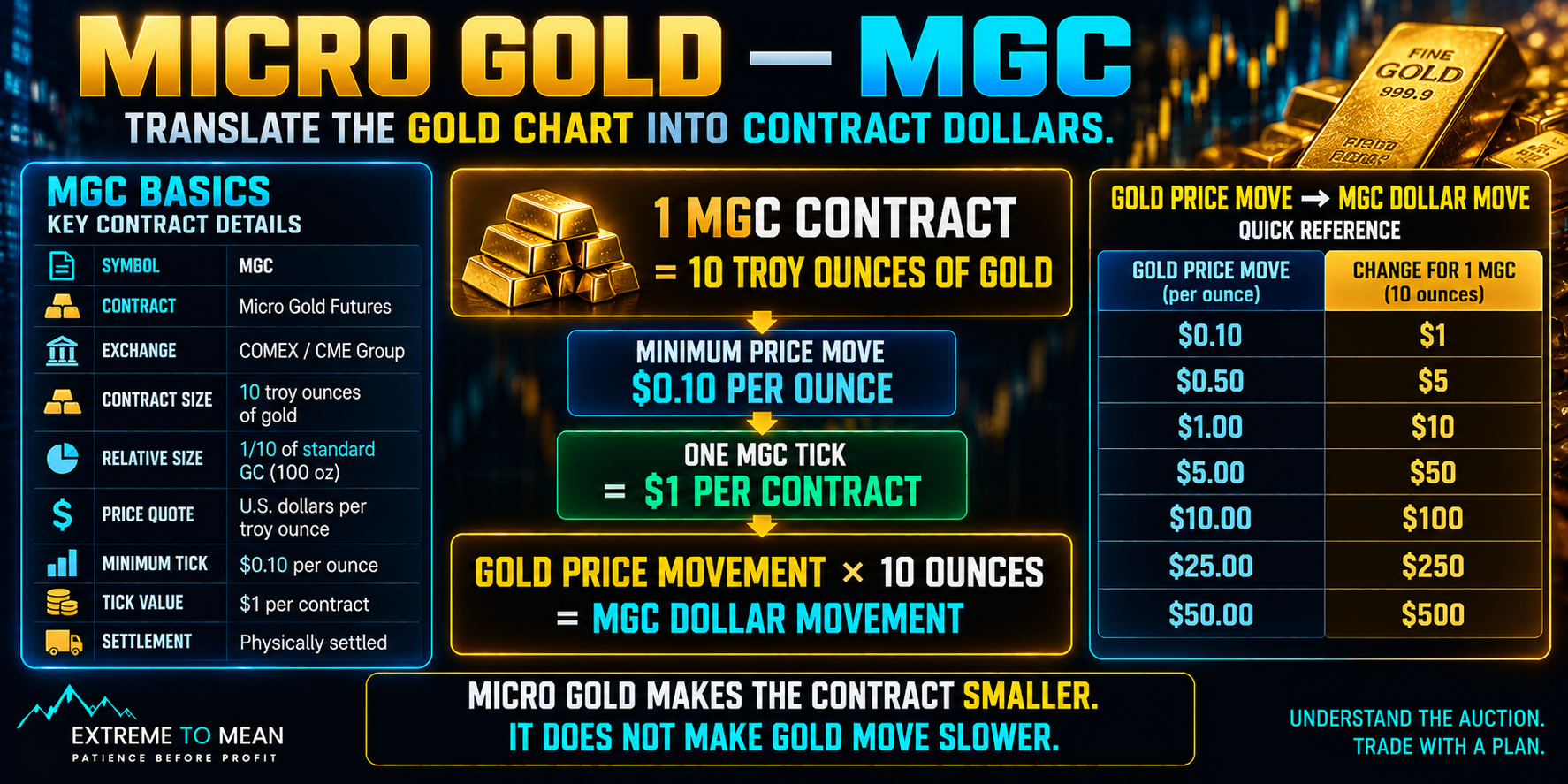
MGC is the Micro Gold futures contract traded through COMEX/CME Group. One contract represents 10 troy ounces of gold, which makes it one-tenth the size of the standard 100-ounce GC Gold futures contract. Because gold is quoted in dollars per troy ounce, that 10-ounce multiplier is the key to translating movement on the chart into actual dollars.
The most useful relationship to learn early is simple: a $1 move in gold equals a $10 move in one MGC contract. A $5 gold move equals $50, a $10 move equals $100, and a $25 move equals $250 per contract. Once that relationship is clear, stop distance and trade risk become much easier to understand.
What Is Micro Gold Futures (MGC)?
MGC is the product code for Micro Gold futures. One MGC contract represents 10 troy ounces of gold, and its price is quoted in U.S. dollars and cents per troy ounce. If the MGC quote says 4,000.00, the market is quoting gold at $4,000 per ounce—not saying that one futures contract costs $4,000.
That distinction matters because the quoted gold price and the dollar change in your futures position are two different things. The contract contains 10 ounces of exposure, so every $1 change in the quoted price of gold changes the value of one MGC position by approximately $10. A trader therefore needs to understand the multiplier behind the chart rather than treating the number on the screen like an ordinary stock price.
MGC is smaller than the standard GC contract, but Micro does not mean low risk. It means the standardized exposure is smaller, which can give traders finer control over how much gold exposure they take. The amount actually at risk still depends on how far the market can move against the position, how many contracts are traded, and where the trade is supposed to be wrong.
MGC Contract Size and What 10 Troy Ounces Means
The easiest way to understand MGC is to imagine the gold price changing by exactly one dollar. Because one MGC controls 10 troy ounces, a $1 move per ounce produces a $10 change in the value of one contract. The multiplication is simply $1 × 10 ounces = $10.
That relationship works for larger moves too. If gold rises from 4,000 to 4,005, the chart moved $5 per ounce, which means one long MGC gained approximately $50 before transaction costs. A short MGC would experience approximately the opposite $50 price effect from the same move.
This is why knowing the contract comes before judging a setup. A move that looks small on the chart may represent meaningful account movement once the contract multiplier is applied. A Micro contract gives you smaller exposure than GC, but the underlying gold market can still move quickly and cover many dollars in a short period.
MGC Tick Size vs. Tick Value
Tick size describes the smallest normal quoted price movement of the contract. For MGC, that minimum move is $0.10 per troy ounce, so a move from 4,000.00 to 4,000.10 is one tick. Tick size tells you what changed on the price scale.
Tick value tells you what that price change means financially for one contract. Since MGC represents 10 ounces, the calculation is $0.10 × 10 ounces = $1. One minimum MGC tick therefore changes one contract's value by $1.
Beginners often confuse the number displayed on the chart with the number affecting the account. A ten-cent change in the gold quote is not ten cents of account movement, because the futures contract represents multiple ounces. Keep the two questions separate: How far did gold move? and What was that move worth on the contract I am trading?
How Gold Price Movement Becomes Dollars on MGC
Once you know that one MGC represents 10 ounces, larger moves become straightforward to translate.
| Gold Price Move | Approximate Change for 1 MGC |
|---|---|
| $0.10 | $1 |
| $0.50 | $5 |
| $1.00 | $10 |
| $5.00 | $50 |
| $10.00 | $100 |
| $25.00 | $250 |
| $50.00 | $500 |
The important beginner message is worth repeating once: when gold moves $1 on the chart, one MGC contract changes by approximately $10—not $1. If gold moves $25, one contract changes by approximately $250. If the position contains two MGC contracts, that same $25 gold move represents approximately $500 of price movement across the position.
That does not tell you whether the movement is profit or loss because direction matters. A long position benefits when price rises and loses when price falls, while a short position behaves in the opposite direction. The reference table is simply translating gold movement into contract movement so you understand the instrument before placing risk on it.
How to Calculate Risk Before an MGC Trade
There is no fixed answer to the question, “How risky is MGC?” The contract has defined mechanics, but trade risk changes depending on your entry, structural invalidation, number of contracts, execution, slippage, and personal risk plan. A Micro Gold trade with a $2 stop is financially different from one requiring a $15 stop even though both use the same symbol.
The basic price-risk calculation is:
Gold stop distance × $10 per $1 move × number of MGC contracts = approximate price risk before fees and slippage
Suppose a hypothetical MGC long entry is 4,000 and the market structure says the trade is wrong at 3,992. The structural stop is therefore $8 away, and one MGC changes approximately $10 for every $1 gold move. $8 × $10 = approximately $80 of price risk for one MGC contract before fees and slippage.
For two contracts, the same structural stop represents approximately $160 of price risk; for three contracts, approximately $240. Notice that nothing about the chart-based invalidation changed when the number of contracts changed. The market tells you where the thesis is wrong, while position size determines how much account exposure you attach to that distance.
That leads directly to one of the most important ETM risk principles. If a trader wants to risk only $50 but the correct structural stop requires roughly $80 on the smallest available MGC position, the answer is not automatically to squeeze the stop closer until the calculator says $50. The trade is not ready until the risk is clear, and if the smallest appropriate position still risks too much, the trade may simply not fit the account.
MGC vs. Standard Gold Futures (GC)
MGC and GC both track the gold futures market, but they represent very different amounts of standardized exposure.
| Feature | MGC | GC |
|---|---|---|
| Contract | Micro Gold | Standard Gold |
| Gold represented | 10 troy oz. | 100 troy oz. |
| Relative size | 1/10 of GC | Benchmark |
| $1 gold move | Approx. $10 | Approx. $100 |
| $10 gold move | Approx. $100 | Approx. $1,000 |
The point of the comparison is not that MGC is automatically better. Its smaller contract size provides finer control over gold exposure, which may make it easier to align position size with an appropriate structural stop than using the full 100-ounce GC contract. Smaller standardized exposure improves granularity; it does not change the volatility of gold itself.
There is also an important current-product detail. CME now offers 1-Ounce Gold futures, a contract that is one-tenth the size of MGC and one-hundredth the size of standard GC. That means MGC should be described as the established 10-ounce Micro Gold contract, not as CME's smallest available Gold futures product.
Expiration, Settlement, and Trading-Hour Awareness
MGC is a futures contract, so the root symbol alone is not always the complete tradable ticker. Futures have listed expiration months, and traders need to know which contract month is active on the platform they are using. If you are still learning ticker construction, the broader ETM lesson library should be used alongside your broker and exchange specifications rather than guessing which expiration to trade.
CME currently lists MGC as physically settled, which makes expiration awareness important even for traders who normally close positions well before delivery procedures become relevant. “Physically settled” does not mean a typical short-term trader should expect a ten-ounce gold bar to arrive at the door; it means the contract has specific exchange settlement and delivery procedures that matter as expiration approaches. Know what contract you are trading and what your broker requires before holding futures near expiration.
Gold also trades across far more of the week than the U.S. stock-market session. Important movement can develop during overseas trading, economic releases, or other periods when U.S. equity markets are closed. Exact schedules can change, so verify current exchange and broker hours rather than treating an old schedule as permanent.
What Moves Gold Futures? The Context That Matters
Gold traders commonly monitor Federal Reserve policy expectations, inflation data such as CPI and PPI, employment reports, Treasury yields, the U.S. dollar, and periods of geopolitical or financial uncertainty. Those forces can affect expectations about monetary policy, real and nominal yields, currencies, risk demand, and the relative appeal of holding gold. They provide a useful explanation for why gold may suddenly become more active.
The relationships are not mechanical. A stronger dollar does not guarantee gold will fall, higher yields do not guarantee gold will fall, and a geopolitical headline does not guarantee gold will rise. Markets can weaken, strengthen, or temporarily break familiar relationships as participants respond to multiple forces at once.
That makes macro information context, not permission. Market conditions change the quality of a setup, and understanding why gold is volatile does not tell you where an entry belongs. Knowing why gold might move is not the same as knowing where a trade belongs.
Why Macro Context Is Not an Entry Signal
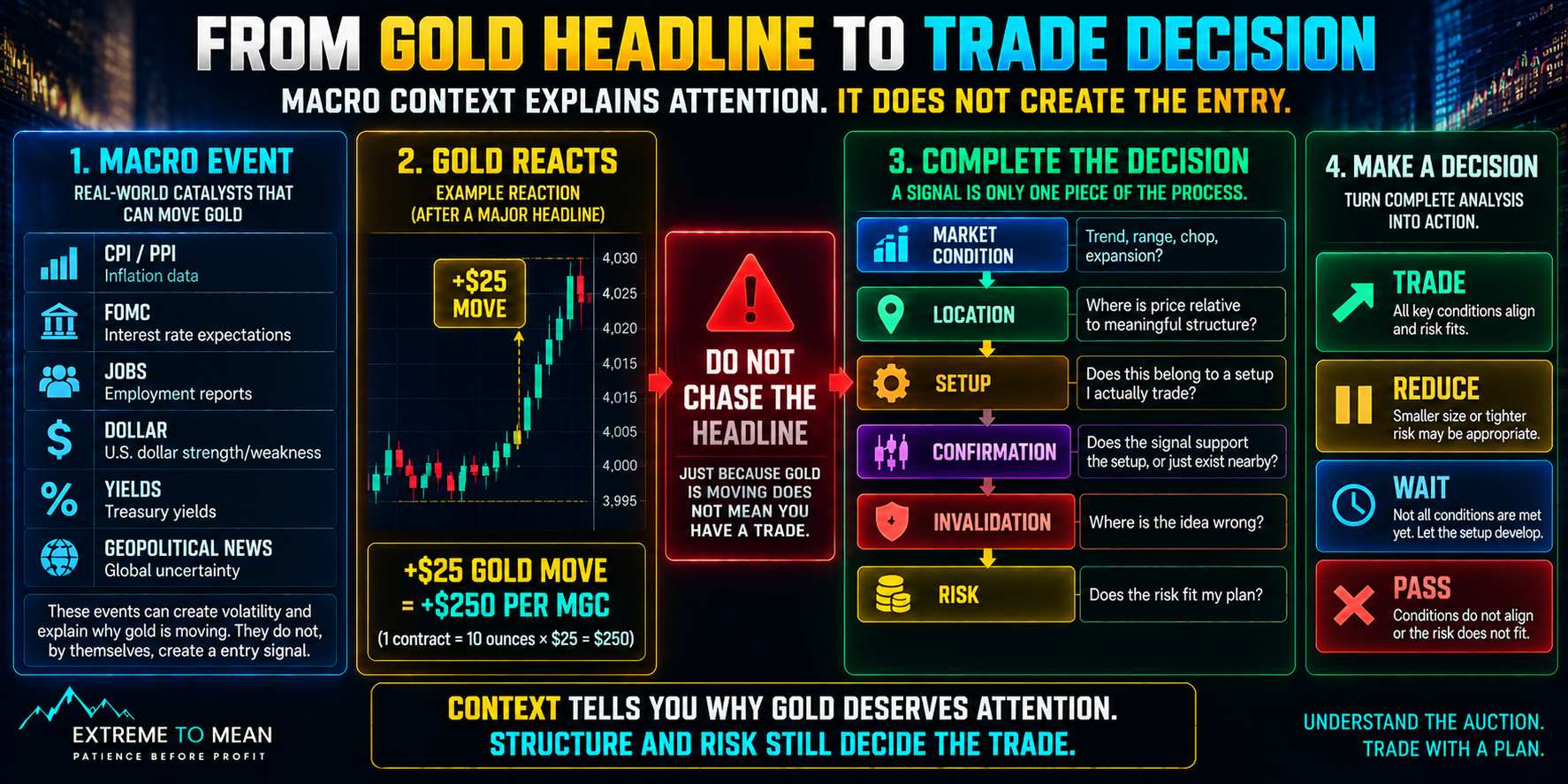
Imagine a major inflation report hits and gold jumps $25 quickly. A beginner sees the headline, decides the news is bullish for gold, and feels pressure to buy MGC before the move gets away. Before doing anything else, translate the movement: a $25 gold move represents approximately $250 per MGC contract.
That translation immediately changes how you see the chart. Price has already traveled a meaningful distance, volatility may be elevated, the structural stop may now be farther away, and chasing after the headline may create substantially more dollar risk than the trader expected. The fact that the original macro interpretation was reasonable does not make the current entry reasonable.
A cleaner sequence is understand the event → observe the reaction → evaluate the market condition → evaluate location → wait for a setup → define structural invalidation → translate the stop into MGC dollars → trade, reduce, wait, or pass. If the reaction has already carried price away from sensible location, chasing the trade because the headline still sounds convincing does not improve the setup. Context explains why gold deserves attention; structure and risk still decide whether it deserves a trade.
The ETM MGC Decision Framework
Use this sequence whenever you evaluate a Micro Gold idea:
- CONTRACT — Am I actually looking at MGC, and what does one contract represent?
- MOVEMENT — How much is a $1 move worth on this contract?
- CONTEXT — Why is gold active today?
- LOCATION — Where is price relative to meaningful structure?
- SETUP — Has an actual trade idea developed?
- RISK — Where is invalidation, and how many gold dollars away is it?
- DECISION — TRADE / REDUCE / WAIT / PASS
The contract math should be completed before emotion enters the decision. If the structural stop is eight gold dollars away, one MGC represents about $80 of price risk before costs and slippage; you should understand that before submitting the order. A $1 move on the gold chart is a $10 move in one MGC contract, so translate the chart into dollars before the trade translates it for you.
Then ask the better questions: Has gold already become extended after the event? Is the location meaningful, does a real setup exist, what actually invalidates the idea, and does the smallest suitable position fit the account? The free tools library can help with calculations, but the calculator cannot decide where the correct structural stop belongs.
Final Thought
MGC gives traders a smaller way to participate in the Gold futures market, but the contract still carries real leverage and real dollar movement. Learn the 10-ounce multiplier, remember that every $1 gold move is approximately $10 per MGC, and translate every structural stop into actual account dollars before deciding whether the trade fits.
Then keep the contract mechanics separate from the trade thesis. Fed policy, inflation data, yields, the dollar, and geopolitical developments can explain why gold deserves attention, but they do not automatically provide an entry. Context tells you why gold deserves attention; location, setup, and risk decide whether it deserves a trade.
Educational content only. Trading involves substantial risk and is not suitable for everyone.