Two traders can sit still for ten minutes and look equally disciplined from the outside. One may be following a clear plan while the other is avoiding a decision they already know how to make. The difference is not the absence of action; it is the reason the action is being delayed.
Key Idea
Patience delays action until a defined condition is met. Procrastination delays action to avoid the discomfort of deciding.
Trading patience is often praised because acting too early can ruin otherwise good ideas. But inactivity by itself is not evidence of discipline, and hesitation is not automatically caution. The useful question is not simply, “Am I waiting?” but, “What exactly am I waiting for, and what happens when it arrives?”
That distinction belongs inside the broader Trader curriculum because disciplined trading requires both restraint and commitment. Sometimes the cleanest decision is to wait longer, and sometimes it is to stop waiting and use the rules already defined. Neither action nor inaction is automatically disciplined; the plan determines which one fits.
Waiting Is Not Automatically Patience
A trader can spend an entire morning doing nothing and still be avoiding the work of deciding. Thoughts such as “I do not want to be wrong,” “maybe I need one more candle,” or “I will know when it feels better” can sound cautious while leaving the actual decision undefined. Patience is defined by the reason for the wait, not by the absence of a trade.
Fear and uncertainty can easily borrow the language of discipline. Saying “I am being patient” feels better than admitting “I do not want to commit risk even though my plan has already given me enough information.” The goal is not to shame hesitation; it is to identify whether the delay still serves the process.
Hesitation can also be completely rational. Information may be incomplete, the market may be poorly located, risk may no longer fit, or conditions may have changed. The test is not whether you acted quickly; it is whether you can explain why waiting is still the correct response.
Patient Traders Know Exactly What They Are Waiting For
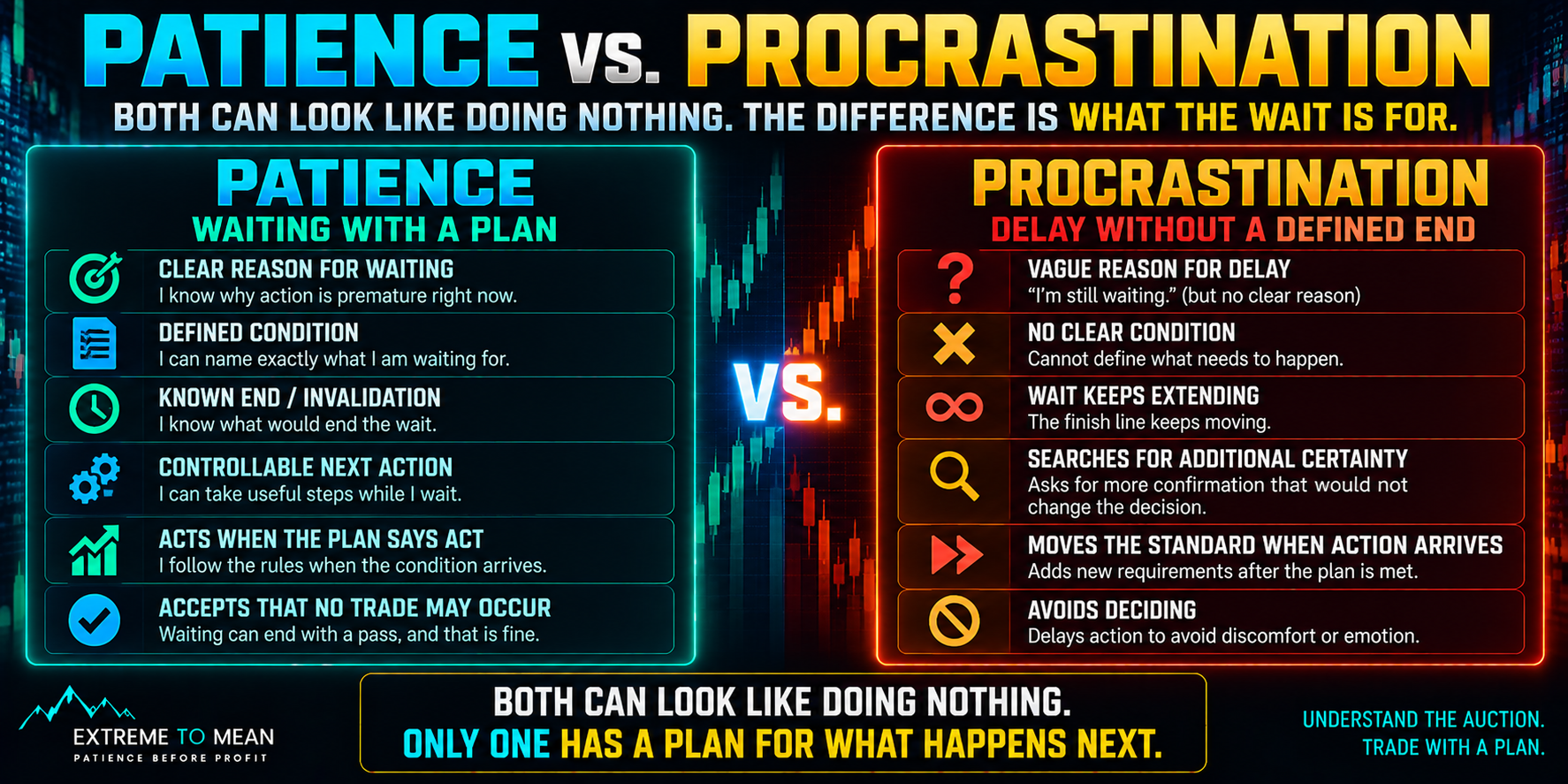
A patient trader can usually complete one sentence: “I am waiting for ______.” The blank might be a pullback into planned location, a setup to finish forming, an economic release to pass, volatility to settle, or market structure to become clearer. The condition does not guarantee a trade; it explains why action is premature right now.
That makes planned waiting very different from vague delay. If price is extended and your plan requires a pullback before you evaluate an entry, you know what must change before the trade becomes relevant. You are not waiting for confidence to magically appear; you are waiting for a market condition your process already defined.
This is where a trading plan made before the open becomes especially useful. A written plan gives the waiting period a purpose because the future decision already has a reference point. Instead of asking every candle whether you should act, you can compare the market with the condition you said mattered before urgency arrived.
Good Waiting Has an Ending
Strategic waiting also needs an exit condition. A trader should know not only what could make the trade interesting, but what would make the idea expire, require reassessment, or disappear entirely. Without that boundary, “patience” can become indefinite attachment to an opportunity the market no longer offers.
Suppose you are waiting for NQ to pull back into a planned area during an uptrend. If price keeps accelerating higher without returning, your opportunity may simply be gone; if structure breaks, the original bullish idea may no longer deserve attention. If you know what starts the trade but not what ends the wait, you may stay loyal to an idea long after the market has changed.
This is also where restraint protects you from the opposite mistake. If price never returns to your location, the answer is not to chase because you “waited long enough.” Chasing the trade turns the absence of your setup into a reason to abandon the very location rule that made waiting useful.
When “More Confirmation” Becomes Avoidance
Additional confirmation can be legitimate when the plan requires it. The problem begins when the original standard has already been satisfied and the trader invents a new requirement because acting now feels uncomfortable. “One more candle” becomes another indicator, then another timeframe, then another test that was never part of the original plan.
A useful question is, “What specific information am I waiting for, and what decision would it change?” If another candle could genuinely disqualify the trade or improve a required part of the setup, waiting may still be purposeful. If nothing meaningful would change except the trader feeling more certain, the delay may be asking the market for something trading cannot provide.
That does not mean a qualifying setup must always be taken. Risk may no longer fit, event risk may have changed, a daily stopping rule may have been reached, or personal readiness may have deteriorated. The important distinction is whether a legitimate condition changed or whether the trader simply moved the standard after the original condition arrived.
Ask What You Can Actually Control Right Now
Purposeful waiting becomes easier when the trader separates what the market controls from what the trader controls. You cannot force price to pull back, create a setup, calm volatility, or deliver a cleaner location. You can decide what will qualify, where the idea would be wrong, how much risk would fit, and what you will do if price never returns.
That may mean setting an alert instead of staring at every tick. It may mean documenting the scenario, checking scheduled event risk, reviewing another market, or stepping away until the relevant condition occurs. Active patience does not require constant activity; it means the next useful action is already known.
The same principle applies outside the entry itself. “I will work out my sizing rules later” is not patience when nothing external has to happen before the work can begin, just as postponing review of a repeated mistake is not strategic waiting when the evidence is already available. Ask, “Is there something I genuinely need to wait for, or is the controllable action available now?”
Do Not Move the Goalposts When Action Becomes Uncomfortable
Consider a trader watching NQ in an uptrend. The plan says not to chase the extension; wait for price to pull back into a planned location and for the setup to qualify. While price remains extended, doing nothing is patience because the trader can name the condition, the reason for it, and what makes the opportunity disappear.
Eventually the pullback arrives, the setup qualifies, and risk remains acceptable. Now the trader says, “Maybe I will wait for another candle,” then asks for stronger momentum, then waits to make sure support really holds. Nothing in the original plan required those extra conditions; they appeared only after the decision became real.
That is the core distinction: Patience waited for the plan. Procrastination moved the finish line after the plan arrived. The problem is not that the trader took more time; the problem is that the standard changed without new information requiring it. When the condition arrives, the plan should become clearer—not suddenly require an entirely new set of conditions.
Sometimes Patient Waiting Ends With No Trade
Waiting with a plan does not mean every idea eventually becomes an entry. The condition may never appear, the setup may arrive after risk has become unattractive, or new information may invalidate the scenario. A pass does not mean the waiting failed.
The purpose of waiting is to prevent premature action, not to guarantee participation. Doing nothing can still be a trading decision when the process says the opportunity never became good enough. A trader can wait correctly, watch the idea disappear, and finish with no trade at all.
This matters because traders sometimes judge patience only by whether they eventually participated. If they waited and missed the move, they assume they were too slow; if they waited and entered, they assume the patience was justified. The better measure is whether the waiting followed a defined condition and whether the final action—or pass—matched the plan.
The ETM Patience-vs.-Procrastination Test
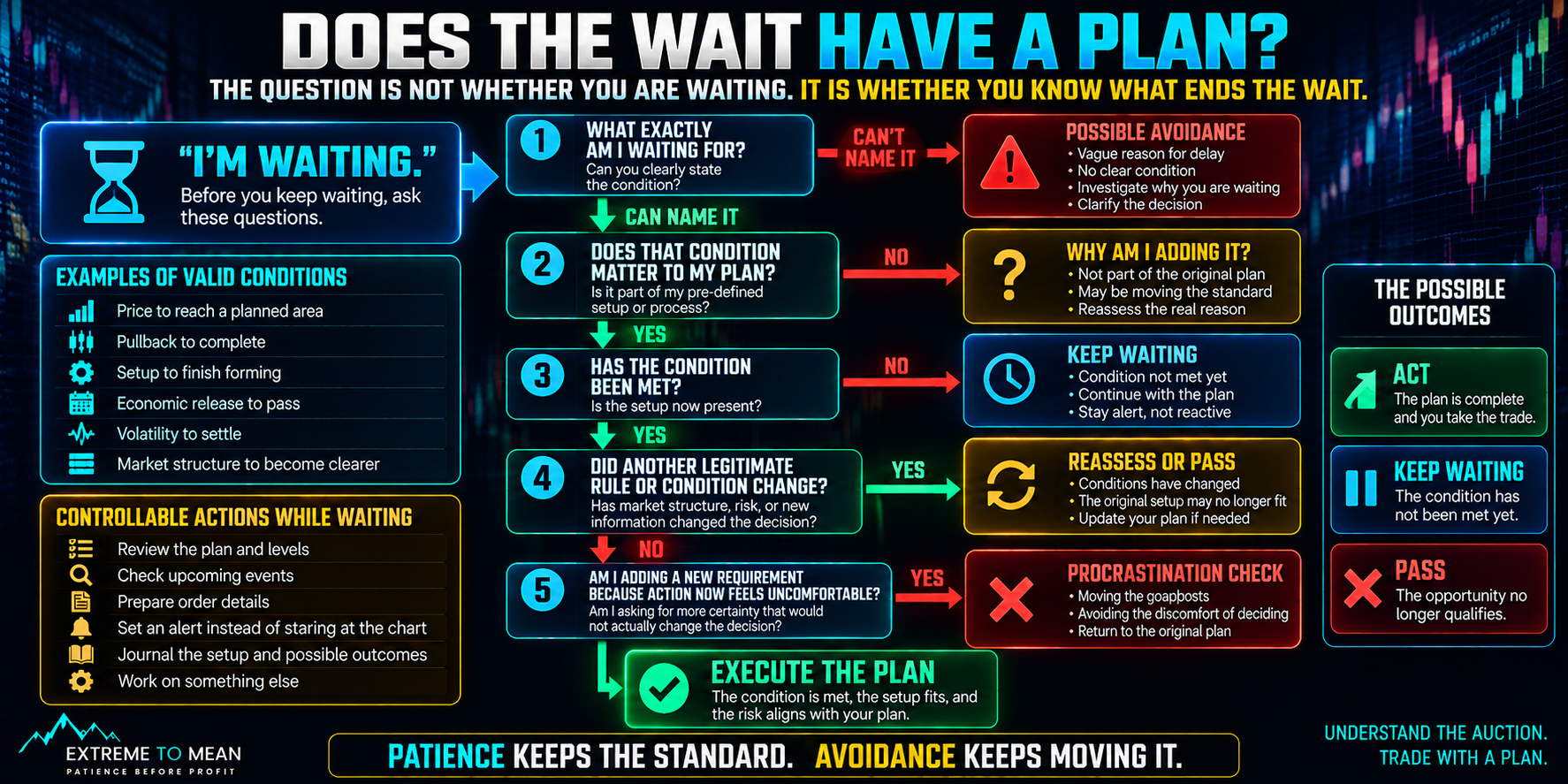
When you hear yourself say, “I am waiting,” run five questions:
- WHAT AM I WAITING FOR? — Name the exact condition.
- WHY DOES IT MATTER? — Explain what that condition adds to the decision.
- WHAT ENDS THE WAIT? — Define what invalidates, expires, or changes the idea.
- WHAT CAN I DO NOW? — Identify useful preparation currently within your control.
- IF THE CONDITION APPEARS, WILL I ACT? — If the answer becomes “maybe I need something else,” investigate why the standard changed.
The broader sequence is PURPOSE → CONDITION → END POINT → ACTION NOW → DECISION. When the market changes, the possible outcomes are ACT / KEEP WAITING / PASS. The most important review question comes after the condition is met: Did I move the condition after it arrived?
Specific if-then rules can make that process easier to follow. For example: if price has not reached my planned location, I do not evaluate an entry; if price reaches the location and the setup qualifies, I make the decision using the rules already defined; if the scenario invalidates before qualification, I stop waiting for that trade. The goal is not to remove judgment but to keep the standard from changing simply because commitment feels uncomfortable.
If repeated hesitation keeps spilling into every decision, protecting your next decision may be more useful than forcing yourself to act faster. A trader does not need to become aggressive to solve procrastination. The cleaner objective is to know in advance what justifies waiting, what justifies acting, and what justifies walking away.
Final Thought
Patience and procrastination can look identical from the outside because both involve not acting. The difference is whether the delay has a purpose, a condition, an ending, and a defined response when the condition changes. Good waiting has an answer to “What happens next?”
Wait when the process says wait. Act when the process says act, without inventing a new finish line simply because risk has become emotionally real. Pass when the opportunity no longer qualifies, because patience is not measured by how long you waited—it is measured by whether the waiting served the plan.
Educational content only. Trading involves substantial risk and is not suitable for everyone.