
Every trader wants the next trade to work. That is normal. Nobody enters a position hoping to be wrong, and nobody enjoys taking a loss. But the mistake many traders make is treating the current trade like it is the whole game. They become so focused on saving it, fixing it, proving it right, or recovering from it that they damage the one thing they needed most: the ability to evaluate the next opportunity with a clear mind.
This is where trading often breaks down. Not because the first loss was too large by itself. Not because the setup was impossible to understand. Not because the market did something mysterious. The trader psychology lessons focus on what happens after the trade, in the decisions that follow.
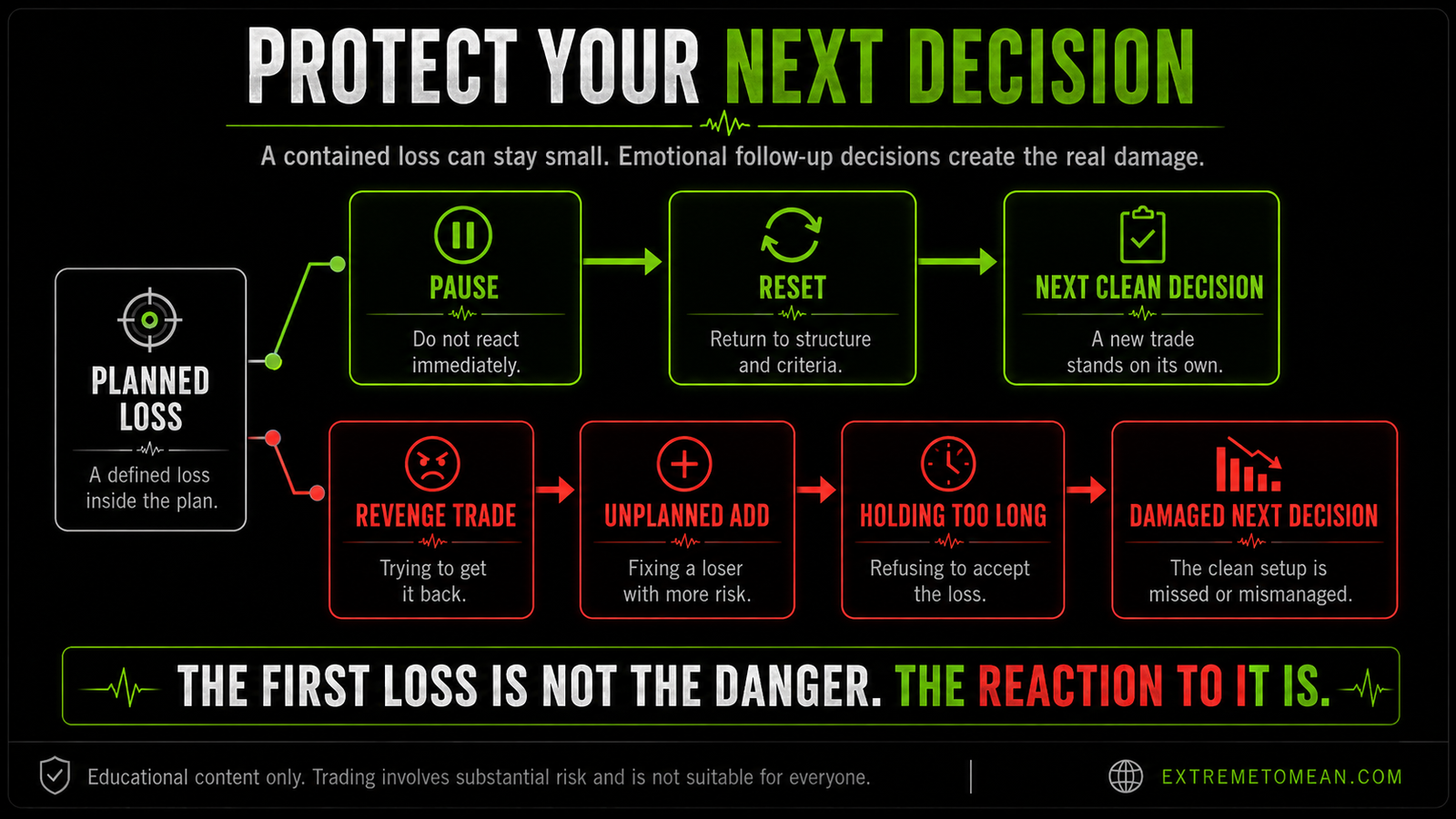
A planned loss can usually be absorbed. It may be frustrating, but it is part of the business of trading. A planned loss has a defined entry, a defined invalidation point, and a reason for exiting when the idea no longer makes sense. What causes real damage is what happens when a trader refuses to let the first loss stay planned. Revenge trades, emotional re-entries, unplanned adds, moving stops, holding too long, doubling size, and forcing the next setup are usually not trading decisions. They are attempts to repair discomfort.
That is why the next decision matters so much. The next decision may be the clean one. The next setup may be the one that actually fits your plan. But if the previous trade leaves you tilted, rushed, angry, or desperate to recover, you may not be able to take it properly. That is where FOMO becomes the tax you pay for chasing.
The Next Decision Is the Asset
Most traders think their capital is the only thing they are trying to protect. Capital matters, of course. Without it, there is no trade to place. But capital is not the only resource in play. Your attention, emotional control, and decision quality are also part of the account, which is why size affects decision quality.
A trader can take a small planned loss and remain fully capable of evaluating the next setup. That is a healthy outcome, even if the trade itself did not work. The loss did not damage the process. It simply confirmed that the idea was wrong or that conditions did not follow through.
The problem begins when a trader makes the loss mean more than it should. Instead of seeing it as one completed decision, they treat it as a threat to their identity, their confidence, or their day. The next trade becomes less about opportunity and more about repair. That shift is subtle, but it changes everything, and reversing it is a big part of what it takes to recover confidence after a difficult stretch.
Once the goal becomes “get it back,” the trader is no longer evaluating the market on its own terms. They are evaluating the market through the emotional residue of the previous trade. A setup that would normally be rejected suddenly looks acceptable. A late entry suddenly feels necessary. A stop that should be respected suddenly feels negotiable. The market has not changed. The trader’s state has.
Your next decision is the asset because it is the point where your process either stays intact or starts to unravel. Protecting that decision means accepting that no single trade is important enough to compromise the next one.
How Traders Damage the Next Trade
The most common way traders damage the next decision is by trying to fix the current one after it has already failed. This often starts with a small adjustment that feels reasonable. The stop gets moved a little farther because “the idea is still valid.” Size gets added because “the better entry is lower.” A losing trade gets held longer because “price should come back.” None of these choices may feel reckless in the moment. They often feel logical.
But there is a difference between managing a trade and negotiating with a failed idea. Managing a trade means responding to new information inside a trading plan you made before the open. Negotiating with a failed idea means changing the plan because the outcome is uncomfortable.
Revenge trading follows the same pattern. It rarely announces itself as revenge. It sounds more professional than that. The trader says the next setup is related, the tape still supports the direction, or the move is overextended and ready to turn. Sometimes those statements may even contain some truth. But the question is not whether the trader can build a story around the next trade. The question is whether they would have taken that trade with the same conviction if the previous trade had not just lost money.
Unplanned adds are another major source of damage. Adding to a trade can be part of a structured strategy when it is planned in advance, sized properly, and tied to clear criteria. But adding because the position is losing and the trader wants a better average price is a different behavior entirely. That is not structure. That is emotional repair disguised as trade management.
Holding too long can be just as destructive. A trader sees the exit, knows the idea has weakened, but stays in because closing the trade would make the loss real. The longer they hold, the more attention the position consumes. By the time the trade finally ends, the trader is mentally exhausted, frustrated, and far less prepared for the next clean opportunity.
Why Bad Follow-Up Decisions Feel Reasonable
Bad follow-up decisions feel reasonable because they are usually attached to a real market observation. Price may still be near a level. The trend may still exist. A bounce may still be possible. The trader is not always inventing everything from nothing. The danger is that the observation gets used to justify a decision that is really being driven by emotion.
This is why the period immediately after a loss is so important. A trader who just lost money is often searching for evidence that the loss can be corrected. The mind wants closure. It wants the trade to make sense again. It wants the discomfort to end. That pressure can turn ordinary market movement into a reason to act.
The market also makes this difficult because it does not move cleanly enough to remove doubt. A losing trade may briefly move back toward the entry. A failed setup may produce a small bounce after the stop would have been hit. A revenge entry may work for a few candles before failing again. These moments teach the wrong lesson if the trader is not careful. They make emotional decisions feel like they almost worked.
That “almost” is dangerous. It encourages the trader to repeat the behavior, refine the excuse, or believe the problem was timing rather than process. But the issue is not that the trader needed to hold longer, add sooner, or react faster. The issue is that the decision was no longer clean.
A cleaner decision is one that can stand on its own. It does not need the previous trade to justify it. It does not exist because the trader is angry, embarrassed, or eager to recover. It has location and context, and the trade is not ready until the risk is clear.
What a Better Trader Protects
A better trader does not try to protect every trade from becoming a loss. That is impossible. Losses are part of trading, and pretending otherwise creates fragile decision-making. A better trader protects the process that decides what happens next.
That means respecting planned exits, even when they are annoying. It means letting a trade be wrong without turning the next five minutes into a recovery mission. It means understanding that the market will continue offering movement, but not all movement deserves participation. Sometimes doing nothing is still a trading decision.
Protecting the next decision also means protecting emotional bandwidth. If a trade has left you angry, rushed, or fixated on getting back to even, that is not a small detail. That is market-relevant information about you. The next setup may look clear, but your ability to judge it may not be clear. In that situation, waiting is not weakness. It is risk management.
This is where patience becomes practical. Patience is not only waiting for a setup before the first trade. It is also waiting after a trade has gone wrong. It is the discipline to pause long enough for the next decision to be made from structure instead of emotion.
The trader who protects the next decision is not passive. They are actively preserving the conditions required for good judgment and taking time to prepare the decision before pressure appears. They understand that one bad trade does not have to become a bad sequence. The sequence usually starts when the trader refuses to stop, reset, and let the next decision be independent.
A defined daily loss limit protects decision quality before that sequence can compound.
A Decision Filter Before You Continue
After any losing trade, frustrating exit, missed move, or emotional reaction, pause before taking the next trade. The goal is not to punish yourself or avoid trading altogether. The goal is to determine whether the next decision is clean enough to deserve risk.
Ask these questions before continuing:
- Would I take this next trade if the previous trade had not happened?
- Am I entering because the setup is ready, or because I want to recover?
- Is the risk defined before entry, or am I still emotionally negotiating?
- Has the market created a new opportunity, or am I trying to fix the old one?
- Can I clearly explain why this trade stands on its own?
If the answer to any of those questions is unclear, the next trade has not earned your risk yet. That does not mean the setup cannot work. It means your evaluation may not be clean enough to trust. In trading, that distinction matters.
A better question to ask is this: “Am I protecting my next decision, or am I spending it to feel better right now?”
That question cuts through the noise. It forces the trader to separate opportunity from emotional relief. Some trades are taken because they meet criteria. Others are taken because the trader wants the discomfort of the previous trade to end. Those are not the same thing, even if the chart appears to support both.
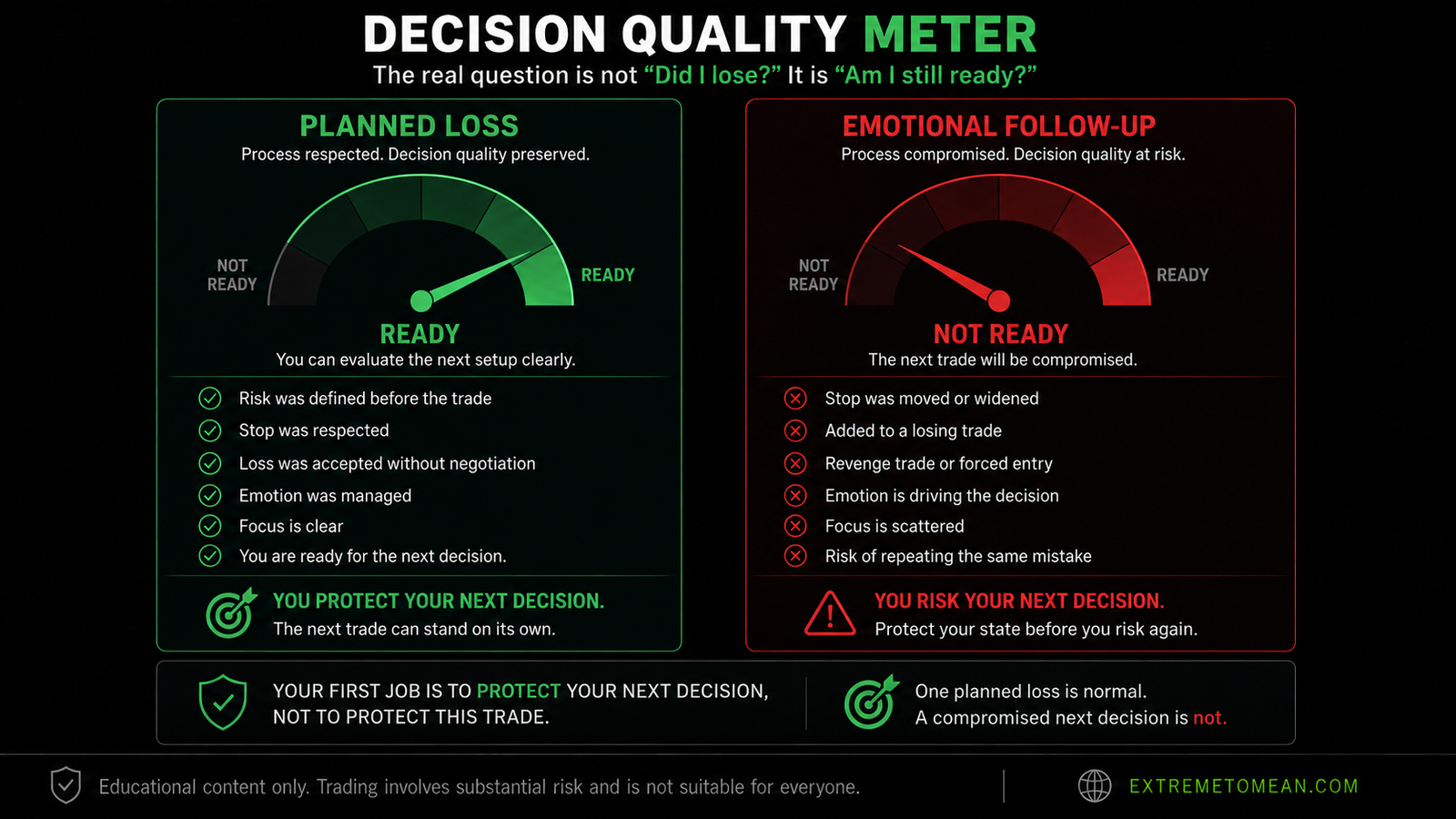
A simple rule can help: after a planned loss, your next trade must be able to stand alone. It needs its own setup, its own location, its own context, and its own defined risk. It cannot be a continuation of frustration from the last trade. If it cannot stand alone, you stand down.
Final Thought
Your first job is not to avoid every loss. That is not realistic, and it is not how trading works. Your first job is to prevent one trade from damaging the decision that comes after it.
A planned loss is information. An emotional follow-up trade is damage. The difference between the two is process. When you respect a stop, avoid revenge entries, refuse unplanned adds, and give yourself time to reset, you are not just protecting capital. You are protecting the ability to take the next clean setup when it appears.
The next trade may be the one that actually fits your plan. Do not arrive at it angry, rushed, oversized, or emotionally committed to getting something back. Arrive with a clear head, a defined process, and the patience to let the trade earn your risk. For longer-form work on this process, explore the Extreme to Mean books.
Patience Before Profit means protecting the next decision before chasing the next result.
That protection begins when the trader filters weak ideas instead of reacting to them.
It also depends on remembering that process beats prediction when the rules are clear.
That protection starts with understanding why the trader must think like a risk manager first.
Protecting decision quality also means recognizing when additional trades are making the process worse.
The same protection becomes critical after a loss, when a defined revenge-trading reset can keep one result from controlling the rest of the session.
Educational content only. Trading involves substantial risk and is not suitable for everyone.