
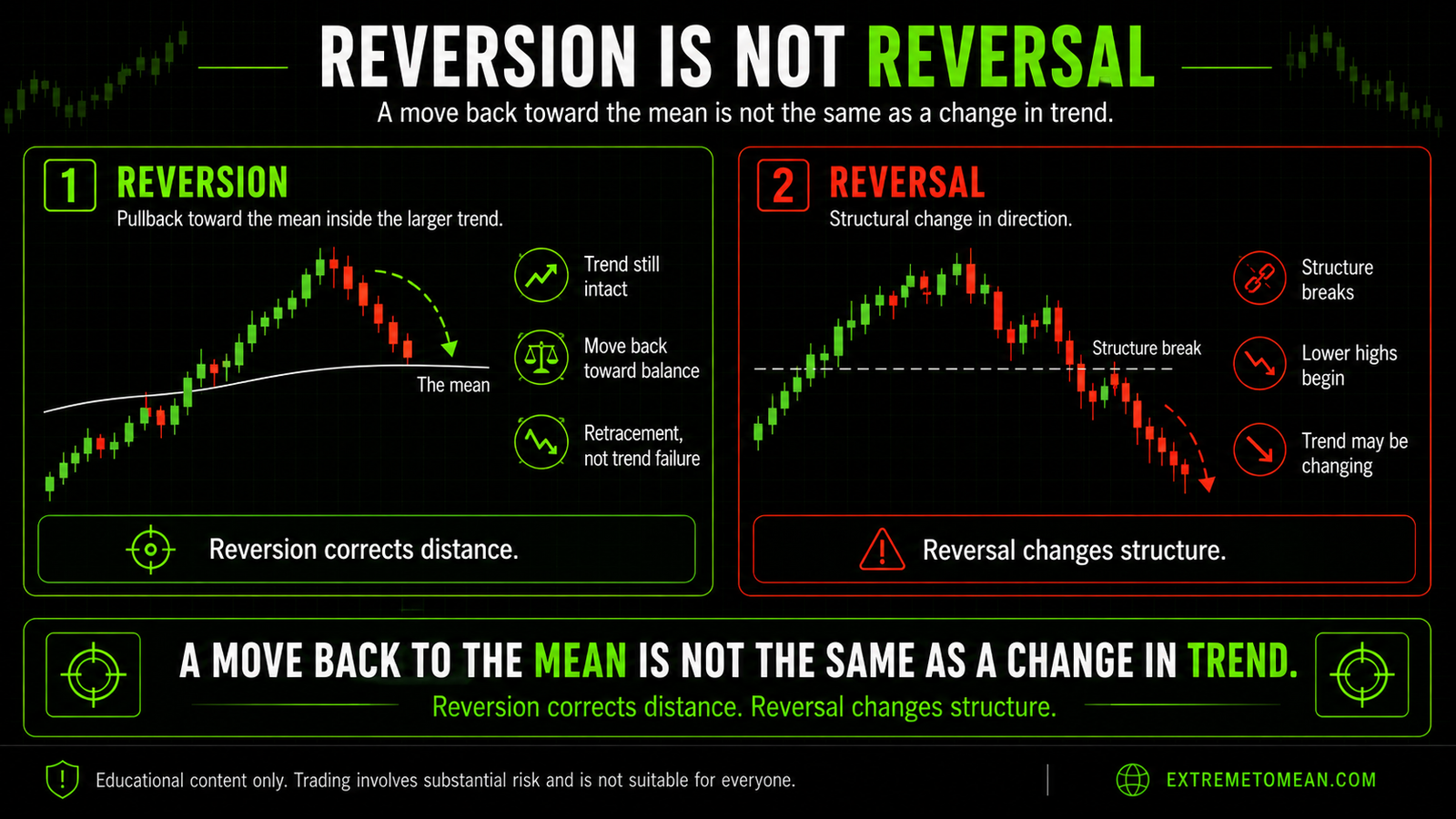
One of the biggest mistakes traders make is treating every pullback, bounce, or mean reversion as if the entire market has flipped. Price stretches, pulls back, pauses, and rotates all the time. That does not always mean the trend is over. Often, it simply means the market is working through a normal wave inside a larger move.
This distinction matters because reversion traders are not trying to predict a complete trend change every time price moves away from an extreme. The job is to evaluate whether price has stretched far enough from a meaningful reference point, whether there is room back toward balance, and whether structure supports the idea. That is very different from assuming the market is about to reverse completely.
In Extreme to Mean terms, the trader is not looking for drama. The trader is looking for context, location, structure, and risk.
A Reversion Is a Move Back Toward Balance
A reversion happens when price moves back toward a reference point after stretching away from it. That reference point may be a moving average, a prior balance area, a mean zone, or another level that helps define where price may be more "normal" compared to the recent stretch.
This is why reversion has a lot in common with what many traders already understand as a Fibonacci retracement. In a strong uptrend, price can pull back 38.2%, 50%, or 61.8% of a move and still remain inside the larger bullish structure. The retracement may be meaningful, but it does not automatically mean the uptrend has failed.
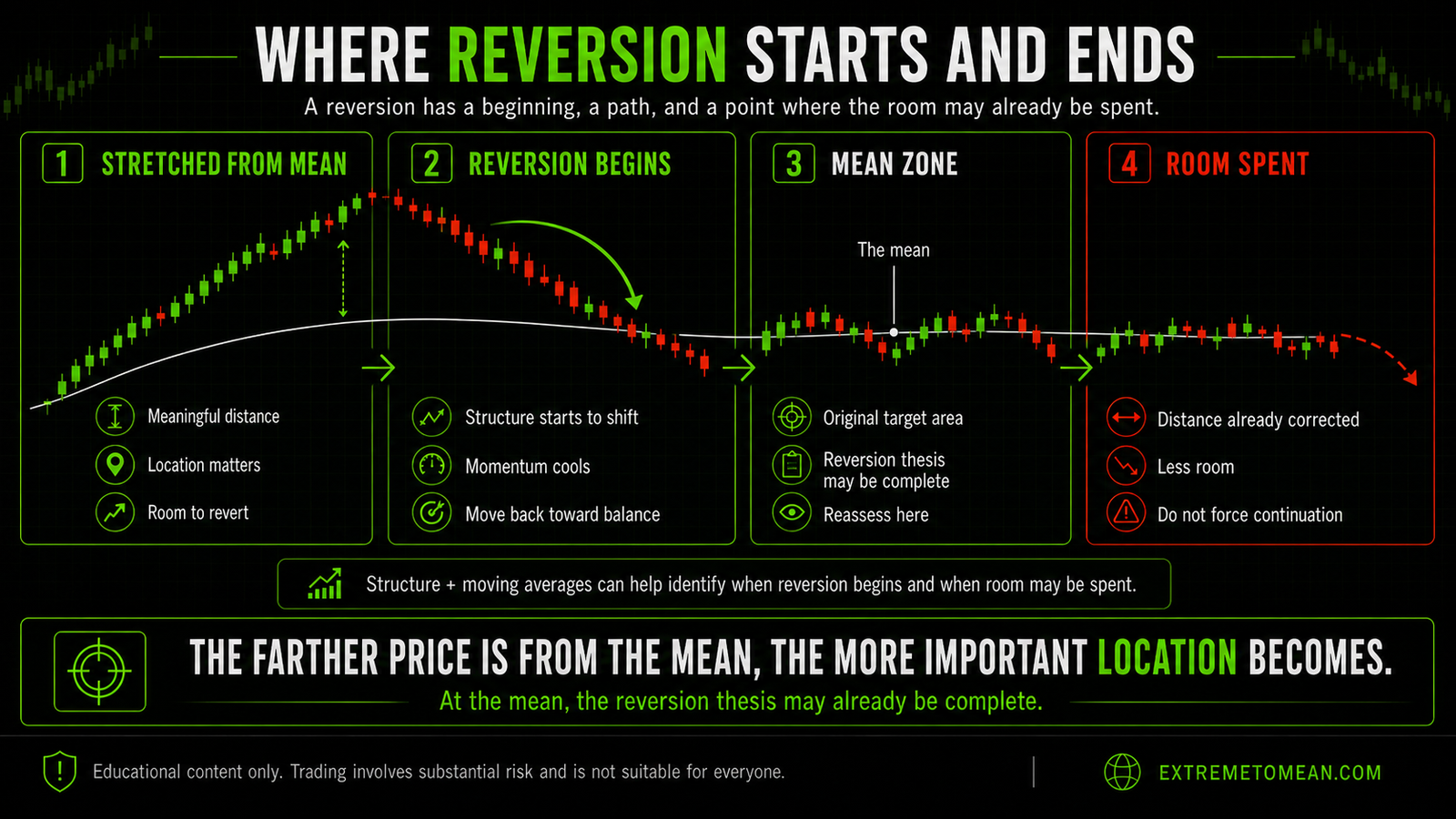
The same idea applies to reversion-to-the-mean trading. Price can stretch away from the mean, begin moving back toward it, and then stabilize without creating a full trend reversal. The reversion may be complete once price returns to a reasonable zone. After that, the trader has to reassess instead of assuming the next move must continue.
Why Traders Confuse Reversion With Reversal
The confusion usually starts because reversions can feel powerful in the moment. If price has been trending up and suddenly pulls back quickly, the move can look like a major change. If price has been selling off and then bounces sharply, the bounce can feel like the beginning of a new trend.
That reaction is understandable. Fast movement attracts attention. A sharp candle can make the trader feel as if something important has changed. The problem is that speed alone does not define a reversal. The market can move quickly back toward balance and still remain within the prior trend.
This is where traders often get trapped. They see a reversion begin, assume it is a reversal, and then hold the idea too long. What started as a clean move back toward the mean becomes a forced opinion about the entire market. Instead of taking the reversion for what it is, the trader starts expecting a complete directional shift that may not be supported by structure.
A better question is: Is this move correcting an extreme, or is it actually changing the larger structure?
The Risk of Treating Every Reversion Like a Reversal
The main risk is overstaying the trade idea. A reversion has a natural logic: price was stretched, price began moving back toward balance, and the trader evaluates the path toward the mean. Once price reaches that area, the original reason for the trade may no longer be as strong.
If the trader treats the reversion as a reversal, they may ignore the fact that the trade has already done what it was supposed to do. Instead of recognizing that price has returned to a more balanced zone, they begin looking for more. That is where a process problem can develop.
This mistake can also lead to trading against a strong trend without realizing it. A pullback in an uptrend may create a short-term reversion lower, but the larger trend may still be intact. A bounce in a downtrend may create a short-term reversion higher, but that does not mean sellers have lost control. Without structure, the trader is guessing.
The market does not owe the trader a reversal just because a reversion worked.
What a Better Trader Should Watch Instead
A better trader separates the reversion idea from the reversal idea before acting. That starts with identifying what the trade is actually trying to capture. Is the goal a move back toward a mean zone? Or is the trader trying to position for a broader directional change?
Those are not the same trade.
For a reversion idea, the trader should pay close attention to distance, location, and the path back toward balance. Is price stretched far enough from the reference point to create room? Is the move occurring at a meaningful extreme? Is the mean close enough that the trade may already be late? These questions help keep the trader grounded in the actual setup.
Tools like the TMT system's Foundation Stack can support this evaluation by giving the trader a structured way to read market structure and moving average behavior. The point is not that any moving average can predict the market. The point is that structure and proprietary moving averages can help the trader judge when price may be beginning a reversion, when the move is approaching its reference zone, and when the original reversion idea may be losing room.
That matters because the same setup can look very different depending on where price is in the wave. A reversion beginning from an extreme is not the same as a trade idea forming after price has already returned to the mean. At the mean, the room may already be spent.
A Simple Reversion-or-Reversal Filter
Before treating a move as a reversal, slow the decision down. The trader's job is not to react to the strongest candle. The job is to evaluate what the move actually means in context.
A simple filter can help:
- Is price only moving back toward balance, or has it broken important structure?
- Is the larger trend still intact, or has the sequence of highs and lows changed?
- Has price already reached the mean zone, or is there still room to revert?
- Am I trading the reversion, or am I hoping for a full reversal?
- If this were only a retracement, would my trade still make sense?
These questions do not remove uncertainty. They help define the trade idea more clearly. A reversion setup can be useful without needing to become a reversal. In fact, many cleaner decisions come from respecting that difference.
This is where patience matters. A trader does not need to force a reversal story onto every move. Sometimes the better decision is to let the reversion complete, reassess at the mean, and wait for the next structure to form.
Final Thought
Reversion is not reversal. A market can stretch, retrace, rotate back toward the mean, and still remain inside the larger trend. That is not a contradiction. That is normal market movement.
The cleaner process is to define the trade before entering it. If the idea is a reversion, treat it like a reversion. Watch the distance, the mean, the structure, and the risk. Once price returns to balance, reassess instead of assuming the market has fully changed direction.
Patience Before Profit means the trader evaluates the wave they are actually trading, not the story they want the market to confirm.
Educational content only. Trading involves substantial risk and is not suitable for everyone.