
Mean reversion can be statistically real and still become dangerous when the environment supporting it changes. August 2007 shows why being right eventually and surviving until eventually are different things.
Mean reversion assumes you can survive the deviation.
During the week beginning August 6, 2007, a number of quantitative long/short equity funds suffered unusually large simultaneous losses. Khandani and Lo proposed that one or more large quantitative equity market-neutral portfolios were forced to unwind, moving shared positions against other funds with similar exposures and triggering further deleveraging. A substantial rebound followed on August 10, but that recovery is not evidence that every participant could simply hold through the stress.
For Extreme to Mean, that distinction belongs inside The Market. The lesson is not that mean reversion stopped working or that quantitative models were useless. An edge, a position, and the environment allowing that position to survive are three different things.
The Week Quant Strategies Stopped Behaving Normally
The episode looked sudden because the most dramatic losses arrived during the week of August 6. Later work by Khandani and Lo found evidence that the broader factor unwind had begun in July, including unwinds on August 1 and August 6. Their analysis also pointed to a withdrawal of market-making risk capital beginning around August 8.
That matters because the crisis was not simply one bad day or one broken signal. Pressure had been building underneath apparently familiar relationships before the losses became obvious. By the time the dislocation was visible to everyone, the environment supporting normal exits and normal relative-value behavior was already under stress.
Market Neutral Does Not Mean Risk Neutral
A market-neutral equity strategy usually tries to reduce broad market direction by holding long positions against short positions. The thesis may not be “stocks will rise”; it may be that one group should outperform another, so the portfolio profits from the relative relationship rather than the market’s overall direction. That can reduce one kind of risk without eliminating leverage, liquidity, crowding, model, or execution risk.
August 2007 exposed that distinction brutally. The broad market did not need to collapse for long/short portfolios to suffer because the longs and shorts could move against each other in exactly the wrong way. Market neutral does not mean risk neutral.
Crowding: Different Models Can Still Find the Same Trades
Quantitative firms can use different researchers and models while still discovering overlapping opportunities. They may study the same securities, factors, anomalies, and risk constraints. Different models do not guarantee different trades.
That overlap matters because apparently diversified strategies can become connected through ownership. A portfolio may look independent when everyone is calmly holding it, yet become crowded when many participants need to reduce the same exposures at the same time. A strategy can look diversified until everyone tries to exit the same door.
This is where what an edge actually is needs an additional qualifier. Practical performance depends on how much capital is pursuing the relationship, whether positions overlap, and whether the market can absorb entries and exits. An edge can survive while the amount of capital safely exploiting it changes.
How Forced Selling Becomes a Feedback Loop
Imagine many funds are effectively long Stock A and short Stock B because their models see A as unusually cheap relative to B. One large participant suddenly needs to reduce risk and sells A while buying back B. The spread widens, creating losses for other funds holding the same relationship.
If those losses trigger their own risk limits, those funds also sell A and buy B. Their defensive action pushes the relationship farther away from its historical norm, creating still larger losses elsewhere and forcing still more deleveraging. The strategy’s liquidation becomes part of the market that the strategy is trying to model.
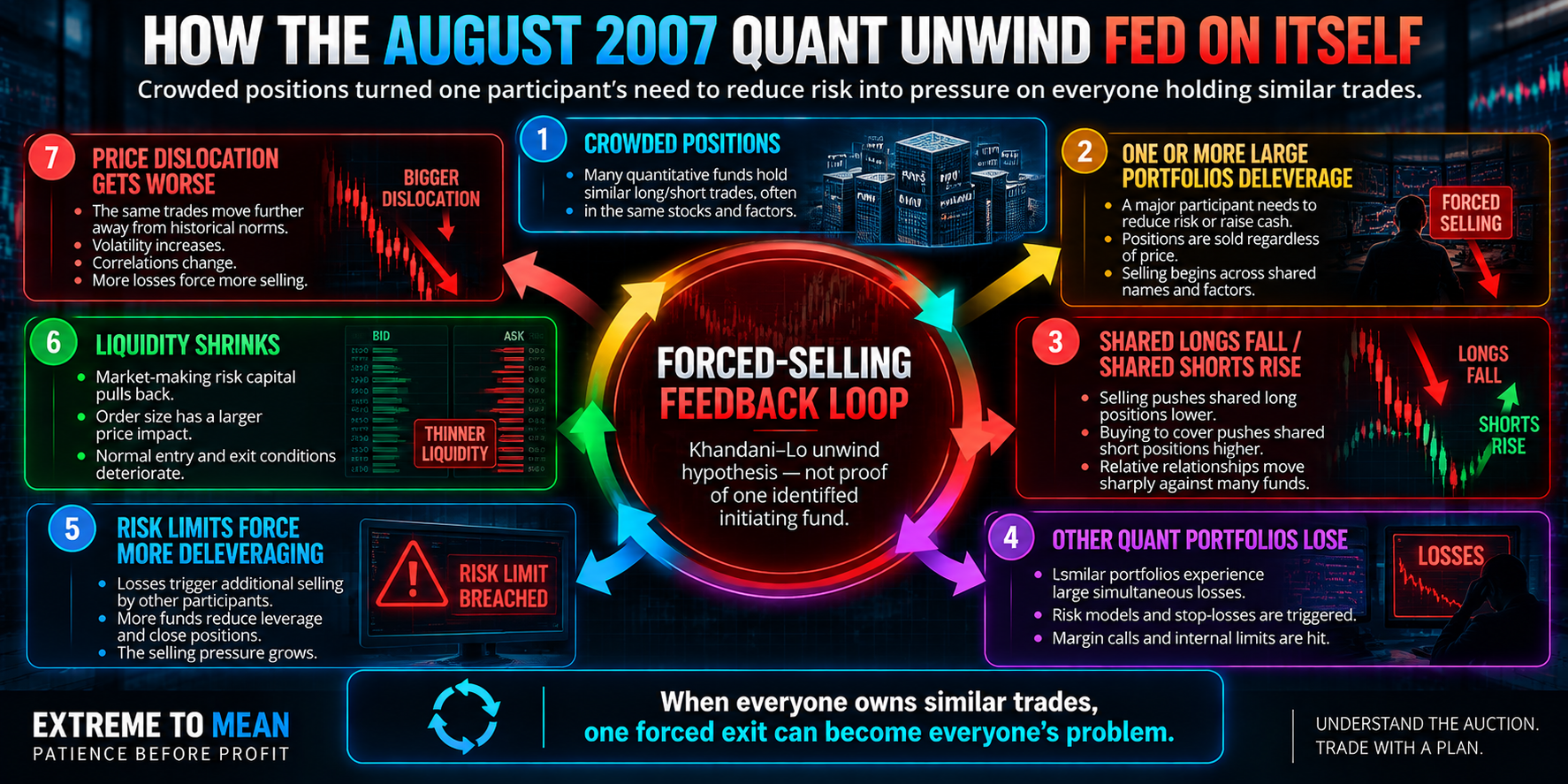
This is what makes forced liquidation different from ordinary disagreement about fair value. A forced seller does not need to believe the current price is attractive; the immediate objective may simply be to raise cash or reduce exposure. Liquidity matters most precisely when everyone suddenly needs it at once.
Liquidity Can Disappear When the Model Needs It Most
Historical backtests use observed prices, but those prices do not guarantee that a large portfolio can transact similarly under stress. Khandani and Lo’s later work found significant losses in a simulated short-horizon market-making strategy during the week of August 6 despite profitability before and after, alongside evidence of reduced market-making risk capital. A strategy tested on prices is not automatically tested on the ability to trade those prices under stress.
As liquidity worsens, larger orders create more price impact and exits become more expensive. Relationships that looked distinct can also move together because the same balance sheets are unwinding several positions at once. Two trades can become correlated because the same portfolio is being forced to liquidate both.
That is why market conditions change the quality of a setup. Historical behavior is conditional on an environment, even when the strategy itself does not explicitly label that environment. Volatility, liquidity, crowding, and financing conditions are not side issues when they determine whether the edge can be expressed safely.
The August 10 Rebound—and the Wrong Lesson
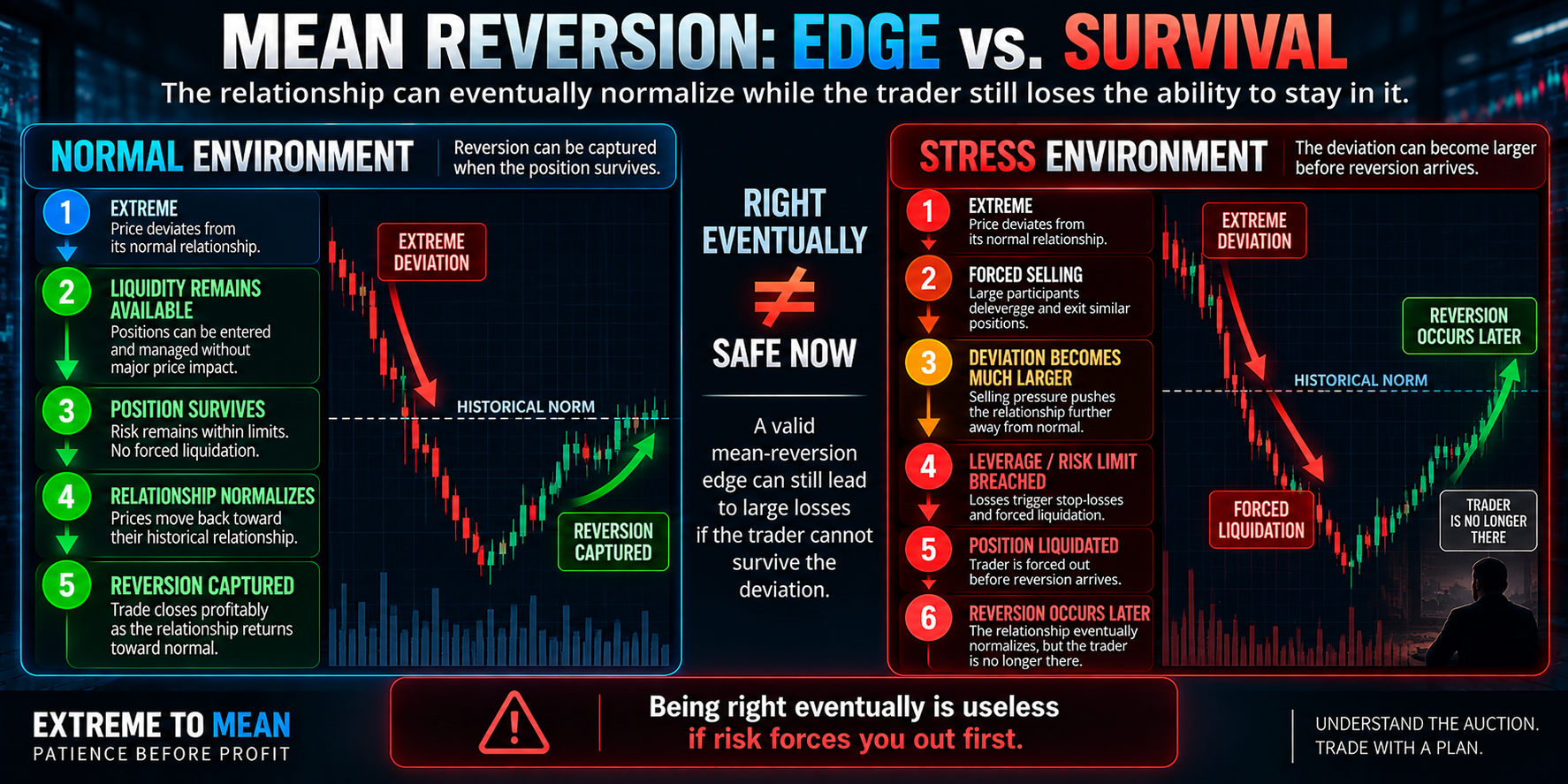
Khandani and Lo reported a significant rebound in the affected strategies on August 10, which they viewed as consistent with the unwind hypothesis. For a mean-reversion trader, that fact can sound comforting: if the dislocation eventually reversed, perhaps the answer was simply to hold longer. That is precisely the wrong lesson.
The rebound showed that prices and relationships could recover after forced liquidation distorted them. It did not show that every manager still had the capital, risk capacity, financing, or mandate to stay in the positions until recovery arrived. A trader forced to liquidate near the worst point does not benefit from being “right later.”
More Extreme Is Not Automatically More Attractive
Mean-reversion logic can create a seductive mistake: if a deviation was attractive at one level, a larger deviation must be an even better opportunity. That reasoning assumes the environment producing the historical relationship has not changed. August 2007 shows why that assumption deserves scrutiny.
A widening deviation may indeed increase potential opportunity, but it can also signal that leverage is being cut, liquidity is disappearing, correlations are changing, or a previously stable relationship is temporarily being overwhelmed by forced positioning. More extreme is not automatically more attractive. The right question is not only, “How far from normal are we?” but also, “What is causing normal to stop behaving normally?”
Statistical rarity has the same limitation. Future markets can combine leverage, liquidity, and synchronized risk constraints in ways the historical sample did not. Rare in the historical sample does not mean impossible in the next regime.
A Simple Example: Right Model, Wrong Survival
Suppose Stocks A and B historically move closely together, and a strategy buys A while shorting B when A becomes unusually cheap. Many funds discover similar versions of the relationship, then one large participant needs cash and exits by selling A and buying B. The spread widens, so other models see an even stronger mean-reversion opportunity and add exposure.
The forced seller continues, losses hit other portfolios, and their risk limits force them to exit in the same direction. The spread becomes far more extreme than the models expected before selling exhausts, liquidity improves, and the relationship finally snaps back. The model may have identified eventual reversion correctly, but risk management determined who was still there to capture it.
That is the practical warning behind what Extreme to Mean really means. An extreme raises a question; it does not grant immunity from the path between extreme and mean. A strategy that cannot define how much adverse movement it can survive does not have a complete trade simply because history favors normalization.
The Mean-Reversion Stress Test
Before assuming a stretched market should behave normally, ask:
- Has volatility changed materially from the environment the idea was built around?
- Has liquidity changed enough to affect normal entry or exit?
- Are the relationships I depend on still behaving normally?
- Could this trade or positioning style be crowded?
- Am I adding because qualification improved, or only because the deviation became larger?
- Does my invalidation still exist, or does every adverse move become “an even better price”?
- Can the position survive if reversion takes much longer than expected?
- Am I relying on eventual reversion instead of current evidence?
- What would tell me the regime has changed?
The purpose is not to predict another August 2007. It is to stop historical tendency from becoming certainty when current conditions may have changed. A cleaner process treats volatility, liquidity, correlation, and survival as part of the trade.
The ETM Edge → Environment → Liquidity → Survival Framework
Use EDGE → ENVIRONMENT → LIQUIDITY → SURVIVAL → DECISION. First identify the historical behavior you are trying to exploit, then ask whether the conditions supporting that behavior are still present and whether the market can absorb normal entry and exit. Only after that should you ask whether the position can survive a larger or longer deviation without violating risk.
The final decision is still trade, wait, or pass. The Extreme to Mean system should never reduce to “far from normal means fade it.” The environment determines whether the edge can be expressed safely.
Final Thought
The August 2007 quant meltdown is a warning against one of the most seductive ideas in mean-reversion trading: “It has moved this far, so it has to come back.” Some of the relationships caught in the dislocation did rebound, which is exactly why the episode is so instructive rather than simply a story of models failing.
Crowded positions, leverage, forced deleveraging, and shrinking liquidity pushed familiar relationships much farther than many participants expected, and some traders could not remain in place long enough to see normalization. Mean reversion is useful only when the trader can survive the path. Treat the environment as part of the edge, because being right eventually does not make the trade safe now.
Educational content only. Trading involves substantial risk and is not suitable for everyone.