
Markets sometimes reverse after extreme moves, but one of behavioral finance’s most famous findings is often stretched far beyond what the research actually tested. De Bondt and Thaler gave traders a reason to study overreaction—not permission to fade every extreme.
Key Idea
Overreaction is a market hypothesis, not an entry trigger.
For Extreme to Mean, the useful lesson is not that markets “always come back.” It is that extreme past performance can contain information worth investigating because expectations and prices may sometimes overshoot. The trader’s job is still to determine whether the current market is actually showing evidence that a reversal or normalization deserves attention.
The Study That Put Market Overreaction on the Map
Werner De Bondt and Richard Thaler published “Does the Stock Market Overreact?” in The Journal of Finance in 1985. Drawing on psychological research about excessive responses to dramatic information, they asked whether similar behavior could leave a measurable footprint in stock prices. Their study used monthly CRSP stock-return data and compared portfolios built from extreme prior winners and extreme prior losers.
In one of the paper’s main tests, stocks were ranked by their previous three years of performance, and portfolios of 35 extreme winners and 35 extreme losers were then followed for the next 36 months. The loser portfolio ultimately outperformed the market by about 19.6%, while the winner portfolio underperformed by about 5.0%, creating a roughly 24.6 percentage-point spread between the two groups. The authors described the evidence as consistent with the overreaction hypothesis, not as proof that every large price move reflects irrationality.
What the Winner-Loser Reversal Was Saying
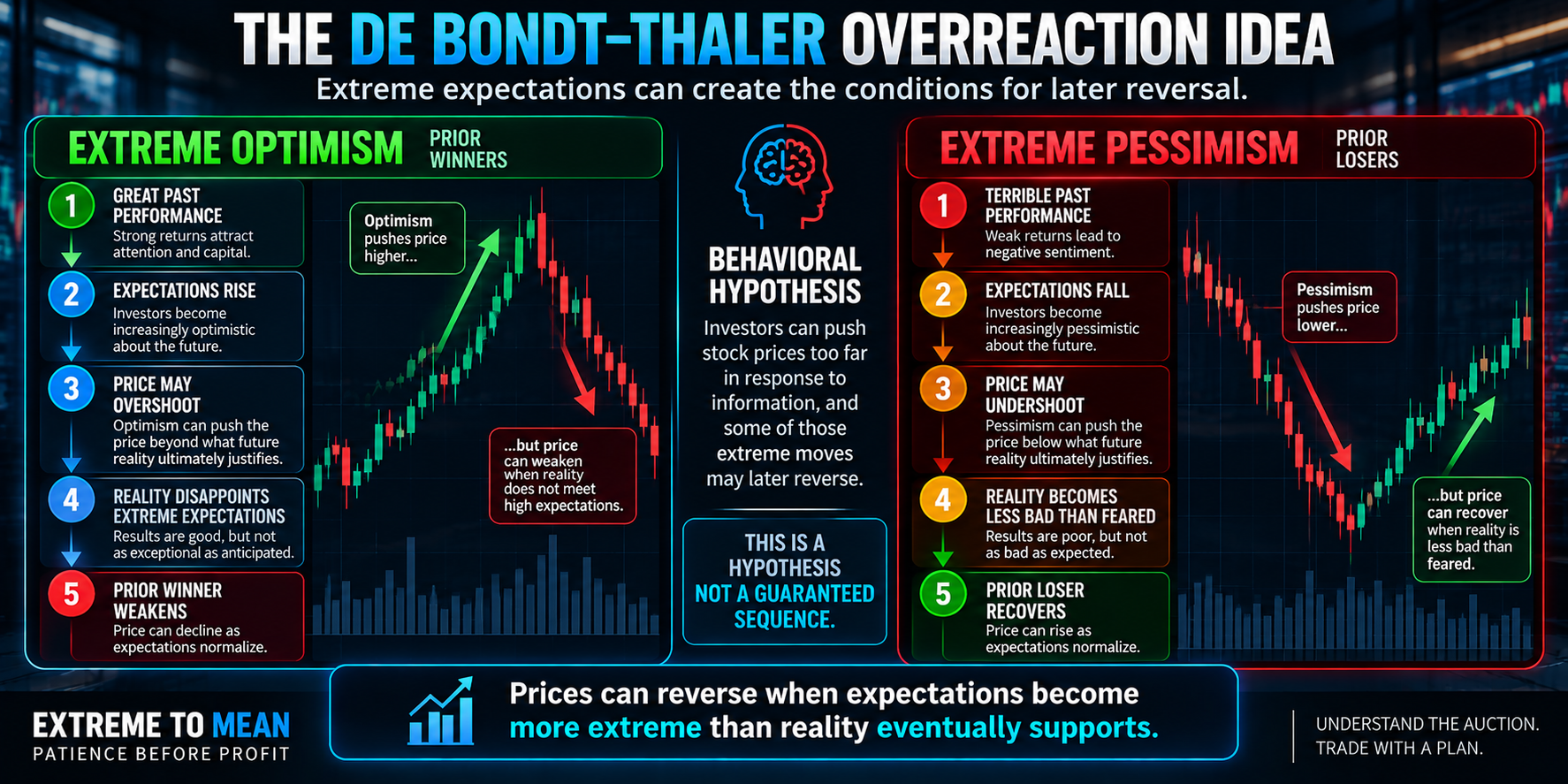
The behavioral intuition is straightforward. Strong past performance can push optimism and expectations unusually high, while terrible past performance can push pessimism unusually low. If expectations move farther than later reality justifies, part of that extreme pricing can reverse when reality turns out to be less exceptional than investors had assumed.
That does not mean the original news was irrelevant or that the market should never have repriced. A company can legitimately become more or less valuable because its earnings, balance sheet, competitive position, or risk changed. Overreaction refers to the possibility that the price response went beyond what the information ultimately justified, not to the claim that every dramatic move was a mistake.
This distinction fits the broader ETM idea behind what Extreme to Mean really means. An extreme can be meaningful because it raises a question about expectations, positioning, and potential normalization. It does not become a trade simply because it looks stretched.
Why the Finding Became Controversial
The original result had an important complication: much of the loser portfolio’s excess performance appeared in January, and the paper noted unusually large January returns even years after portfolio formation. De Bondt and Thaler’s 1987 follow-up returned directly to both overreaction and stock-market seasonality, reporting additional evidence they viewed as supportive while examining the January pattern more closely. That immediately raised harder questions about tax-loss selling, firm size, seasonality, and whether the effect could be separated cleanly from other return patterns.
The debate then moved beyond seasonality. Ball and Kothari argued in 1989 that much of the long-horizon negative serial correlation could be explained by changes in relative risk and expected returns, especially among extreme-performing firms. In other words, a reversal pattern could be observable even if the cause was not irrational mispricing.
Other researchers still found economically important reversal after making different adjustments. Chopra, Lakonishok, and Ritter reported in 1992 that prior five-year losers outperformed prior winners by roughly 5% to 10% per year over the following five years even after adjustments for beta and firm size, with a stronger effect among smaller firms. Conrad and Kaul then argued in 1993 that some reported long-term contrarian profits were inflated by biases created when monthly returns were cumulated over long periods, showing why the measurement method itself became part of the controversy.
The important lesson is not that one side permanently defeated the other. The sequence was finding, challenge, refinement, and continued debate. The empirical reversal became an important fact to study, while the explanation for why it appeared remained more contested.
What the Research Does—and Does Not—Say About Mean Reversion
The research gives conceptual support to the idea that extreme historical performance does not have to continue indefinitely. Markets can overshoot, expectations can normalize, and prices can reverse part of an earlier move. That is one reason extremes deserve attention.
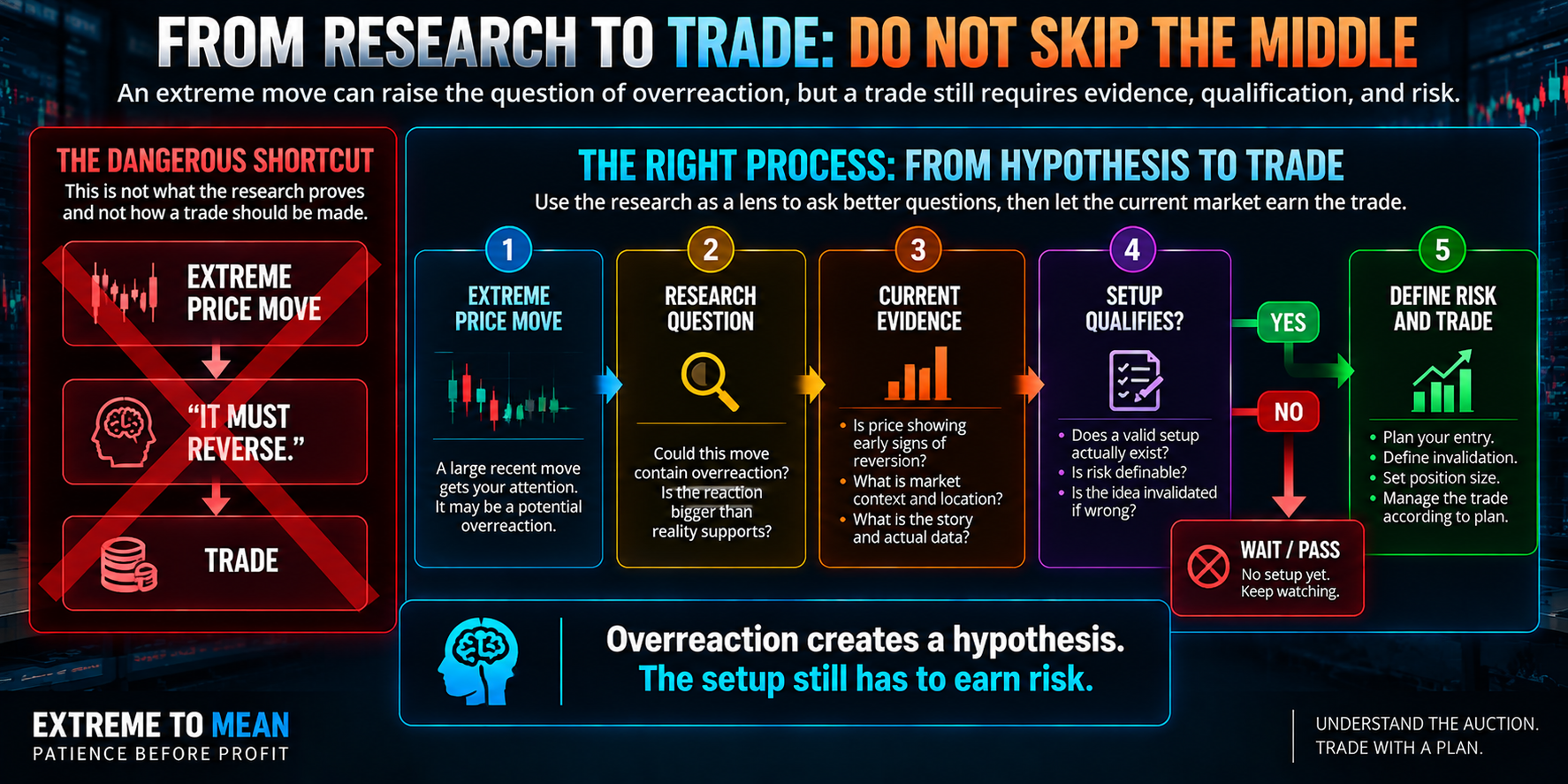
But the transition must be EXTREME → RESEARCH QUESTION, not EXTREME → TRADE. A large decline can reflect excessive pessimism, but it can also reflect a permanent deterioration in value, a new risk regime, or information the trader has not fully appreciated. This is why not every extreme is a trade.
The overreaction effect is also only one piece of the broader mean-reversion story. De Bondt and Thaler did not invent mean reversion, and their work did not establish a universal rule that losers become winners. They documented a long-horizon portfolio pattern that was consistent with one behavioral explanation for reversal.
The Time Horizon Matters More Than Traders Think
This may be the most important practical limitation. De Bondt and Thaler studied stocks with monthly returns over multi-year formation and test periods, and their main reversal unfolded over years rather than minutes. A long-horizon stock-market anomaly cannot simply be compressed into an intraday futures entry rule.
An NQ trader cannot point to a three-minute extension and say, “De Bondt and Thaler proved this has to revert.” The original study says nothing directly about whether the news move is finished, whether price is mispriced at this location, whether buyers are returning, or whether a qualified setup exists. Reversion is not reversal, and even evidence of eventual reversal does not identify the path or timing of a trade.
Correctly suspecting overreaction does not tell you where overreaction ends. A market can remain extreme, become more extreme, or reprice further because genuinely new information continues to arrive. A theory about eventual correction is not a risk-management plan.
A Better Way to Think About the Effect
Imagine two hypothetical companies. Stock A has delivered years of excellent performance, expectations are extremely high, and investors increasingly price in continued exceptional results; if future results are merely good rather than extraordinary, the stock can weaken without the business becoming bad. Stock B has delivered years of terrible performance, expectations are deeply pessimistic, and the price reflects almost everything going wrong; if results become merely less bad than feared, expectations can normalize and the stock can recover.
That example captures the behavioral intuition without turning it into a rule. Prices do not always require good news to rise or bad news to fall; sometimes the surprise is that reality is less extreme than expectations. Still, this is intuition, not proof that every beaten-down stock will recover or every high-flyer will collapse.
For a futures trader, the responsible translation is similar. Behavioral finance can tell you what question to ask—“Could this move contain overreaction?”—but current market behavior still has to help answer it. The evidence from the 1985 paper is a reason to investigate an extreme, not a substitute for present-tense qualification.
The Overreaction Reality Check
Before calling a move “overreaction,” slow the decision down and ask:
- What actually changed?
- What makes the move extreme relative to a meaningful reference?
- What time horizon am I discussing?
- Could the price change reflect changing fundamentals, risk, or new information?
- Am I calling it overreaction mainly because I disagree with the market?
- Has any actual reversion behavior begun?
- Does a setup exist?
- Where is the idea wrong?
- Am I using a long-horizon research result to justify a short-horizon trade?
These questions protect against the easiest misuse of behavioral research: turning an explanation into a prediction. If the only evidence is “price moved a lot,” the trader has not yet shown that the move was excessive. An extreme is evidence worth investigating, not permission to stand in front of it.
The ETM Extreme → Question → Evidence Framework
Use EXTREME → QUESTION → EVIDENCE → QUALIFICATION → RISK. The extreme tells you something unusual has happened; the question asks whether expectations, positioning, or emotion may have become excessive; the evidence asks whether current market behavior is beginning to support normalization. Qualification then asks whether a real setup exists, and risk asks whether invalidation and position size can be defined before capital is committed.
That keeps the research in its proper role. Overreaction creates the question; it does not answer the trade. The Extreme to Mean system still requires the market, the setup, and the risk to earn participation.
Final Thought
De Bondt and Thaler’s work matters because it challenged the assumption that extreme past performance should simply be expected to continue. Their winner-and-loser portfolios produced influential evidence consistent with long-term reversal, and their behavioral interpretation helped make investor overreaction a serious question in finance.
But the research never established that every extreme must reverse, that prior losers always outperform, or that an intraday futures trader can fade a stretched move because a famous paper documented long-horizon stock reversal. The durable ETM lesson is narrower and more useful: markets can overshoot, so extremes deserve investigation; the actual trade still requires evidence, qualification, invalidation, and risk.
Educational content only. Trading involves substantial risk and is not suitable for everyone.