
Many traders begin the session with an unspoken expectation that an opportunity should eventually appear. They prepared, woke up early, marked levels, and committed time to watching the market. As the session continues, that effort can begin to feel like an investment that deserves a return. The trader may then lower the standard because leaving without a trade feels like receiving nothing for the work.
The lessons in The Trader category emphasize that the trader’s job is to evaluate rather than react. Evaluation does not guarantee that the session will produce a qualified setup. It may reveal that the market is unclear, poorly located, too slow, too unstable, or mismatched to the strategy. Accepting that conclusion is part of the work rather than evidence that the work failed.
The Market Offers Conditions, Not Obligations
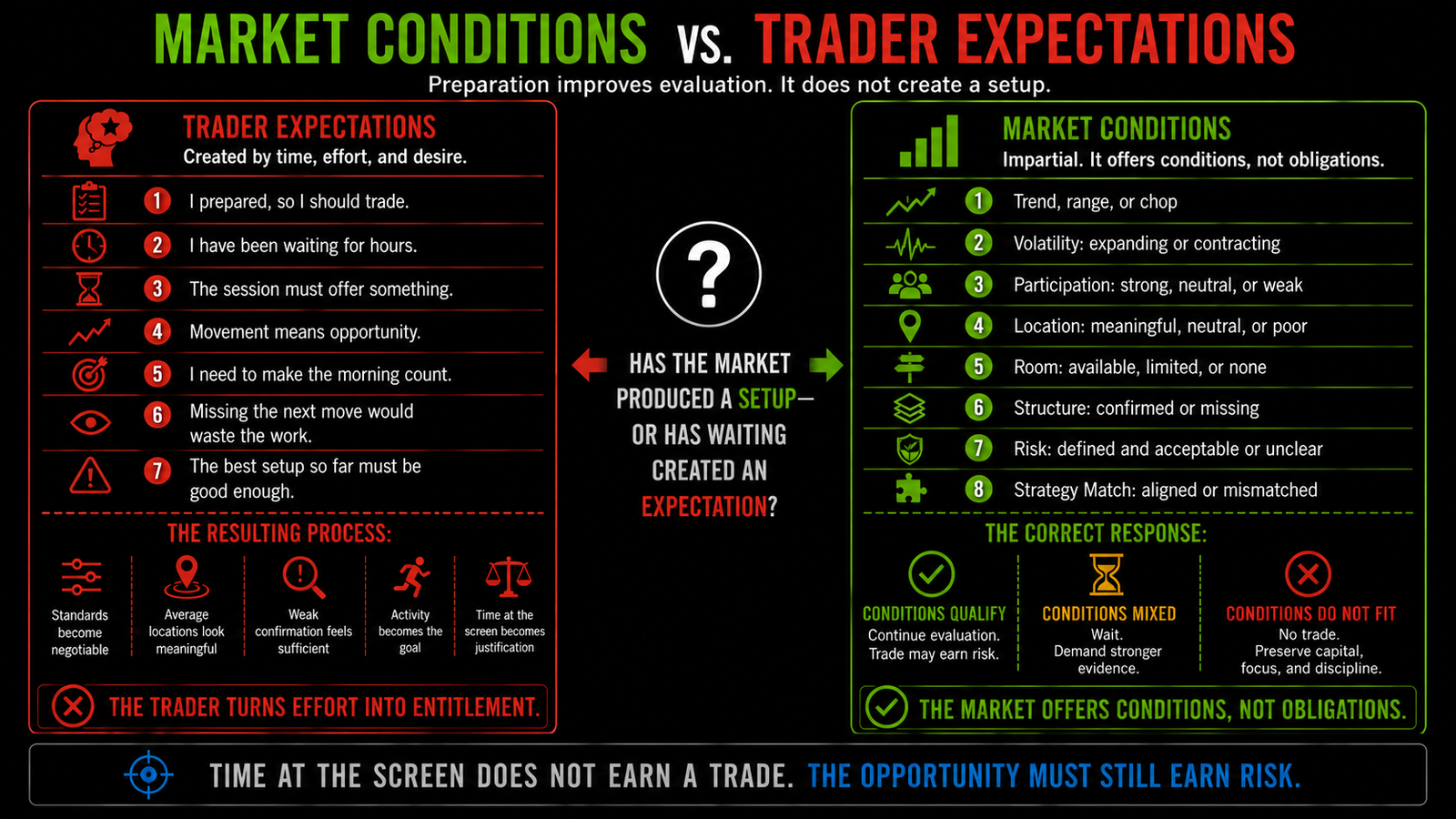
The market does not know how long the trader has been waiting. It does not respond to preparation, financial goals, recent losses, or the need to make the day feel productive. It simply produces changing conditions through price, participation, volatility, and structure. The trader must decide whether those conditions create an opportunity that fits the plan.
This distinction removes entitlement from the decision. A trader can prepare correctly, remain focused, and still receive no acceptable setup. The absence of a trade does not mean the analysis was useless or the session was wasted. It means the market never produced the complete conditions required for risk.
Screen Time Can Create a False Sense of Entitlement
The longer a trader watches, the more emotionally invested the session can become. Small movements begin to look more important because attention has been concentrated on them for an extended period. A mediocre pattern may feel significant simply because it is the best thing that has appeared so far. Time at the screen quietly becomes part of the justification for entry.
That reaction feels reasonable because people naturally expect effort to produce an outcome. Trading does not reward effort in a direct or predictable sequence, however. Preparation improves the quality of evaluation, but it cannot force the market to create location, structure, room, or follow-through. The trader must separate the value of the process from the availability of an opportunity.
Activity Is Not the Same as Opportunity
A market can move continuously without producing a trade that fits the strategy. Price may rotate through the middle of a range, create repeated false breaks, or move in short bursts that offer little room before reversal. The chart looks active, but the activity lacks dependable structure. A trader who believes movement must equal opportunity can become vulnerable to overtrading.
Slow markets create a similar problem. Small candles and limited range can make the trader feel that something must be taken before the session ends. The setup standard may be reduced because waiting no longer feels productive. In reality, low-quality movement may be communicating that the strategy has no clear job to perform.
Some Sessions Do Not Match the Strategy
Every strategy depends on certain market behaviors. A continuation approach may need directional progress and follow-through, while a reversion approach may need meaningful extension, location, and evidence that pressure is changing. When those conditions are absent, the strategy may have nothing useful to do. The trader should not convert a mismatch into a new setup merely to remain active.
This is where patience becomes more than a personality trait. The lesson that Patience Before Profit is more than a tagline means that participation must remain conditional. The trader waits because the required structure has not appeared, not because waiting is morally superior to trading. Patience is the plan responding correctly to a market that does not currently fit it.
The Need to Make the Session Count
A trader may also feel pressure to produce something measurable from the morning. A completed trade creates an entry, exit, result, and journal record, while a no-trade session can feel empty. That difference can make activity seem more professional than restraint. The trader may take a weak setup simply to create evidence that the session mattered.
A useful session does not require an executed order. The trader may identify changing market states, observe how price responds at key locations, or recognize that conditions remained too weak to justify participation. Those observations can strengthen future preparation and review. Productivity should be measured by decision quality rather than by the number of positions created.
Entitlement Changes the Qualification Standard
Once the trader believes a setup should appear, evidence is no longer evaluated neutrally. An average location becomes close enough, weak confirmation becomes sufficient, and limited room becomes something the market might overcome. The trader begins negotiating with standards that were clear before the session. The opportunity is being kept alive because the trader wants a trade, not because the conditions have improved.
Entitlement can also change the meaning of patience. Waiting begins to feel like hesitation, fear, or failure to execute. The trader may believe that disciplined people take action when opportunities appear, then redefine an incomplete setup as an opportunity. This is how a valid principle about execution becomes permission to force participation.
No Trade Is a Complete Outcome
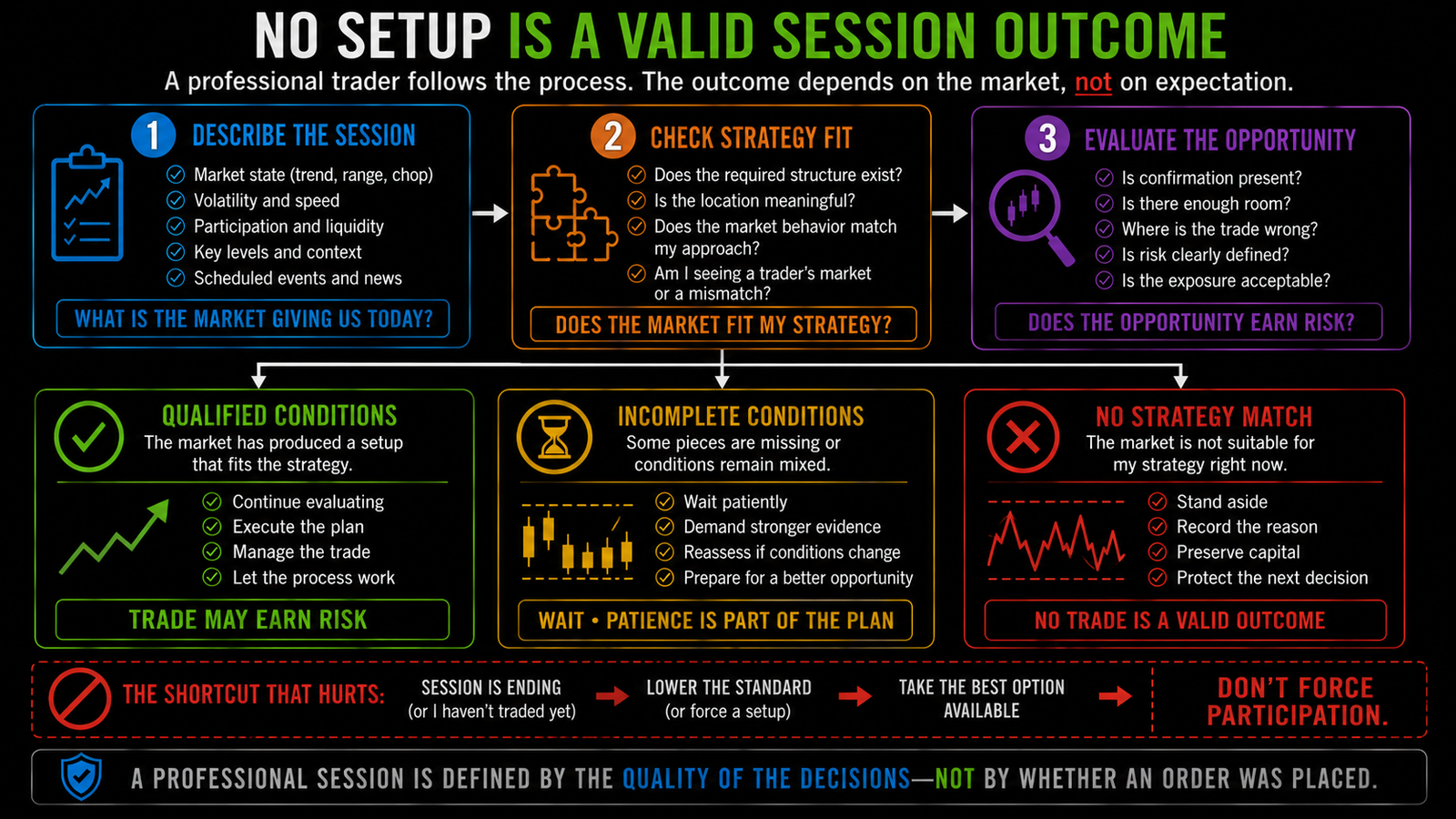
A session can end with no trade and still contain a complete decision process. The trader reviewed the market, identified the available conditions, compared them with the plan, and withheld risk because the requirements were not met. Nothing was missing from that sequence. The absence of an order was the result of the evaluation.
The principle that doing nothing is still a trading decision becomes practical here. No trade should not be used as a vague escape whenever uncertainty appears. It should result from specific evidence such as poor location, choppy structure, insufficient room, unclear risk, or a mismatch with the strategy. A defined reason turns inactivity into a professional decision.
Patience Is Active Evaluation
Patience does not mean staring at the chart without a plan. The patient trader continues monitoring structure, location, participation, and the conditions that would make the setup valid. If those conditions appear, the trader can evaluate the opportunity without inventing a new process. If they do not appear, patience remains the correct operating decision.
Passivity looks different because it lacks standards and preparation. A passive trader may avoid action because of fear, confusion, or uncertainty about the rules. An actively patient trader knows what is missing and what would need to change. The difference is whether waiting is supported by a defined process.
Protect the Decisions That Come Later
A forced trade affects more than the immediate position. If it fails, frustration may increase urgency, encourage revenge trading, or create pressure to recover before the session ends. If it works, the trader may learn that lowering the standard is acceptable. Either outcome can damage the decisions that follow.
This is why protecting the next decision begins before the current trade is entered. Refusing a weak opportunity preserves attention, emotional stability, and risk capacity. Those resources remain available if stronger conditions develop later. The decision not to force the first trade can protect the complete session.
Define Trade-Worthy Conditions Before Waiting Becomes Difficult
The cleanest way to manage entitlement is to define acceptable conditions before the session begins. The trader should know which market states fit the strategy, which locations matter, what confirmation is required, and what would make the risk clear. These standards reduce the amount of negotiation required once price begins moving. The session then becomes an evaluation of conditions rather than a search for activity.
The trader should also define conditions that make participation unlikely or unacceptable. Heavy overlap, limited range, repeated failed breaks, nearby opposition, unclear invalidation, or scheduled event risk may all justify standing aside. Naming those conditions in advance makes it easier to accept a quiet session. The no-trade outcome has already been included in the plan.
A Practical No-Setup Filter
Before entering because the session feels slow, late, or unproductive, the trader can use a short filter. The questions should determine whether the market has actually improved or whether the desire to participate has become stronger. Several weak answers should lead to patience rather than creative justification. The goal is to separate market evidence from the trader’s expectation that something should happen:
- Is the market producing the structure my strategy requires?
- Is price at a meaningful location or trapped in the middle?
- Is current movement receiving participation and follow-through?
- Is there enough room for the trade to develop?
- Is the invalidation clear and based on market logic?
- Has the setup improved, or have I only become tired of waiting?
- Would I consider this trade acceptable near the beginning of the session?
- Am I trying to make the time at the screen feel worthwhile?
- What specific evidence would make standing aside the correct decision?
- Is the market offering an opportunity, or am I creating an obligation?
The better question is not, “When will the market finally give me a trade?” It is, “Has the market produced the complete conditions my process requires?” That question returns control to the qualification standard. It also removes the assumption that waiting long enough must eventually lead to participation.
Traders who repeatedly create opportunities during unclear sessions may need to examine the broader problem of trading too much. Excess activity often begins with the belief that attention should produce action. Once the trader accepts that no setup may appear, the pressure to convert ordinary movement into a trade becomes easier to recognize. The correction begins before the order, when the session’s conditions are classified honestly.
Review No-Trade Sessions Seriously
No-trade sessions should be included in the journal. The trader can record the market state, the missing conditions, the moments when impulse increased, and whether the decision to stand aside followed the plan. This creates evidence that disciplined inactivity is part of the process. It also reveals whether the trader is rejecting markets for specific reasons or avoiding participation through vague fear.
The review should not judge the decision by what price did later. A move that developed after the trader stopped watching does not prove that an earlier weak setup deserved risk. The relevant question is whether the required evidence existed when the decision was made. Hindsight should not turn a properly qualified no-trade outcome into a mistake.
Final Thought
The market does not owe the trader a setup because time, attention, and preparation do not create market conditions. Some sessions will align with the strategy, while others will remain slow, choppy, unclear, or poorly located. The trader cannot force that distinction to disappear. The professional responsibility is to recognize which environment is present.
The goal is not to celebrate inactivity or avoid every uncertain trade. It is to accept that participation must remain conditional and that no trade is sometimes the most accurate outcome of the process. The market offers conditions, not obligations. The trader’s job is to evaluate those conditions and wait when they have not earned risk.
Educational content only. Trading involves substantial risk and is not suitable for everyone.