
“Price Has to Come Back Here” Is the Wrong Starting Point
The basic mean-reversion idea sounds simple: price moves away from balance, becomes extended, and eventually returns toward some central reference. The problem begins when the trader freezes that reference at the exact price where it sat when the extension first became interesting. From that moment forward, they start treating yesterday’s measurement as today’s destination.
That is not how dynamic references work. Moving averages, VWAP, developing volume references, and similar tools update as new price or volume information arrives. A mean-reversion trade therefore depends on the current relationship between price and reference, not a screenshot from twenty minutes ago.
This is an important extension of what the mean really is. Traders often use “the mean” as shorthand for a reference representing recent balance, value, or central tendency, but different tools estimate that center differently. The reference is calculated from the market; the market is not obligated to obey the reference.
Not Every “Mean” Is the Same Thing
A moving average summarizes price according to a chosen lookback and weighting method. Session VWAP summarizes traded prices weighted by volume during the defined session, while a developing Point of Control identifies the price where the most volume has accumulated within a selected profile. Those are related ways of orienting price around a center, but they are not mathematically interchangeable.
The distinction matters because each reference has a different memory. A rolling average may gradually discard older bars, session VWAP keeps accumulating that session’s traded history, and anchored VWAP starts from a chosen event. Before asking whether price is far from “the mean,” the trader should know exactly what that reference remembers and what it forgets.
There is also no single universal market mean that every strategy should use. One trader may care about VWAP, another about an explicitly defined moving reference, and another about a volume-based center. The useful question is not, “Which mean is best?” but, “Which reference does this strategy define, and why is that reference relevant to the behavior being traded?”
Why Dynamic References Move
Suppose an average is centered near 5,000 when ES begins rallying and price reaches 5,020. At first the distance is twenty points, but price then spends time trading around 5,018–5,024 rather than immediately falling. As those higher prices enter the calculation, the average might rise from 5,000 to 5,005, then 5,010, and eventually 5,014.
If price is still near 5,020, the original twenty-point extension has now become roughly six points relative to the updated reference. Price did not have to return to 5,000 for the separation to shrink. The distance closed partly because the mean moved.
VWAP demonstrates the same principle through a different calculation. As additional volume trades at new prices, the cumulative volume-weighted reference evolves, although its responsiveness can differ depending on when the activity occurs and how much volume has already accumulated. Dynamic references change because the market history they summarize keeps changing.
Three Ways Price and the Mean Can Converge
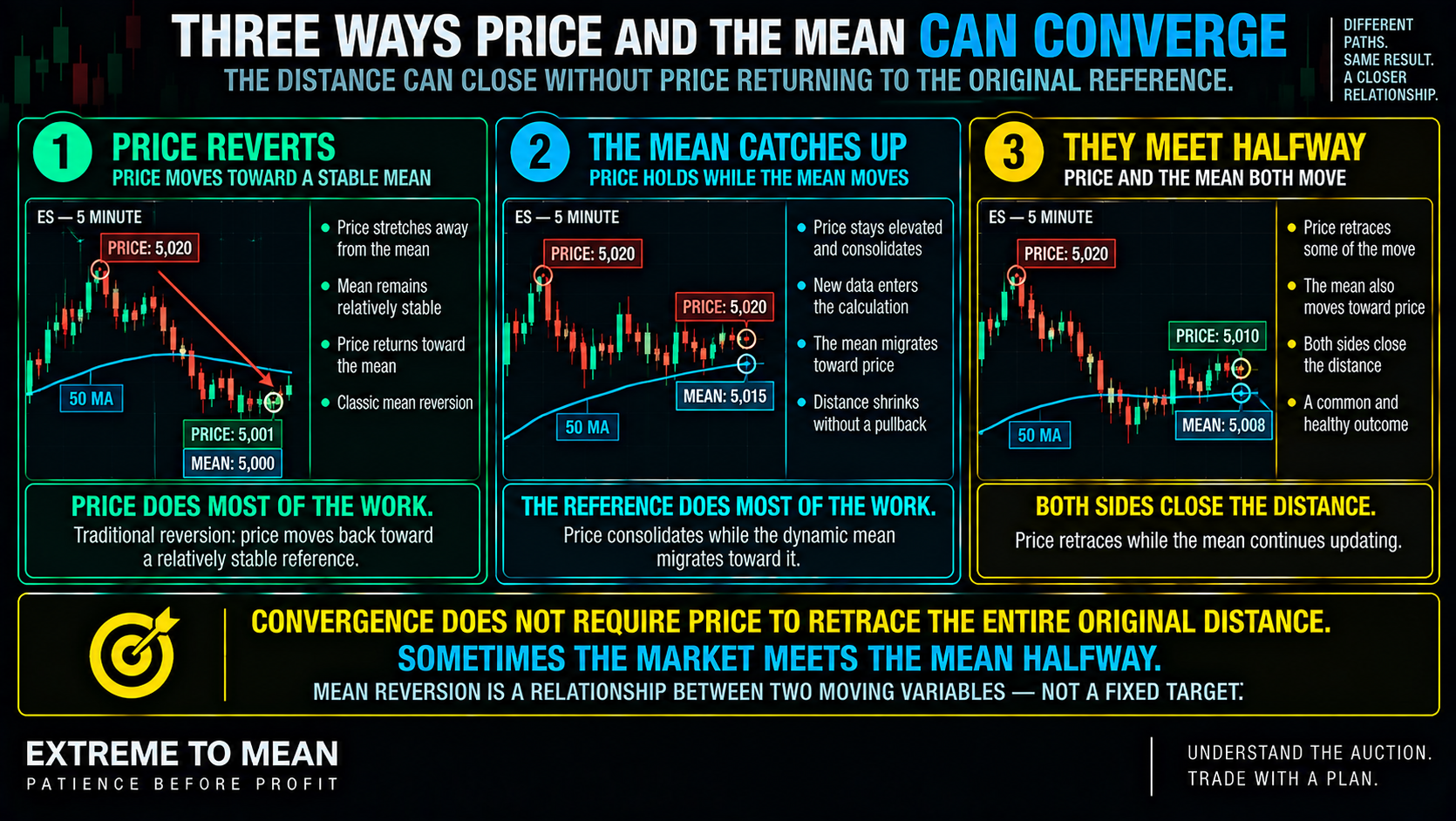
There are three broad ways the separation can shrink. Price can retrace toward a relatively stable reference, the reference can migrate toward relatively stable price, or price and reference can move toward one another at the same time. Convergence does not require price to retrace the entire original distance.
The first case is the picture most traders imagine when they hear “mean reversion.” Price stretches away and then moves back while the reference changes very little. Sometimes the market really does behave that way.
The second case is easy to miss because price may barely reverse at all. Price stalls or consolidates while the dynamic reference catches up, allowing the extreme to shrink through time rather than through a dramatic countertrend move. The third case combines both: price retraces some distance while the mean continues migrating toward it.
Sometimes the Market Meets the Mean Halfway
Imagine price initially sits 100 points above a reference. During the next period, price pulls back 30 points while the reference rises 40 points, leaving only 30 points of separation. A trader still targeting the original reference is now trading geometry that no longer exists.
This is why a strong market can work off an extreme sideways. Price may stop advancing, spend time near the highs, allow the mean to rise, and eventually resume the trend after the relationship has normalized. The original observation—price was extended—may have been correct even though the expected sharp reversal never arrived.
The same process can occur in a declining market. Price can stabilize near the lows while a falling reference catches down toward it, reducing the distance without requiring a powerful rally. An extreme can disappear because price comes back—or because value catches up.
Static Levels and Dynamic References Behave Differently
A prior-day high is a historical price and remains fixed once established. A moving average, VWAP, developing POC, or developing value area can change as new information enters the measurement. Some levels wait for price; dynamic references move with price.
That does not make static references less useful, nor does it make dynamic references better. They simply answer different questions about the market. Confusing the two encourages traders to treat a changing calculation as though it were an immovable support or resistance price.
The distinction also helps with targets. An old dynamic reference may still coincide with meaningful structure, but the fact that it was “the mean” earlier does not automatically make it the best reversion target now. The first mean you noticed does not earn permanent ownership of the trade.
Strong Trends Pull the Mean With Them
During persistent directional movement, many dynamic references migrate in the direction of the trend. Higher prices remain in the calculation, newer volume accumulates at higher levels, and the estimated center begins rising with the market. A rising mean is part of the trend—not evidence that the market forgot to revert.
This is also why reversion is not reversal. An uptrend can become extended, pull back toward a rising reference, and then resume higher without the larger bullish structure ever reversing. A declining market can similarly rally toward a falling mean and continue lower.
Different references can move at different speeds because they summarize different information. A fast average may react quickly, a slower average may lag, session VWAP may adjust according to accumulated volume, and a broader-horizon reference may barely move. Different means can disagree because they are answering different questions about the same market.
The Mean Depends on the Horizon Too
P052 in the Market curriculum established that one market can contain different structures on different horizons, and the same logic applies to central references. Price may look extremely stretched from a fast intraday mean, moderately extended from session VWAP, and completely ordinary relative to a broader trend reference. All three observations can be true simultaneously.
That makes “price is far from the mean” an incomplete statement. The better question is: far from which mean, on which horizon, for which trade? Once the reference and horizon are defined, distance becomes meaningful rather than arbitrary.
This is where market conditions change the quality of a setup as well. The same raw distance can mean something completely different in a quiet environment than in a fast, expanding one. P053 does not need a volatility formula; it only needs the trader to stop treating raw distance as self-explanatory.
Acceptance Can Move the Center
Suppose price breaks above a prior area of balance and initially appears extremely stretched. Instead of rejecting, however, price remains above the old area, pullbacks hold, volume accumulates, and dynamic references begin moving higher. What looked like price far above value can gradually become higher value being accepted.
Rejection behaves differently. If price spikes away from the reference and quickly returns while little sustained business occurs at the extreme, the existing center may barely change. The important question becomes whether the market is temporarily away from balance or whether balance itself is beginning to relocate.
An extreme can become the new normal if the market keeps doing business there. That does not guarantee continuation, but it does tell us that the reference is adapting toward the new market rather than preserving the old one indefinitely. A dynamic mean is useful partly because it can update when acceptance changes.
The Moving Mean Can Change the Setup Before Entry
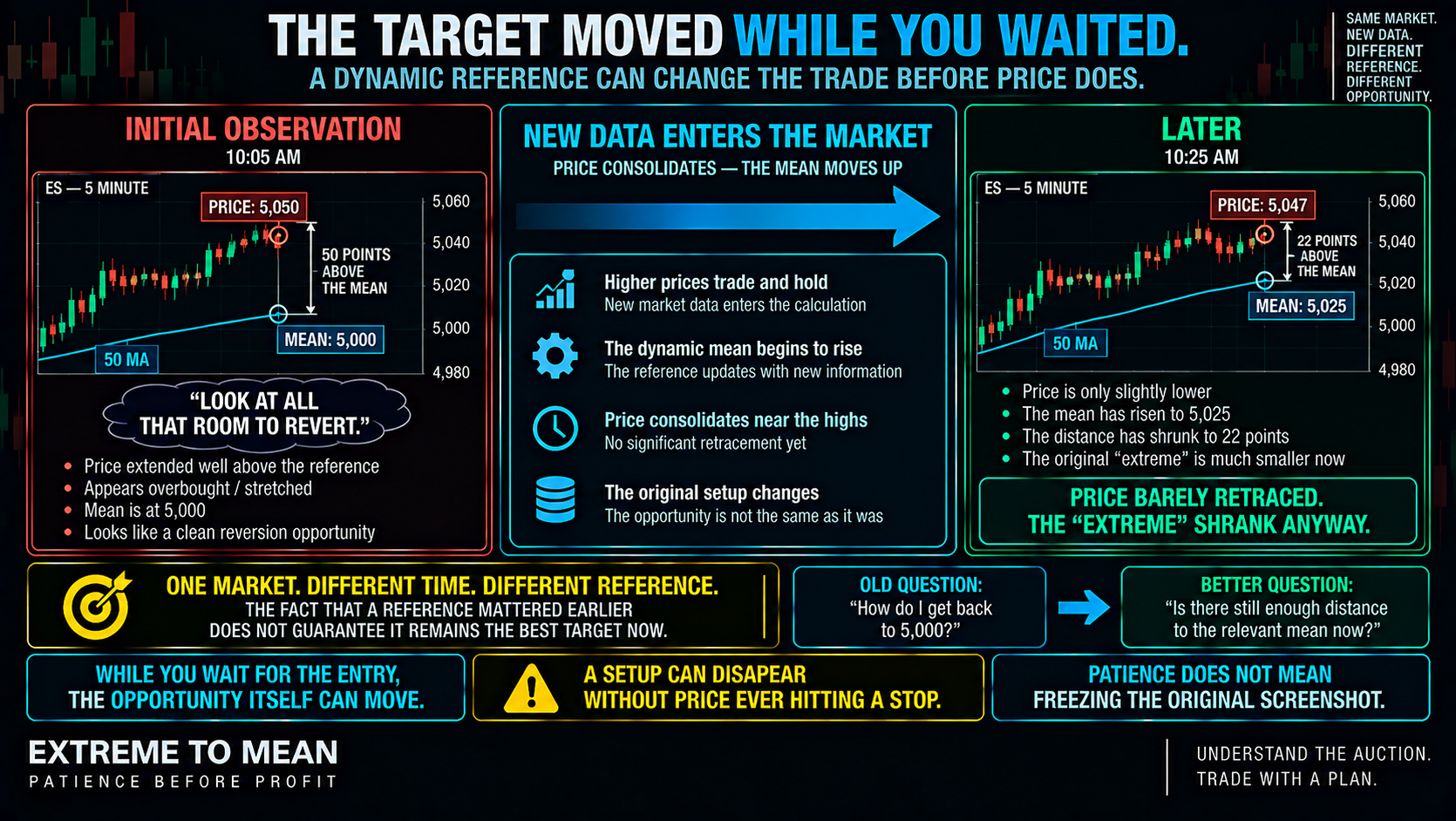
Suppose a trader first notices price forty points above a reference. They wait correctly for the setup to qualify, but during that wait the reference migrates fifteen points toward price while price remains relatively stable. The potential reversion distance has fallen from forty points to twenty-five.
If invalidation has not improved proportionally, the trade geometry is now less attractive. The market did not need to hit a stop or reverse dramatically for the opportunity to deteriorate; the setup simply changed while the trader waited. Patience is not freezing the original screenshot.
The reference can move enough to eliminate the setup entirely. Price consolidates, the mean catches up, and by the time a possible trigger appears there is very little distance left to revert. The correct decision can be no trade, which is why not every extreme is a trade.
News and Regime Changes Can Make the Old Mean Less Relevant
A major repricing event can move price faster than an existing reference can adapt. The old mean may remain mathematically correct as a summary of the earlier data while becoming much less useful for the new trade question. After a true repricing event, the old mean may be more historical than attractive.
The same issue can emerge when a range becomes a trend, volatility expands, or the market begins accepting a different area. Traders waiting for full reversion to the former center may actually be fighting a migration toward a new center of balance. Sometimes the market is temporarily stretched; sometimes the market is moving its center.
That distinction cannot be reduced to one line or one indicator. Sustained trade, continued acceptance, developing volume, and migration of the reference can all help the trader evaluate what is happening. The goal is not to predict the new mean perfectly, but to stop assuming the old one retains permanent authority.
Define the Reference Before the Trade
A mean-reversion process becomes meaningless if the trader is allowed to change the mean every time the trade becomes uncomfortable. If a fast average fails, switching to a slower one, then VWAP, then anchored VWAP, and finally a distant POC is just another form of confirmation shopping. If you can change the mean after the trade moves against you, the mean was never really part of the plan.
Multiple means can also create false confluence. Several similar averages may cluster simply because they summarize overlapping price history, while a different type of reference may contain genuinely independent information. More means do not automatically mean more evidence.
The strategy should therefore define the reference before distance from that reference becomes part of the thesis. Once the trade is open, management should follow the strategy’s established rules rather than moving targets impulsively because the reference changed. P053 is primarily about evaluating the current setup correctly before committing to it.
The ETM Dynamic-Mean Framework
The objective is to track the relationship between price and the reference instead of worshipping the line. A dynamic strategy requires a trader willing to update a dynamic market, while still keeping the definition of the reference consistent. Use the sequence below to keep the question current.
- Reference — What exactly represents the mean or value for this strategy?
- Horizon — What market horizon does that reference describe?
- Distance — How far is price from the reference now?
- Reference movement — Is the mean flat, rising, falling, or accelerating?
- Price behavior — Is price reverting, extending, or consolidating?
- Convergence — Is price moving toward the mean, the mean moving toward price, or both?
- Acceptance — Is the market rejecting the extended area or doing sustained business there?
- Current room — Does the updated reference still leave meaningful reversion distance?
- Thesis — Is this still temporary extension, or is balance beginning to migrate?
- Decision — Trade, wait, or pass.
The condensed version is Reference → Distance → Movement → Acceptance → Updated Mean → Thesis → Decision. The better question is not, “How far is price from where the mean was?” but, “What is the relevant reference now, how is it moving, and what is price doing relative to it?” That keeps the trader evaluating the market that exists rather than defending the market that existed earlier.
Final Thought
The mean is useful precisely because it adapts to the market. A moving average changes as new prices enter its calculation, VWAP changes as new volume trades, and developing volume-based references can migrate as the market begins doing more business somewhere else. None of those references creates an obligation for price to return to one fixed number.
Price can revert toward the reference, the reference can move toward price, or both can happen together. Sometimes the market works off an extreme through a sharp counter-move, sometimes through sideways consolidation, and sometimes by establishing a new center entirely. Mean reversion is a changing relationship, not a promise.
Define the reference, define the horizon, track the current distance, and keep evaluating whether the market is rejecting the extension or accepting a new area. Never let yesterday’s mean become today’s reason to ignore what the market is actually doing. That process-first discipline is part of the broader Extreme to Mean system.
Educational content only. Trading involves substantial risk and is not suitable for everyone.