“Two percent a day” does not sound outrageous. It sounds small—until you let the math finish the sentence.
A return target can describe what you want. It cannot create the opportunities required to produce it.
There is no universal percentage that turns day trading into a realistic income plan. A genuine trading process can produce winning days, losing days, flat days, periods full of opportunity, and periods when almost nothing qualifies. An edge produces a distribution of outcomes—not a fixed daily paycheck.
That is why this lesson belongs inside The Trader. The useful question is not, “What percentage should I make every day?” It is: Am I measuring what my process can reasonably produce, or deciding what I want the market to pay me?
Why 2% a Day Sounds Smaller Than It Really Is
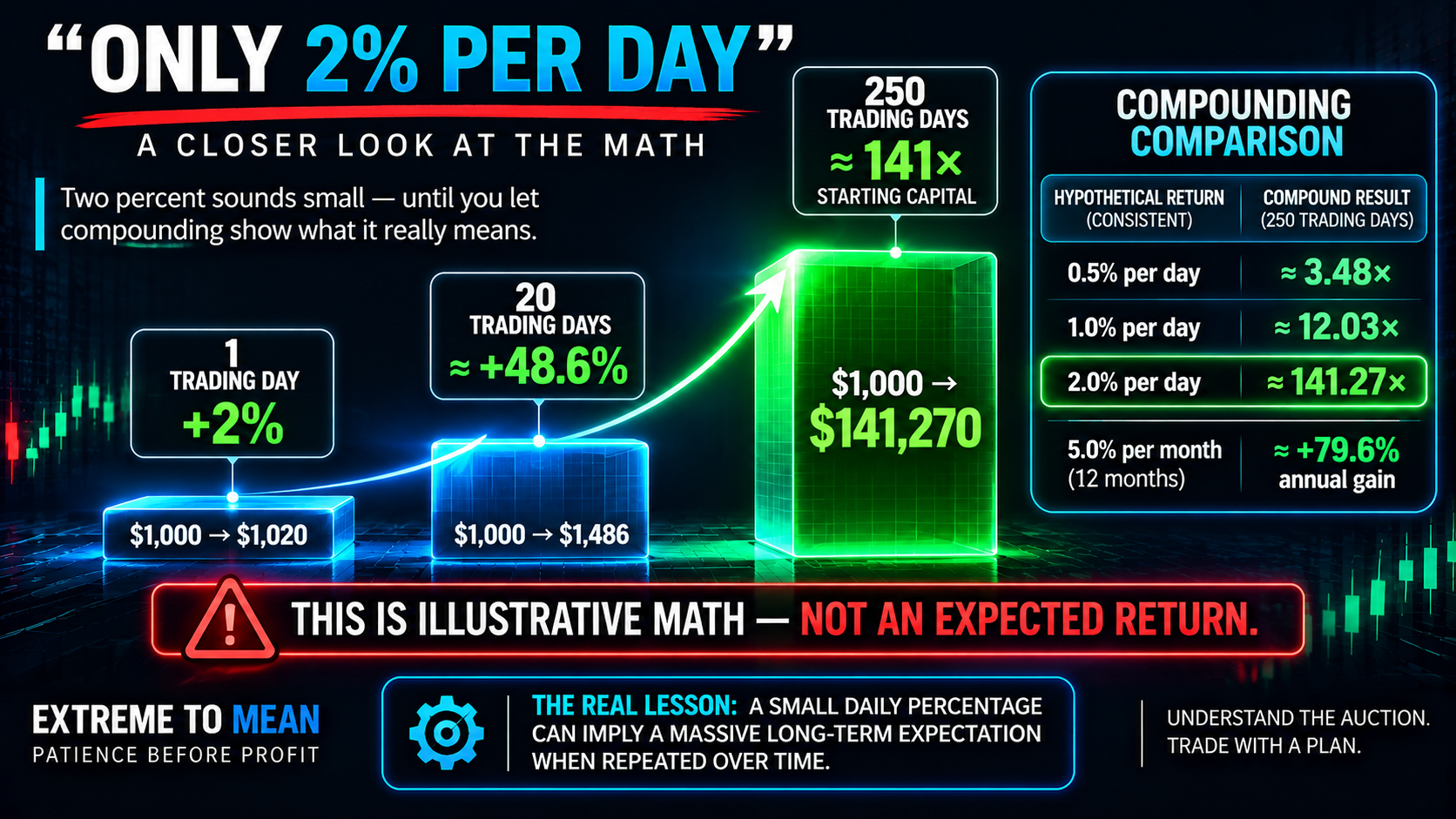
Two percent sounds small because two is a small number. Compounding tells a very different story. If a trader somehow earned 2% every trading day for 20 consecutive sessions, the compounded gain would be approximately 48.6%.
Extend that perfectly smooth assumption across 250 trading days and $1 of starting capital mathematically becomes about $141.27. That is roughly 141 times the starting capital, or an illustrative gain of more than 14,000%. This is not a forecast or an income claim; it is simply compound arithmetic.
“Only 2% a day” stops sounding small when you let the math finish the sentence.
| Illustrative smooth-return assumption | Compound result |
|---|---|
| 0.5% every trading day for 250 days | About 3.48× starting capital |
| 1% every trading day for 250 days | About 12.03× |
| 2% every trading day for 250 days | About 141.27× |
| 5% every month for 12 months | About 79.6% annual gain |
The table does not prove any of those outcomes are impossible. It shows how demanding those percentages become when they are treated as repeatable expectations. The calculations also assume a smooth path with no losses, drawdowns, fees, slippage, withdrawals, missed opportunities, or changing market conditions.
A Small Dollar Goal Can Hide a Huge Percentage Target
Suppose someone says, “I have $2,000 and I only want to make $50 per day.” Fifty dollars sounds modest in isolation. Against $2,000, however, it represents 2.5% of the account every day.
If 2.5% somehow compounded smoothly across 250 trading days, the mathematical result would approach 480 times the starting capital. Again, that is not a projection; it shows what the supposedly modest daily objective actually implies when repeated. A small dollar goal can hide an enormous percentage expectation when the account is small.
Account size changes the meaning of every dollar target. Making $100 on $2,000 is a 5% return, while making the same $100 on $100,000 is 0.1%. Dollar goals become meaningless until you compare them with the capital and risk required to pursue them.
Futures add another complication because leverage allows a relatively small amount of capital to control much larger exposure. That can make large percentage changes in account equity possible without making those changes easy or safe to pursue repeatedly. Leverage can make a return target easier to reach mathematically without making it safer to pursue.
The Market Does Not Owe You 2% Today
Imagine today's market offers no qualified setup, but the trading plan says today's objective is +2%. The trader now faces a conflict: accept that the market offered nothing, or manufacture enough activity to chase the required return. That is where a return target stops being an aspiration and starts influencing trade selection.
Once a daily target becomes mandatory, a day without opportunity begins to feel like a problem that trading must solve. A trader who is up 0.8% by noon may stop thinking, “I executed well,” and start thinking, “I still need another 1.2%.” The remaining target can turn perfectly acceptable performance into a feeling of being behind.
That is why doing nothing is still a trading decision. If no setup qualifies, zero may be the correct result for that session. The market is not required to produce enough opportunity to match the trader's desired income schedule.
Goal, Expectancy, and Outcome Are Different Things
A trader can absolutely have financial goals. The mistake is treating a goal as though it were the statistical expectancy of the trading process or the outcome that should occur today. GOAL ≠ EXPECTANCY ≠ OUTCOME.
A goal says, “This is what I would like.” Expectancy asks what the process has historically produced across comparable trades after winners and losers are included. Outcome says, “This is what happened this time.”
Confusing those three is how wishes become risk decisions. If the trader needs today's outcome to satisfy a financial goal, the next marginal setup can suddenly look more attractive than it would have looked without the target. The desired result begins altering the process that is supposed to produce it.
An Edge Changes Probabilities. It Does Not Schedule Profits.
A trading edge is statistical. It means that across enough comparable opportunities, the distribution of outcomes may favor the trader after losses and costs are considered. It does not mean each trade wins or each day ends positive.
That is the key distinction behind what an edge actually is. Positive expectancy can still contain losing trades, losing days, drawdowns, and periods when very few valid setups appear. The market can offer an edge without offering today's income target.
Real trading returns are therefore uneven because opportunity is uneven. A perfectly legitimate week might include a winner Monday, no trade Tuesday, a loss Wednesday, a larger winner Thursday, and nothing Friday. Trying to force that distribution into +2% every day requires activity on days when the process may have no reason to trade.
Drawdown Changes the Return Conversation
Returns cannot be evaluated without considering what the account had to survive to produce them. Suppose a $10,000 account falls to $8,000. That is a 20% drawdown, but returning from $8,000 to $10,000 requires a 25% gain.
The asymmetry grows as drawdowns become deeper:
| Drawdown | Gain required to recover |
|---|---|
| 10% | 11.1% |
| 20% | 25% |
| 30% | 42.9% |
| 50% | 100% |
Losses and recovery are mathematically asymmetric. This matters because aggressive return targets often encourage traders to take greater risk, and the damage from that additional risk can create a recovery burden much larger than the original target suggested. A return number without its drawdown is only half a performance statement.
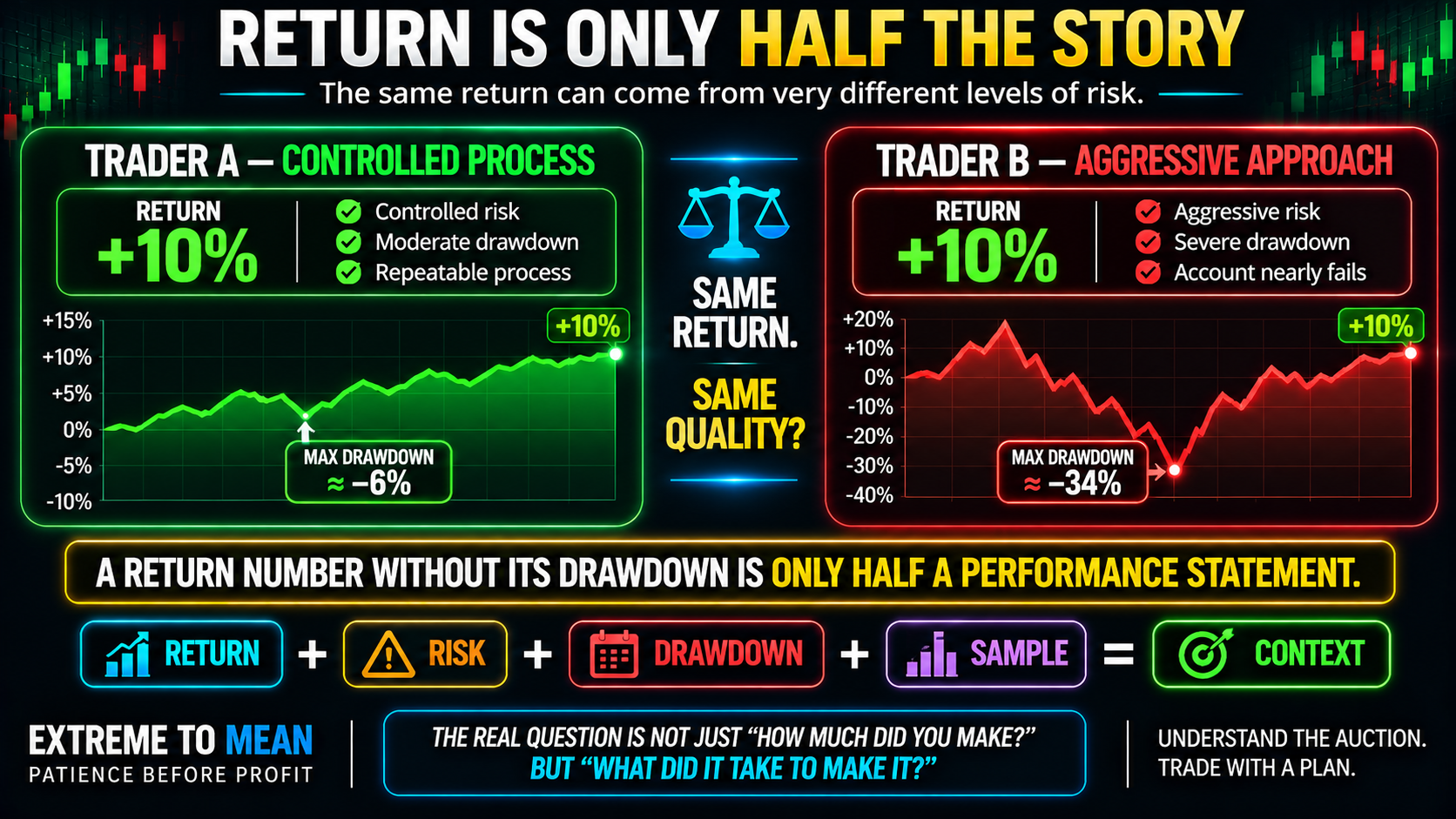
Imagine two traders both make 10% over the same period. Trader A uses controlled risk and experiences moderate drawdown, while Trader B takes aggressive exposure and repeatedly comes close to losing most of the account. The headline return is identical; the quality and survivability of the process are not.
Is 5% a Month Realistic?
The same reasoning applies to monthly targets. Five percent in one month is certainly a possible outcome, but asking whether 5% should be expected every month is a different question. If 5% were earned and fully compounded every month for 12 months, the illustrative annual gain would be approximately 79.6%.
That arithmetic does not prove a trader cannot have months that produce 5% or more. It shows how demanding the assumption becomes when converted from “this happened” into “this should happen repeatedly.” What has happened is not automatically what should be expected to happen repeatedly.
The solution is not to replace 5% monthly with some lower universal number. Doing that repeats the same mistake with a smaller target. There is no percentage that becomes realistic merely because it sounds conservative.
So What Is a Realistic Day-Trading Return?
The correct answer is conditional. Results depend on the strategy, market, capital, leverage, transaction costs, trade frequency, risk, execution quality, skill, market regime, and the actual number of valid opportunities. Without that information, a universal daily or monthly return figure tells the trader very little.
This answer can be frustrating because people naturally want a clean number. But replacing “2% a day” with “0.5% a day” would simply create another salary schedule that the market is expected to satisfy. The solution to an unrealistic fixed target is not a smaller fixed target.
A more useful expectation emerges from evidence. What has the strategy produced across a meaningful sample? How much drawdown accompanied those results, what costs were incurred, and how much risk was required? Only after those questions are answered does a return expectation begin to have context.
What Traders Should Measure Instead
Move from income targets toward process statistics. Ask:
- What is the strategy's expectancy across a meaningful sample?
- What is the average result relative to the risk taken?
- What has the maximum drawdown been?
- How often do qualified opportunities actually appear?
- How much do commissions, fees, and slippage remove?
- Are results dependent on one unusually large trade or day?
- Is the position size appropriate for the account?
- Is the process repeatable across different market conditions?
- Would I take the same trades if my daily profit target were hidden?
- Can I accept a flat day when the market offers nothing?
That last question matters because a process cannot remain selective if every session is required to produce income. A trading plan made before the session should tell the trader what qualifies, how risk is handled, and when participation makes sense. The desired paycheck cannot become an additional setup criterion.
The Realistic Returns Check
Before adopting a return target, ask what the number actually implies. Compound it over a month and a year, compare the dollar objective with account size, and consider the risk required to pursue it. Then compare that demand with the actual opportunity frequency and historical behavior of the strategy.
Next, examine the distribution rather than the best screenshot. A remarkable day is an outcome; a realistic return expectation requires a history. One exceptional week or month can show what happened without proving what should happen repeatedly.
Finally, ask whether the target changes your behavior. If falling behind causes more trades, larger size, weaker setups, or difficulty accepting a flat session, the target is no longer merely measuring performance. It is beginning to create trades.
For traders who recognize that pressure turning into unnecessary activity, the trading-too-much problem guide is a useful next step. The important question is not whether the account has reached today's desired number. It is whether the next opportunity independently deserves risk.
The ETM Edge → Risk → Sample → Drawdown → Expectation Framework
Use EDGE → RISK → SAMPLE → DRAWDOWN → EXPECTATION. First determine whether the process has evidence of positive expectancy, then understand what each opportunity requires the account to risk. Next, evaluate a meaningful sample rather than a handful of memorable outcomes.
Then study the drawdown the process has historically required the account to survive. Only after those pieces exist should realistic expectations begin to form. Returns should emerge from the process; the process should not be reverse-engineered from the return you want.
The wrong sequence is INCOME GOAL → REQUIRED DAILY % → FORCE TRADES. The better sequence is EDGE → OPPORTUNITIES → RISK → RESULTS. A target is a preference; an edge is evidence.
Final Thought
There is no universal percentage that turns day trading into a realistic income plan. Two percent a day may sound modest until compounding reveals what the assumption means, 5% a month may sound conservative until it is annualized, and $50 a day may sound small until it is compared with a $2,000 account.
The deeper problem is that markets do not distribute opportunity evenly enough to behave like a paycheck. A genuine edge can produce winners, losers, flat periods, and drawdowns across a meaningful sample. Return alone cannot tell you whether the process that produced it was realistic, repeatable, or survivable.
Start with the edge, the risk, the sample, and the drawdown. Let the return emerge from those answers instead of beginning with the income you want and forcing the market to provide it.
Educational content only. Trading involves substantial risk and is not suitable for everyone.