
A prop-firm challenge puts a bright number in front of the trader: the profit target. The danger is letting that number make every session feel like a requirement to earn.
Passing begins by refusing to spend drawdown on trades that never earned it.
A futures evaluation creates a structural tension because the trader needs profits while operating with limited room for error. Every trade consumes something valuable: risk capacity. A qualified trade may deserve some of that capacity; a weak trade can consume the same drawdown without enough reason to take the risk.
That is why this lesson belongs inside The Trader. The profit target tells you where you eventually want to get, but it does not tell you that the next trade deserves to help you get there. The sharper question is: Does this trade deserve part of my limited challenge risk, or am I spending risk because I want progress?
Why Passing Is as Much About Rejection as Execution
Most traders enter a challenge thinking mainly about what they need to make. The target is obvious, while the less visible job is preserving enough flexibility for qualified opportunities. Passing depends on executing good trades and refusing trades that never met the standard.
That does not mean fewer trades are automatically better. A trader may see several excellent setups in one session and take several, or see none and finish flat. The count is not the point; trade selection is.
Drawdown Is Limited Risk Inventory
Think of challenge drawdown as limited inventory. Every trade spends some of that inventory for the possibility of profit. The useful question is not merely, “Can I afford this stop?” but, “Is this opportunity good enough to justify spending this room?”
Small weak trades still accumulate. One unnecessary loss may be manageable, but several can shrink the cushion while increasing pressure on every decision that follows. The issue is not whether one bad trade fails the account; it is why drawdown was spent on a trade the trader already knew was weak.
Drawdown rules vary by provider and program, so this is a mental model rather than a universal calculation. Available loss capacity is scarce, and weak trades consume it. Skipping bad trades cannot create an edge, but it can protect an existing edge from unnecessary damage.
The Profit Target Is Not a Trading Signal
Targets create urgency when the trader converts an account objective into a daily requirement. “I still need $2,000” becomes “I should make $400 today,” and suddenly the remaining target starts influencing setup selection. The market does not know how much profit stands between the trader and passing.
A challenge target is an account objective, not a setup signal. Being close to passing does not improve location, strengthen structure, or clarify invalidation. Being close to passing does not make the next setup closer to qualifying.
This is where location remains the first filter. If the trader would reject the setup under normal conditions, proximity to the target should not transform it into acceptable risk. The account goal cannot repair a weak market decision.
Why Flat Days Can Protect a Challenge
A flat day can feel wasted because the target did not move. Yet if no qualified setup appeared, zero P&L may also mean no drawdown was consumed, no emotional spiral began, and tomorrow's opportunities remain fully available. A skipped bad trade does not advance the target; it protects the ability to make progress later.
That is why doing nothing is still a trading decision. Rejecting a weak setup is not inactivity when the trader has evaluated it and decided the opportunity is not worth spending risk on. Not every flat day is good; the standard is whether the decision process was sound, not whether a transaction occurred.
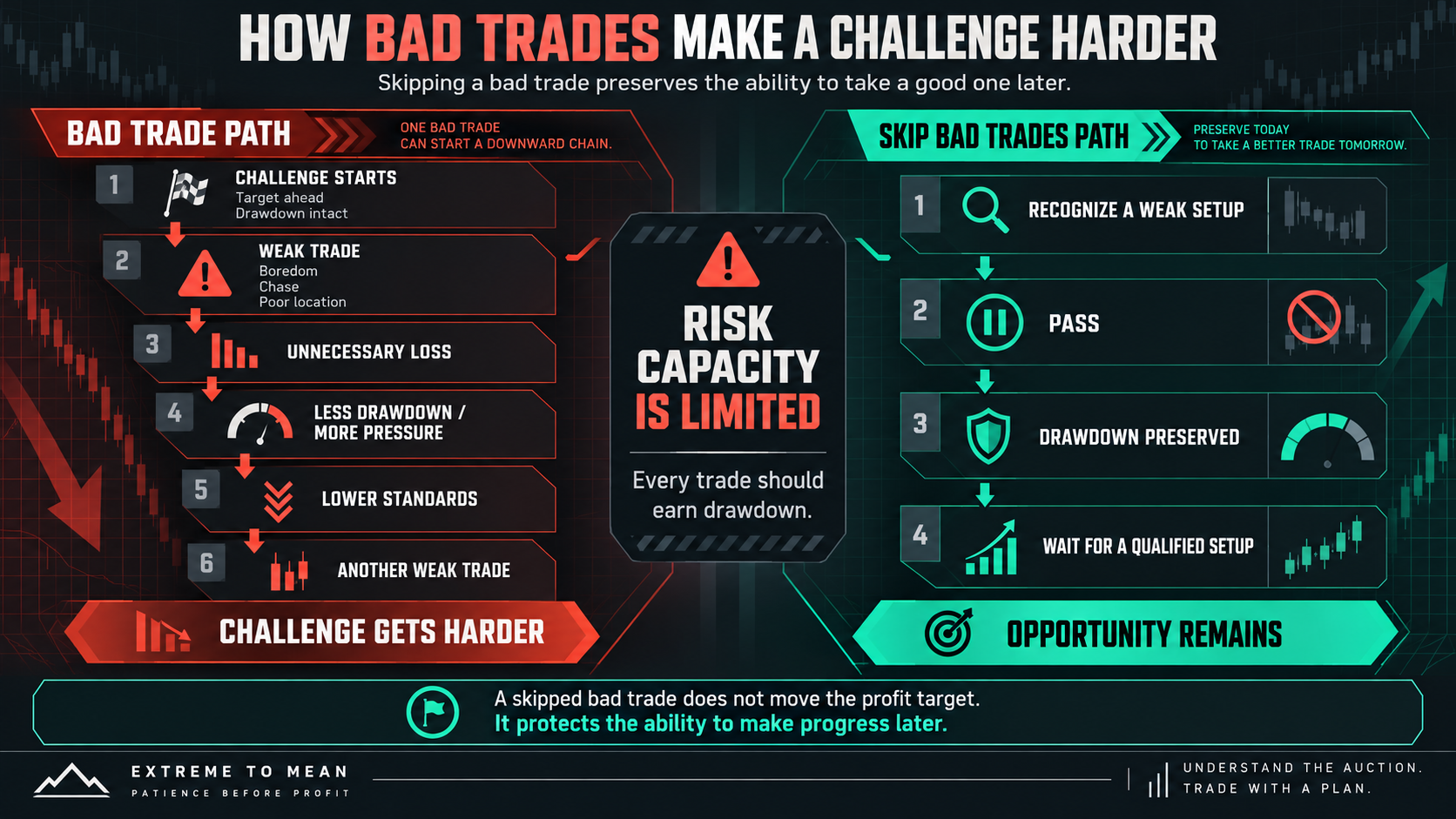
The Bad Trades That Quietly Make Evaluations Harder
The most damaging challenge trades are not always dramatic. They can be mediocre entries with poor location, incomplete qualification, vague invalidation, or timing that would normally cause hesitation. Because the risk looks small, the trader says, “It is only one trade.”
The direct loss may be modest, but the indirect cost can be larger. Remaining drawdown shrinks, the target feels farther away, and the next setup can start carrying emotional pressure it did not create. A low-quality loss can make every trade that follows feel more important than it should.
That pressure can become self-reinforcing. A weak trade loses, the trader feels behind, standards loosen slightly, and another weak trade suddenly seems acceptable. The challenge becomes harder because unnecessary losses compressed both financial and psychological room.
Missed Moves, Boredom, Revenge, and News Shortcuts
Missing a clean move can create one of the worst follow-up trades. The trader calculates what the missed winner “would have done” for the challenge, then accepts a poorer entry later because it feels like a second chance. A missed winner does not create permission for a worse trade afterward.
Boredom creates a similar distortion because inactivity feels expensive when a target is waiting. Revenge gives the next trade a second job—repair the account—and fast news can look like an efficient shortcut to passing. The possibility of rapid progress can make dangerous conditions look more attractive than they really are.
News-trading rules vary by firm and program, so current provider rules should always be checked directly. Regardless of the rule set, volatility, boredom, FOMO, or frustration cannot substitute for qualification.
A Winning Bad Trade Can Be More Dangerous
A weak trade can win and still make the challenge more dangerous. The trader gets closer to the target, feels rewarded for ignoring the standard, and may conclude that greater aggression is required. The account improved while the process deteriorated.
That is why losing trade and bad trade must remain separate ideas. A qualified trade can lose and still deserve to have been taken, while an unqualified trade can win and still deserve rejection. The objective is not to remove losses; it is to reduce losses created by decisions that should never have existed.
Two Traders, Same Challenge
Imagine two traders begin with the same objective and loss cushion. Trader A feels pressure to make progress every day, takes a mediocre trade on Day 1, chases after missing a move on Day 2, and trades a fast move on Day 3 because “I need a good day.” None of those trades alone must fail the challenge, but together they reduce room and increase pressure.
Trader B sees no setup on Day 1 and finishes flat. On Day 2, the best move is missed but the chase is rejected; on Day 3, one qualified setup finally appears and is taken under the normal process. Whether that trade wins or loses, Trader B reaches it with more flexibility because the previous two days cost nothing.
Trader A tried to force progress. Trader B protected the ability to make progress when the market finally offered it. That is the practical value of rejection inside a challenge.
Trade Rejection Is Active Risk Management
Rejecting a trade can look passive because nothing appears in the ledger. In reality, the trader may have preserved drawdown, attention, flexibility, and eligibility with one decision. Risk management can begin with refusing the position altogether.
The challenge fee does not change that logic. “I paid for this, so I should use it” can create unnecessary activity, but the next setup still has to stand on its own. The cost of the challenge does not make a weak trade more valuable.
Good challenge trading may look surprisingly unimpressive. It can include waiting, flat sessions, and rejected setups. The account does not care whether the path to passing was exciting.
The Challenge Trade-Rejection Check
Before a questionable trade, ask:
- Would I take this trade if I were not in a challenge?
- What exactly qualifies this setup?
- Is the location good, or am I chasing because I missed the move?
- Am I bored, frustrated, behind, or trying to recover?
- Would I take this trade if my current challenge P&L were hidden?
- Does the risk fit the account's current room?
- Am I using volatility or news as a shortcut to the target?
- If this loses, will I still believe the trade deserved to exist?
- If I pass, what do I actually lose?
- Does this trade earn drawdown?
That final question changes the problem from “How do I make progress?” to “Is this opportunity worth spending scarce risk capacity on?” It does not require perfection or demand that the trade win. It requires the decision to deserve its place before the outcome is known.
For traders who notice missed moves turning directly into poor follow-up entries, the chasing-the-trade problem guide is the natural next step. Challenge pressure may explain why the chase feels reasonable, but it cannot make the chase qualify. The setup still has to earn the risk.
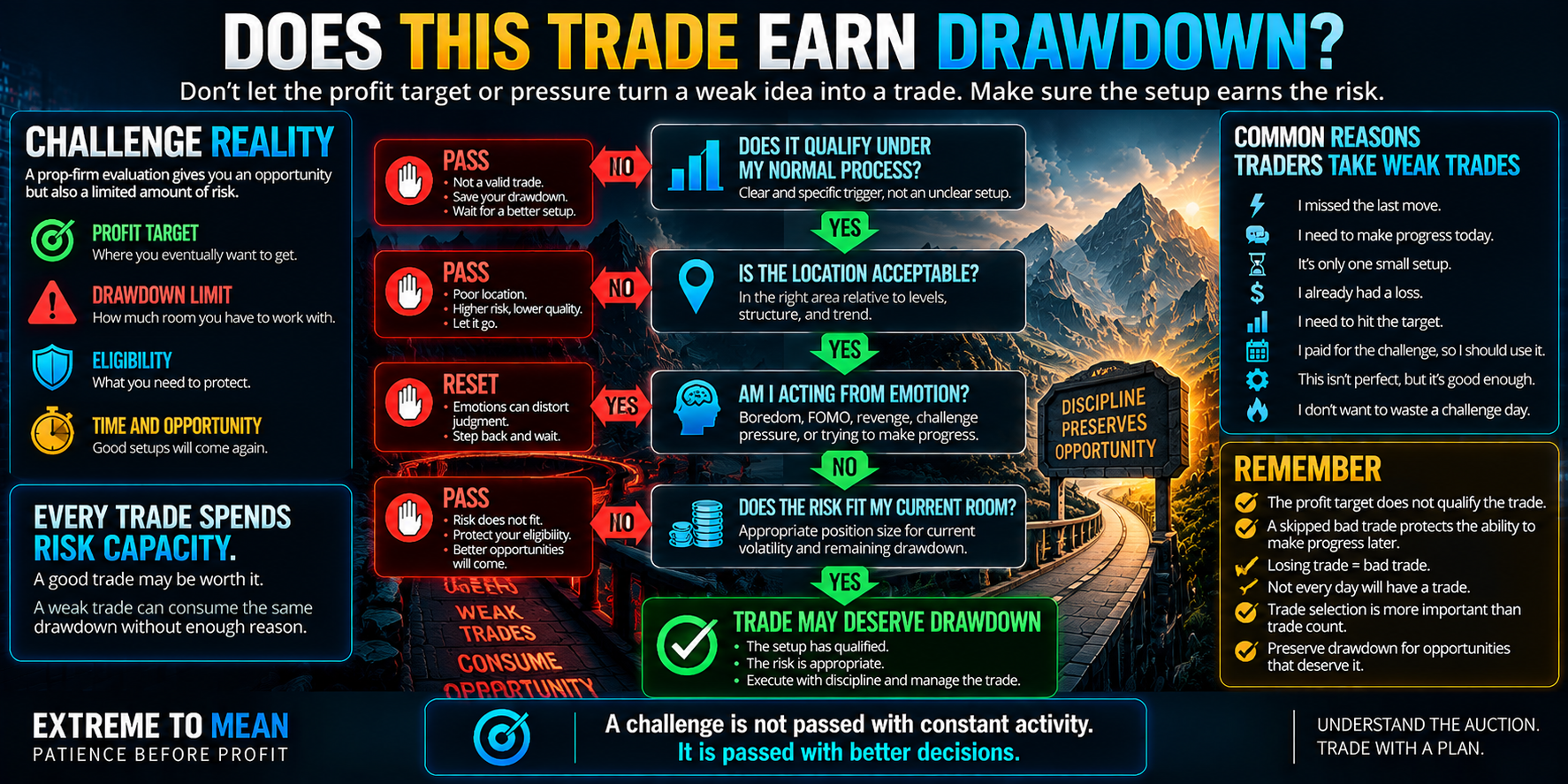
The ETM Protect → Qualify → Risk → Execute → Preserve Framework
Use PROTECT → QUALIFY → RISK → EXECUTE → PRESERVE. Start with the fact that eligibility and remaining room matter, then ask whether the market is actually offering a qualified setup and whether that opportunity deserves part of the account's current risk capacity. Only then should execution happen.
Afterward, preserve the quality of the next decision instead of letting one result rewrite the standard. Protecting the next decision matters because a challenge can make every gain or loss feel unusually important. The choices remain trade, wait, pass, or done.
Risk is spent only after the setup earns it. The challenge target does not qualify the trade; the trade qualifies itself. Passing requires both execution and rejection.
Final Thought
A prop challenge naturally pulls attention toward the profit target, but the other half of the job is preserving enough risk capacity for good opportunities. Weak setups, chases, boredom trades, revenge trades, and shortcuts can consume that room without enough reason. The goal is not fewer trades for its own sake; it is making every trade earn its place.
Qualified trades will still lose. The avoidable damage comes from paying challenge risk for decisions that never met the standard. Protect the account, let the market provide the opportunity, and remember that sometimes the decision that gets you closer to passing is the trade you were disciplined enough to skip.
Educational content only. Trading involves substantial risk and is not suitable for everyone.