
Every trader eventually learns that patience matters. The only question is how long it takes and how much it costs. Some traders learn it early through journaling, review, and small mistakes. Others learn it after chasing weak setups, forcing trades in poor conditions, and giving back progress because they wanted action more than clarity.
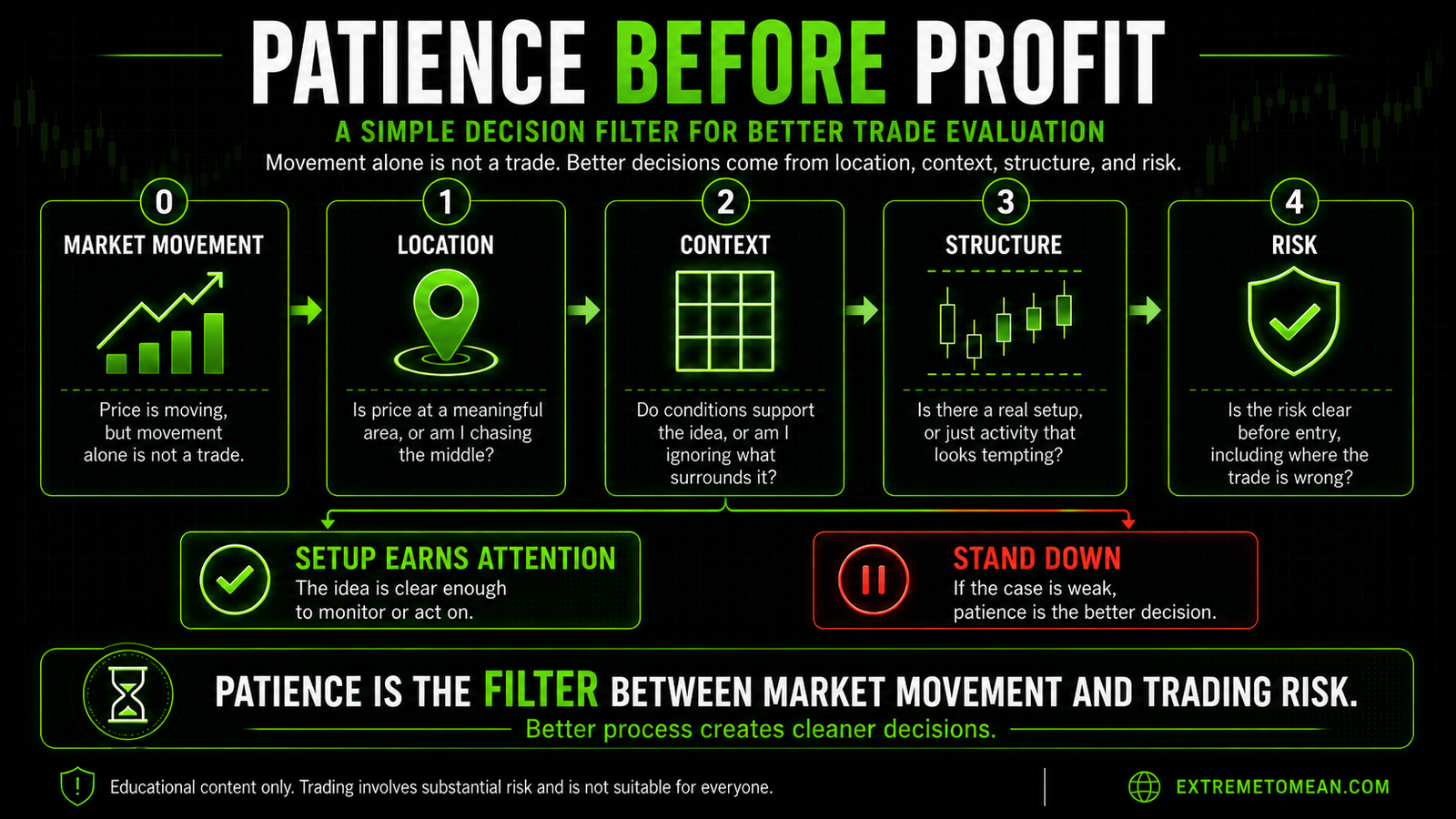
That is why Patience Before Profit is more than a tagline for Extreme to Mean. It is a reminder that the outcome is not the first thing a trader should be focused on. The first question is whether the decision is clean enough to risk money on. Profit is never guaranteed, but decision quality can be improved. That improvement starts before the entry.
Patience Is a Skill, Not a Personality Trait
Many traders think patience means being naturally calm. That is not really the point. In trading, patience is a skill that gets built through repetition, rules, and consequences. It is the ability to wait until the market gives enough information to make a decision instead of reacting to every candle, wick, or burst of movement.
This matters because markets are designed to tempt reaction. A fast move can make a trader feel late. A missed trade can make the next setup feel more urgent than it really is. A quiet session can make doing nothing feel like failure. None of those feelings prove that a trade is good.
A patient trader is not someone who never feels pressure. A patient trader is someone who does not let pressure become the entry reason. They understand that a setup has to earn attention before it earns risk.
Why Impatience Feels Reasonable in the Moment
Impatience rarely feels reckless when it is happening. It usually feels logical. The trader sees movement, remembers a missed opportunity, and starts building a story around why this one should work. The market looks active, the candle looks strong, and the fear of sitting out starts to feel worse than the risk of being wrong.
That is what makes impatience dangerous. It often hides behind reasonable-sounding thoughts. "I do not want to miss the move." "This looks close enough." "I can just use a tight stop." "I will manage it if it goes against me." Those thoughts may sound practical, but they can also be signs that the trader is negotiating with a weak setup.
The problem is not that the trader wants opportunity. The problem is that they start treating movement like opportunity. Price moving is not enough. A candle moving fast is not enough. A trade idea needs context, location, and a clear risk plan before it deserves action.
The Cost of Learning Patience Late
Every successful trader eventually learns that patience is not optional. Some learn it from mentors. Some learn it from reviewing their own mistakes. Many learn it from paying too much attention to entries and not enough attention to conditions.
The cost is not only financial. Impatience damages confidence because it creates trades that are hard to review cleanly. When the entry was emotional, the lesson becomes blurry. Was the setup bad? Was the stop too tight? Was the market condition wrong? Or was the real mistake entering before the trade had enough structure?
That confusion matters. A trader cannot improve a process they are not honestly tracking. When trades are forced, the journal fills with exceptions instead of lessons. Over time, the trader may start believing the market is the problem when the real issue is decision quality.
Patience protects the trader from unnecessary complexity. It does not make the market predictable, and it does not guarantee the next trade will work. It simply gives the trader a cleaner decision to evaluate.
What a Better Decision Looks Like
A better trade decision usually feels less rushed. It has a reason beyond "price is moving." The trader can explain the setup, the location, the broader context, and the risk before entering. They know where they are wrong, where the trade idea should respond, and what would make them stand down.
This is especially important for Extreme to Mean-style thinking because the goal is not to chase every move. The goal is to evaluate whether price has stretched into a meaningful area, whether the context supports attention, and whether the potential trade has a clear path back toward a more reasonable zone. The trader is not predicting perfectly. They are building a case.
That case does not need to be complicated. In fact, cleaner is usually better. The trader should be able to say, in plain English, "This is the location, this is the context, this is the risk, and this is why the setup is worth watching." If that cannot be said clearly, patience may be the better decision.
This is also where a resource like The Patience Principle fits naturally into the trading process. The book is not about sitting around and hoping. It is about understanding why patience is active, why waiting is often part of risk management, and why better decisions usually begin before the trade is placed.
Want to go deeper on this idea? The Patience Principle expands on why waiting is not passive, why forced action damages decision quality, and how traders can build a more deliberate process before risking capital.
A Better Question Before Acting
Before entering a trade, a trader can slow the decision down by asking one better question:
Has this setup earned risk, or am I trying to turn movement into a trade?
That question cuts through a lot of emotional noise. It forces the trader to separate what the market is doing from what they wish the market would give them. It also moves the focus away from prediction and back toward evaluation.
A simple patience filter can help:
- Is price in a meaningful location, or am I chasing the middle?
- Does the current context support this idea, or am I ignoring conditions?
- Is the risk clear before entry, or am I planning to figure it out later?
- Do I have a real setup, or only a reason to feel involved?
- Would I still take this trade if I had not missed the previous one?
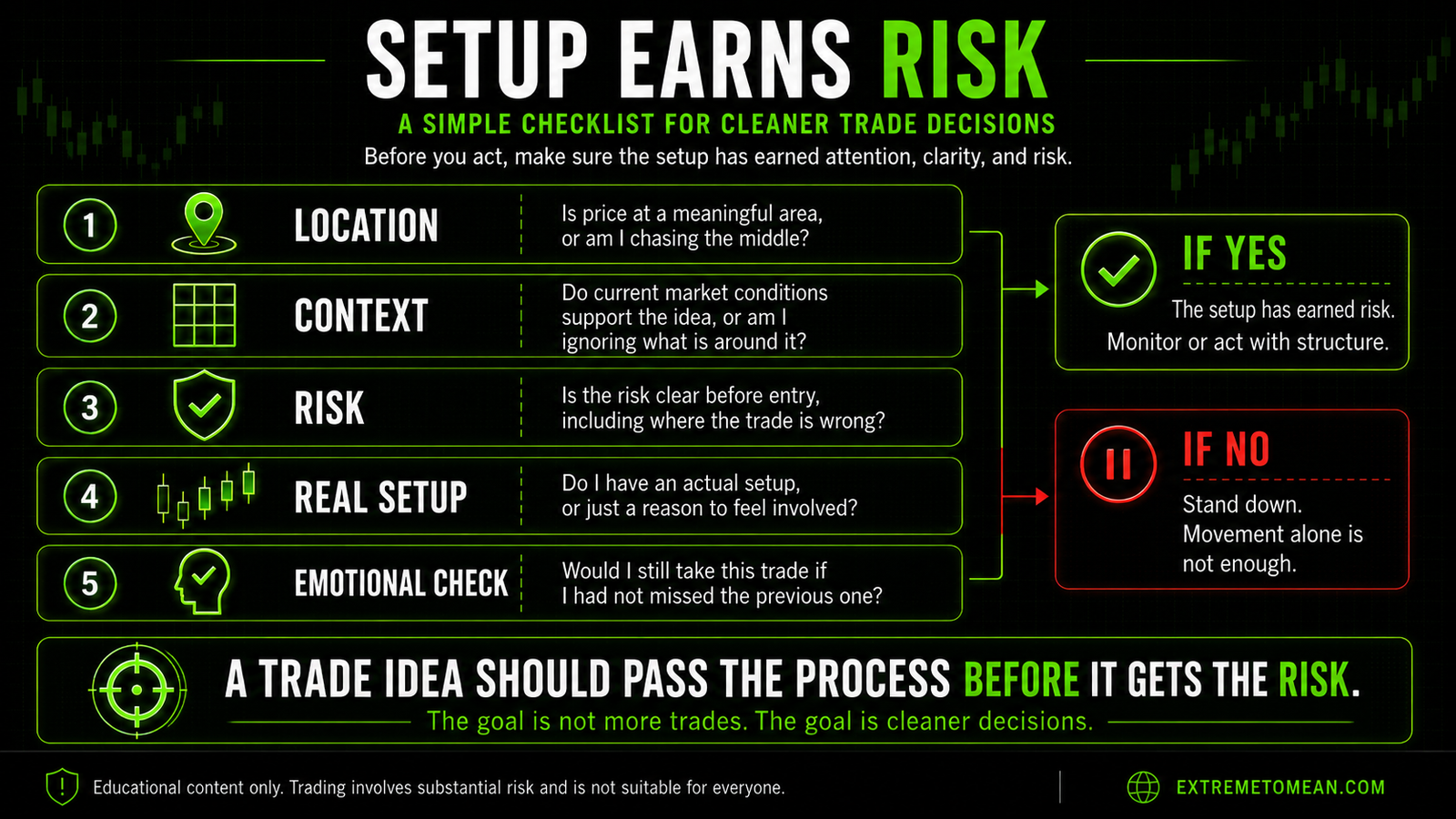
These questions do not guarantee a good outcome. They are not supposed to. Their purpose is to improve the quality of the decision before money is at risk. That is the work of a trader.
Final Thought
Patience is one of the hardest lessons in trading because the market constantly rewards action just often enough to make impatience feel justified. But over time, most traders learn the same truth: not every move deserves a trade, and not every trade idea deserves risk.
Patience Before Profit means the trader's first job is not to make a prediction. The first job is to evaluate the decision. When patience comes first, the trader gives themselves a cleaner process, a clearer review, and a better chance to avoid paying for lessons that could have been learned before the entry.
Educational content only. Trading involves substantial risk and is not suitable for everyone.