A profitable backtest can make going live feel like the obvious next step. So can 100 trades, three green months, a year of paper trading, or simply the feeling that you have researched long enough.
Going live is another validation stage—not graduation.
There is no universal number of trades, profitable months, or simulation hours that proves a strategy is ready for real risk. Readiness should come from several different forms of evidence agreeing: the edge is defined, the sample is meaningful, unseen data has been tested, execution assumptions are realistic, expectancy remains positive after costs, drawdown is understood, and the trader can follow the process as markets unfold.
That is why this belongs inside The Setup. The sharper question is not, “Have I tested long enough?” It is: Have I collected enough evidence to justify real risk—or have I simply spent enough time testing that I now want the answer to be yes?
“Am I Ready?” Is Not the Same as “Have I Been Green?”
A green result is useful evidence, but it does not explain how reliable that evidence is. Three profitable months might contain hundreds of independent opportunities across several environments, or twelve trades concentrated in one favorable regime. Calendar time measures duration; it does not measure evidence quality.
The same problem applies to win rate, profit factor, and backtest length. A 65% historical win rate sounds impressive until we learn that the strategy was heavily optimized, the profitable sample came from one market condition, or realistic costs were missing. GREEN MONTHS ≠ READINESS.
The goal is not to collect one impressive statistic. It is to make the evidence increasingly difficult for a weak strategy to fake.
Why There Is No Magic Number of Trades
Sample size matters because more observations generally reduce uncertainty. Suppose a strategy has an observed 60% win rate and, only for illustration, we temporarily assume every trade is an independent and identical win-or-loss observation. A simple normal approximation gives us something like this:
| Sample | Observed win rate | Approx. 95% margin around estimate |
|---|---|---|
| 25 trades | 60% | about ±19 percentage points |
| 100 trades | 60% | about ±10 points |
| 400 trades | 60% | about ±5 points |
This is illustrative statistics—not a go-live rule. More observations narrow uncertainty; they do not eliminate it, and real trading outcomes are usually messier than identical independent coin flips.
A strategy can have 100 trades and still have weak evidence if those observations came from one narrow environment. Trades can also be correlated: ten entries during the same directional event may create ten records without providing ten independent tests of the underlying idea. Sample size tells you how much data you have; sample diversity tells you how much of the market that data actually represents.
Gate 1: Can You Define the Edge?
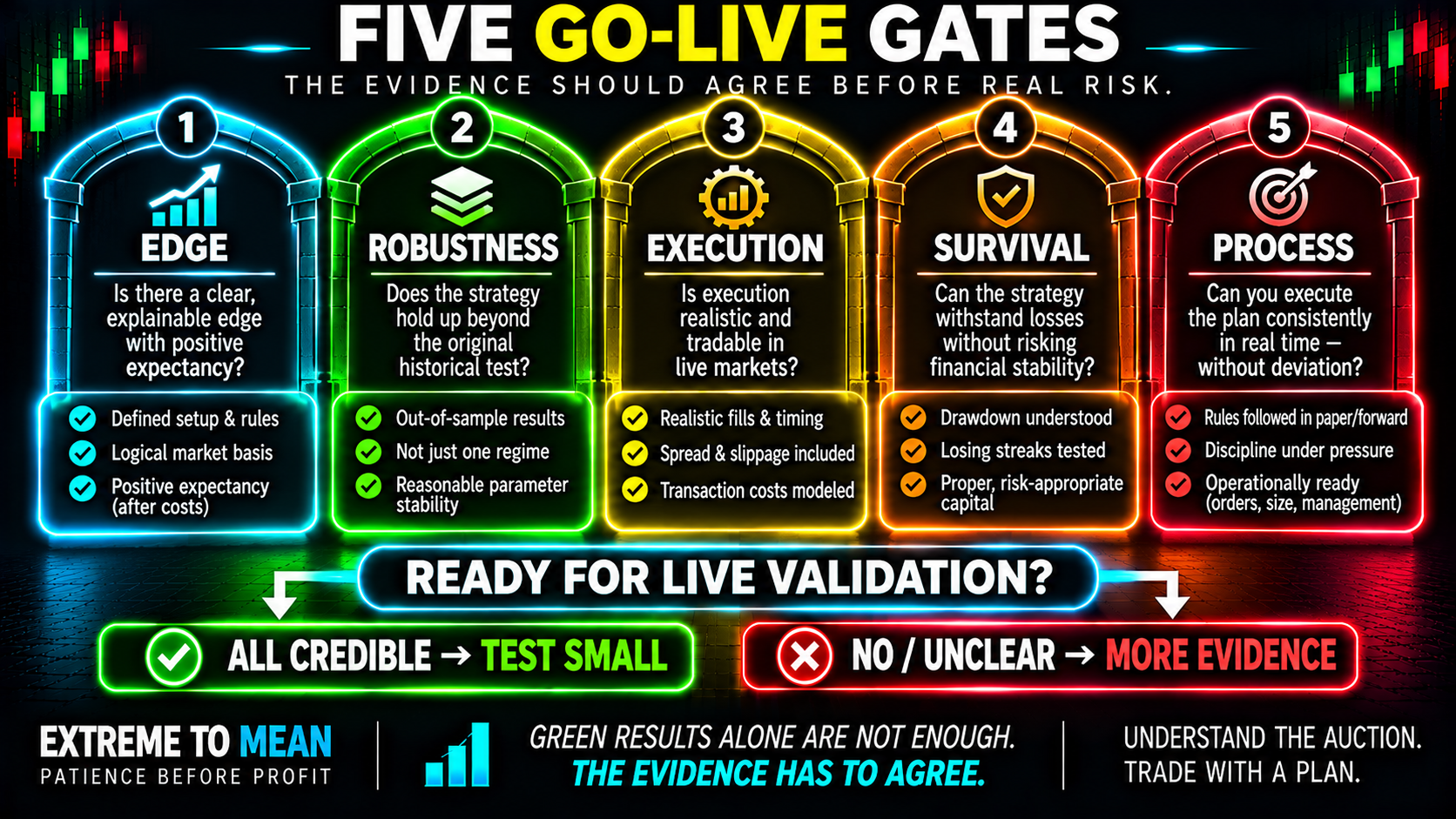
Before risking real money, the strategy should be explicit enough to evaluate. You should be able to define the setup, qualifying market conditions, entry logic, invalidation, exit logic, and risk logic without rewriting the rules after seeing each result.
That does not mean every edge has to be publicly disclosed or reduced to one indicator. It means the process must be sufficiently clear internally that evidence can confirm or challenge it. If you cannot explain what creates the edge, you cannot know what evidence is supposed to validate it.
This is where what an edge actually is becomes a prerequisite. Going live should test an edge—not search for one.
Gate 2: Has the Research Survived Overfitting and Unseen Data?
A profitable backtest is weaker evidence when it emerged from a large search process in which hundreds or thousands of variants were tested and only the winner survived. Reasonable parameter stability, explicit research history, chronological holdouts, and genuinely unseen data all make the evidence harder to manufacture.
That is the problem addressed in Overfitting in Trading Strategies. A strategy should survive something it was not optimized to pass. If every profitable result comes from data that helped build the model, the evidence remains incomplete.
Out-of-sample success does not prove future profits either. It raises confidence because the strategy survived a harder test, and that is all we need from the stage. EVIDENCE OF EDGE ≠ GUARANTEE OF FUTURE PROFIT.
Gate 3: Are Costs and Execution Assumptions Realistic?
Historical profitability is not useful if the profitable version depends on fills that a live trader could not reasonably receive. Commissions, spread, slippage, signal timing, missed limits, partial fills, and order logic belong inside the evidence before real money is introduced.
The preceding lesson on why backtests beat live results owns that execution problem in detail. The readiness question is simpler: does positive expectancy survive after execution is modeled conservatively enough to resemble the market the strategy will actually face?
Do not risk real money merely to discover that the simulator's fill model was the strategy's real edge. BACKTEST SUCCESS ≠ LIVE VALIDATION.
Gate 4: Do You Understand the Drawdown?
A backtest showing +20R can look reassuring until you examine the path required to produce it. What was the maximum historical drawdown, what did ordinary losing streaks look like, how long did recoveries take, and did some environments behave much worse than others?
Historical drawdown is context, not a future ceiling. If the worst historical decline was 8R, the future is not prohibited from producing 10R or 15R. Historical drawdown describes what happened—not the maximum the future is allowed to produce.
That matters because an ordinary losing sequence can look like strategy failure to someone who studied only the equity curve's ending value. If you have studied only how the strategy wins, you are not ready for what its losses may require you to endure.
Gate 5: Is the Capital Appropriate for the Experiment?
A broker allowing the trade does not prove the strategy is ready or the account is appropriately funded. Margin answers whether the broker permits the position; it does not answer whether the capital can survive the validation process or whether that money should be exposed to speculative loss.
The financial boundary should remain hard: real-money testing should use genuine risk capital rather than money required for living expenses, emergencies, retirement needs, or financial security. Evidence can justify testing a strategy. It cannot turn essential money into risk capital.
This is where readiness extends beyond the backtest. Broker permission is not strategy validation.
Gate 6: Can You Execute the Strategy in Real Time?
A strong historical strategy can still be paired with an unready live process. During forward or paper trading, can the trader identify valid entries as they happen, honor invalidation, avoid unplanned trades, follow exits, and maintain the same decision rules without knowing the outcome?
Backtesting asks whether the idea worked historically. Forward testing asks whether the process can operate as new markets arrive one decision at a time. Real money should not be used to repair execution habits that are already failing in simulation.
This creates an essential distinction: STRATEGY READINESS ≠ TRADER READINESS. A strategy can have credible research while the person or operational process intended to execute it remains unstable.
Simulation Still Cannot Reproduce Everything
Even disciplined forward testing has limits because simulated trading does not carry actual financial consequence. NFA's current hypothetical-performance guidance specifically warns that hypothetical results do not represent actual trading and cannot fully account for financial risk, adherence during losses, liquidity effects, or price slippage.
That does not make simulation useless. It makes simulation one form of evidence rather than an experience certificate from the live market. Backtesting evaluates history; forward testing evaluates the process as the future arrives; live validation introduces actual execution and actual financial consequence.
This distinction is why the final research gate should not produce the word PROVEN. A more responsible conclusion is READY FOR LIMITED LIVE VALIDATION.
Going Live Should Begin as Validation, Not Income Production
Moving from simulation to live trading does not have to mean moving immediately to the largest intended exposure. The first live phase can be deliberately constrained so that actual fills, slippage, operational behavior, and decision quality can be observed without turning the experiment into a test of maximum financial tolerance.
The purpose is research. Does live execution resemble the model? Does real P&L change decisions? Do the same rules remain executable? The first live trades should answer questions—not prove confidence.
That also means early success should not automatically trigger more size. Eight winning live trades make the live sample eight trades larger; they do not complete validation. Any later size increase should follow its own evidence-based process rather than becoming a reward for the first green week.
Compare Backtest, Forward and Live Evidence Side by Side
The purpose is not for all three environments to match perfectly. The purpose is to understand whether the differences are explainable and still consistent with a viable process.
| Metric | Backtest | Forward / Paper | Live |
|---|---|---|---|
| Win rate | Historical | Observed | Observed |
| Average winner | Historical | Observed | Observed |
| Average loser | Historical | Observed | Observed |
| Expectancy | Historical | Observed | Observed |
| Drawdown | Historical | Observed | Observed |
| Slippage | Modeled | Simulated | Actual |
| Rule adherence | Assumed | Observed | Observed |
| Missed fills | Modeled | Simulated | Actual |
A green live week does not prove the strategy. A red live week does not automatically invalidate it either if the losses fall within a plausible distribution and the process is behaving as expected. The purpose of live validation is to reconcile the evidence—not demand immediate profitability.
The Go-Live Readiness Checklist
Before moving from research or simulation into real risk, ask:
- Can I clearly define the edge and the conditions where it should exist?
- Has the strategy produced a meaningful sample rather than merely reached a magic trade count?
- Does that sample include more than one narrow market environment?
- Has the strategy survived genuinely unseen data?
- Have realistic costs, slippage, signal timing, and fill assumptions been included?
- Is expectancy still positive after those costs?
- Do I understand the strategy's historical losing streaks and drawdown?
- Can I execute the process in real time without frequent rule violations?
- Is the capital genuinely available to lose without threatening financial security?
- Have I defined in advance what the first live phase is supposed to test and what would trigger a pause?
No individual answer creates readiness by itself. The question is whether the independent pieces of evidence point in the same direction.
The ETM Backtest → Withhold → Forward → Reconcile → Live Small Framework
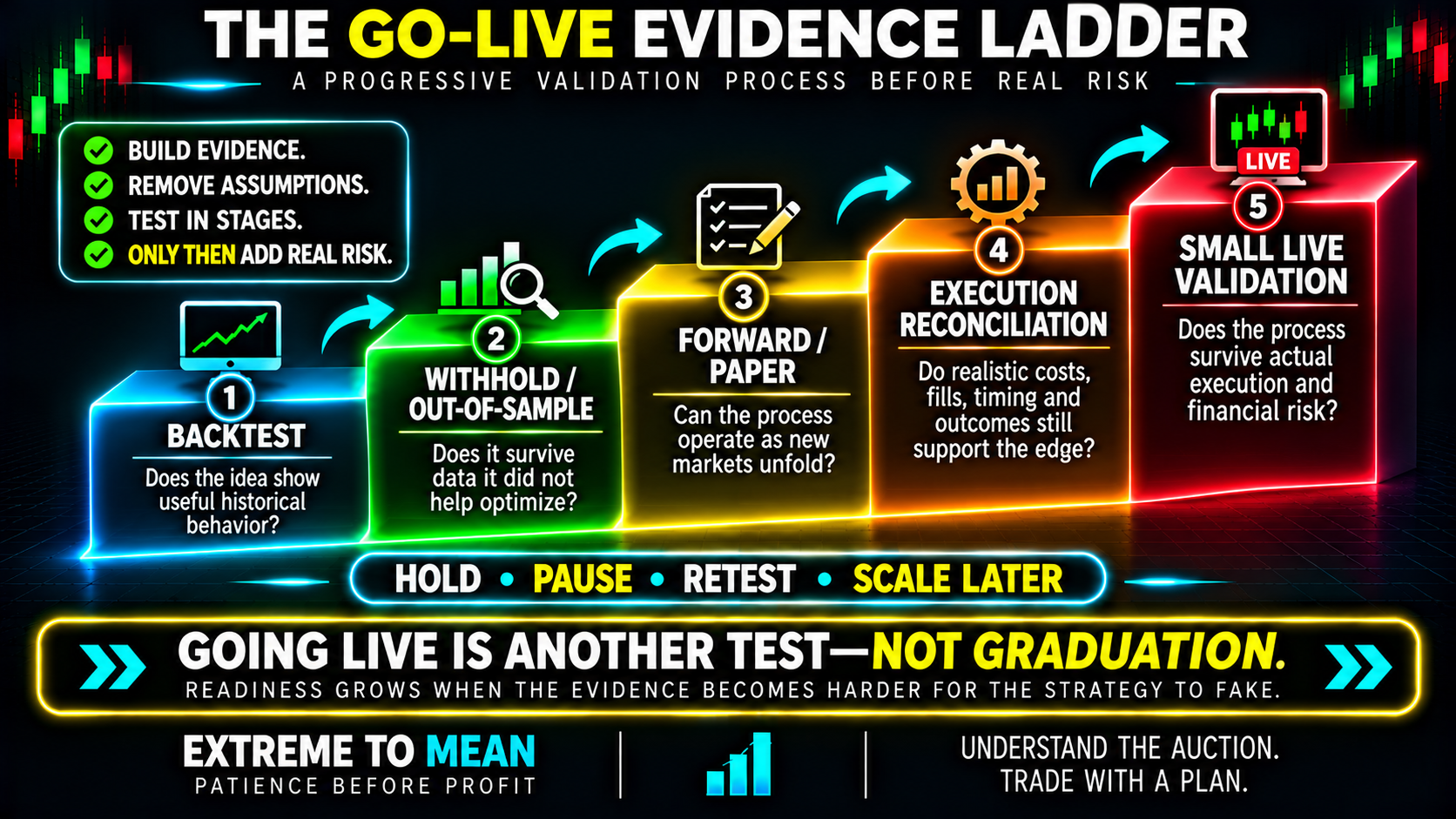
Use BACKTEST → WITHHOLD → FORWARD → RECONCILE → LIVE SMALL. Backtest asks whether the historical hypothesis shows useful behavior; withhold asks whether it survives information it did not help optimize; forward testing asks whether the process works as markets unfold; reconciliation asks whether costs, fills, timing, and outcomes still resemble the model.
Only then does LIVE SMALL begin collecting the evidence simulation cannot fully provide: actual execution, actual financial consequence, and actual behavioral response. From there the decision remains HOLD / PAUSE / RETEST / SCALE LATER. Progress through the validation ladder is reversible.
Each stage should answer a new question rather than simply repeat the previous test. Readiness grows when the evidence becomes harder for the strategy to fake. “Not enough evidence yet” is a legitimate research conclusion.
The ETM free tools can help organize testing and review, but no worksheet can replace the sequence itself. Going live is not proof that the strategy works. It is permission to begin collecting a new kind of evidence.
Final Thought
There is no universal number of trades, green months, or paper-trading hours that proves a trader is ready to go live. A larger sample matters because uncertainty generally falls as observations accumulate, but 100 trades from one market regime, an overfit model, or an unrealistic execution assumption can still be deeply misleading.
Readiness should come from several different forms of evidence agreeing. Define the edge, test it honestly, expose it to unseen data, include realistic execution and costs, understand drawdown, demonstrate that the rules can be followed in real time, and use only capital genuinely available for speculative risk.
If those pieces are credible, the conclusion still is not “proven profitable.” The conclusion is that the strategy and process may be ready for the next experiment: carefully controlled live validation. Going live should not end the research process; it should be the point where research begins confronting the assumptions only real execution and real financial risk can test.
Educational content only. Trading involves substantial risk and is not suitable for everyone.