
The double-spend problem sounds simple: if digital information can be copied, how can a digital monetary system prevent the same unit of value from being used twice? Bitcoin’s answer is not one security feature. It combines transaction rules, independent validation, a shared history, and proof of work so that conflicting spends cannot both become part of the accepted ledger.
The lessons in The Market category treat monetary systems as structures rather than slogans. Saying that “the blockchain prevents double spending” skips the mechanism that actually matters. A transaction must spend valid unspent outputs, nodes must verify those inputs, and the network must converge on a valid history. The trader’s job is to understand where confidence comes from and where risk still remains.
Why Digital Money Has a Double-Spend Problem
Ordinary digital files can be duplicated perfectly. If a digital currency were only a file that said someone owned one unit, copying that file could create competing claims to the same value unless a trusted authority maintained the official ledger. Traditional payment systems solve that problem through banks, card networks, or another central recordkeeper. Bitcoin was designed to coordinate the record without requiring one institution to decide which spend is final.
The broader CBDC-versus-Bitcoin comparison shows why this distinction matters. A centrally administered digital currency can rely on an authorized ledger operator to determine which balance changes are valid. Bitcoin instead distributes validation across participants running compatible consensus rules. The system therefore needs a way for independent nodes to reach the same conclusion about whether particular value is still available to spend.
Bitcoin Tracks Spendable Outputs
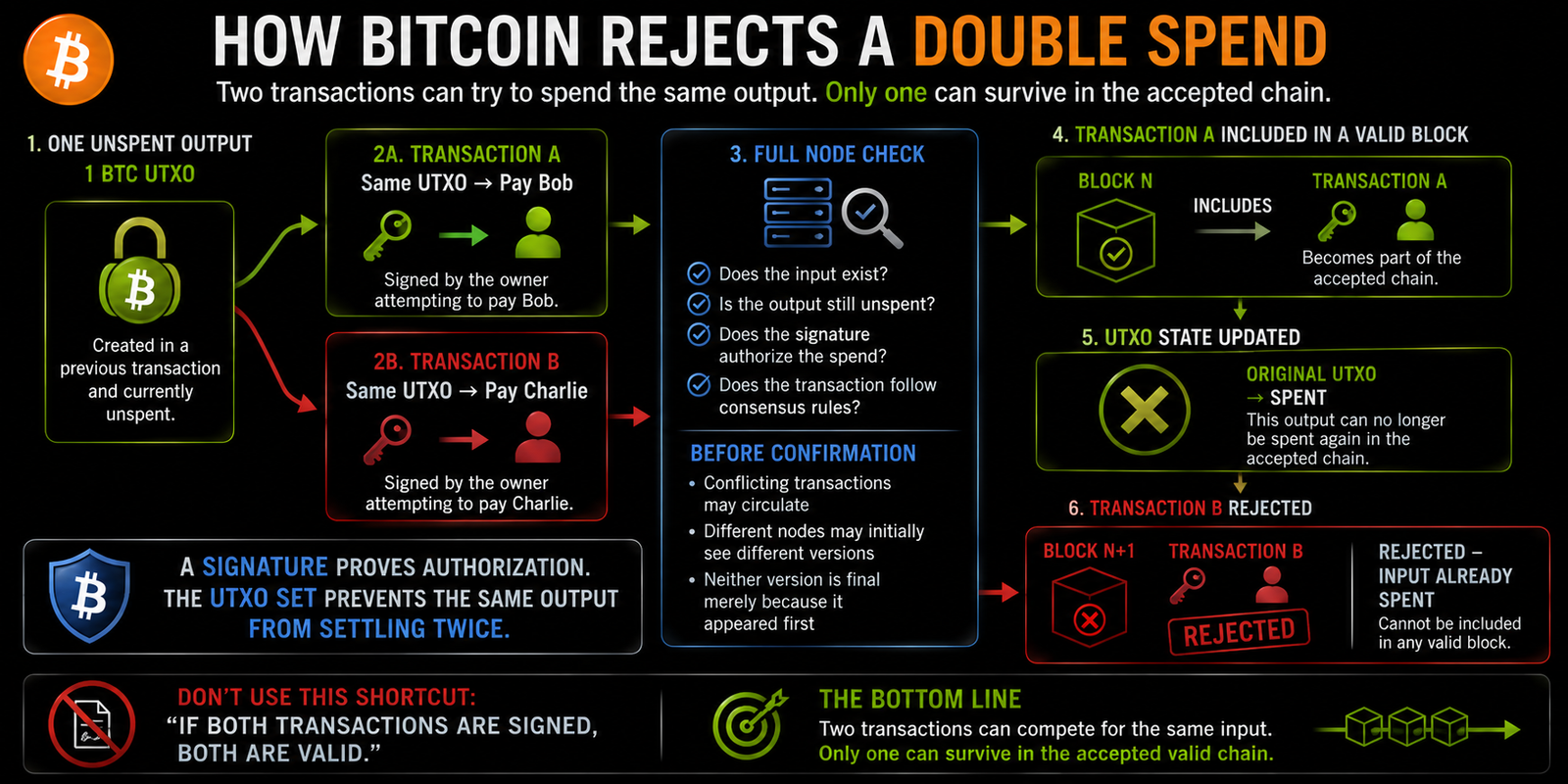
A valid Bitcoin transaction does not simply announce that a wallet balance should decrease. It identifies one or more previously created transaction outputs and attempts to spend them as inputs. Each output remains an Unspent Transaction Output, or UTXO, until a later valid transaction consumes it. Once that output has been spent in the accepted chain, the same output cannot be used again in another valid transaction.
This is why it is more accurate to think of Bitcoin as moving spendable outputs through a transaction history rather than moving individual coins between account balances. A wallet may display a single balance, but that balance can be assembled from UTXOs the wallet can authorize. When a payment is created, some of those outputs become inputs and new outputs are created for the recipient and, when needed, for change. The structure gives nodes something specific to test when they receive a transaction.
The fixed-supply lesson explains how nodes enforce Bitcoin’s issuance rules, and the same basic principle applies to spending rules. A digital signature proves that the person spending an output has the required authorization under that output’s conditions. That is necessary, but a signature alone does not solve double spending because one spender could sign two conflicting transactions using the same input. The network still needs to determine which spend can belong to the accepted transaction history.
What Full Nodes Actually Reject
Full nodes independently validate transactions and blocks against the rules they run. Among other checks, a node verifies that the referenced inputs exist, remain unspent in the relevant chain state, and satisfy the required spending conditions. A block that tries to spend an already-spent output violates the consensus rules and is rejected by nodes enforcing those rules. No miner can make both conflicting spends valid inside the same accepted chain.
Suppose one UTXO contains value that Alice controls. She broadcasts Transaction A paying Bob, then creates Transaction B spending the exact same UTXO somewhere else. Both cannot settle in the same valid history because each attempts to consume the same output. Before either transaction is confirmed, however, different nodes may temporarily hear different versions or apply different mempool policies.
Broadcasting a Transaction Is Not Settlement
That temporary uncertainty is why “broadcast” and “settled” should not be treated as synonyms. A receiver can see an unconfirmed transaction in a wallet or block explorer even though the transaction is not yet part of a block. Another conflicting transaction may exist or be propagated later, and only one conflicting spend can ultimately enter the accepted valid history. Until one version receives confirmation, the receiver is taking more settlement risk.
Replace-by-fee makes this distinction easier to see. Some unconfirmed transactions may be replaced by a conflicting transaction that pays a higher fee under applicable relay and mempool policy. That feature is useful for fee management, but it reinforces the broader lesson that an unconfirmed transaction is not final merely because it appeared first. Unconfirmed transactions can be double spent regardless of whether replace-by-fee is involved.
This does not mean every unconfirmed payment is fraudulent. It means the receiver must decide whether the additional uncertainty is acceptable for the transaction being completed. A coffee purchase, an exchange deposit, a vehicle sale, and a large institutional transfer do not have identical consequences if a payment disappears. Settlement policy should reflect the value at risk rather than a slogan about Bitcoin being instant or irreversible.
What Confirmations Actually Add
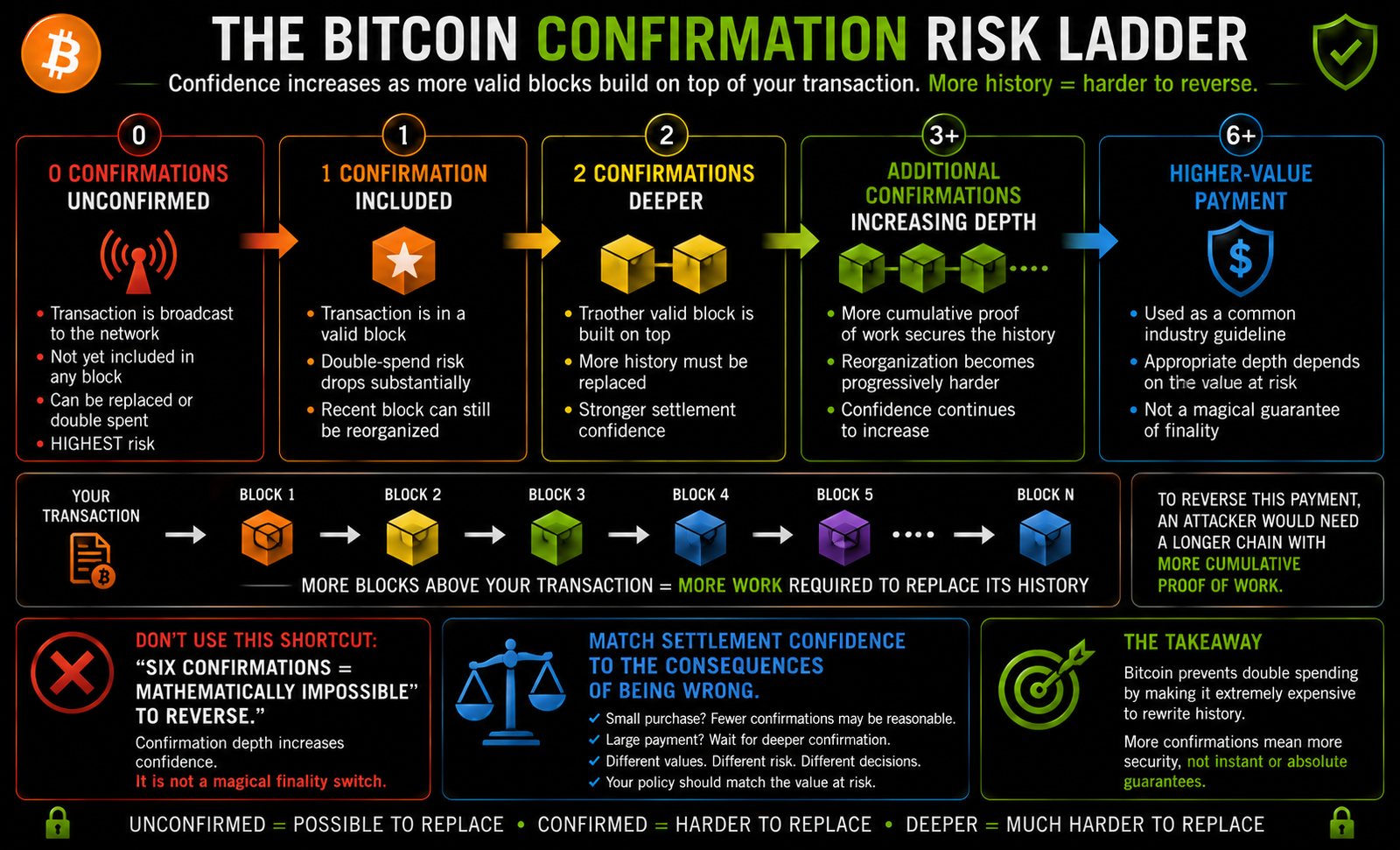
The first confirmation occurs when a transaction is included in a valid block on the node’s accepted chain. If another block is added on top of that block, the transaction gains another confirmation, and additional blocks increase its depth. Reversing the payment would then require a competing valid history that removes that transaction and accumulates enough proof of work to become the chain the node accepts. The practical difficulty generally rises as more work is built on top of the payment.
Confirmations therefore represent increasing confidence rather than an on-off switch between unsafe and mathematically irreversible. A one-confirmation payment is protected by a block, but a short chain fork or successful reorganization can still replace a recent block. Deeper confirmations require progressively more chain history to be replaced. The appropriate waiting period depends on the value, fraud exposure, and operational needs of the recipient.
A chain reorganization does not mean Bitcoin permanently accepts two final histories. Miners can occasionally find competing valid blocks at nearly the same time, creating a temporary fork. Nodes eventually follow the valid chain with greater cumulative proof of work, and transactions from a stale block may return to an unconfirmed state or disappear if they conflict with transactions in the selected chain. This is why recent confirmations carry more reorganization risk than transactions buried deeper in history.
The familiar “six confirmations” guideline is useful as a convention, but it should not be treated as a magical threshold. Increasing confirmation depth provides stronger protection for higher-value or fraud-sensitive payments. The correct threshold can still vary with the amount at risk and the receiver’s tolerance for delay. Bitcoin finality is better understood as progressively harder to reverse rather than suddenly becoming absolute at one number.
What a Double-Spend Attack Can—and Cannot—Do
An attacker with substantial hash power could attempt to build a competing chain that excludes a payment and later spends the same inputs differently. The attack does not allow the attacker to spend bitcoin they do not control or create an otherwise invalid transaction. Its objective is to replace part of recent transaction history with another valid history carrying greater cumulative proof of work. The more confirmations the target has, the more history and work the attacker must overcome.
This distinction also explains why a so-called 51 percent attack is serious without giving miners unlimited control over Bitcoin. Majority hash power can improve an attacker’s ability to reorganize recent history, censor transactions, or execute certain double-spend strategies. It does not let the attacker forge another person’s signature or force full nodes to accept transactions that violate their consensus rules. Mining power influences ordering and chain selection within the validity rules rather than replacing those rules.
The same separation between control and verification appears in the self-custody-versus-ETF lesson. Private keys determine who can authorize a particular spend, while network consensus determines whether that spend belongs to the accepted valid history. Holding the keys is therefore necessary to spend an output but does not give the owner authority to make two conflicting spends settle. Different parts of the system solve different problems.
A Practical Payment Review
For ordinary users, the practical lesson is not to calculate attack probabilities every time a payment arrives. It is to match settlement confidence to the consequences of being wrong. A small in-person purchase may justify different procedures from a large asset transfer, exchange deposit, or irreversible delivery of valuable goods. Risk management begins with the value at stake rather than with one universal confirmation number.
A cleaner payment review asks what state the transaction is actually in. The user should distinguish a wallet notification from mempool acceptance, block inclusion, and deeper confirmation. They should also consider whether the transaction may be replaced, whether the counterparty is trusted, and what happens if the payment disappears or is reorganized. Those questions turn “Bitcoin is secure” into an operational decision instead of a slogan.
A practical review can use these questions:
- Is the transaction still unconfirmed or already included in a block?
- Which UTXOs does the transaction attempt to spend?
- Is there evidence of a conflicting transaction?
- Is the transaction replaceable while unconfirmed?
- How many confirmations does it currently have?
- What value or obligation depends on accepting the payment?
- What happens if a recent block is reorganized?
- Does the recipient need immediate acceptance, or can settlement wait?
- Is the confirmation policy appropriate for the value at risk?
- Am I confusing a wallet notification with irreversible settlement?
The better question is not, “Can Bitcoin ever be double spent?” It is, “What would have to happen for this specific payment to be replaced, and how much confirmation is appropriate for the value at risk?” That framing recognizes meaningful zero-confirmation risk while also recognizing that confirmed transactions become progressively more difficult to reverse.
Final Thought
Bitcoin’s solution to double spending is a layered process. Transactions spend identifiable UTXOs, signatures authorize those spends, nodes reject attempts to reuse already-spent outputs in the accepted chain, miners assemble valid transactions into proof-of-work blocks, and additional blocks deepen the transaction’s history. None of those pieces alone provides the complete answer. Together they allow scarce digital value to be transferred without one central ledger operator deciding every payment.
The goal is not to claim that every broadcast transaction is final or that confirmed history can never be reorganized. It is to understand why competing spends cannot both survive inside the accepted valid chain and why confirmation depth changes the practical cost of replacing a transaction. That distinction turns the double-spend problem from a slogan into an understandable system. Readers seeking the broader monetary framework can continue through The Monetary Revolution.
Educational content only. Trading involves substantial risk and is not suitable for everyone.