
The choice is often reduced to a slogan. One side says that holding keys is the only ownership that matters, while the other says an exchange-traded fund makes direct ownership unnecessary. Both positions identify a real advantage and then treat it as the entire decision. A cleaner comparison begins by defining what is owned, who controls the underlying asset, and which risks the holder can manage.
The lessons in The Market category treat ownership structures as parts of a wider monetary system. Convenience can reduce operational difficulty while increasing reliance on institutions, and direct control can reduce some counterparties while creating personal security responsibilities. Neither structure removes Bitcoin’s volatility or guarantees a better outcome. The trader’s job is to evaluate the complete chain of ownership, access, and risk.
Two Different Things Are Being Owned
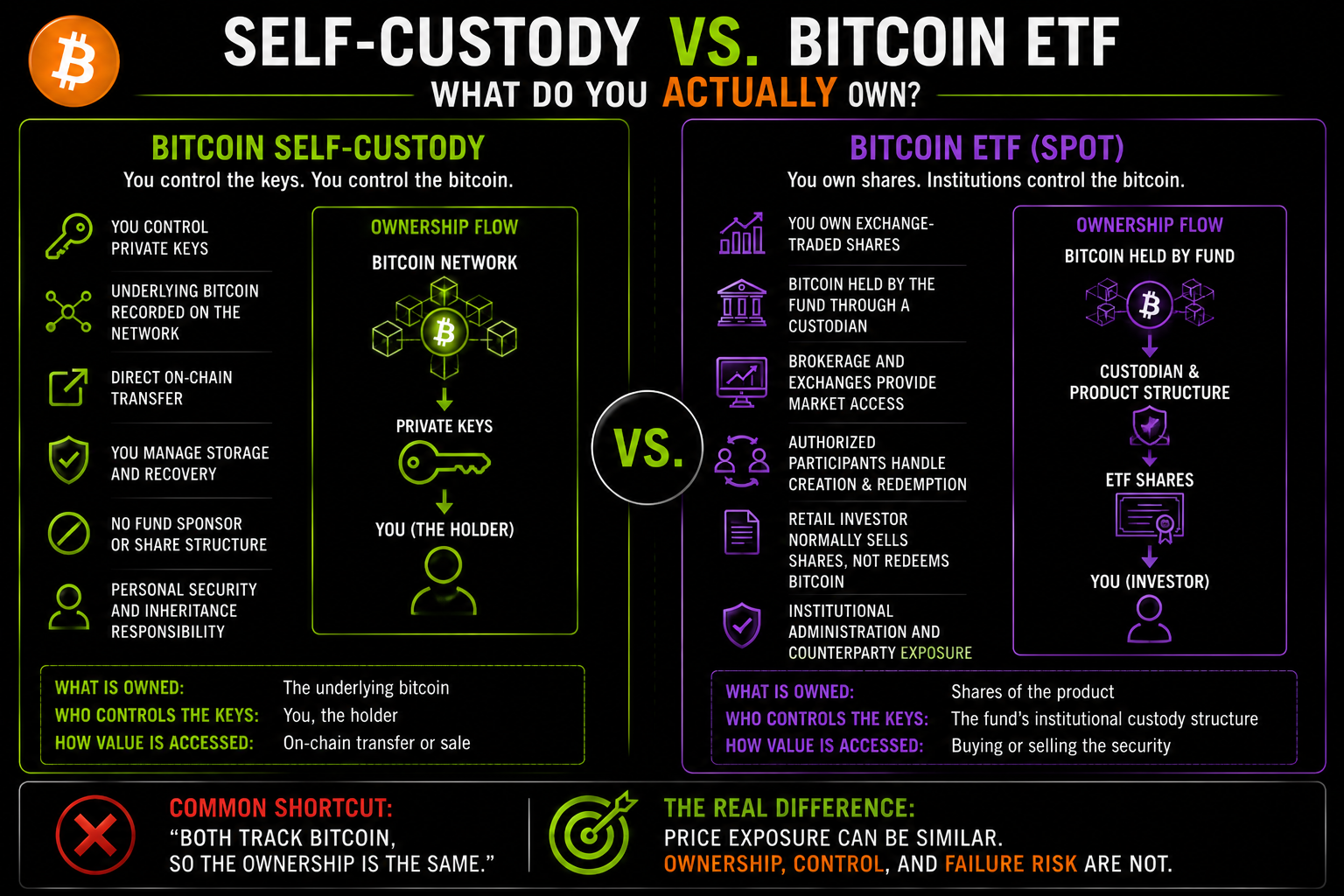
With self-custody, the holder controls private keys that authorize movement of bitcoin recorded on the network. The wallet protects the credentials required to spend the asset rather than storing coins in the way a physical wallet stores cash. Control of the keys provides practical control over the bitcoin. Losing or exposing them can remove that control permanently.
A Bitcoin ETF investor owns exchange-traded shares rather than the underlying bitcoin held by the product’s custodian. The shares seek to reflect Bitcoin’s market value after expenses and operational effects, but retail shareholders generally sell the shares rather than redeem them for bitcoin. Authorized participants perform the large creation and redemption transactions. The investor receives price exposure without private keys or ordinary withdrawal rights to the fund’s bitcoin.
For simplicity, this article uses “Bitcoin ETF” as the familiar term. Many U.S. spot products are technically exchange-traded products or commodity trusts, so the prospectus remains the controlling description of what the investor owns.
What Self-Custody Provides
Self-custody allows the holder to transfer bitcoin directly without asking a fund sponsor, broker, or custodian to release the underlying asset. Transactions can be initiated whenever the network is operating, subject to fees, confirmation conditions, and access to the keys. The asset can be moved to another wallet, used in a transaction, or verified against the public ledger. That transferability is one reason direct ownership matters in a monetary-asset discussion.
The fixed-supply lesson explains how nodes validate Bitcoin’s monetary rules, while self-custody answers who can authorize movement of a specific holding. A person may understand the protocol and still rely on an exchange or custodian for access. Direct control exists only when the holder controls the required keys. Legal ownership questions involving taxes, inheritance, marital property, or creditors can still exist outside the blockchain.
What a Bitcoin ETF Provides
A Bitcoin ETF places the investment inside a familiar brokerage structure. Shares can generally be bought and sold through accounts that already hold stocks, bonds, and other exchange-traded products. Brokerage statements, beneficiary designations, portfolio reporting, and institution-managed security can make administration easier. For many investors, that convenience is the product’s main value.
The ETF also shifts key management away from the shareholder. The sponsor, trustee, bitcoin custodian, broker, exchange, and authorized participants perform different parts of the process. This can reduce the risk that one person loses a seed phrase or sends bitcoin to the wrong address. It replaces personal operational risk with institutional, legal, custody, market-structure, and counterparty exposure.
Custody Risk Changes Form
Self-custody concentrates responsibility with the holder. A secure process may require careful wallet setup, protected backups, recovery testing, physical security, and a plan for incapacity or death. The holder must also defend against phishing, malware, coercion, accidental disclosure, and irreversible transaction mistakes. Personal control is useful only when the security process is strong enough to preserve it.
An ETF concentrates custody with professional institutions instead. Public disclosures and regulated exchange trading provide information and securities-market protections, but they do not guarantee that the fund, custodian, broker, or market infrastructure cannot fail. The shareholder cannot independently move the underlying bitcoin if an intermediary becomes unavailable. The two methods therefore move risk rather than eliminate it.
Trading Hours, Transferability, and Liquidity
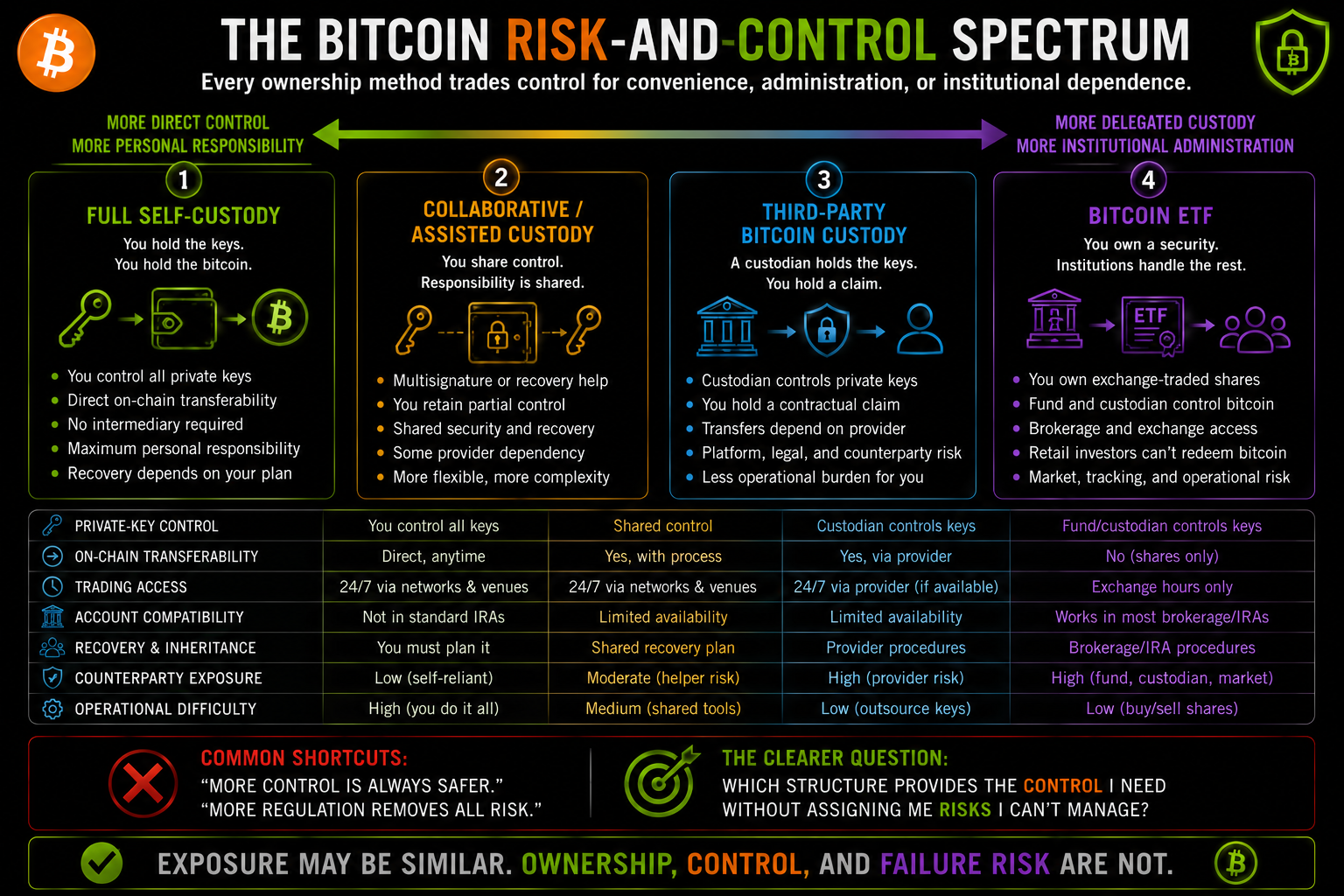
Bitcoin markets operate continuously, and a self-custodied holder can submit a network transaction outside normal securities-market hours. Execution at a desired price still depends on the trading venue used, while network congestion, fees, and confirmations affect transfers. Direct bitcoin can be moved as bitcoin rather than first converted into cash. The holder controls the timing, subject to the network and any service used to buy or sell.
ETF shares trade through their listing exchange during available market sessions. Their price can differ from the per-share value of the product’s bitcoin holdings, especially when Bitcoin moves while the securities exchange is closed or when demand becomes uneven. Retail investors generally exit by selling shares in the secondary market. The ETF is transferable as a security, but not normally as the underlying monetary asset.
Fees, Taxes, and Account Access
ETF ownership usually includes a sponsor fee or expense ratio, plus possible trading spreads, commissions, and premiums or discounts to net asset value. Self-custody may involve acquisition spreads, network fees, wallet hardware, secure backups, and setup assistance. Cost should include both money and the time required to operate the structure safely.
In the United States, directly held bitcoin is generally treated as property for federal income-tax purposes, so sales and other dispositions can create reportable gains or losses. ETF shares are securities, and their tax reporting follows the product and account structure rather than direct on-chain ownership. Exact outcomes depend on jurisdiction, account type, and transaction details. The word “Bitcoin” does not make the two tax structures identical.
Exchange-traded shares may fit more easily inside brokerage IRAs and other tax-advantaged accounts that permit the product. Direct bitcoin inside a retirement arrangement generally requires specialized custodial or self-directed administration. Availability depends on the plan, broker, custodian, and applicable rules. Tax convenience does not remove concentration or product risk.
Inheritance Planning Is Part of Custody
ETF shares can usually pass through a brokerage account’s beneficiary and estate procedures. Heirs do not need private-key knowledge merely to establish that the account exists. The brokerage record creates a discoverable ownership trail. That can simplify continuity for families unfamiliar with digital-asset security.
Self-custodied bitcoin requires a plan that reveals enough information to recover the asset without exposing it too early. Heirs may need instructions, wallet information, backup locations, access conditions, and trusted assistance. A plan that is too secret can make the bitcoin undiscoverable, while one that is too accessible can invite theft. Inheritance must therefore be designed into the custody process.
Understand the Loss Scenarios
Self-custody can fail through lost keys, destroyed backups, device compromise, fraudulent recovery tools, physical theft, coercion, or an incorrect irreversible transaction. Some failures remain hidden until the holder attempts recovery or transfer. There may be no institution capable of restoring access. The independence of the structure is inseparable from that finality.
ETF ownership can fail through brokerage-account compromise, fund-custody problems, tracking differences, market closure, unfavorable premiums or discounts, product liquidation, legal disputes, or intermediary delays. The shareholder avoids personal seed-phrase loss but cannot bypass the institutional chain. These risks are different rather than automatically smaller. The relevant question is which failures are most realistic for the holder.
A Risk-and-Control Spectrum
The choice is not always limited to one method. A person may hold some bitcoin in self-custody, keep some with a third-party custodian, and use ETF shares in a retirement or brokerage account. Each layer assigns control and responsibility differently. The Bitcoin-versus-gold comparison applies the same principle by separating the native asset from the product used to access it.
One end of the spectrum emphasizes direct control, transferability, and personal responsibility. The other emphasizes institutional access, reporting, delegated custody, and compatibility with conventional accounts. Neither end is automatically safer for every purpose. Safety depends on whether the structure matches the holder’s skills, legal needs, time horizon, and failure plan.
A Practical Ownership Review
A cleaner decision begins with the purpose of the holding. Someone seeking direct monetary control is asking a different question from someone seeking price exposure inside an existing retirement account. The method should follow the required function rather than the strongest slogan. The comparison can be organized through these questions:
- Do I need direct control of the underlying bitcoin or only price exposure?
- Who controls the private keys?
- Which legal claim do I own?
- Can the asset be transferred as bitcoin, or only sold as a security?
- Which trading hours and liquidity limits apply?
- What recurring and one-time costs belong to the structure?
- Which counterparty risks remain?
- What security knowledge does self-custody require?
- How would the holding be recovered after device loss, incapacity, or death?
- Can it be held in the intended brokerage or retirement account?
- Which loss scenario is most likely for this holder?
- Would using more than one structure reduce or complicate the risk?
The better question is not, “Which method proves that I understand Bitcoin?” It is, “Which form of ownership provides the control I need without assigning me risks I cannot manage?” That question makes room for different answers across taxable accounts, retirement accounts, long-term reserves, and transactional holdings. It also prevents convenience or ideological purity from replacing a complete ownership plan.
The Bitcoin reserve-asset lesson shows why institutions must match custody to purpose, liquidity, governance, and survival requirements. Individuals face a smaller version of the same decision. Ownership is not complete when the purchase settles; it includes storage, access, documentation, inheritance, and recovery. Those responsibilities should be planned before the position becomes difficult to change.
Final Thought
Self-custody and a Bitcoin ETF provide different relationships with the same underlying market. Self-custody gives the holder direct key control, transferability, and responsibility for security and recovery. An ETF provides securities-market exposure, delegated custody, brokerage integration, and institutional administration. Each solves problems that the other leaves with the holder.
The goal is not to declare that direct ownership is always superior or that an ETF makes self-custody obsolete. Define the purpose, trace the ownership chain, identify who controls the keys, and examine the most realistic loss scenario. The better method is the one whose benefits matter for the intended role and whose risks can be managed honestly. Readers seeking the wider monetary context can continue through The Monetary Revolution.
Educational content only. Trading involves substantial risk and is not suitable for everyone.