
CBDC and Bitcoin are often grouped together because both allow value to move electronically. That comparison feels convenient because the word digital appears in both descriptions. It becomes misleading when the shared format is treated as proof of shared ownership, governance, or monetary policy. The cleaner comparison begins with architecture rather than price.
The lessons in The Market category emphasize that similar labels can hide different structures. A CBDC belongs to a sovereign monetary system, while Bitcoin operates without a central issuer or bank controlling the network. Each can support electronic payments, but the rules governing access, issuance, settlement, and control come from different sources. The trader’s job is to evaluate those differences rather than react to the word digital.
What a CBDC Actually Is
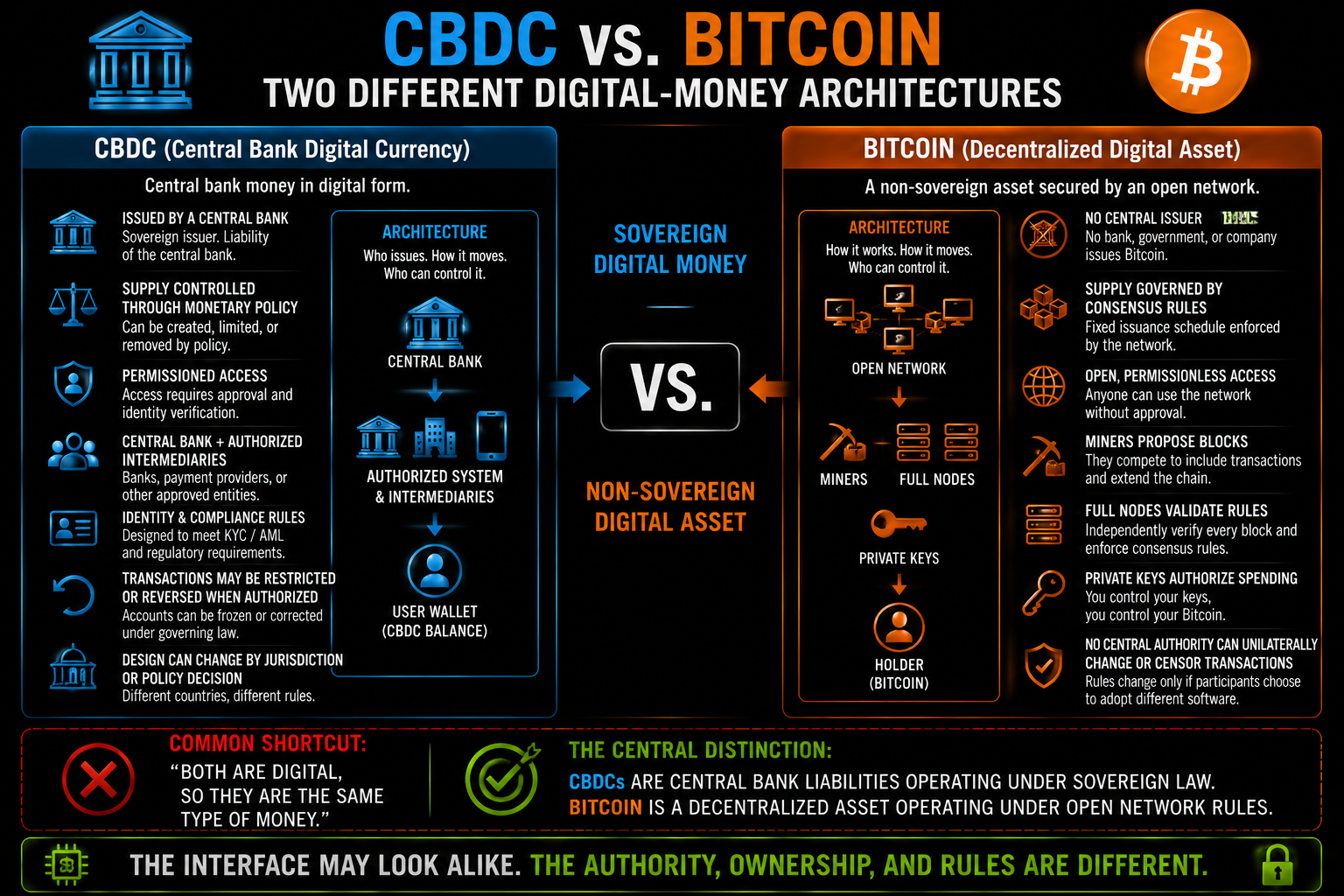
A central bank digital currency is a digital form of central bank money. In a retail design, the public would hold money that is ultimately a liability of the issuing central bank rather than a deposit liability of a commercial bank. That distinction separates a CBDC from the digital bank balances and payment-app balances people already use. The exact legal form and delivery model still depend on the jurisdiction.
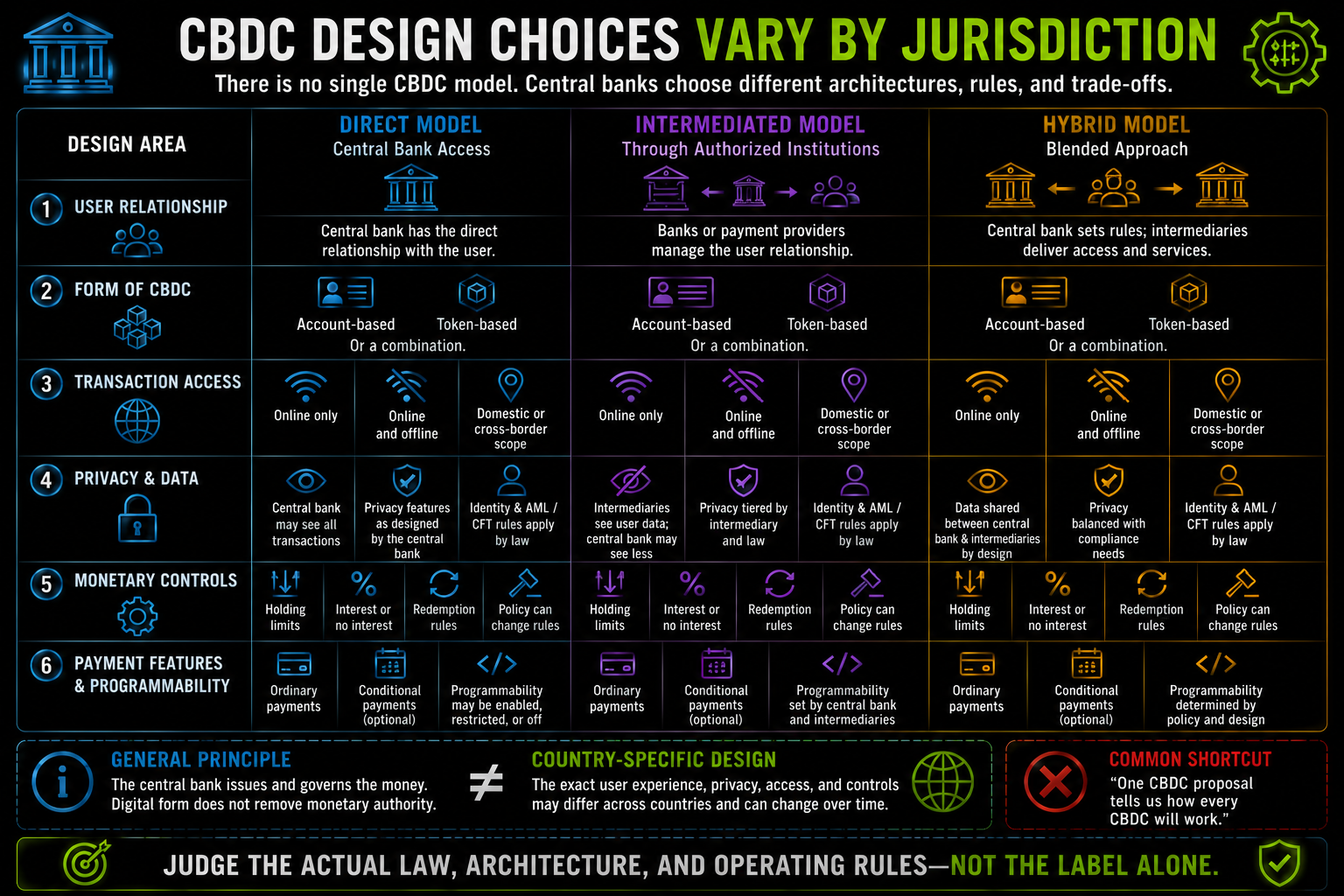
CBDCs can also be designed for different users and purposes. A retail CBDC is intended for use by the public, while a wholesale CBDC would primarily support transactions among financial institutions. Some models may place the central bank closer to the user relationship, while others rely on banks or supervised payment providers as the public interface. The label CBDC therefore identifies the issuer and monetary claim more clearly than it identifies one universal technical design.
Who Issues It—and What Does the User Own?
A person using a CBDC would hold central bank money under the legal and operating rules of that system. Access might occur through a bank, public intermediary, wallet provider, card, or dedicated application. The user’s ability to transact, recover access, or challenge an error would depend on the governing law and the institutions assigned those responsibilities. The central bank remains the source of the monetary liability even when private intermediaries deliver the service.
Bitcoin works differently because no central bank issues the asset or promises redemption at a fixed national-currency value. The network records transactions on a shared public ledger, while private keys authorize movement of a particular holding. As the self-custody-versus-ETF lesson explains, direct key control is different from owning a claim through a financial institution. The holder is interacting with a decentralized asset rather than holding a liability issued by a monetary authority.
Supply Rules Come From Different Sources
A CBDC’s supply exists inside the issuing central bank’s monetary framework. The central bank and applicable law determine how units are created, distributed, redeemed, or removed, and those rules can change with policy. Holding limits, interest rules, or distribution mechanisms may also be used to support monetary-policy or financial-stability objectives. Digital form does not remove discretionary monetary authority from the system.
Bitcoin’s issuance follows consensus rules rather than a central bank decision. The fixed-supply lesson explains how miners propose blocks while independently validating nodes reject blocks that violate the supply rules they run. Changing those rules would require participants to adopt an incompatible ruleset rather than merely approving a new policy at one institution. Bitcoin’s supply structure is therefore different from a sovereign currency whose issuer retains monetary-policy authority.
Validation, Access, and Settlement
Most CBDC proposals use permissioned infrastructure. A central bank, government, or supervised intermediary determines who may access the system, which identification standards apply, and how legal requirements are enforced. Transactions may be processed using a conventional database, distributed ledger, or hybrid architecture because a CBDC does not require one particular technology. Validity comes from the authorized system and its legal framework.
Bitcoin is designed as an open peer-to-peer network in which anyone can run compatible software, broadcast a valid transaction, or independently verify blocks. Miners compete to include transactions and extend the chain, but full nodes determine whether the resulting blocks satisfy the rules they recognize. Permissionless network access does not mean every exchange, custodian, or jurisdiction must provide unrestricted service. Institutional access points can still impose identity checks, withdrawal limits, or legal restrictions.
Privacy, Reversibility, and Censorship
Privacy is not determined by the word digital. CBDC privacy depends on architecture, law, data collection, intermediary access, offline functionality, and the balance between confidentiality and financial-crime controls. One design might minimize what the central bank sees while allowing supervised intermediaries to retain information required by law. Another jurisdiction could make different choices, so privacy claims must be tested against the actual system.
Bitcoin does not place a central account administrator between every user and the ledger, but that does not make every transaction private. Confirmed transactions are recorded on a public blockchain, and privacy can be weakened when addresses or transaction patterns become connected with information gathered elsewhere. Users can transact without asking the protocol for identity approval, yet exchanges and custodians may collect identifying data. The more accurate description is public settlement with privacy that depends partly on how the asset is acquired and used.
Reversibility and censorship also depend on where control sits. A CBDC could permit account freezes, court-ordered actions, compliance blocks, or administrative correction when its law and design authorize those powers. Bitcoin has no central customer-service authority that can cancel a confirmed payment, although custodial services can restrict the bitcoin or accounts they control. One structure can emphasize institutional recourse and legal control, while the other places greater weight on direct authorization and settlement finality.
Programmability Is a Design Choice
Programmability is another area where slogans create confusion. A central bank or legislature could design restrictions into a CBDC, but restricted use is not an unavoidable feature of digital currency. The proposed digital euro, for example, distinguishes programmable money from conditional payments selected by users, and the ECB says the currency would not limit where, when, or with whom it could be spent. A different jurisdiction could choose different rules.
Bitcoin supports transaction scripts and conditions without giving one institution general authority to assign every unit an approved purpose. Multisignature requirements, time locks, escrow-like arrangements, and other spending conditions can be created by participants. Application providers and custodians can still impose separate restrictions on their users. The important question is whether a condition belongs to the asset’s base rules, an optional transaction, or an intermediary’s service.
CBDC Designs Differ by Jurisdiction
There is no single CBDC architecture that can be applied to every country. Central banks may choose direct, intermediated, or hybrid structures and make different decisions about accounts, tokens, offline use, privacy, holding limits, interest, and public access. CBDC design work treats these features as policy and technical tradeoffs rather than settled characteristics. A claim that CBDCs always behave one particular way is therefore incomplete.
The developing digital euro provides one case study rather than a universal template. The ECB’s current design work uses banks and supervised intermediaries as the primary interface, includes planned online and offline payments, emphasizes privacy protections, and rejects restricted programmable money while allowing conditional payments. As of August 2026, issuance remains a potential future decision tied to legislation and preparation, with a pilot planned to begin in the second half of 2027. Those details describe the European proposal, not every possible CBDC.
Why the Distinction Matters
The distinction also matters when governments interact with Bitcoin. A government can hold Bitcoin as a reserve asset without issuing it, controlling its supply, or transforming it into a CBDC. The Bitcoin reserve-asset lesson explains why reserve ownership, legal-tender status, and monetary issuance describe different jobs. Holding a decentralized asset does not make the holder its issuer.
A Practical Architecture Review
A practical comparison should begin by identifying the control points in each system. The reader should ask who creates the units, who validates transactions, who can deny access, what transaction data exists, and which authority can change the rules. The same digital interface can hide very different answers. Architecture should be evaluated before convenience, politics, or price becomes the focus.
- Who issues the money or asset?
- What legal or technical claim does the user hold?
- Who determines the supply rules?
- Who validates a transaction?
- Is access open, permissioned, or delivered through supervised intermediaries?
- Which identity requirements apply?
- Who can view or retain transaction data?
- Can an account or transaction be frozen, reversed, or blocked?
- Are spending conditions controlled centrally or chosen voluntarily?
- What happens when the governing rules change?
- Which failure can the user appeal, and which failure may be final?
- Is the conclusion based on general architecture or one country’s proposed design?
The better question is not, “Which form of digital money is more modern?” It is, “Which institution or network defines the money, and what powers follow from that design?” That question directs attention toward authority, rights, and enforcement rather than the technology label. A CBDC may provide sovereign digital settlement and institutional recourse, while Bitcoin may provide open network access and non-sovereign settlement.
This framework can also improve the review of future announcements. A new pilot, wallet, law, or central-bank paper should be examined for its actual issuer, liability, access rules, privacy model, and settlement structure. A Bitcoin service should be examined separately to determine whether the user controls private keys or holds an intermediary claim. Clear definitions prevent one form of digital money from being evaluated through assumptions borrowed from another.
Final Thought
CBDCs and Bitcoin are not two versions of the same system. A CBDC is central bank money expressed through a chosen legal and technical architecture, while Bitcoin is a decentralized digital asset whose transactions and monetary rules are validated by a distributed network. Both can move value electronically, but their supply, ownership, permission, privacy, and governance structures remain different. Those differences are the lesson, not a minor technical detail.
The goal is not to declare that sovereign digital money is automatically dangerous or that Bitcoin is automatically superior. It is to identify who issues the asset, what the user owns, how transactions become valid, and which participant can change or enforce the rules. General CBDC principles must be separated from country-specific designs, just as Bitcoin’s base protocol must be separated from exchanges and custodians. Readers seeking the broader monetary framework can continue through The Monetary Revolution.
Educational content only. Trading involves substantial risk and is not suitable for everyone.