
Headline adoption numbers often create a cleaner story than the evidence supports. A country may rank highly in crypto activity while most residents never use Bitcoin for daily payments, and a legal policy may receive global attention without producing sustained household use. Exchange volume, wallet downloads, merchant acceptance, remittances, savings, and speculation measure different behaviors. A useful review must identify which behavior the evidence actually captures.
The lessons in The Market category treat monetary change as a structure that must be examined rather than a narrative that should be repeated. High inflation can increase demand for alternatives to the local currency, but it does not tell us whether people choose Bitcoin, dollar cash, bank deposits, stablecoins, gold, or another asset. Access, volatility, regulation, and the intended job all influence that choice. The trader’s job is to separate the observed behavior from the conclusion attached to it.
Adoption Is Not One Behavior
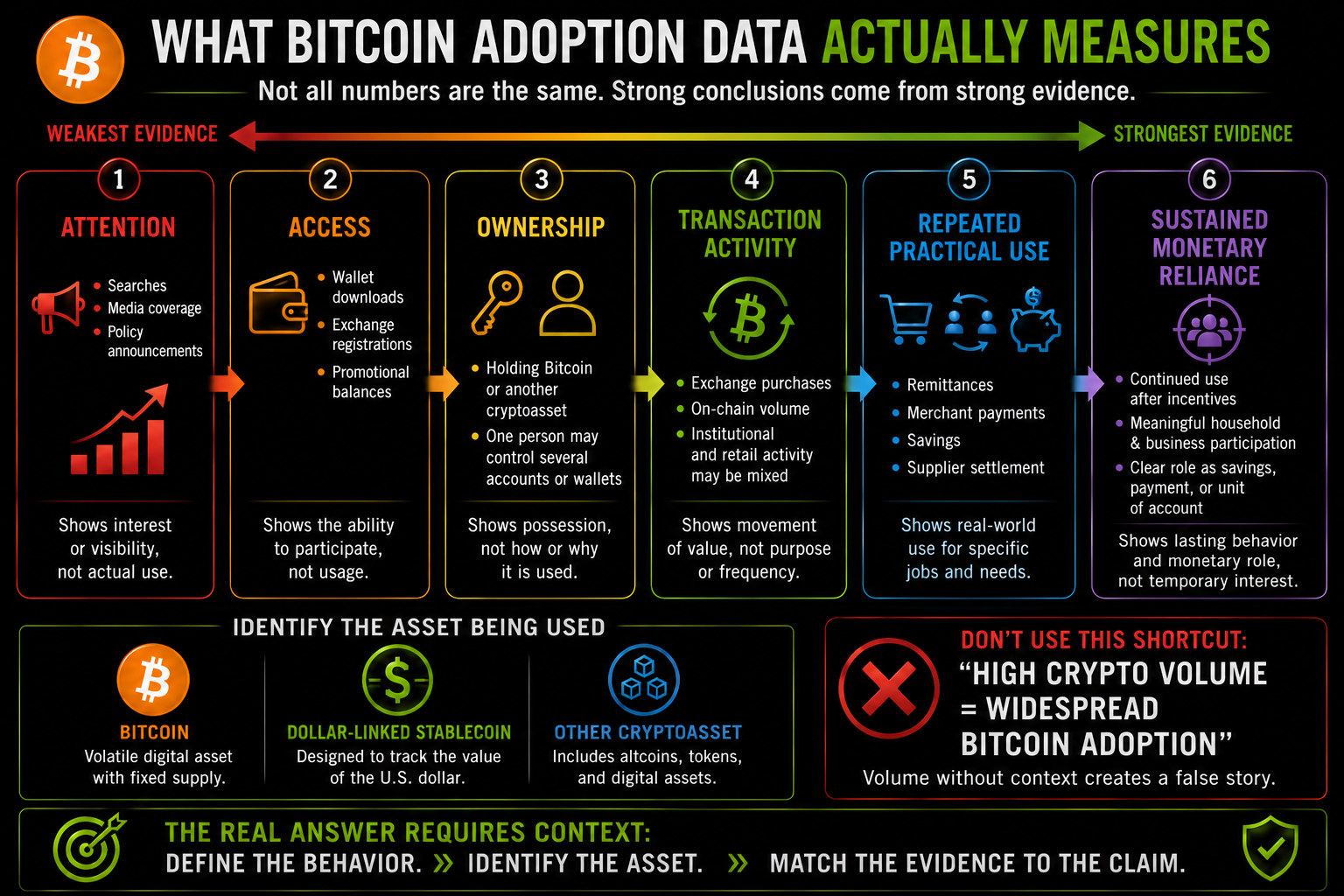
The word adoption can describe several unrelated developments. It may mean that someone opened an exchange account, received a promotional wallet balance, held a cryptoasset once, used a stablecoin for dollar exposure, accepted Bitcoin at a business, or relied on it repeatedly for savings or payments. Each behavior requires different evidence and has different economic meaning. Combining them produces impressive totals while weakening the conclusion.
Ownership is especially easy to overstate because one person may maintain several wallets or accounts, while a large transaction may belong to an institution rather than a household. On-chain value also crosses borders without carrying a reliable geographic label for the person behind every address. Exchange data can show what tracked platforms processed, but it may omit informal dealers, over-the-counter activity, peer-to-peer cash trades, and transactions occurring elsewhere. These limitations do not make the data useless, but they prevent volume from becoming a direct count of sustained users.
The asset itself must also be identified. Bitcoin exposes the holder to Bitcoin’s changing market price, while a dollar-linked stablecoin is designed to provide digital access to a more stable unit of account. A household trying to preserve next month’s purchasing power may therefore choose a stablecoin even while supporting Bitcoin’s longer-term monetary thesis. Calling both choices Bitcoin adoption hides the reason the person entered the market.
The distinction matters because high inflation creates more than one financial problem. Households may need a short-term store of value, businesses may need dollars for imports, migrants may need a remittance rail, and traders may seek speculative exposure. Bitcoin can serve some of those roles for some users, but its volatility may make it less suitable for routine obligations. The evidence should be organized around the job being performed rather than the technology being used.
El Salvador: Official Adoption Without Widespread Use
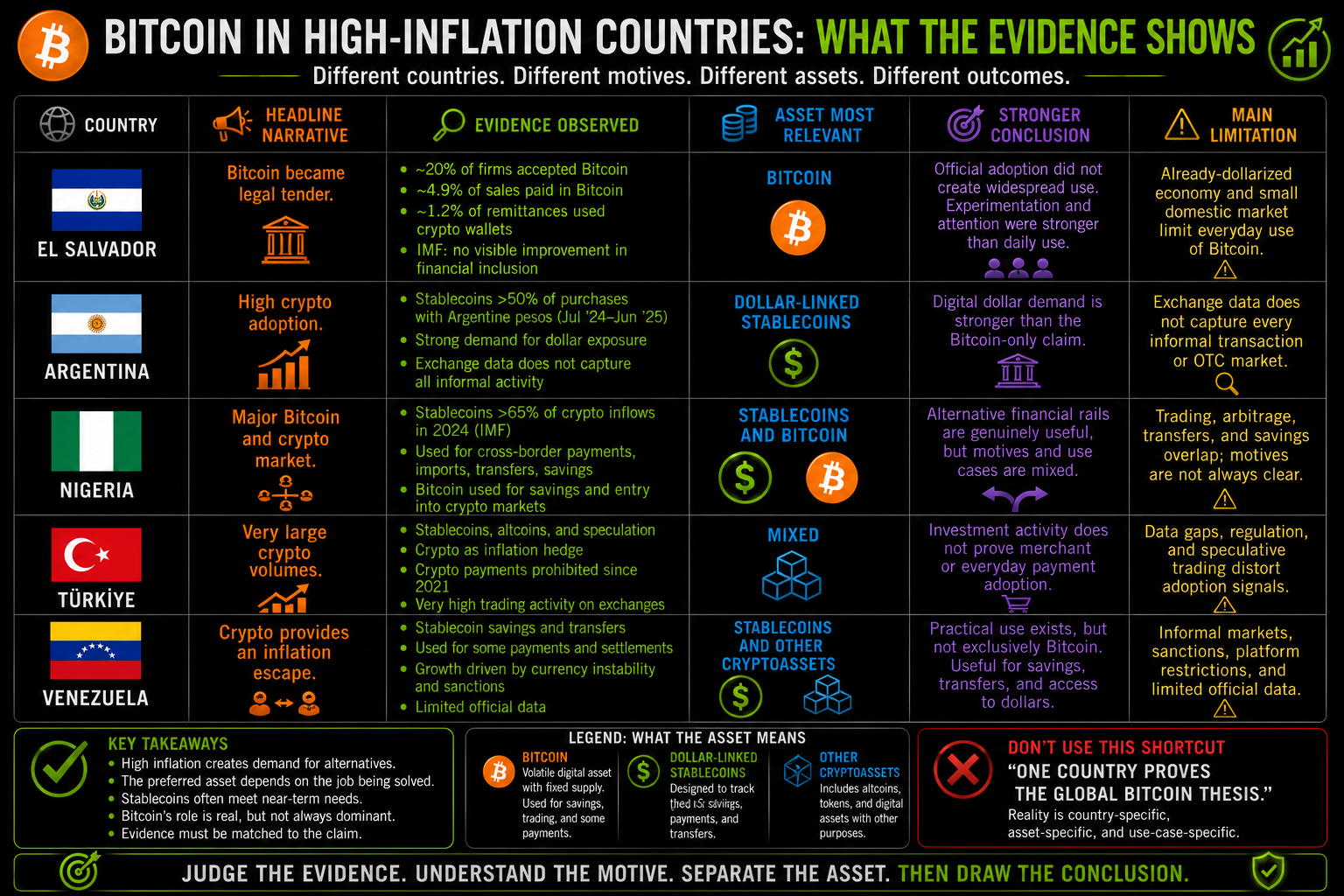
El Salvador provides the clearest warning against equating official status with widespread use. The 2021 policy was intended to expand financial inclusion, reduce remittance costs, and encourage payments through the government-supported Chivo wallet. Government subsidies and legal-tender rules created strong incentives to try the system. That made the country a visible experiment, but visibility was not the same as durable adoption.
IMF reporting found that Bitcoin use remained limited: surveys cited in the 2025 program documents indicated that about 20 percent of firms accepted it, only 4.9 percent of sales were paid in Bitcoin, and roughly 1.2 percent of remittances used a crypto wallet. The IMF also concluded that the policy had not produced visible improvements in financial inclusion or digital remittances. In 2025, legal changes removed the mandatory-acceptance features that had made Bitcoin legal tender in practice, and the government committed to ending public participation in Chivo. The evidence supports experimentation and international attention more clearly than sustained household or merchant use.
Argentina: Crypto Activity Often Means Digital Dollars
Argentina presents a different pattern because repeated inflation and currency restrictions have created persistent demand for dollar exposure. Industry exchange data for July 2024 through June 2025 indicated that stablecoins accounted for more than half of purchases made with Argentine pesos on the tracked order books. That result does not mean Bitcoin was irrelevant, and it does not measure every informal transaction. It does suggest that much of the practical demand was for a digital dollar substitute rather than Bitcoin-specific monetary adoption.
The Argentine case demonstrates why cryptocurrency ownership and Bitcoin use should not be treated as synonyms. A person may enter a crypto exchange only to purchase a dollar-linked token, hold it as savings, and later convert it back into pesos or use it in a transfer. That behavior uses crypto infrastructure while preserving exposure to the dollar rather than accepting Bitcoin’s volatility. The evidence therefore supports digital dollarization more directly than a broad claim that households have moved to a Bitcoin standard.
Nigeria: Practical Use, but Stablecoins Dominate
Nigeria offers stronger evidence of crypto rails being used for cross-border transfers, foreign-currency access, savings, and business payments. IMF reporting found that stablecoins represented more than 65 percent of Nigeria’s crypto inflows in 2024 and had become an important link between crypto markets and the traditional financial system. Small importers and some larger firms have used stablecoins to settle with overseas suppliers, while households have used them for transfers and dollar exposure. These are practical use cases, but the dominant asset is often a dollar-linked token rather than Bitcoin.
Bitcoin still has a recognized role in Nigeria as an alternative savings asset and an entry point into crypto markets. The evidence does not allow every exchange purchase to be classified as inflation protection, because trading, arbitrage, investment, and transfers can occur through the same platforms. Foreign-exchange shortages and differences between official and crypto-market exchange rates have also created incentives for speculation. The cleaner conclusion is that currency instability expanded demand for alternative rails, not that one motive or asset explains every transaction.
Türkiye and Venezuela: High Activity, Different Behaviors
Türkiye provides another case where large crypto volumes do not identify one clear form of adoption. Cryptoassets, especially stablecoins, can serve as an alternative inflation hedge, while trading activity also includes substantial altcoin and speculative participation. Cryptoassets have been prohibited as a direct payment instrument in Türkiye since 2021, which limits what high exchange activity can prove about everyday merchant use. The country shows that investment, savings, and payment adoption can move in different directions.
Venezuela provides supportive evidence that crypto infrastructure can help people obtain digital dollar exposure, receive transfers, and settle some payments during currency instability. Research and reporting point to rapid growth in crypto activity and frequent use of dollar-linked stablecoins. The same environment includes sanctions, platform restrictions, informal exchange markets, changing government policy, and limited official data. Those conditions make the use case meaningful while making exact household adoption difficult to measure.
Why Stablecoins Often Win the Practical Use Case
Stablecoins often gain practical traction because they separate blockchain-based transfer from Bitcoin’s price movement. A worker sending money home, an importer paying a supplier, or a household protecting a near-term budget may care more about dollar stability than fixed supply. This does not make stablecoins decentralized or equivalent to Bitcoin. It means the immediate problem is often currency access rather than demand for a new monetary standard.
The practical advantage comes with a different risk structure. Most stablecoins are issued by centralized entities and depend on reserve management, redemption, legal access, and the continued operation of intermediaries. Widespread use can also deepen digital dollarization and weaken a country’s monetary control. A tool can solve an individual user’s problem while creating broader institutional concerns.
What Limits Real Adoption
Bitcoin’s main constraint in daily high-inflation use is not that scarcity lacks meaning. The problem is that short-term price volatility can conflict with rent, food, payroll, and supplier obligations that are due in local currency or dollars. A household may believe in Bitcoin over a long horizon and still avoid using it for next week’s expenses. Monetary conviction and operational suitability are separate questions.
Technology and infrastructure create additional limits. Reliable smartphones, internet access, electricity, identity documents, exchange access, banking connections, wallet security, and local liquidity all affect whether someone can enter or leave the system. Fees and spreads can erase part of the apparent remittance advantage, especially when users must convert through several intermediaries. A theoretically open network can still be difficult to use in a specific location.
Regulation, custody, and consumer protection shape the outcome as well. Governments can restrict exchanges, banks can limit transfers, custodians can fail, and users can lose keys or fall victim to fraud. The self-custody-versus-ETF lesson explains how control and failure risk change with the ownership structure. Real adoption requires a survivable process, not merely access to an asset.
A Practical Evidence Review
A cleaner country review begins by defining the claim before collecting the supporting number. The analyst should ask whether the claim concerns ownership, active saving, repeated payments, merchant acceptance, remittances, speculation, or official policy. Evidence should then be matched to that behavior and separated by asset. This prevents one exchange-volume estimate from carrying more meaning than it can support.
- What asset is actually being used: Bitcoin, a stablecoin, or another cryptoasset?
- Does the evidence measure people, accounts, wallets, transactions, or total value?
- Are the transactions retail, institutional, commercial, or speculative?
- Is the activity repeated, or did it occur only around an incentive or announcement?
- Are households saving, spending, trading, or receiving remittances?
- How many businesses accept the asset regularly?
- Do merchants retain the asset or convert it immediately?
- Does the data include informal, peer-to-peer, and over-the-counter activity?
- Which technological or banking access requirements apply?
- Has regulation moved the activity to another platform or channel?
- What conventional alternatives are already available?
- Does the evidence support the claim being made, or only a narrower conclusion?
The better question is not, “Which high-inflation country has adopted Bitcoin?” It is, “Who is using which asset, for what job, how often, and through which infrastructure?” That question makes contradictory evidence useful rather than inconvenient. It also distinguishes the fixed-supply thesis from the separate question of whether households choose Bitcoin in practice.
Country evidence should also be reviewed over time. A promotional wallet download may disappear after an incentive ends, while a remittance or savings practice may persist because it solves a continuing problem. Legal recognition can be reversed, and exchange activity can migrate when regulation changes. The CBDC-versus-Bitcoin comparison reinforces why official monetary architecture and voluntary asset use should not be confused.
Final Thought
The evidence from high-inflation and currency-stressed countries does not support one universal Bitcoin story. It shows limited sustained use in some highly publicized experiments, meaningful Bitcoin savings and investment in other markets, and strong practical demand for dollar-linked stablecoins across several countries. Adoption depends on the problem users are trying to solve and the alternatives they already possess. The strongest conclusion is conditional rather than promotional.
The goal is not to dismiss Bitcoin because stablecoins sometimes receive more practical use or to treat every crypto transaction as proof of monetary revolution. It is to identify what the data measures, separate the assets, and judge whether the behavior continues after incentives and headlines fade. That process produces a clearer view of both Bitcoin’s potential and its limits. Readers seeking the broader monetary framework can continue through The Monetary Revolution.
Educational content only. Trading involves substantial risk and is not suitable for everyone.