
Bitcoin reserve announcements often receive more attention than the policy behind them. Supporters may treat institutional adoption as proof that the monetary debate is over, while critics may dismiss every reserve decision as speculation. Both reactions skip the most important questions. A serious evaluation begins by defining what kind of reserve is being created and what problem it is supposed to solve.
The lessons in The Market category treat monetary assets as parts of operating systems rather than symbols of confidence. An asset can be scarce and liquid while still creating volatility, custody, governance, and political risks. A policy can be coherent for one institution without proving that every other institution should copy it. The trader’s job is to evaluate the structure rather than react to the announcement.
A Reserve Asset Is a Job, Not a Compliment
A reserve asset is something an organization holds to support future obligations, liquidity, resilience, or a strategic objective. The word reserve does not automatically mean that the asset is stable, safe, or available at the exact moment it is needed. Suitability depends on the holder’s purpose and the conditions under which the asset might be used or sold. The same asset can fit one reserve function and fail another.
A corporation, central bank, treasury department, and individual do not face the same obligations. A company may seek long-duration exposure only after protecting working capital, while a government may want strategic control of an asset it already owns. A monetary authority managing exchange-rate intervention requires a different form of liquidity and control. The title of the policy matters less than the job the reserve must perform.
Five Terms That Should Not Be Blurred Together
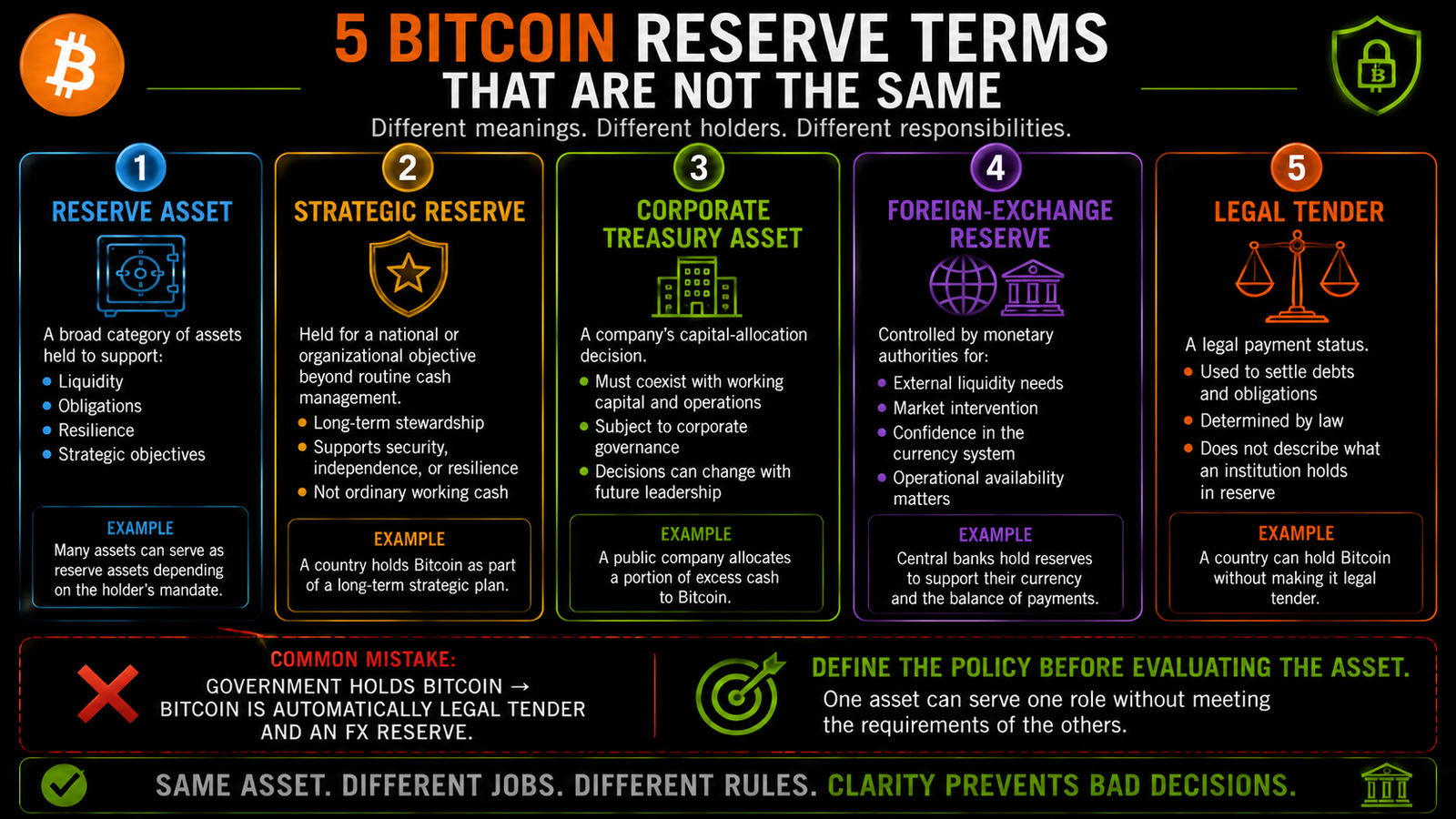
A reserve asset is the broad term for an asset held to support liquidity, obligations, resilience, or another stated purpose. A strategic reserve is generally maintained for a national or organizational objective beyond routine cash management. A corporate treasury asset belongs to a company’s capital-allocation policy and must coexist with payroll, taxes, debt service, investment, and operating needs. These terms describe different holders and different responsibilities.
A foreign-exchange reserve has a more specific monetary-authority function involving balance-of-payments needs, market intervention, and confidence in the currency system. Legal tender is different again because it concerns the legal settlement of obligations rather than what an institution holds in reserve. A country can hold Bitcoin without making it legal tender, and legal-tender status does not automatically make an asset part of official foreign-exchange reserves.
Why an Institution Might Hold Bitcoin
The reserve case usually begins with scarcity, portability, market access, and independence from discretionary sovereign issuance. The fixed-supply lesson explains why Bitcoin’s issuance rules are maintained through distributed validation rather than one issuer’s promise. An institution may therefore view Bitcoin as a long-duration monetary asset, a diversification tool, protection against a particular monetary risk, or a way to gain experience with digital settlement and custody. Those possible roles do not guarantee that it will preserve value over the institution’s chosen timeframe.
How a Corporate Bitcoin Treasury Policy Works
A corporate treasury policy should begin with operating liquidity rather than the Bitcoin allocation. Management must determine how much cash or short-term liquidity is required for payroll, suppliers, taxes, debt service, capital spending, and unexpected disruption. Only assets beyond those needs can be considered for a volatile long-duration allocation without changing the company’s basic risk profile. Calling the holding strategic does not repair a policy that neglects working capital.
Strategy provides a documented example of a company treating Bitcoin as its primary treasury reserve asset. Its filings describe maintaining cash assets for working-capital requirements while acquiring Bitcoin through combinations of excess cash and capital-market financing, connecting the reserve decision to debt, equity, liquidity, and shareholder exposure. U.S. accounting guidance requires qualifying crypto assets to be measured at fair value with changes recognized in earnings for fiscal years beginning after December 15, 2024. That improves current-value reporting but can also make reported earnings more sensitive to Bitcoin’s price.
How a Government Strategic Bitcoin Reserve Works
A government reserve begins with legal authority, custody, ownership records, permitted uses, and rules governing acquisition or disposal. The policy should identify which agency controls the assets, how transactions are authorized, whether holdings can be sold, and what governmental objective the reserve serves. It should also distinguish strategic asset preservation from routine monetary intervention. Without those details, the reserve remains a headline rather than an operating framework.
The United States established a Strategic Bitcoin Reserve by executive order on March 6, 2025. The order directed the Treasury to administer reserve accounts initially capitalized with qualifying government-owned Bitcoin obtained through forfeiture, stated that deposited Bitcoin would not be sold, and authorized budget-neutral strategies for possible additional acquisition. It also required an evaluation of the legal and investment considerations involved in managing the reserve. This is a documented policy case study, not proof that Bitcoin has replaced traditional official reserves.
What Bitcoin Can Provide
Bitcoin can provide a transferable monetary asset with a transparent issuance structure and the possibility of direct ownership without a corporate issuer. Institutional custody can make access more practical for organizations that cannot manage keys internally, although it reintroduces legal and counterparty exposure. The Bitcoin-versus-gold comparison shows why scarcity and portability should be weighed against history, volatility, infrastructure, and custody. No single property determines whether Bitcoin fits a reserve mandate.
What Could Go Wrong
Volatility is the most visible risk. A reserve intended to meet near-term obligations may be forced to sell during a large drawdown, turning a long-duration thesis into an immediate liquidity problem. The danger becomes greater when purchases are financed with debt or depend on continued access to capital markets. The liability structure must be able to tolerate the asset’s volatility.
Custody is another major risk because ownership depends on control of private keys or enforceable claims against a custodian. Self-custody requires secure key generation, authorization controls, personnel and geographic redundancy, recovery procedures, and protection against insider threats. Third-party custody reduces some operational demands while adding counterparty, legal, and access risk. The reserve policy should define failure procedures before a failure occurs.
Concentration can transform a reserve allocation into a single-asset balance-sheet strategy. As Bitcoin rises or additional purchases are made, the position may become large relative to cash, equity, revenue, or public financial resources. That concentration can amplify favorable and unfavorable outcomes without improving operating resilience. A policy needs review triggers, exposure limits, and a clear standard for additional accumulation.
Governance risk determines who may change the strategy and under what conditions. Corporate boards can revise treasury policies, shareholders can challenge capital allocation, and future executives may choose another objective. Government reserves can face changes in leadership, law, budget priorities, or public support. A policy that assumes permanent agreement has ignored one of its central risks.
Reversibility Is Part of the Design
A strategic reserve created through executive action is not the same as an irreversible constitutional commitment. The U.S. order requires implementation consistent with applicable law and leaves important management questions subject to legal and investment review. Future legislation, court decisions, or executive policy could therefore change how the reserve operates. Political reversibility should be evaluated as a design feature rather than treated as an afterthought.
Corporate policies are reversible as well. A future board may sell the asset, reduce the allocation, alter its financing methods, or redefine the treasury objective. That flexibility can protect the organization when conditions change, but it also means the policy is not equivalent to Bitcoin’s protocol-level supply rules. Investors should distinguish the relative durability of the asset’s issuance system from the impermanence of an institution’s ownership decision.
A Practical Reserve-Asset Review
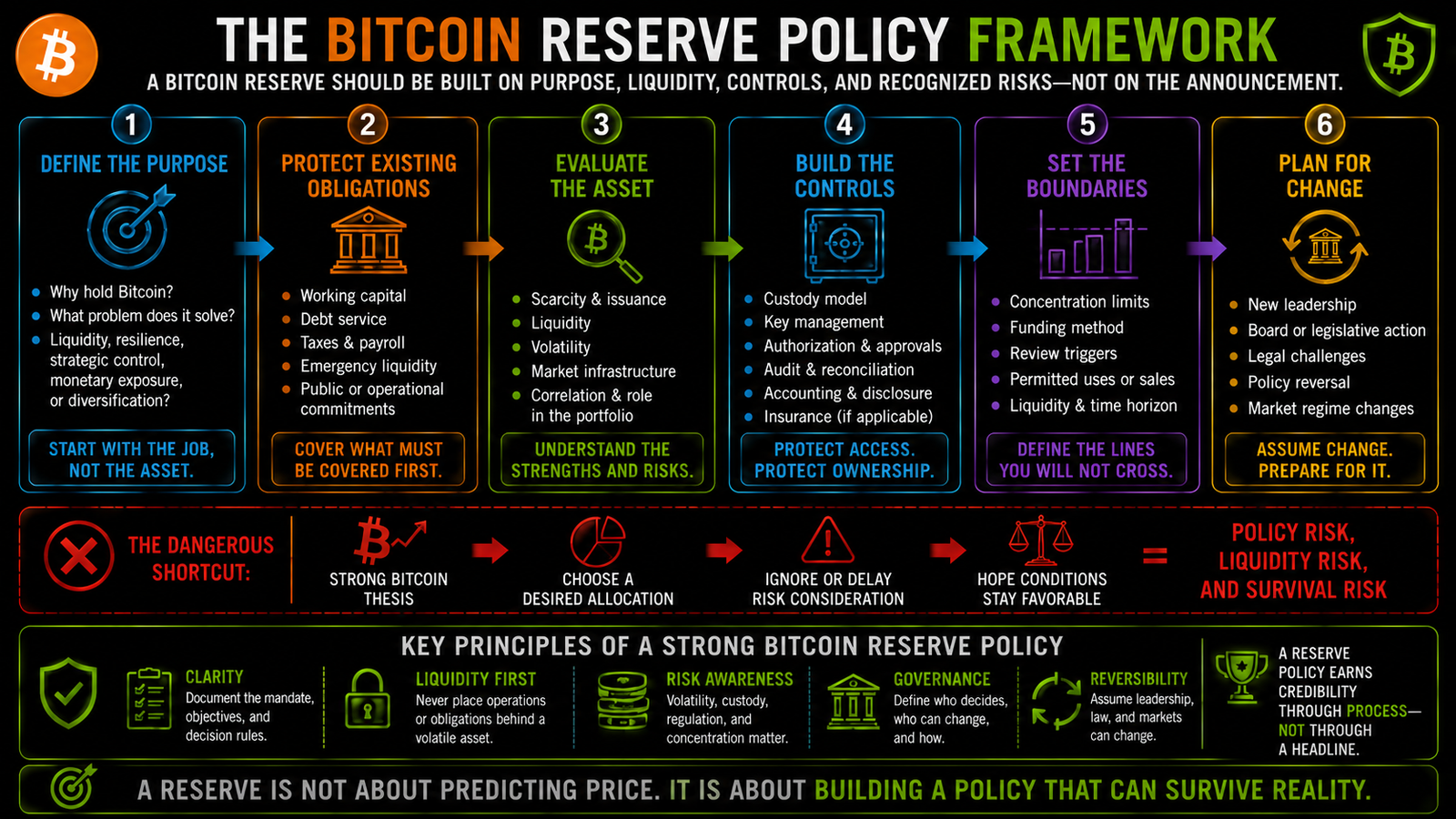
A cleaner evaluation begins with the reserve mandate and works outward toward execution. The institution should define what the asset must accomplish, when it may be needed, and what evidence would show that the policy is failing. Only then should scarcity, liquidity, or expected appreciation enter the discussion. The review can be organized through several questions:
- What exact reserve function is Bitcoin expected to perform?
- Which obligations must remain covered by cash or conventional liquid assets?
- What time horizon allows the policy to tolerate a large drawdown?
- How will the holdings be acquired, custodied, authorized, and audited?
- Which accounting and disclosure rules apply?
- How much concentration is acceptable?
- Is the reserve funded with cash, debt, equity, or assets already owned?
- Who may change the policy, and what approval is required?
- Under what conditions may the asset be sold, transferred, or pledged?
- How would a leadership change affect the reserve?
- What evidence would show that the original objective is not being met?
- Is the policy being evaluated as an operating framework or mainly as a price forecast?
The better question is not, “Who else is adding Bitcoin to reserves?” It is, “What function does the reserve perform, and can the institution survive the risks required to hold it?” Adoption can direct attention toward a monetary change without completing the analysis. The reserve earns credibility through liquidity, governance, custody, and execution rather than through the prestige of the holder.
Case Studies Are Evidence, Not Verdicts
The U.S. strategic reserve and Strategy’s corporate treasury policy show that Bitcoin can be placed inside formal government and corporate frameworks. They also demonstrate how different those frameworks can be: one began with forfeited government assets and public-law constraints, while the other is a corporate capital-allocation strategy connected to financing and shareholder exposure. Neither example proves that Bitcoin is becoming a universal reserve asset. Each provides evidence about one institution’s objectives and implementation.
A reserve policy also operates on a different horizon from a short-term trade. Dollar liquidity and financial conditions still matter, as explained in DXY and the stock market.
The 10-year Treasury yield can change opportunity costs and the appeal of competing assets. A fixed supply does not create fixed demand, and institutional adoption does not identify a favorable entry price. Monetary conviction should not replace risk definition.
Final Thought
Bitcoin can function as a reserve asset when an institution defines its purpose, protects operating liquidity, secures custody, establishes governance, and accepts the volatility and concentration involved. The phrase can describe a corporate treasury strategy, a government strategic reserve, or another long-duration policy. Those uses are not identical to foreign-exchange reserves or legal-tender status. Clear definitions prevent one announcement from being interpreted as several different monetary changes.
The goal is not to prove that every reserve should include Bitcoin or that every Bitcoin reserve will fail. It is to understand what the policy is designed to accomplish, how it works, who controls it, and what could reverse it. Current case studies show that reserve adoption is possible, not that the larger monetary question is settled. Readers seeking the deeper framework can continue through The Monetary Revolution.
Educational content only. Trading involves substantial risk and is not suitable for everyone.