
Yes. A futures trader can lose more than the amount deposited in the account, and a deficit can remain after positions are liquidated.
Margin is collateral—not a maximum-loss limit.
Futures are leveraged contracts, so the cash required to hold a position can be much smaller than the economic exposure the contract creates. The loss is determined by market movement, contract value, and execution—not by the amount of margin posted. A $5,000 deposit therefore does not mathematically cap the loss at $5,000.
This belongs in the ETM lessons under The Basics → Trade Construction & Risk because it explains the worst-case consequence of leverage rather than reteaching margin calculations. The sharper question is: what protects the broker from the trader—and what actually protects the trader from the market? Margin helps support the financial system; it is not a personal stop loss.
Why Margin Is Not a Maximum-Loss Limit
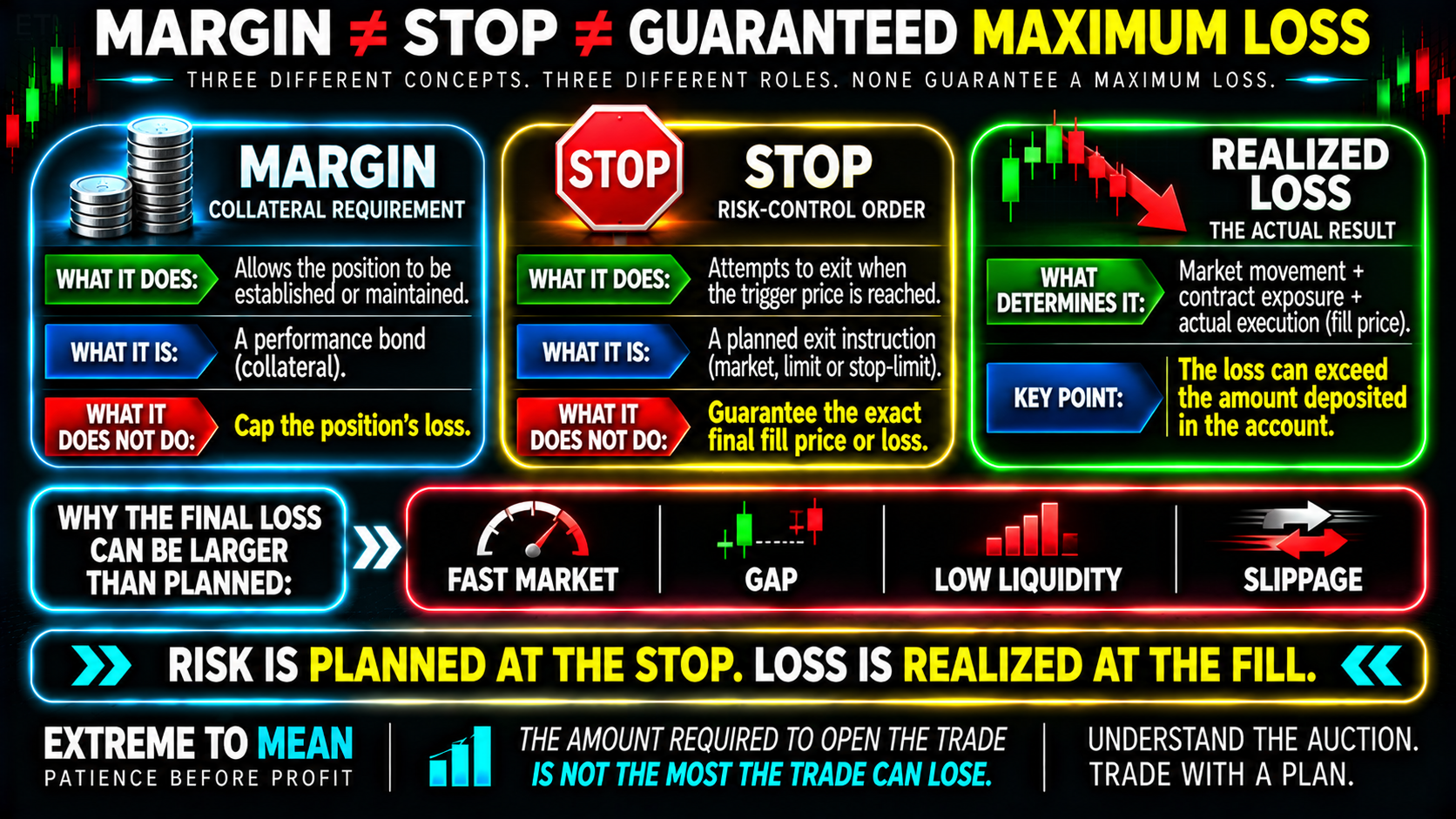
Futures margin is commonly described as a performance bond or collateral requirement. It tells you how much financial support must stand behind the position, but it does not turn the contract into an investment equal to the margin amount. MARGIN ≠ INVESTMENT AMOUNT, and MARGIN ≠ MAXIMUM LOSS.
Suppose, only as an illustration, a futures contract creates $100,000 of economic exposure, required margin is $8,000, and the trader has $10,000 in the account. If the contract produces a $12,000 adverse move, the trading loss is still $12,000. A small margin requirement does not shrink the contract’s dollar movement.
The cleaner risk question is not “How much margin does one contract require?” but “How much dollar P&L can this contract create over a realistic adverse move?” The article on why the trade is not ready until the risk is clear makes the same distinction from the trade-planning side. Permission to hold a position is not the same thing as a sound risk plan.
From Position to Possible Deficit
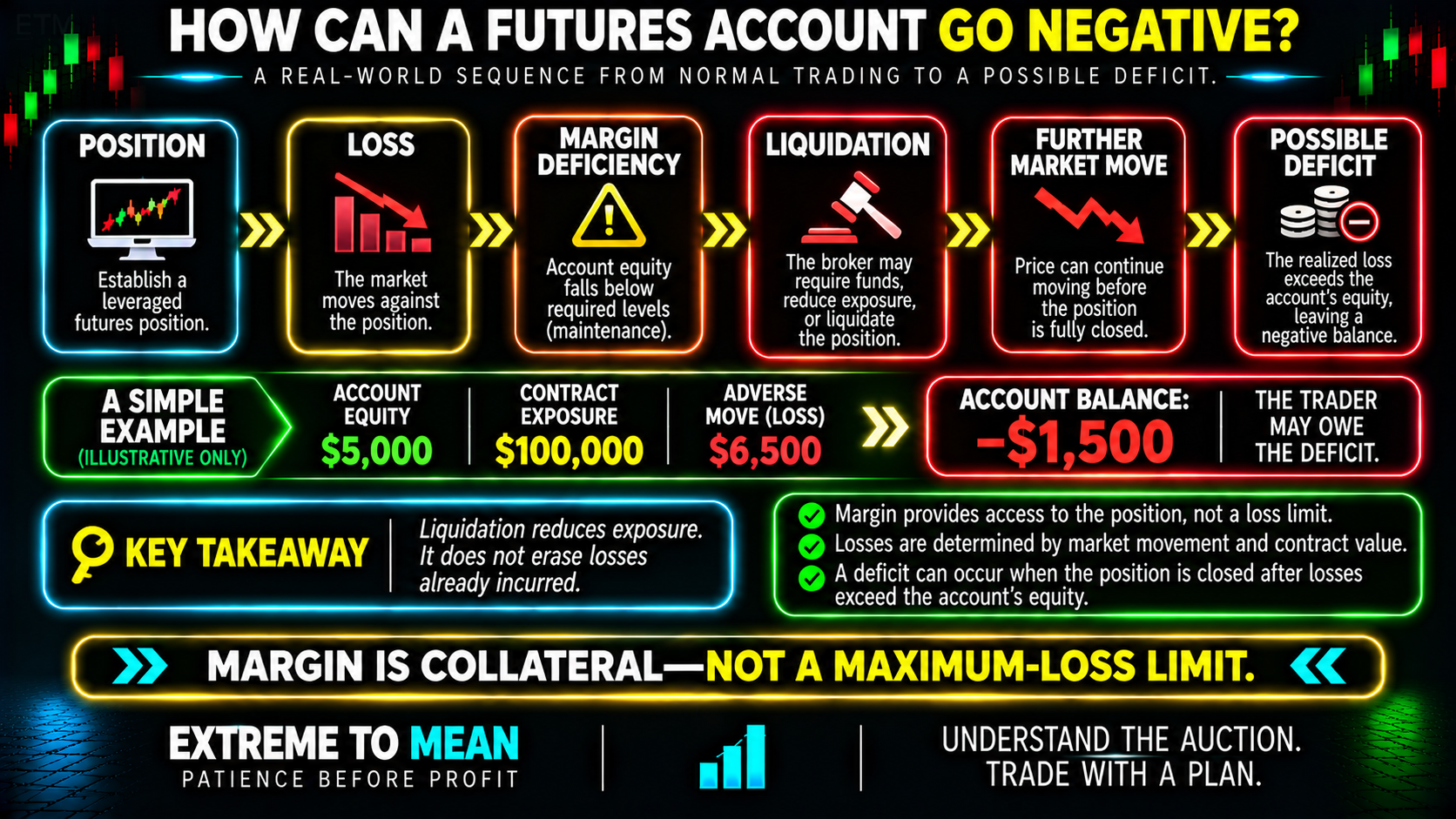
The progression is POSITION → LOSS → MARGIN DEFICIENCY → LIQUIDATION → POSSIBLE DEFICIT. The trader establishes leveraged exposure, the market moves against the position, and account equity falls. Once equity drops below required levels, additional collateral may be required or the broker may reduce or liquidate the position under its own rules.
If the position closes while positive equity remains, there is no debt. If the market keeps moving and the eventual realized loss exceeds the assets remaining in the account, the balance can become negative. Liquidation reduces exposure; it does not erase losses already incurred.
Initial Margin, Maintenance Margin and Margin Calls
Initial margin is the amount required to establish a position, while maintenance margin is the minimum equity level that must be maintained. If equity falls below maintenance, additional funds may be required, the position may need to be reduced, or the broker may liquidate according to its procedures. The maintenance threshold is an intervention point—not a guaranteed liquidation price.
A margin call is therefore a funding problem, not a pause button on the market. It does not guarantee a long warning period and it does not stop losses while the trader decides what to do. MARGIN CALL ≠ GUARANTEED WARNING PERIOD.
Broker policy matters. Firms may impose house margin above exchange requirements, use different intraday and overnight thresholds, and reserve rights to liquidate when account risk becomes unacceptable. Never assume the broker must call first, wait a fixed amount of time, or liquidate at one exact percentage.
Why Forced Liquidation Cannot Guarantee a Zero Balance
A risk system can decide that a position should be closed, but the market determines where the closing order can execute. Between the liquidation trigger, order submission, and fill, price can continue moving. LIQUIDATION TRIGGER ≠ GUARANTEED LIQUIDATION PRICE.
Broker controls are designed to reduce exposure, but they cannot manufacture liquidity or force counterparties to trade at the desired price. The account stops losing only when the position is actually closed. Zero is an accounting value—not a guaranteed liquidation price.
Gaps, Fast Markets and Stops
Consider an illustrative overnight example: an account has $8,000 of equity and an unexpected event causes the next executable prices to be far away. If the eventual trading loss is $10,500, the account could end near −$2,500. A market can move from one tradable price to another without giving you every price in between.
A stop loss helps manage risk, but it does not insure the final fill price. If the planned stop is 100 and the market moves through it before sufficient execution occurs, the realized exit may be worse depending on order type, liquidity, and speed. Risk is planned at the stop; loss is realized at the fill.
That is why a trading plan made before the session should account for poor execution as well as the intended stop. STOP PRICE ≠ GUARANTEED LOSS. A plan is stronger when it acknowledges gap, slippage, and liquidity risk.
What a Negative Futures Balance Means
A negative balance is a debit after trading losses exceed the assets remaining in the account. If an account begins with $5,000 and the closed loss reaches $6,200, the resulting equity is −$1,200. A negative balance means the loss has exceeded the account’s remaining assets.
For ordinary U.S. futures accounts, required risk disclosures explicitly warn that customers may remain liable for a deficit after liquidation. The exact collection process and remedies depend on the FCM, customer agreement, and applicable rules. ZERO ACCOUNT EQUITY ≠ END OF FINANCIAL LIABILITY.
Do not assume the broker automatically absorbs the loss unless the governing agreement and applicable rules say so. Negative-balance arrangements in other products or jurisdictions do not create a universal rule for U.S. futures accounts. Know the deficit policy before the account ever has a deficit.
Why Low Intraday Margin Can Create False Confidence
Low intraday margin can improve capital efficiency, but it can also be mistaken for low risk. A trader may see a small intraday requirement and infer that one contract cannot hurt the account by much more than that amount. Low intraday margin changes buying power; it does not reduce the contract’s dollar risk.
Two traders holding the same contract experience the same contract P&L for the same point move even if one has a $50,000 account and the other has $2,000. What changes is how much of the account that loss consumes and how much buffer remains. The futures contract does not know how large your account is.
The broker’s maximum is not your risk plan. Position size should come from contract value, planned risk, account buffer, and the consequences of worse-than-planned execution—not maximum buying power. If unclear risk is the recurring problem, the ETM page on having unclear risk is the better next place to tighten the process.
Questions to Ask Your Broker Before Trading
Before a margin problem occurs, verify the rules that apply to the actual account. Ask about initial and maintenance requirements, intraday versus overnight margin, house margin, when positions may be liquidated, whether liquidation is automatic or discretionary, whether a margin call is normally provided first, and what the agreement says about debit balances. Also ask whether margin requirements can change during volatile conditions and what risks apply to holding the product overnight.
The point is not to memorize one broker’s thresholds and assume they are universal. Exchange margin mechanics and broker/customer-agreement mechanics are different layers. Separate the exchange’s collateral rules from the broker’s liquidation and deficit policy.
The Futures Worst-Case Risk Check
Before taking leveraged futures exposure, ask:
- What is the contract’s dollar value per point or tick?
- What market move would create a loss equal to the account’s equity?
- What move would exceed it?
- Am I confusing margin required with risk taken?
- What happens if the stop fills materially worse than expected?
- Am I holding through a period where liquidity may be limited?
- How does my broker handle margin deficiencies and forced liquidation?
- What does the agreement say about debit balances?
- Is the position small enough that a bad execution does not become a financial emergency?
Those questions move the focus from buying power to survivability. The better question is not “Can the broker let me take this position?” but “Can the account survive it if the exit is materially worse than planned?”
The ETM Exposure → Buffer → Margin → Exit → Deficit Framework
Use EXPOSURE → BUFFER → MARGIN → EXIT → DEFICIT. EXPOSURE asks how much dollar P&L the contract can create; BUFFER asks how much equity stands behind it; MARGIN asks when more collateral may be required. EXIT asks what happens if the position must be liquidated, and DEFICIT asks what happens if realized loss exceeds remaining equity.
This deliberately separates what margin allows from what risk can do. Risk is determined by exposure and market movement—not by the amount required to open the trade. The ETM free tools can support review and planning, but no worksheet can turn margin into loss protection.
Final Thought
Yes, a futures trader can lose more than the amount deposited. Futures margin is collateral supporting leveraged exposure; it is not a built-in maximum-loss limit, and neither a maintenance threshold nor a stop order guarantees the final execution price.
If the market moves against a position, equity can fall below required levels, additional funds may be demanded, and the broker may reduce or liquidate exposure under the customer agreement. In fast, gapping, or illiquid markets, the eventual fill can occur after further loss, leaving a negative balance for which the customer may remain liable.
The practical lesson is not to fear futures; it is to stop treating margin as protection. Understand the contract’s dollar exposure, keep a meaningful equity buffer, size independently of whatever buying power the broker offers, and know how deficiencies and debit balances are handled. The amount required to open a position is not the maximum amount that position can lose.
Educational content only. Trading involves substantial risk and is not suitable for everyone.