
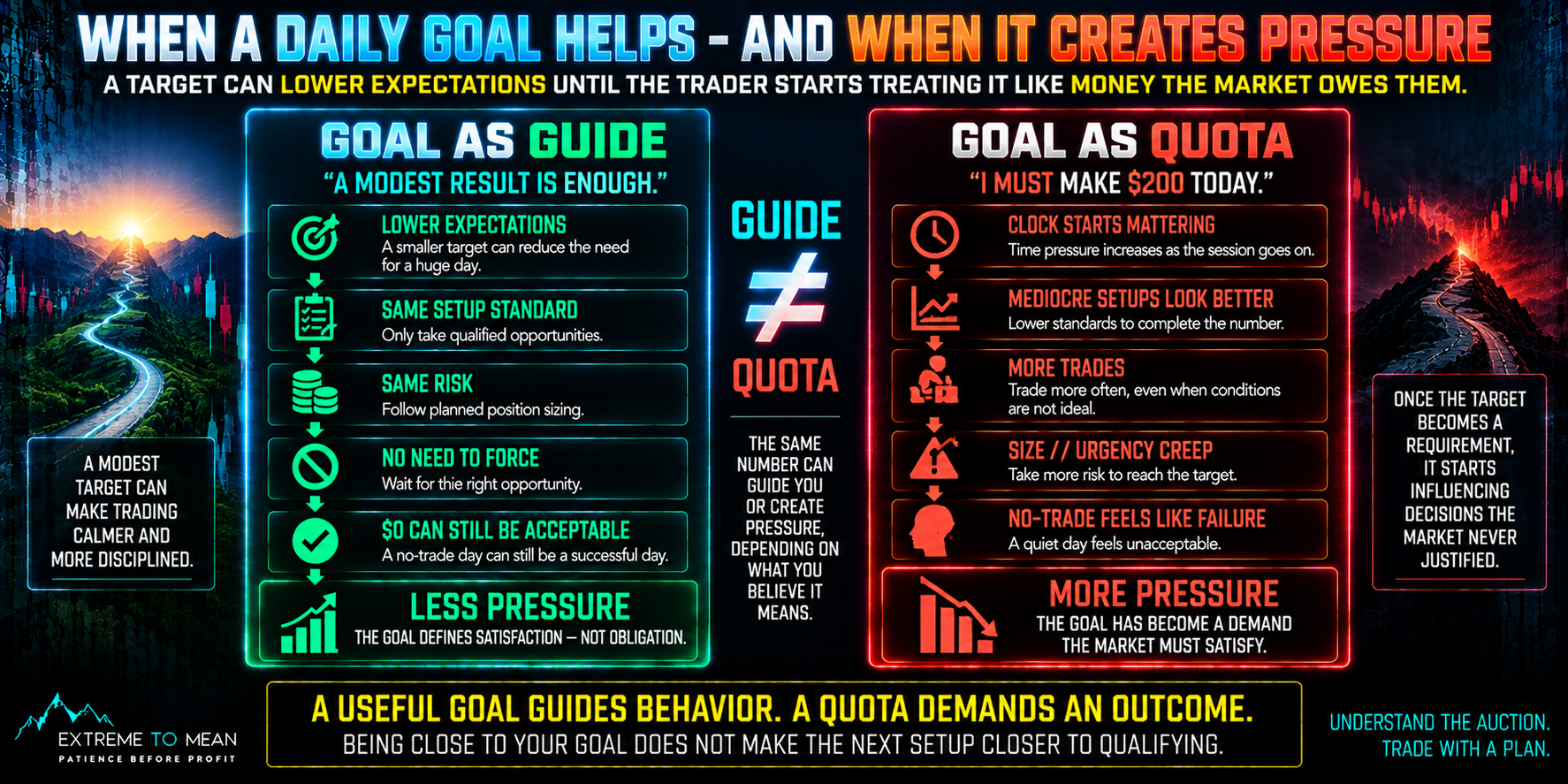
A small daily trading goal can sound disciplined. “I only need $200 today” feels calmer than trying to have a huge session, and for some traders that mindset can reduce greed or unnecessary activity. The problem begins when “$200 would be enough” turns into “I need $200 before I can stop.”
A useful goal guides the trader. A dangerous goal starts making demands of the market.
Daily goals can help organize expectations, but they do not control what kind of opportunity the market provides. Some sessions offer several clean setups, while others offer chop, poor location, conflicting structure, or nothing worth risking. Your financial target can stay the same while the quality of today's opportunity changes completely.
That is why this belongs inside the broader Trader curriculum. Money obviously matters in trading, but the trader cannot responsibly command the market to produce a specific amount on schedule. The trader can control standards, risk, patience, and whether an opportunity genuinely earns participation.
Process Goals and Profit Goals Are Not the Same
A process goal focuses on behavior that is largely under the trader's control. Examples include waiting for qualified setups, following planned position sizing, respecting invalidation, refusing to chase, completing a session review, and honoring a correct no-trade decision. The closer a goal is to your behavior, the more control you have over achieving it.
An outcome goal depends partly on market opportunity and variance. “Make $200,” “earn 1R,” “finish green,” or “hit my daily target” may all be desirable outcomes, but none can be commanded in the same way as following a risk rule. A trader can execute well and still finish the session below the financial target.
Outcome goals are therefore not automatically bad. A trader may use a modest financial objective to remind themselves that they do not need to maximize every move or chase an unusually large day. The mistake is allowing the outcome goal to overrule the behavior that was supposed to make the process disciplined in the first place.
A trading plan made before the open helps separate these two jobs. The plan defines how the trader intends to behave before P&L begins creating emotional pressure. A financial goal can sit inside that plan, but it should not gain authority over the standards that were established before the session began.
A Target Can Define “Enough” Without Becoming an Obligation
Suppose a trader says, “A modest green day is enough. I do not need to make $1,000.” That can be a useful psychological boundary because it lowers the need for the day to become exceptional. The target may reduce oversized trades, unnecessary additional entries, or the temptation to turn a successful morning into entertainment.
In that role, the target defines satisfaction rather than obligation. It reminds the trader that small gains can be meaningful and that protecting a good process matters more than squeezing every possible dollar from the session. A target can define enough without defining what the market owes you.
The danger begins when the same target becomes a requirement. Now the trader is no longer saying, “I would be satisfied with $200.” The trader is saying, “The session is incomplete unless I make $200.”
That shift changes the decision environment. Setups that were previously mediocre can start looking acceptable, waiting begins to feel unproductive, and the remaining distance to the target starts influencing risk. The financial objective has stopped guiding behavior and has started generating pressure.
The Market Does Not Owe You a Daily Number
Some sessions offer several clean opportunities with strong movement and favorable conditions. Other sessions are overlapping, structurally confused, badly located, or simply quiet. A fixed daily target does not adjust itself automatically when opportunity quality deteriorates.
The trader may still say, “I need $250,” while the market is effectively saying, “There may be no qualified trade today.” That mismatch is where a harmless outcome preference can begin forcing decisions the market never justified. Opportunity must outrank quota.
This is why doing nothing can still be a trading decision. If no setup qualifies, the correct application of the trading process may produce no position and no realized P&L at all. A daily goal should never require the market to provide a trade.
Zero dollars can therefore still be a completed trading day. If the trader prepared correctly, avoided chasing, respected risk, rejected weak opportunities, and made the correct pass, the financial outcome may be flat while the process remains excellent. A process goal can be completed even when an outcome goal cannot.
Why Being Close to the Target Can Lower Your Standards
Imagine the daily target is +$300 and the trader is currently +$245. The mind immediately notices that only $55 remains, and the next setup begins to feel as though it has a smaller job to do. The setup itself has not improved, but the remaining distance to the target makes participation feel easier to justify.
This is one of the most dangerous moments created by a daily quota. A mediocre trade can suddenly become “good enough” because the trader is close, and normal patience begins competing with the desire to complete the number. Being close to your goal does not make the next setup closer to qualifying.
The absurd result can be a trader who was +$245, forces one more trade for the remaining $55, and ends the session at +$80 or even negative. The target was supposed to reduce pressure by defining a modest amount as enough. Instead, proximity to the target created exactly the pressure the target was meant to remove.
A useful diagnostic is: Would I take this next trade if I could not see my daily P&L? If the answer changes because the account is $25 or $50 from the target, the P&L may be influencing setup qualification. Your P&L knows nothing about the next trade.
Falling Behind Can Turn a Goal Into an Imaginary Debt
The opposite problem appears when the trader is below the daily goal. Suppose two qualified trades lose and the account is now -$150 while the original daily objective was +$200. The trader may start thinking, “I am $350 away.”
That is dangerous accounting. The trader does not suddenly owe the market $350 before the session can be considered complete, and the original goal did not create a debt simply because the first trades lost. A profit target can turn a normal losing day into an imaginary debt.
The market does not know how far the trader is from breakeven or the original target. A new setup deserves risk only because the current market, location, setup quality, and risk justify the trade—not because a spreadsheet now contains an inconvenient number. The previous outcome cannot improve the next opportunity.
Time pressure can make this worse. As the session gets later, “I still need $200” can become “I am running out of time to make $200,” even if nothing about the market has improved. The closer the session gets to ending, the more a daily quota can make patience feel like failure.
That is where protecting your next decision matters. A losing morning should not be allowed to lower the standard required for the next trade merely because the daily outcome target remains unfinished. The next decision still has to begin from the market that exists now.
A “One Good Trade” Goal Can Become a Trade Quota Too
Financial goals are not the only daily objectives that can create pressure. A trader may say, “My goal is one good trade per day,” which sounds disciplined because it limits activity. But if zero qualified trades appear, “one good trade” can quietly become “I need to find one.”
That is the same mistake in a different form. A daily goal should organize behavior without requiring the market to produce the raw material needed to complete it. My job is to take qualified opportunity when it exists—not manufacture one so I can complete the day's assignment.
A stronger version of the goal would be: “If a qualified setup appears, I will take it correctly. If none appears, I will pass correctly.” The objective is now attached to decision quality rather than the existence of a trade. That makes the goal achievable even on a session when the market offers nothing.
This distinction is especially important for traders vulnerable to trading too much. The desire to complete a daily assignment can make additional activity feel responsible rather than excessive. More trading is not automatically more progress when the setup standard has already been compromised.
When a Small Profit Target Actually Helps
A daily profit framework can still have a legitimate job. Imagine a trader who regularly earns +$400 early, keeps trading because “more is available,” and eventually gives most of it back. A deliberately modest target combined with a predefined stopping rule may help interrupt that specific behavioral pattern.
In that case, the target is serving the process. Its job is not to make the market produce a fixed amount; its job is to prevent “more” from becoming automatic after a sufficiently successful session. The same target can reduce pressure for one trader and create pressure for another because the job of the target is different.
A stop-after-target rule is therefore not universally optimal. One trader's plan may require stopping after reaching a defined threshold, while another strategy may legitimately allow continued participation when exceptional qualified opportunity remains. A small goal can help define satisfaction. It should not mechanically override the trading plan.
The useful question is: What behavior is this goal supposed to change? If the answer is vague—“because disciplined traders have targets”—the rule may simply sound responsible without solving an actual problem. A goal is more useful when it addresses a documented behavioral issue.
Missing the Goal Does Not Mean Missing the Trading Objective
Suppose the financial target is +$200 and the session ends at +$175. If the trader followed the plan, managed risk properly, avoided forced trades, and the market offered limited opportunity, calling the day a failure makes little sense. Missing a financial target does not automatically mean missing the trading objective.
This all-or-nothing thinking can make a useful target destructive. A strong process day becomes emotionally classified as failure because one arbitrary number was not reached. The target stops measuring satisfaction and starts judging the trader.
A good daily goal should make ordinary sessions more acceptable, not make them emotionally unacceptable because they missed a precise dollar threshold. That is one of the strongest positive cases for modest goals: they can lower the need for every session to be financially remarkable. A good daily goal can make an ordinary day acceptable.
But acceptable does not mean required. The market may produce more than the target, less than the target, a clean losing day, or no opportunity at all. The outcome remains information about the session—not a command the next trade is responsible for satisfying.
The Daily Goal Test
Before using a daily target, ask:
- IS THE GOAL ABOUT BEHAVIOR OR P&L? — Know which type of goal you are using.
- CAN I COMPLETE TODAY SUCCESSFULLY WITH $0 P&L? — If not, the goal may encourage forced participation.
- WHAT HAPPENS IF NO QUALIFIED SETUP APPEARS? — There must be an acceptable answer: PASS.
- WHAT HAPPENS IF I AM CLOSE TO THE TARGET? — Does the setup standard remain identical?
- WHAT HAPPENS IF I AM BELOW THE TARGET LATE IN THE SESSION? — Does patience survive?
- WHAT HAPPENS IF I HIT THE TARGET EARLY? — Stop or continue only under defined rules? Decide before the situation occurs.
- WOULD I TAKE THIS NEXT TRADE IF I COULD NOT SEE MY DAILY P&L?
- IS THE GOAL HELPING MY PROCESS—or asking the market for a paycheck on schedule?
The test is designed to expose whether a goal is supporting discipline or manufacturing urgency. It does not tell every trader to use or avoid a specific dollar target. The important question is whether the goal remains subordinate to qualified opportunity.
The ETM Daily Goal Hierarchy
A useful daily framework separates three different jobs:
- PROCESS GOAL — What does good execution look like? Qualify setups, size correctly, execute the plan, and review decisions.
- PROTECTION GOAL — What am I unwilling to damage while pursuing an outcome? Respect risk limits, behavioral stops, and predefined boundaries.
- OUTCOME GOAL — What financial result would be desirable? A modest gain may be preferred, but it is desired—not demanded.
The order matters:
PROCESS > PROTECTION > OUTCOME
Outcome cannot override process or protection. A trader does not get to lower the setup standard because the goal is close, increase risk because the session is behind, or violate a stopping rule because the account has not yet reached the desired number. The goal never skips qualification.
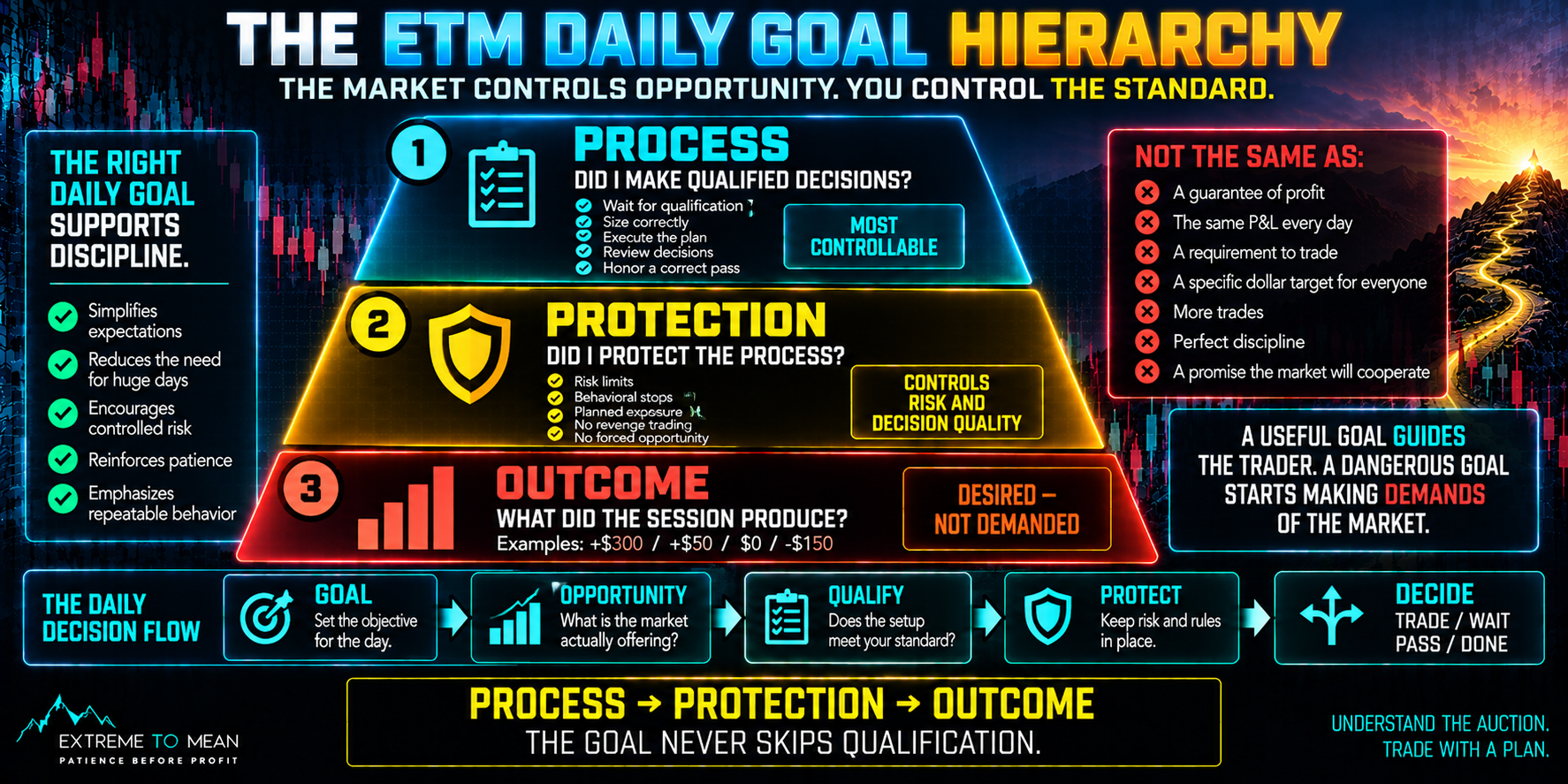
A second decision sequence keeps the hierarchy practical:
GOAL → OPPORTUNITY → QUALIFY → PROTECT → DECIDE
First identify the objective, then ask what the market has actually offered. Make every setup qualify independently, keep normal size and stopping rules intact, and only then choose TRADE / WAIT / PASS / DONE.
Daily targets also need permission to become irrelevant. If the market is messy by late morning, the best opportunity has passed, and nothing qualifies, the trader does not need to search for $250 somewhere else simply because that was the original target. A daily target should lose authority when the market stops offering the conditions required to pursue it responsibly.
Final Thought
Daily goals can be useful when they lower expectations and make trading calmer. A modest target can remind a trader that every session does not need to become a huge financial event, and a well-designed stop-after-target rule can sometimes solve a documented tendency to overtrade or give back strong mornings. The goal should have a specific job.
The trouble begins when the desired result turns into a quota. Being close to the number does not improve the next setup, falling behind does not create a debt, and a flat session does not become incomplete merely because no qualified opportunity appeared. A good goal can improve how you execute a valid process. It cannot create opportunity or edge where none exists.
Put process first, protection second, and financial outcome third. Then let every trade qualify on its own, regardless of whether today's P&L is above, below, or one trade away from the target. The best daily goal is usually something you can complete even on a day when the market gives you nothing.
Educational content only. Trading involves substantial risk and is not suitable for everyone.