
De-dollarization deserves attention because real diversification is occurring, but the term is often used too loosely. The useful market-context question is whether buying more gold, settling trade in local currencies, or building a new payment rail actually changes the currency used for global borrowing, reserve management, or foreign-exchange trading.
What De-Dollarization Actually Means
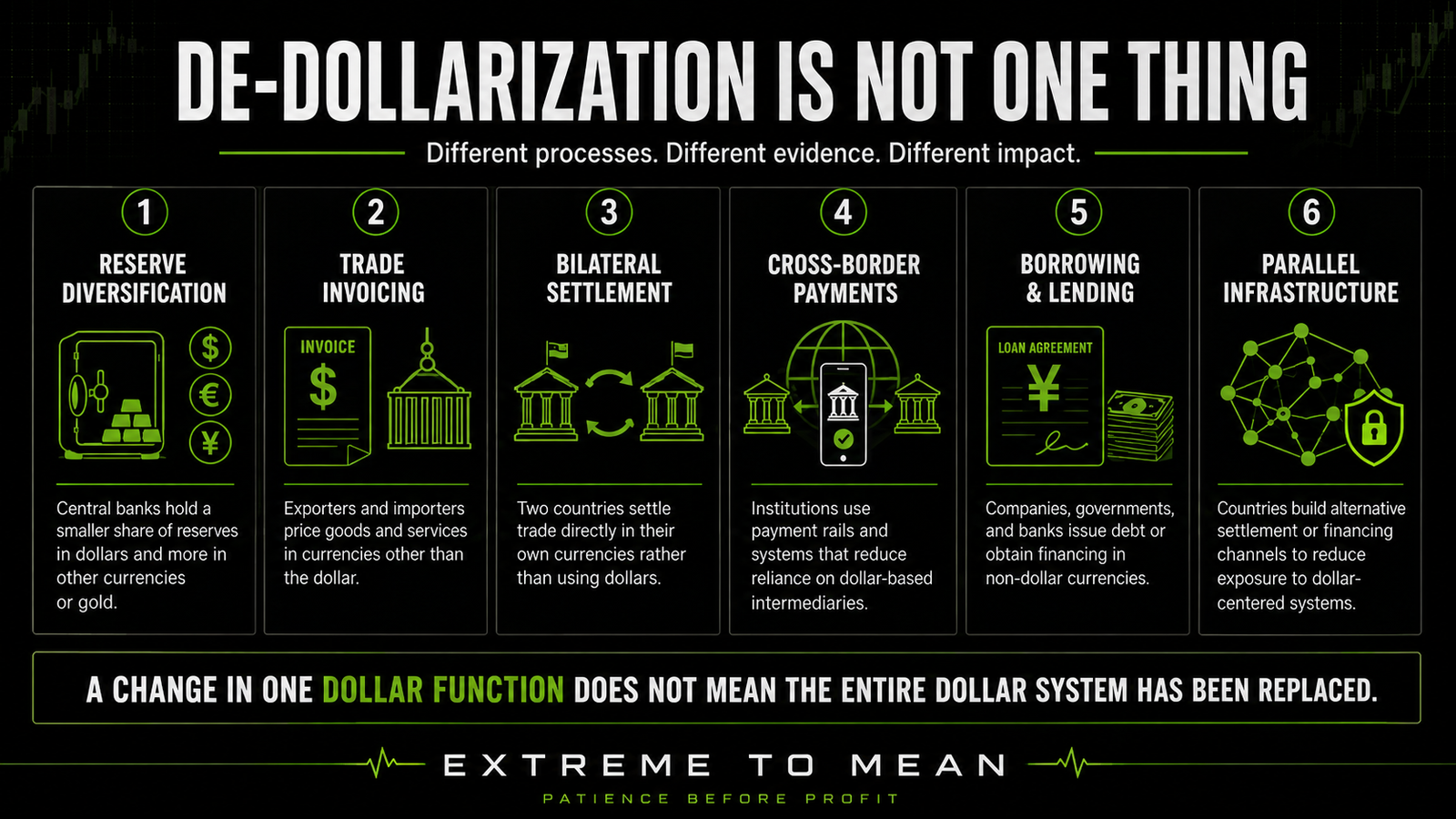
At its simplest, de-dollarization is a reduction in the use of the U.S. dollar for a specific economic or financial purpose. The dollar performs several jobs at once: it is held as a reserve asset, used to invoice trade and settle payments, borrowed and lent outside the United States, used to issue debt, and heavily involved in foreign-exchange markets. A change in one job can matter without proving that all the others are changing at the same speed.
The six broad forms below are useful to separate.
- Reserve diversification: central banks hold a smaller share of reserves in dollars and more in other currencies or gold.
- Trade invoicing: exporters and importers price goods in currencies other than the dollar.
- Bilateral settlement: two countries settle some trade directly in their own currencies.
- Cross-border payments: institutions use payment rails that reduce reliance on dollar-based intermediaries.
- Borrowing and lending: companies, governments, and banks issue debt or obtain financing in non-dollar currencies.
- Sanctions avoidance and parallel infrastructure: countries build alternative settlement or financing channels to reduce exposure to dollar-centered systems.
These forms can overlap, but they are not interchangeable. A shipment settled in yuan is evidence about settlement, not automatic evidence that reserve managers are abandoning Treasuries or global banks are moving away from dollar funding. The cleaner process is to ask what changed before deciding what the change means.
Why Countries Diversify
Countries can have rational reasons to reduce dependence on any single currency: reserve diversification, lower transaction costs, better matching of revenues and expenses, or less exposure to sanctions. They can increase gold holdings, promote local-currency trade, or build alternative payment infrastructure while still using dollars heavily for reserves, debt, and global funding. This is why context comes before the headline: a change can be real without being large enough to transform the system.
What the Reserve Data Actually Show
The IMF’s COFER data show that in the first quarter of 2026 the U.S. dollar represented 57.13% of global foreign-exchange reserves, compared with 20.03% for the euro and 1.99% for the Chinese renminbi. The dollar’s share is lower than around the turn of the century, but it remains far larger than any single alternative. The current data do not show wholesale replacement of the dollar.
Quarter-to-quarter movements also require care because COFER shares are reported in U.S. dollar terms. The dollar share rose from 56.42% in Q4 2025 to 57.13% in Q1 2026, but the IMF estimated that exchange-rate valuation effects accounted for roughly half of that increase; valuation effects also dominated the quarter’s changes in the euro and renminbi shares. A reported reserve-share move is therefore not the same thing as an equivalent amount of active buying or selling.
Why Reserves Alone Are Not Enough
Reserve composition is only one part of the dollar’s international role. The 2025 BIS Triennial Survey found the dollar on one side of 89% of all FX trades in April 2025, while the euro appeared on one side of 28.9%; because each FX trade contains two currencies, currency shares add to 200%, not 100%. That is a separate function from reserve holdings and shows why reserve data alone cannot settle the de-dollarization debate.
BIS global-liquidity data show $14.3 trillion in dollar-denominated credit to non-bank borrowers outside the United States at the end of 2025, after 8.5% year-over-year growth. Federal Reserve research in 2026 likewise continued to describe the dollar as central across reserves, FX, cross-border payments, international debt, and lending. A useful dashboard must therefore track reserves + trade + payments + FX + debt + lending + competing market depth over time.
Why the Dollar Is Hard to Replace
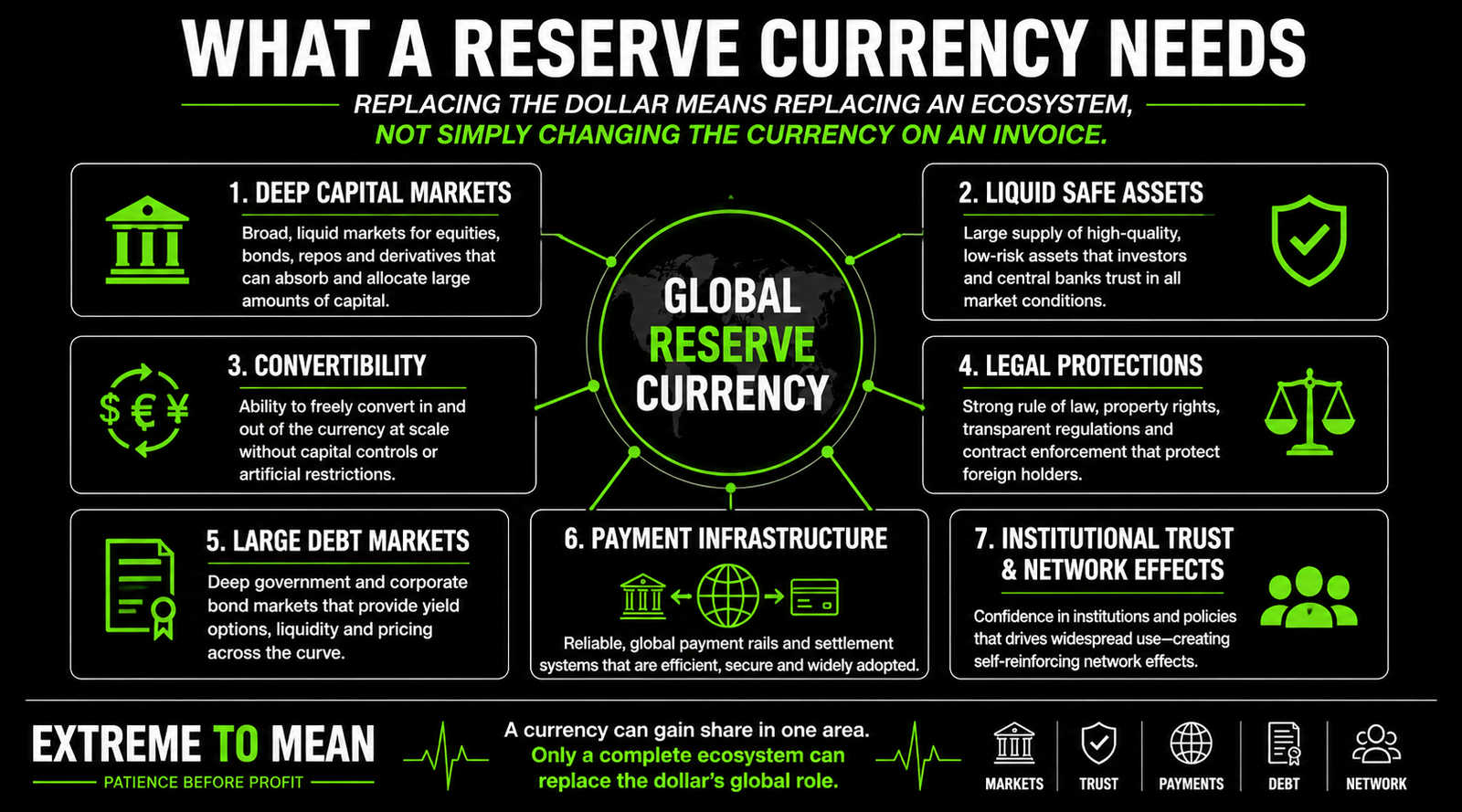
Reserve-currency status is not awarded simply to the country with the largest population or strongest political desire for a new system. Global users need deep and liquid capital markets, a large supply of safe assets, reliable convertibility, legal protections, payment infrastructure, debt markets, institutional confidence, and the ability to move large sums without breaking market liquidity. Network effects reinforce those advantages because widespread existing use makes a currency easier and cheaper for others to adopt.
The Federal Reserve’s 2026 work again pointed to deep U.S. financial markets and confidence in U.S. institutions as enduring foundations of international dollar use. That does not make the dollar permanent, but replacing it means offering substitutes for these functions together, not merely choosing a different currency on an invoice.
Could the Euro or Renminbi Take a Larger Role?
The euro is the clearest existing alternative because it has deep financial markets, broad convertibility, and a reserve share near 20%. The ECB reported in June 2026 that the euro’s international role grew moderately in 2025 and remained the world’s second most important currency, including stronger international debt issuance. Its constraint is that Europe still lacks the same degree of capital-market integration and unified safe-asset depth available in the United States.
The renminbi presents a different case. China is a major trading power, renminbi use in FX trading has increased, and China continues to expand cross-border payment infrastructure, but the currency accounted for only 1.99% of global reserves in Q1 2026. Federal Reserve research has also emphasized limits created by capital controls, incomplete convertibility, and lower investor confidence in Chinese institutions.
BRICS, Gold, Bitcoin, and Stablecoins
BRICS headlines show why definitions matter. During Brazil’s 2025 BRICS presidency, official statements emphasized greater use of local currencies and payment platforms to reduce transaction costs, while Brazil’s BRICS sherpa explicitly said a common BRICS currency was not under discussion. Local-currency settlement can reduce dollar use in specific transactions, but it is not the same as creating a common reserve asset, unified bond market, freely convertible currency, or global safe-asset system.
Gold is a reserve-diversification asset, but it does not provide the same supply of interest-bearing safe assets, credit creation, payment rails, or debt-market infrastructure. The IMF also cautioned that gold’s larger share of official reserves in 2025 was driven heavily by its rising price, so gold diversification and dollar replacement should not be treated as synonyms.
Bitcoin is a non-sovereign asset, but its existence does not automatically translate into reserve-currency replacement. Stablecoins are especially revealing: the Federal Reserve’s 2026 international-dollar conference noted that dominant stablecoins remain overwhelmingly dollar-denominated and may expand access to dollar-based finance rather than displace it. New technology can change the rails without changing the unit of account running across them.
What Genuine De-Dollarization Would Look Like
A genuine erosion of dollar dominance would be broad, persistent, and visible across several functions at once. You would expect a sustained decline in the dollar’s reserve share after valuation adjustments, less dollar invoicing and settlement, a lower FX share, and shifts in international borrowing and cross-border banking. Another system would also need comparable market depth, liquidity, convertibility, legal credibility, safe assets, and payment infrastructure.
That is a much higher bar than one country settling one shipment without dollars. It is also why the market comes first when traders evaluate a macro narrative: the question is whether the underlying system is changing enough to alter capital flows, funding conditions, interest rates, or risk appetite. A headline can be directionally interesting while still being too small to support a broad market conclusion.
De-Dollarization Is Not Dollar Collapse
The dollar can lose some share of global reserves or payments without collapsing. A more multipolar system could leave the dollar as the largest currency while the euro, renminbi, gold, regional currencies, and digital payment systems take larger roles in specific niches. That would be de-dollarization in the literal sense without being the binary event implied by “the dollar is finished” headlines.
Why Traders Should Care
For traders, de-dollarization matters only when the narrative connects to variables the market is actually pricing. Changes in foreign demand for U.S. assets, Treasury liquidity, global dollar funding, exchange rates, commodity settlement, or central-bank behavior can influence yields, the dollar, inflation expectations, and broader risk conditions. The path from “less dollar use” to a specific trade, however, is never automatic.
That is where market conditions change the quality of a setup. A macro story can provide context, but it should not replace structure, location, or defined risk on the chart. The trader’s job is to evaluate, not react, and the better question is: Which dollar function is changing, how large and persistent is the change, and does another system have the infrastructure required to replace it?
Before accepting a de-dollarization headline, use five questions.
- What function changed? Reserves, invoicing, settlement, payments, FX, debt, lending, or something else?
- How large is the change? Is it marginal or meaningful within the relevant market?
- Is it persistent? One quarter, one agreement, or a multi-year trend?
- Are valuation effects involved? Did holdings change, or did prices and exchange rates change the reported share?
- What is replacing the dollar function? Does the alternative offer liquidity, convertibility, safe assets, legal protections, and scalable infrastructure?
Final Thought
De-dollarization is real enough to study and too complicated to reduce to a slogan. Diversification is occurring while the dollar remains central to global FX trading, financing, reserves, payments, and debt markets. Measure the system function by function rather than treating every non-dollar transaction as evidence of replacement.
Replacing the dollar would mean replacing a financial ecosystem, not merely changing the currency used on an invoice. That requires time, market depth, institutional trust, and a credible alternative network. For a deeper look at how monetary systems evolve, The Monetary Revolution is the natural next step.
Educational content only. Trading involves substantial risk and is not suitable for everyone.