
A trader opens their chart, scans for something familiar, spots a pattern they recognize, and starts building a case for why it might work. The setup becomes the center of attention. Everything else gets evaluated around it. A newer trader can think of this as understanding the chart before reacting to the setup.
That order is backwards.
In many failed trades, the setup was technically valid. The pattern was clean, the location made sense, the trigger looked right. The trade failed because the market was not in a condition that could support it. The environment said one thing. The setup said another. The trader followed the setup.
Understanding market conditions before anything else is not a filter that slows you down. It is the foundation that makes every other decision more defensible.
What Market Conditions Actually Are
Market conditions describe the overall behavior of price over a meaningful stretch of time. Not what the last candle did. Not whether the most recent move was up or down. The broader pattern — what price has been doing, how it has been moving, and what that implies about how it may continue.
The Trend, Location, Momentum Decision Stack turns those separate observations into a sequence for evaluating a trade.
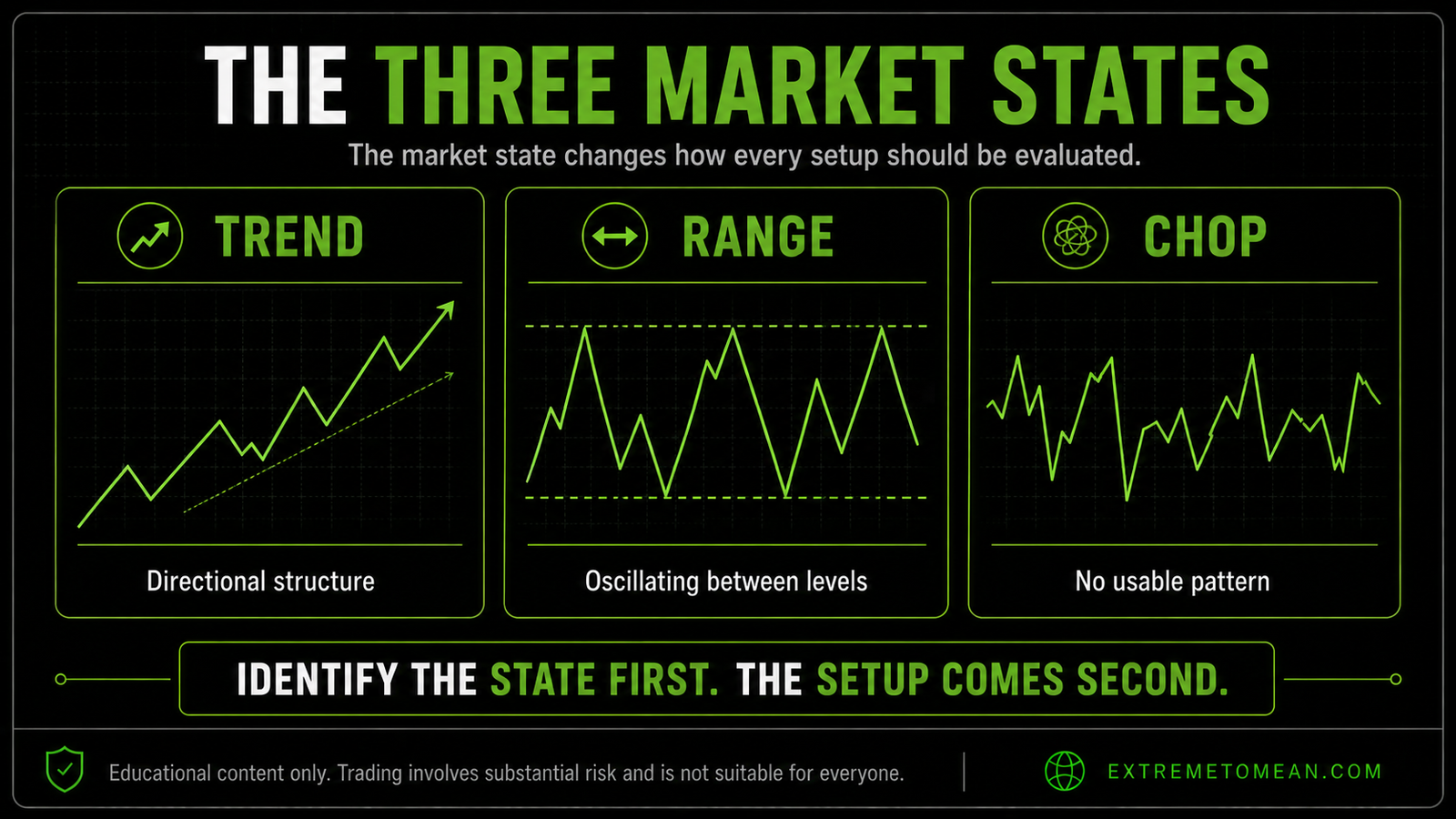
At a basic level, markets move through three market states. They trend, where price makes consistent directional progress — higher highs and higher lows in a bull market, lower highs and lower lows in a bear market. They range, where price oscillates between a visible ceiling and floor without a clear directional bias. Or they chop, where price moves without usable structure — no consistent trend, no reliable boundaries, just noise.
Each state creates a different trading environment. A pullback entry in a strong uptrend carries a different risk profile than the same-looking pullback inside a low-structure, choppy market. The pattern on the chart looks similar. The conditions are not the same. That difference matters more than the pattern does.
When we talk about evaluating conditions first, we are asking one prior question: what state is this market in right now, and does that state support the type of trade I am considering?
Why Traders Skip This Step
The setup pulls attention. That is the honest answer.
When something familiar appears on the chart — a recognized candle pattern, a clean level, a moving average test — the brain shifts into evaluation mode. The impulse is to assess the trade, not the environment it is sitting in. This is not a character flaw. Pattern recognition works fast. Once the brain finds a shape it knows, it builds momentum toward acting on it. The setup feels like evidence.
The problem is that a pattern does not carry its own context. A pullback to support tells you that price returned to a level. It does not tell you whether that level is likely to hold, whether the trend behind it is still intact, or whether the broader market is in any condition that favors a bounce. That is why context comes before the candle.
Many traders also develop earned confidence in specific setups over time. If a pattern has worked before, it builds credibility. But that credibility is conditional. It applied in whatever market conditions existed when the setup worked. The pattern does not carry that edge automatically into a different environment.
What Goes Wrong When You Get the Order Backwards
When the setup comes first and conditions come second — or never — a predictable set of problems emerges.
Trades get taken in low-structure markets because the entry pattern was present, even though price had not been respecting structure for days. Setups in uptrend continuation get taken in markets that have been quietly rolling over at the larger timeframe. Clean-looking reversion-to-mean entries appear in environments that have been trending in one direction without meaningful pauses — markets where reversion is not the active dynamic at all. That is why the timeframe behind the chart view matters.
The same is true for session context before reacting to price, because a move outside regular hours may not carry the same participation as one during the main session.
In each case, the setup did what setups do. It showed up where it was supposed to. The surrounding environment just could not support what the setup implied.
The other consequence of skipping condition evaluation is inconsistency that is hard to diagnose. A pullback entry works well for a few sessions. Then the same entry type fails repeatedly. The trader starts doubting the setup, their execution, their timing. What they are actually experiencing is how market conditions change the quality of a setup. Because conditions were never part of the evaluation, the variable never gets identified, and the lesson never lands cleanly.
What to Look at Before the Setup Gets Any Attention
Before a setup earns evaluation, a prior set of questions needs answering. These are not complicated. They are structural.
What has price been doing over the last meaningful stretch of time? Is there directional bias — a clear lean toward higher or lower? Are moves in one direction larger and cleaner than moves in the other? Is there structure — identifiable highs and lows — or is price moving without a repeating pattern?
Beyond direction, what is the character of the market? Is it moving with momentum or grinding? Are ranges expanding or contracting? Has price been respecting technical levels, or has it been running through them without follow-through?
These answers build a frame. Once that frame exists, the question of whether a setup fits becomes a much cleaner evaluation. A breakout entry makes more sense when momentum is present and structure is directional. A reversion-to-mean trade makes more sense when price has consistently returned to equilibrium after extended moves. A range trade makes more sense when price has been oscillating with visible boundaries on both sides.
The setup does not change based on conditions. But what a given setup implies — and whether that implication has any supporting context — changes significantly depending on where the market is.
A Decision Filter: Conditions Before Setup
Work through these questions before any setup earns attention. If the conditions do not support the trade type you are evaluating, the right move is to wait.
Step 1 — Define the current market state:
- Is price in a clear trend, a clear range, or moving without usable structure?
- Where is price within that context — extended from a key level, or sitting near one?
Step 2 — Check alignment between conditions and trade type:
- Does the setup type fit the current market state?
- Continuation setups fit better in markets with consistent directional structure. Reversion-to-mean setups fit better in markets showing consistent pullbacks to equilibrium after extended moves.
Step 3 — Ask the better question:
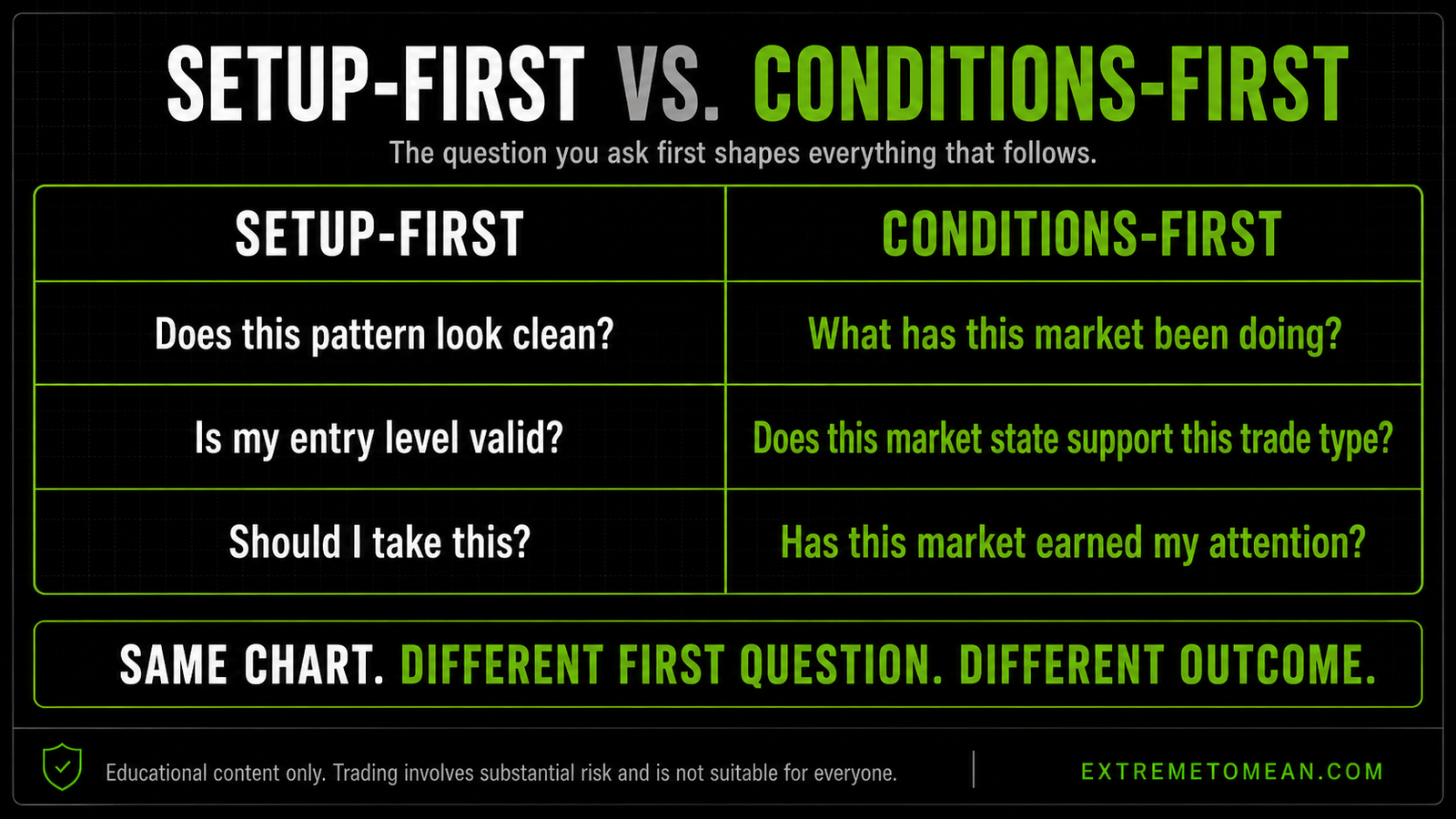
Instead of: Does this setup look clean?
Ask: Does this market condition support what this setup is implying?
That shift matters. The first question evaluates the pattern. The second question evaluates whether the pattern fits the environment. Both questions need answering, but the second one comes first.
Step 4 — Identify conflict:
- Is the trend direction at the higher timeframe in conflict with the setup direction at the entry timeframe?
- Is the market in a period of expansion or contraction that works against the trade type?
If there is unresolved conflict between conditions and setup, the default is to wait. A technically valid setup in a contextually mismatched environment is not a good opportunity. It is a recognizable pattern sitting in the wrong market.
Final Thought
A setup is not a signal, and it does not create edge on its own. Edge comes from a valid setup operating in a supportive environment. Most of the evaluation work that determines trade quality happens before the setup ever comes into focus.
We look at the market first. We define what it has been doing. We identify what state it is in. Then — only then — we ask whether a setup makes sense in that context.
This sequence does not make trading slower. It makes the decisions we do reach more grounded. The market does not owe any setup a result. What we can do is make sure we are placing our attention — and our capital — on setups that are operating in conditions where the logic behind them actually applies. From there, see how the TMT System organizes market context within the full process.
That begins with knowing what a stock really represents before treating its movement as a setup.
The next foundation is learning basic market structure.
From there, market phases show how those conditions tend to cycle from accumulation through markup, distribution, and markdown.
Participation can help confirm whether a move reflects broad improvement or only a narrow rebound, which is the distinction explored in breadth thrust versus a weak market bounce.
When the question extends beyond one session, the evidence that an economy may be entering recession provides another layer of market context.
That same context-first discipline applies when reviewing stock market crash warning signs without treating them as automatic predictions.
Educational content only. Trading involves substantial risk and is not suitable for everyone.