
Search long enough for information about day trading and you will eventually encounter a remarkably confident statistic: 90% of day traders lose money. Sometimes it becomes 95%. Sometimes 97%. Occasionally 99%. The number changes more easily than the confidence behind it.
The exact percentage is less certain than the direction of the evidence.
There is no single credible percentage that describes every day trader in every market. Studies examine different countries, instruments, time periods, experience levels, trading frequencies, transaction costs, and definitions of profitability. But several unusually large datasets point toward the same broad conclusion: most retail day traders in the populations studied performed poorly after costs, while traders who demonstrated persistent and reliably predictable profitability were a small minority.
That is why this lesson belongs inside The Trader. The useful question is not simply, “What percentage of traders fail?” It is: Are we using a statistic—or repeating a trading proverb with a percent sign attached?
Where Did “90% of Day Traders Lose” Come From?
The generic 90% claim is difficult to trace to one primary academic study or regulator dataset establishing it as a universal failure rate for all day traders. That does not mean every version of the claim points in the wrong direction. Some well-designed studies have reported results worse than 90% for specific populations.
That distinction matters. A poorly sourced statistic can point in a broadly correct direction and still be a poor statistic. Replacing “90%” with another impressive percentage without carrying along its sample, market, period, and definition simply repeats the same mistake.
The Brazil Futures Study: Where a Real 97% Number Comes From
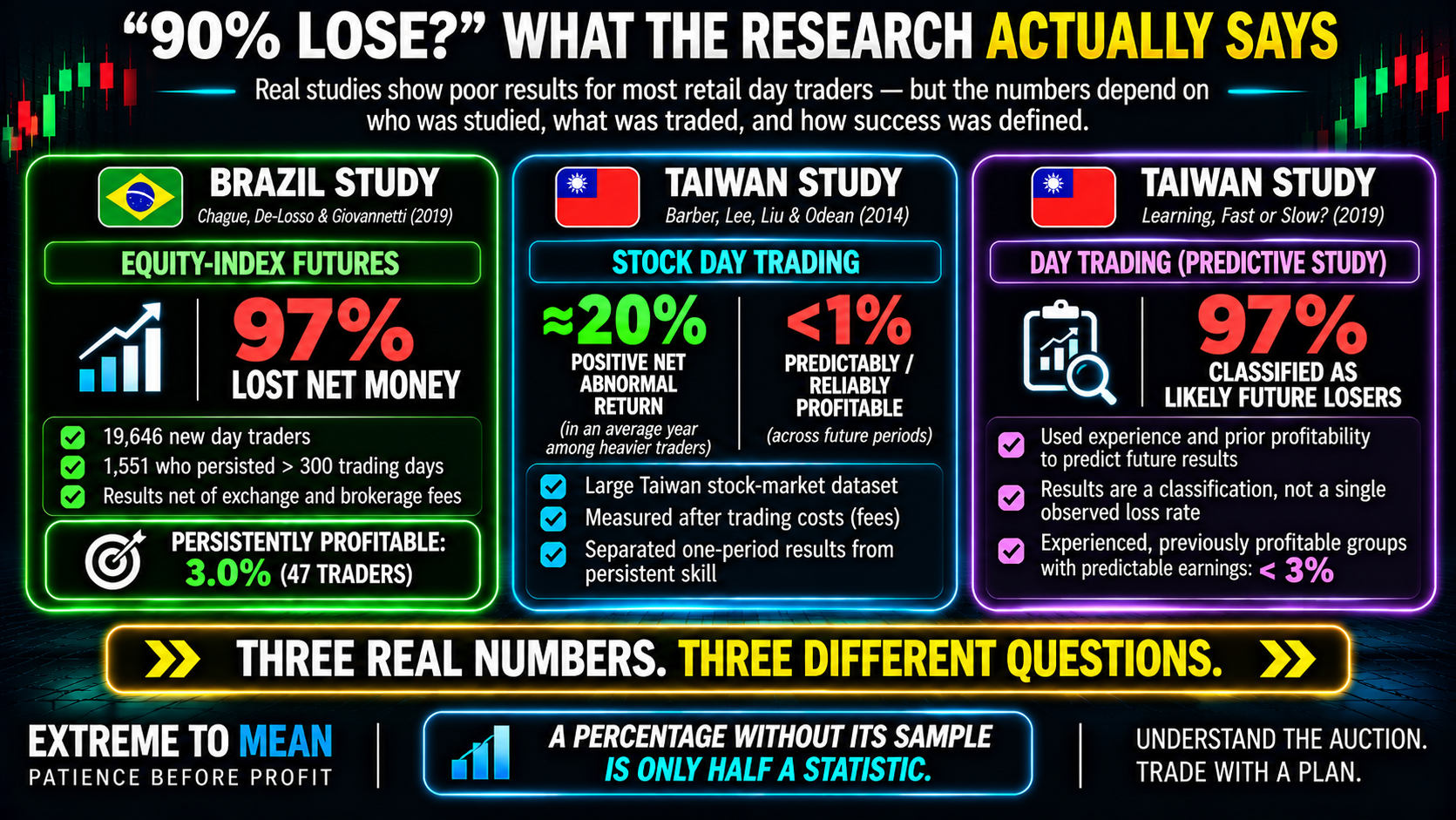
One of the most relevant studies for futures traders is Day Trading for a Living? by Fernando Chague, Rodrigo De-Losso, and Bruno Giovannetti. Using regulator-provided Brazilian trading records, the researchers identified 19,646 individuals who began day trading mini-Ibovespa equity-index futures from 2013 through 2015. These were actual futures transactions rather than survey responses or self-reported results.
The researchers grouped traders according to how long they continued. Among the 1,551 people who persisted for more than 300 trading days, 97% lost money net of exchange and brokerage fees. Only 47 traders, or 3.0%, finished that cohort with positive net profit.
The income results were even narrower. Seventeen of the 1,551 traders—1.1%—earned more than the Brazilian minimum-wage benchmark used by the researchers, while eight traders, about 0.5%, earned more than the bank-teller salary benchmark used in the paper. The top trader averaged approximately $310 per trading day, but with very large day-to-day variability.
Those are striking numbers. They still require their full sentence.
What the Brazilian 97% Does—and Does Not—Mean
The accurate statement is not, “A study proved 97% of day traders lose.” The accurate statement is: In one Brazilian study, 97% of the 1,551 new retail traders who persisted in day trading mini-Ibovespa futures for more than 300 days lost money net of exchange and brokerage fees.
Every qualifier matters. The study does not establish that 97% of current U.S. MES or MNQ traders lose, that 97% of stock traders lose, that every new trader has a 3% probability of success, or that an individual cannot become profitable. It describes a specific population in a specific futures market during a specific period.
A percentage without its sample is only half a statistic. Strong evidence is not the same thing as universal evidence.
Persistence Did Not Automatically Become Proficiency
The Brazilian data become even more interesting when traders are grouped by how long they remained active. About 29.8% of people who traded for only one day finished with positive net profit. That fell to 15.5% among those who traded 2–50 days, 8.9% for 51–100 days, 6.8% for 101–200 days, 5.4% for 201–300 days, and 3.0% among those exceeding 300 days.
That does not prove that trading longer causes performance to deteriorate. Selection effects, behavior, market conditions, capital, and other factors can affect the groups. It does show that the simple story—“people keep practicing until most eventually learn to become profitable”—did not appear in this population.
The researchers also tested whether expected daily performance improved as the persistent traders accumulated experience and reported no evidence of learning in that cohort. The responsible conclusion is narrow: in that population, persistence did not automatically become proficiency.
The Taiwan Evidence Gives Us a Different Number
A separate body of research by Brad Barber, Yi-Tsung Lee, Yu-Jane Liu, and Terrance Odean examined day traders on the Taiwan Stock Exchange from 1992 through 2006. This was an enormous transaction dataset covering hundreds of thousands of individuals in an average year. It studied equities rather than futures, so it should not be treated as the same population as Brazil.
Among a heavily trading subset, approximately 20% earned positive abnormal returns net of fees in an average year. At first glance, that sounds dramatically more optimistic than Brazil's 3% among persistent futures traders. But the Taiwan researchers then asked a harder question: could previous performance reliably identify traders who would continue outperforming?
The answer changed dramatically. Less than 1% of the overall day-trader population was able to predictably and reliably earn positive abnormal returns net of fees. The most successful prior traders continued to perform unusually well, which is important because it provides evidence that genuine trading skill existed in the population.
The evidence therefore is not “nobody can do this.” The evidence says profitable day traders are rare—not imaginary.
Profitable Once and Persistently Skilled Are Different Standards
Suppose someone finishes one year with a profit. That result may reflect skill, favorable conditions, variance, luck, or some combination of them. A positive period proves the outcome occurred; it does not by itself establish that the trader possesses a repeatable edge.
This is where understanding what an edge actually is becomes important. A stronger test asks whether earlier performance predicts future performance across a sufficiently large sample. A winning period and evidence of persistent skill are not the same statistical hurdle.
That distinction explains why roughly one-fifth of one Taiwan subgroup could show positive net abnormal performance in an average year while fewer than 1% of the total population demonstrated predictably reliable positive performance. The two figures answer different questions.
A Third 97% Number Means Something Else Again
A later Taiwan study, Learning, Fast or Slow?, examined experience, prior profitability, continued trading, and future performance. The researchers reported that 97% of day traders were classified as likely to lose money in future day trading based on the historical characteristics of their groups.
That is not the same measurement as Brazil's 97%. Brazil counted the realized net profitability of a specific cohort that persisted more than 300 days. The Taiwan figure is a predictive classification based on experience and prior profitability.
The study also found that only the most experienced previously profitable group predictably earned positive future net returns, representing less than 3% of active day traders on an average day. Once again, the broad message is difficult to call encouraging, but the percentage only makes sense when attached to what was actually measured.
Three Real Numbers. Three Different Questions.
| Research | Population | Main finding | Important limitation |
|---|
|---|---|---|---|
| Chague, De-Losso & Giovannetti | 19,646 new Brazilian mini-index futures traders; emphasis on 1,551 who persisted beyond 300 days | 97% of the persistent cohort lost net money; no evidence of learning in that cohort | One country, one futures market, historical period |
|---|---|---|---|
| Barber, Lee, Liu & Odean | Taiwan stock day traders, 1992–2006 | About 20% of a heavier-trading group positive net abnormal in an average year; less than 1% predictably/reliably profitable | Taiwan equities and an older market structure |
| Barber et al., Learning, Fast or Slow? | Taiwan day traders | 97% classified as likely future losers; small experienced profitable group showed persistent positive performance | Predictive classification, not a simple observed loss percentage |
The table is exactly why “What percentage of day traders lose?” does not have one scientifically honest universal answer. Different denominators, definitions, markets, and tests produce different percentages. Correcting a bad universal statistic with another study-specific statistic would repeat the same mistake.
Costs Change the Definition of Profitable
A trader can have positive gross trading P&L and still lose after commissions, transaction taxes, spread, slippage, and other costs. That distinction matters particularly for day trading because frequent trading repeatedly exposes the strategy to friction. The more often an edge has to survive costs, the more important those costs become.
This is another reason study definitions matter. “Positive gross P&L,” “positive net profit,” “positive abnormal return after fees,” “profitable for one year,” and “predictably profitable in future periods” are not interchangeable measures of success. If two studies define success differently, their percentages should not be expected to match.
Survivorship Bias Can Fool You in Either Direction
A trader might say, “Most experienced traders I know are profitable.” That observation may be completely sincere and still produce a bad estimate of the overall population because traders who exhausted capital, quit, stopped posting, or simply moved on are missing from the visible sample. You cannot estimate the survival rate from the survivors.
The reverse can happen too. Someone spending time only in beginner communities, blown-account forums, or groups dominated by struggling traders may conclude that nobody succeeds. Personal experience is a sample too—and usually a very small one.
Before asking how many traders fail, ask who was counted as a trader. Someone who makes one intraday trade, someone who trades heavily for a year, and someone who persists for more than 300 trading days belong to very different statistical populations.
Possible Does Not Mean Common
The Taiwan evidence is important because it shows that some traders demonstrated persistent performance strong enough for previous results to predict future results. That means individual trading skill is not merely imaginary. But evidence that skill exists is not evidence that skill is common or easily acquired.
The useful framework is POSSIBLE ≠ COMMON ≠ EXPECTED. Day trading can be a legitimate activity without widespread sustainable profitability being typical among participants. Population evidence should influence expectations without being converted into an individual's predetermined fate.
That is also why a trading plan made before the session matters more than a slogan about failure rates. A population statistic cannot decide whether today's setup qualifies or whether an individual process has evidence of positive expectancy. It can only remind the trader that the burden of proof should be high.
Before You Believe Any Trading Statistic
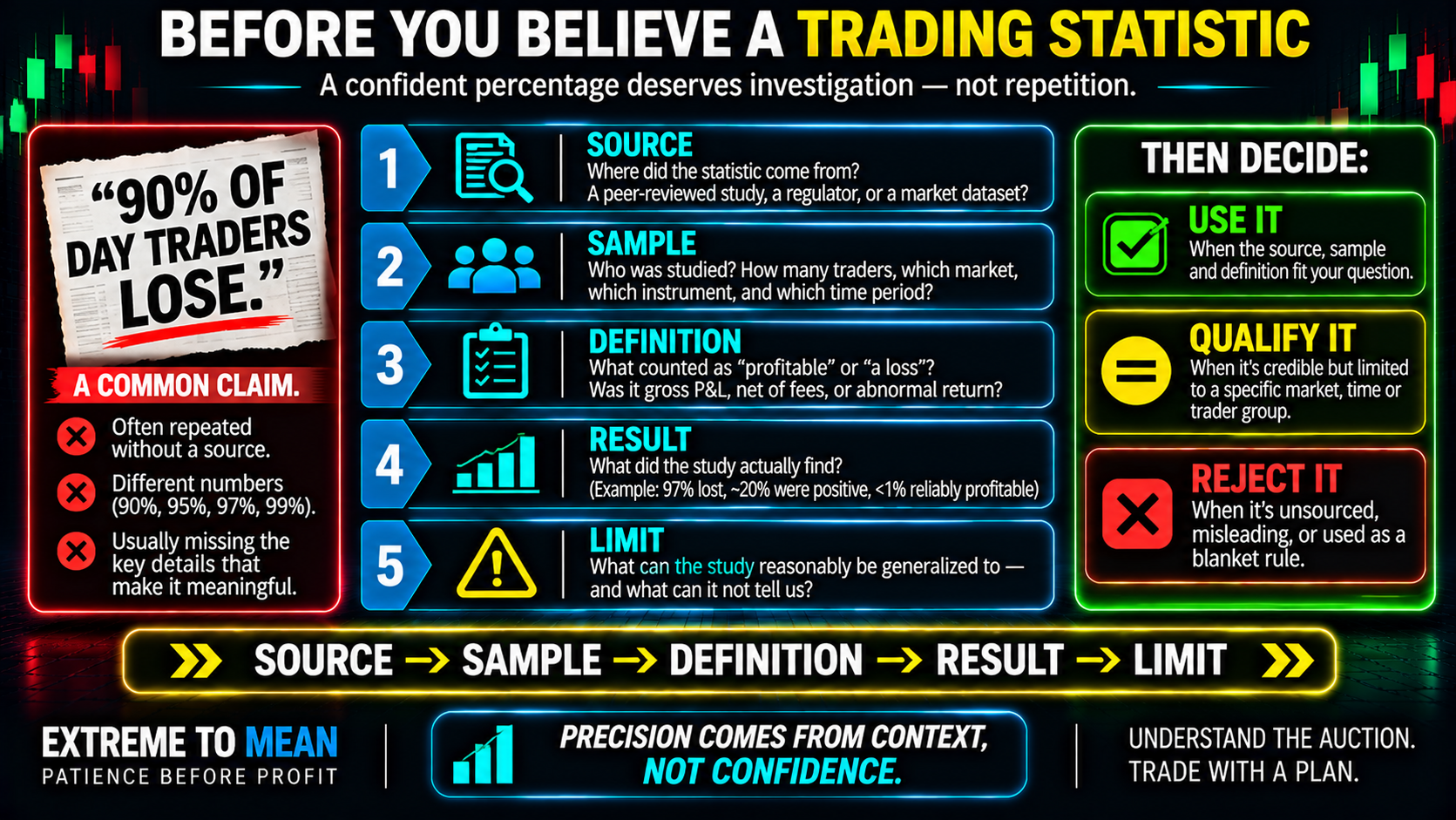
Whenever someone gives you a success or failure percentage, ask:
- What is the primary source?
- Which market was studied?
- Which country?
- Which time period?
- Who counted as a day trader?
- What counted as success?
- Were transaction costs included?
- Is the number measuring one-period profitability or persistent skill?
- Is the result observed or predicted?
- What can the study reasonably be generalized to?
If the answer is simply “everyone knows 90% lose,” you do not have a statistic yet. You have a claim.
What Should This Research Mean for a New Trader?
Poor base rates should not lead to fatalism. They should raise the standard of evidence a trader demands before committing meaningful capital. A bad base rate is a reason to become more evidence-driven—not a reason to declare the outcome predetermined.
Instead of trying to prove that you are “one of the profitable ones,” ask whether you have a defined setup, whether it has been tested honestly, whether costs are included, whether results remain positive outside the original development sample, whether risk is controlled, and whether performance persists across enough comparable trades. One good month is an outcome; it is not yet evidence of durable skill.
The ETM free tools can help structure preparation and review, but the larger principle matters more than any worksheet. Require more evidence from yourself than a screenshot, a hot streak, or somebody else's percentage.
The ETM Source → Sample → Definition → Result → Limit Framework
Use SOURCE → SAMPLE → DEFINITION → RESULT → LIMIT.
SOURCE: Where did the statistic actually come from? SAMPLE: Who and what were studied? DEFINITION: What counted as success or failure? RESULT: What did the researchers actually find? LIMIT: What can the study not tell us?
Only then decide whether to USE, QUALIFY, or REJECT the claim. Never separate a trading statistic from the population that produced it. Precision comes from context, not confidence.
Final Thought
No credible evidence reviewed here establishes a universal rule that exactly 90% of every kind of day trader loses money. But the better large-sample research is still sobering: most traders in the studied retail populations performed poorly after costs, while persistent and predictably profitable traders were uncommon.
The Brazil futures study found that 97% of its specific 1,551-person persistent cohort lost net money. The Taiwan research found that many more traders could show a profitable period than could demonstrate reliably predictable future profitability. Those results are not contradictory; they measure different populations and different standards of success.
Day trading is possible. The evidence also suggests durable success is uncommon. Population statistics do not calculate an individual trader's destiny, but they should raise the burden of proof: define an edge, include costs, control risk, test the process honestly, and require stronger evidence than a good month before calling the result skill.
Educational content only. Trading involves substantial risk and is not suitable for everyone.