
A futures broker may let you control a large contract with what looks like a surprisingly small amount of money. That number can make a beginner think the trade itself is small, the loss is somehow capped, or the broker has already decided how much risk is reasonable. None of those conclusions follows from the margin requirement.
Futures margin is a capital requirement, not a trade-risk limit.
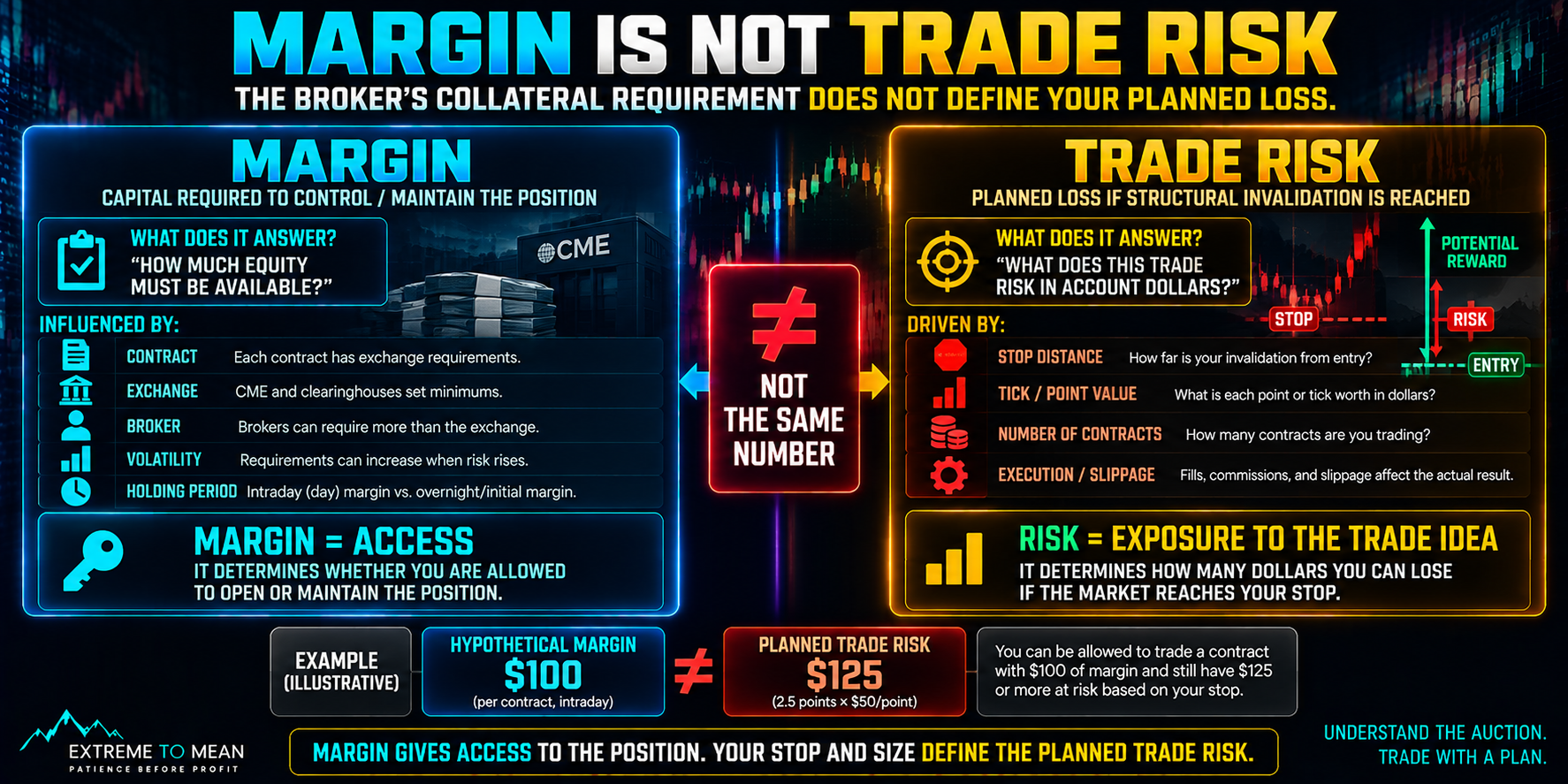
Margin answers a practical access question: how much account equity must be available under the exchange and broker rules to establish or maintain the position? Trade risk answers a different question: if the market reaches the point where your trade idea is wrong, how many account dollars will that movement cost? Those numbers can be very different.
This distinction belongs early in the broader ETM lesson library because leverage makes futures powerful and easy to misunderstand. A small margin requirement can support exposure that moves by much more than the margin amount, which is why the trader must separate permission to hold the contract from the decision about how much to risk. The cleaner sequence is to understand the contract, define the trade, calculate the risk, choose size, and only then confirm that the account comfortably satisfies the margin requirement.
What Futures Margin Actually Is
Futures margin is money that must be deposited and maintained to support the financial obligations created by a futures position. It is often described as a performance bond or good-faith deposit rather than the purchase price of the underlying asset. Margin is the collateral required to control the contract—not the price of the contract.
That makes futures margin different from the way many beginners first encounter the word margin in securities. Stock margin may involve borrowing part of a purchase price, while futures margin supports a leveraged contractual position whose value changes as the futures price changes. The trader is not buying the underlying asset with the margin deposit.
Futures positions are marked to market, so gains and losses affect the account as prices move. Margin is not a fixed pot of money that absorbs losses and then protects the trader from anything beyond it. The position continues producing gains or losses according to price movement, contract value, and quantity until it is closed or liquidated.
Initial Margin, Maintenance Margin, and Margin Calls
Initial margin is the amount required to establish a position under the applicable margin rules. The exchange or clearinghouse establishes minimum performance-bond requirements, but a broker can require its customers to maintain more than the exchange minimum. The number shown by one broker therefore does not automatically apply to every trader at every firm.
Maintenance margin is the minimum required equity level that must be maintained while the position remains open. If losses reduce the relevant account equity below that requirement, additional funds may be required to restore the account to the required level. A margin call is therefore a demand to bring the account back into compliance, not a statement that the trader's loss has reached some predetermined maximum.
A margin call also does not guarantee time to add money. Depending on broker policy and market conditions, positions may be reduced or liquidated when requirements are not met. Know the broker's policy before the problem appears.
Broker Day Margin Is Not the Same as Overnight Margin
Retail futures brokers may offer reduced intraday or day-trading margin during designated periods. That is a broker risk policy allowing the trader to control a contract with less required account equity than may be needed under full initial or overnight requirements. The exact amount and the time window are broker-specific and can change.
The critical beginner point is that lower day margin does not make the futures contract smaller. The multiplier, tick value, underlying exposure, and price volatility remain the same; only the capital requirement for holding the position under that broker's policy changed. Reduced margin increases access. It does not reduce the contract's ability to hurt you.
This becomes especially important near the broker's intraday cutoff. A position that qualifies for reduced day margin may require substantially more capital if it remains open into the broker's overnight or full-margin period. Reduced intraday margin does not necessarily apply through the entire electronic session.
Why Margin Is Not the Same as Trade Risk
Imagine a clearly hypothetical futures contract for which a broker currently requires $100 of intraday margin per contract. That means the broker presently allows the account to control one contract intraday while satisfying a $100 collateral requirement. It does not tell us where the trade is wrong or what the planned loss would be.
Now suppose the trade entry is 100.00, structural invalidation is 97.50, and the fictional contract moves $50 for each full price point. The stop distance is 2.5 points, so the approximate planned price risk is 2.5 × $50 = $125 for one contract, before fees and slippage. The margin requirement is $100 while the planned trade risk is $125: two different numbers answering two different questions.
Suppose instead the trader ignores or fails to exit at the planned stop and the market moves five points against the position. The price loss is now approximately 5 × $50 = $250, even though the margin requirement was still only $100. Margin never promised to cap the loss at the collateral figure.
This is why the trade is not ready until the risk is clear. The margin page cannot tell you where invalidation belongs, how far away it is, or what that distance is worth. Those are trade-construction questions, not margin questions.
Notional Value, Margin, and Leverage Are Three Different Ideas
Notional value is the economic exposure represented by the futures contract. An index future might calculate that exposure from the index level multiplied by the contract multiplier, while a commodity contract might use market price multiplied by the standardized quantity of the commodity. The trader can therefore control substantial notional exposure while posting only a fraction of that value as margin.
That difference is leverage. A relatively small margin deposit can support a position whose value changes much more quickly than the collateral amount suggests. Notional value tells you what you control; margin tells you what collateral is required; neither one tells you what your planned stop risks.
Margin requirements are also not permanent contract specifications in the way a tick value or multiplier may be. Clearinghouses and brokers can adjust requirements as volatility, liquidity, event risk, and broader market conditions change. The moment a market becomes more dangerous can therefore be the same period when price movement expands and margin requirements rise.
The Same Margin Can Support Very Different Trade Risk
Consider two traders using the same contract at the same broker. Their margin requirement is identical, but Trader A's structural stop translates to $40 of planned price risk, while Trader B's wider structural stop translates to $180. Same contract, same broker access, different trade risk.
That simple comparison proves why margin cannot be a position-sizing formula. If an account technically has enough day margin to open ten contracts, that does not answer whether ten contracts fit the trader's risk plan. The broker is answering, “Can the account satisfy our collateral rule?” while the trader must answer, “How much loss can this setup responsibly expose the account to?”
Available buying power becomes dangerous when it is interpreted as permission. An account may have enough margin capacity to open a position while still having too little risk capacity for the planned stop or normal adverse movement. Sizing from what the platform allows instead of what the trade can responsibly risk is a form of unclear risk.
Calculate Position Size From the Trade, Not the Margin Table
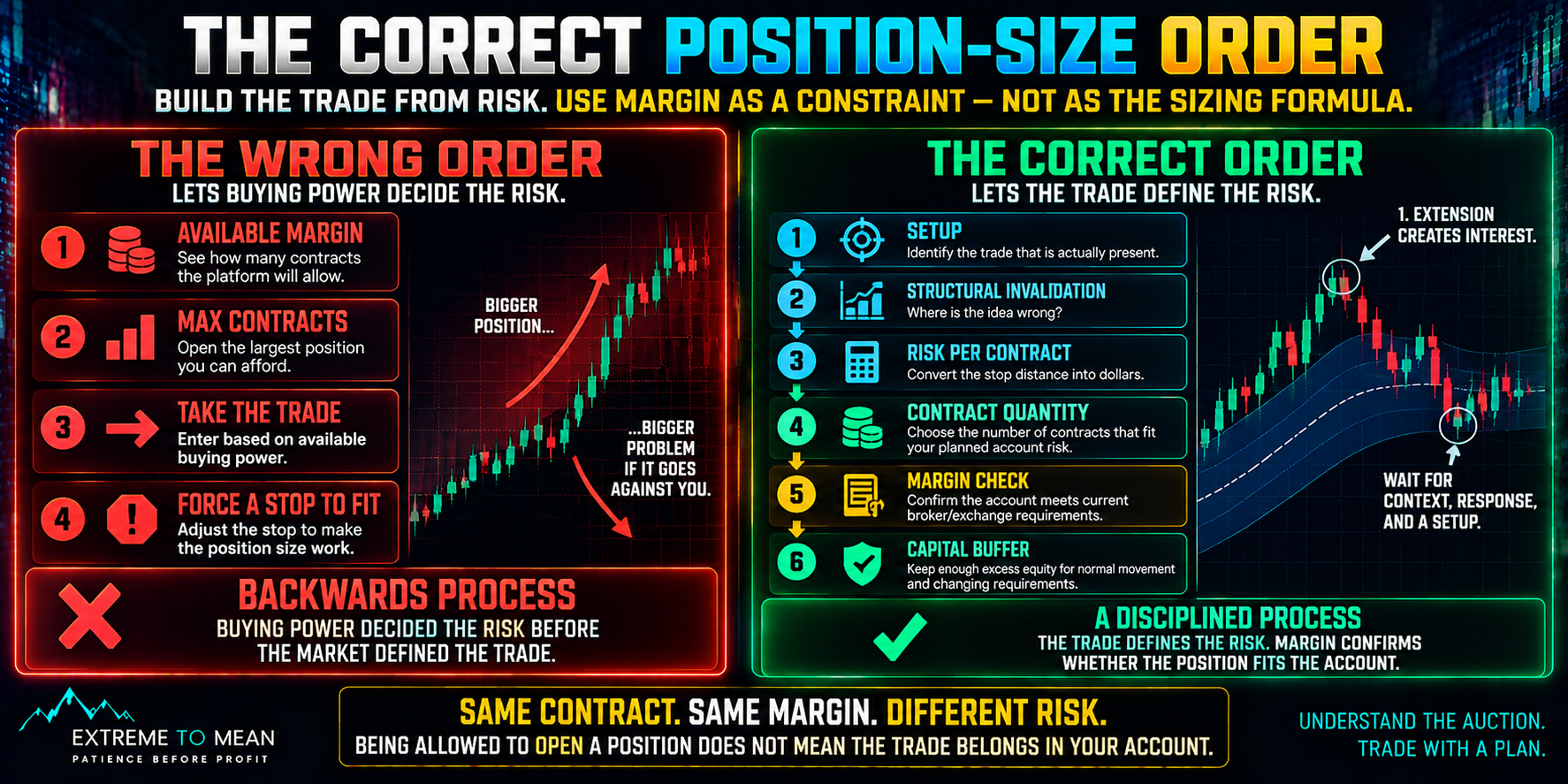
The correct order starts with the actual market idea. First identify the setup and define the structural level that proves the thesis wrong; then measure the stop distance and convert that distance into dollars using the contract's tick or point value. Only after you know the risk per contract can you decide how many contracts fit the account's planned risk.
A trading plan made before the open can keep that order intact before live buying power starts influencing the decision. The purpose is not to predetermine every trade, but to establish that position size comes from risk rather than from the maximum number of contracts the platform will permit. The broker's margin figure belongs near the end of the process, not the beginning.
Use this order:
- SETUP — What trade is actually present?
- INVALIDATION — Where is the idea wrong?
- RISK PER CONTRACT — What is that stop distance worth in dollars?
- CONTRACT QUANTITY — How many contracts fit the planned account risk?
- MARGIN CHECK — Does the account satisfy the current broker/exchange requirement?
- CAPITAL BUFFER — Is enough excess equity left for normal movement and changing requirements?
The backwards process is AVAILABLE MARGIN → MAX CONTRACTS → TAKE THE TRADE → FORCE A STOP TO FIT. That lets the broker's buying-power number dictate risk before the market structure has even defined the trade. Build the position from risk; use margin as a constraint, not as the sizing formula.
The ETM Margin-vs.-Risk Framework
A useful way to keep the concepts separate is CONTRACT → MARGIN → INVALIDATION → RISK → SIZE → BUFFER. Start by identifying the contract and checking the current margin policy, including whether the number is intraday, initial, or maintenance margin. Then leave the margin table and return to the chart.
Ask where the trade is actually wrong, how far that level is from entry, what the distance is worth per contract, and how many contracts fit the planned account risk. After the size is determined from the trade, confirm that the account also meets the applicable margin requirement with room to spare. The free tools library can help with arithmetic, but no calculator can decide the correct structural invalidation for you.
The final decision is TRADE / REDUCE / PASS. Being able to open the trade does not mean the account can responsibly absorb the trade, and excess capital is not automatically wasted capital. It can be the room that keeps normal movement, changing margin rules, or an overnight requirement from turning a technically allowed position into an account-management problem.
Final Thought
Futures margin makes leveraged market exposure possible, but the margin figure is not a substitute for risk management. It tells you how much collateral the exchange and broker currently require—not how much a trade can lose, where the stop belongs, or how many contracts you should trade. A small margin number can support a position capable of a much larger gain or loss.
Define the trade first. Measure risk from actual structural invalidation and contract value, choose position size from the amount of risk the account can responsibly carry, and only then confirm that the account comfortably meets the current margin requirement. Margin tells you whether the broker will let you hold the position; it does not tell you whether the trade belongs in your account.
Educational content only. Trading involves substantial risk and is not suitable for everyone.