
Many U.S. futures traders hear that futures receive “60/40 tax treatment.” That is broadly pointing toward a real federal tax rule, but the shorthand is often explained badly enough to create entirely wrong conclusions.
Last reviewed: November 2026
Tax Note: This article is a general educational overview of U.S. federal tax mechanics, not personal tax, legal, accounting, or financial advice. Tax treatment can depend on your specific instruments, account structure, taxpayer circumstances, elections, hedging or straddle activity, business or entity structure, state of residence, and changes in tax law. Before filing a return or making a tax-related financial decision, consult a qualified CPA, enrolled agent, tax attorney, or other tax professional familiar with futures and derivatives. Consult your financial advisor as appropriate for broader financial-planning decisions.
The 60/40 rule describes the character of a qualifying gain or loss—not a 60% tax rate.
For many common U.S. exchange-traded futures, the starting point is a federal tax category called Section 1256 contracts. A regulated futures contract is one type of Section 1256 contract, and qualifying gains and losses are generally split into 60% long-term capital character and 40% short-term capital character, regardless of how long the contract was actually held.
That can sound strange to a day trader. A qualifying futures trade could last several months, several hours, or ninety seconds and still fall under the statutory 60/40 character split. HOLDING PERIOD ≠ SECTION 1256 CHARACTER.
Start With the Simplest 60/40 Example
Suppose a trader finishes the year with a $10,000 net gain from qualifying Section 1256 contracts. Under the basic rule, $6,000 is treated as long-term capital gain and $4,000 as short-term capital gain. That allocation applies even if the underlying trades were all extremely short-term.
What it does not mean is that the trader owes 60% tax, that 60% of the profit is tax-free, or that the final tax bill can be calculated from those two numbers alone. The $6,000 and $4,000 amounts describe tax character; the actual liability interacts with the rest of the taxpayer's return, including income, other gains and losses, filing status, deductions, applicable rates and other rules.
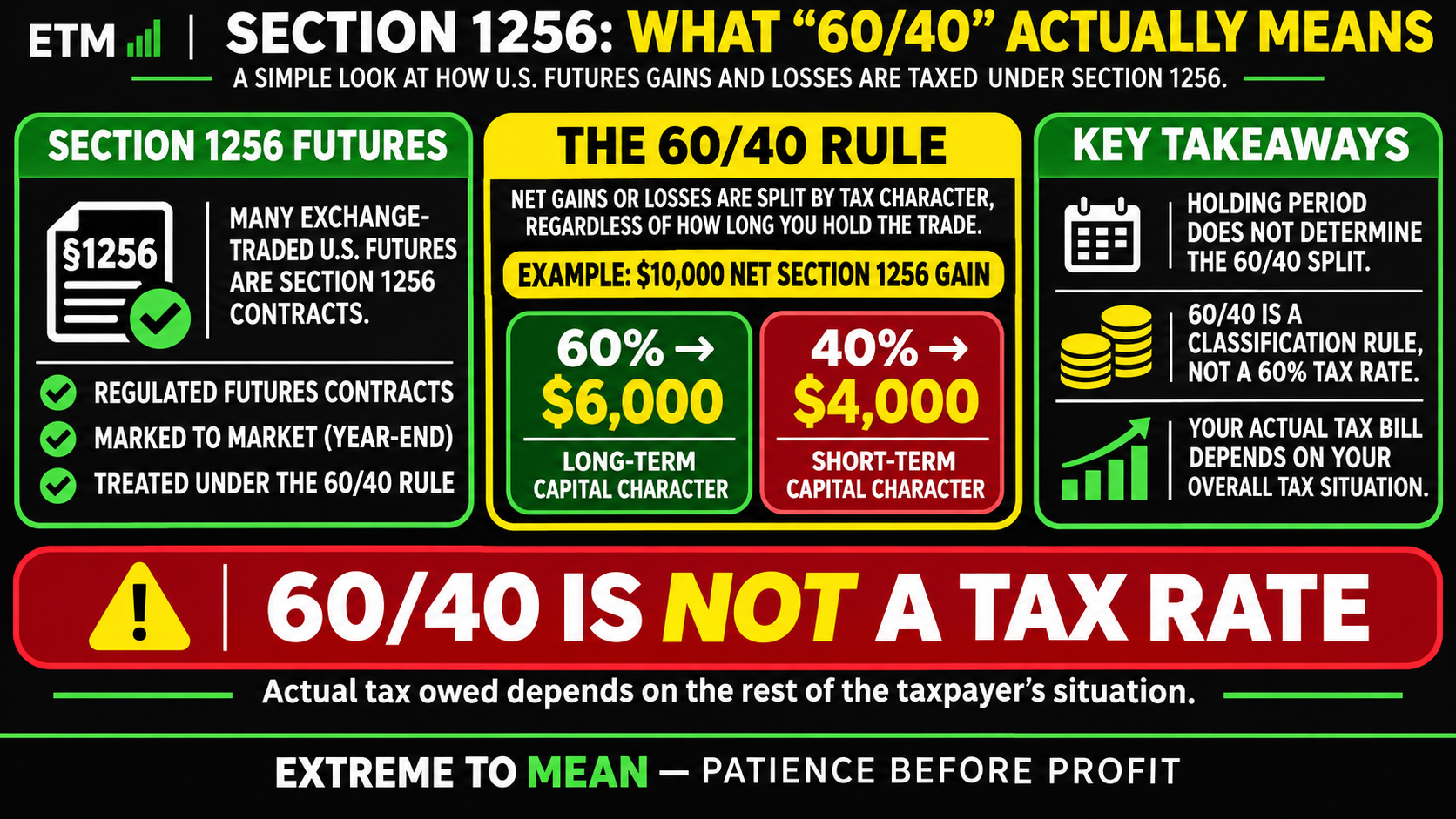
That is the distinction worth memorizing: 60/40 is a classification rule, not a tax percentage.
What Is a Section 1256 Contract?
Section 1256 covers several categories of financial contracts. For this beginner article, the important one is the regulated futures contract, because that is where many familiar exchange-traded U.S. futures fall.
Under federal law, a regulated futures contract generally involves a system of marking to market and is traded on, or subject to the rules of, a qualified board or exchange. Common exchange-traded equity-index, energy, metals and interest-rate futures are the kinds of contracts beginners frequently encounter, but the legal classification still matters. Tax treatment follows the legal classification of the instrument—not the nickname traders use for it.
That is why we should not say that everything containing the word “futures” automatically receives identical treatment. Securities futures, hedging transactions and other specialized arrangements can involve different rules. For a specific contract, verify its actual classification rather than assuming from the ticker alone.
Why a Two-Minute Futures Trade Can Still Be 60% Long-Term
With ordinary stock investing, holding period is generally central to whether a capital gain is long term or short term. Section 1256 works differently for covered contracts because the statute imposes its own 60/40 character rule.
Imagine a trader opens and closes a qualifying futures position in ninety seconds and earns $1,000. Under the simplified Section 1256 framework, $600 of that result would carry long-term capital character and $400 short-term capital character. The trader did not somehow “hold 60% of the trade for more than a year”; the character comes from the statute rather than the actual trade duration.
That does not tell us what the trader owes in tax. It tells us how the qualifying result is divided before it enters the broader tax return. The 60/40 rule describes tax character—not your tax rate.
Year-End Mark-to-Market Changes the Calendar
The second major Section 1256 concept is mark-to-market at tax year-end. A qualifying Section 1256 position still open at the end of the year is generally treated for federal tax purposes as though it were sold at fair market value on the last business day of the tax year.
Suppose a trader still holds a qualifying futures position and, on that tax-year checkpoint, it has an unrealized $5,000 gain. Section 1256 generally recognizes that $5,000 for that year's tax calculation even though the trader has not actually closed the market position. Under the basic 60/40 split, that would mean $3,000 of long-term character and $2,000 of short-term character.
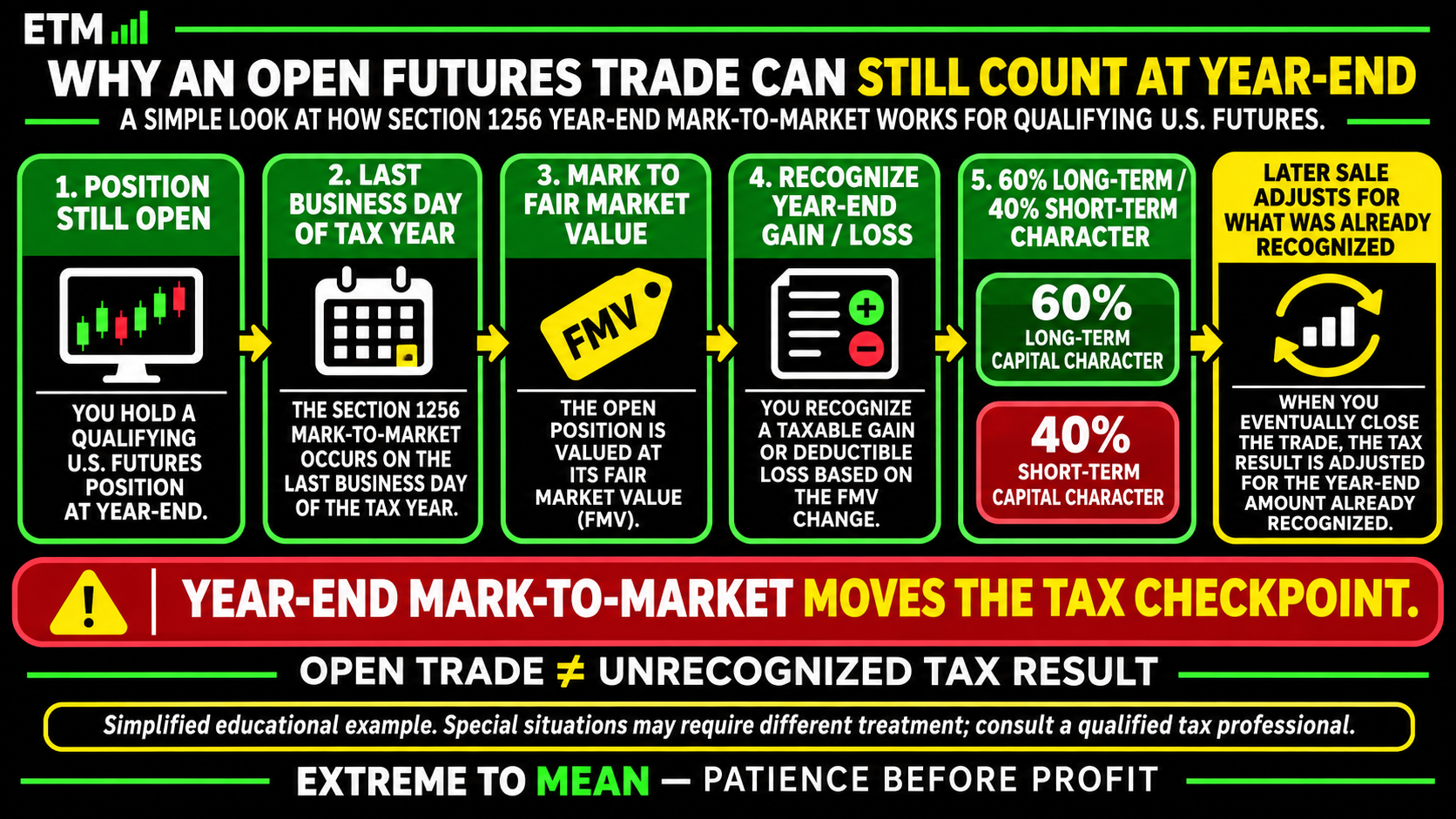
This is why OPEN POSITION ≠ UNRECOGNIZED YEAR-END RESULT. For Section 1256 tax purposes, the calendar can create a recognition event even while the trading position remains open.
Why Mark-to-Market Does Not Mean Taxing the Same Gain Twice
The obvious beginner question is: if the open position is treated as sold at year-end and I later actually close it, do I get taxed twice? The answer, under the basic Section 1256 mechanism, is no.
The amount already recognized through year-end is taken into account when the later gain or loss is calculated. If a position is treated as worth $57,000 at year-end and later closes at $56,000, the subsequent tax result reflects the $1,000 decline from the previously recognized value rather than treating the earlier gain as new again.
A useful way to think about it is that year-end mark-to-market moves the tax checkpoint. It does not intentionally count the same economic gain twice.
Futures traders may already be familiar with economic mark-to-market through daily settlement. Section 1256's year-end tax rule is related in concept but serves a different purpose. Daily account settlement and year-end federal tax recognition should not be treated as the same accounting event.
How Form 6781 Fits In
The specialized federal form associated with these rules is Form 6781, Gains and Losses From Section 1256 Contracts and Straddles. Its Section 1256 portion organizes the covered gain or loss and applies the 40% short-term / 60% long-term split before the amounts flow into the broader capital-gain reporting process.
Broker reporting can provide an important input. Current IRS guidance provides for regulated futures and other Section 1256 transactions to be reported through Form 1099-B information, including aggregate reporting in appropriate circumstances. That is one reason Section 1256 reporting does not simply look like manually typing every individual futures scalp into a tax form.
That does not mean every broker statement will look identical or that Form 6781 is the trader's entire tax return. Follow the actual tax documents supplied by the broker and the instructions applicable to the taxpayer's return. If something does not reconcile, that is precisely where a qualified tax professional should be involved.
Do Wash-Sale Rules Apply to Futures?
This is another area where trading-room shorthand gets dangerous. Current IRS guidance states that the ordinary wash-sale rules do not apply under the Section 1256 mark-to-market rules, and Publication 550 separately says ordinary wash-sale rules do not apply to losses from commodity futures contracts and foreign currencies.
The safe beginner takeaway is therefore narrower than “futures have no wash sales.” For qualifying Section 1256 futures under the mark-to-market framework, the ordinary stock wash-sale mechanism is not applied in the same way. NO ORDINARY WASH-SALE RULE ≠ NO DERIVATIVES LOSS RULES.
Straddles are the obvious reason to keep that distinction. Federal tax law has separate rules that can defer or alter the treatment of losses involving offsetting positions, and Form 6781 contains a separate section dealing with straddles. Do not import ordinary stock wash-sale rules blindly into Section 1256 futures, but do not assume derivatives taxation is rule-free either.
When the Simple 60/40 Explanation Is Not Enough
The clean beginner explanation begins to break down when the trader has more complicated facts. Mixed straddles, hedging transactions, unusual derivatives combinations, certain elections, specialized contract types and business hedges can require analysis beyond the basic 60/40 example.
A properly identified business hedging transaction, for example, can have different treatment from a speculative futures trade. Section 1256 also has special rules and elections for certain straddles. The simple framework is a starting point—not permission to self-diagnose every derivatives-tax situation.
This is one of the places where professional advice matters most. If your positions include hedges, straddles, options combined with futures, entity accounts, unusual elections or other complex structures, have a qualified tax professional familiar with derivatives review the actual facts rather than relying on a general internet explainer.
Losses and the Special Carryback Rule
The 60/40 character split applies to qualifying losses as well as gains. A simplified $10,000 net Section 1256 loss would generally be divided into $6,000 long-term loss character and $4,000 short-term loss character before the other applicable capital-loss rules are considered.
Section 1256 also contains a special loss carryback mechanism. An individual with a qualifying net Section 1256 contracts loss can generally elect, subject to statutory limits, to carry that loss back as far as three years against qualifying Section 1256 gains in those prior years.
The word elect matters. This is not an automatic refund mechanism and not a recommendation that every losing futures trader should use it. Whether the election applies or makes sense in a specific situation is a tax-planning question for current IRS guidance and professional advice.
Section 1256 Is Not Section 475(f)
Both Section 1256 and Section 475(f) discussions use the phrase mark to market, which can make beginners assume they are the same thing. They are not.
Section 1256 creates statutory treatment for qualifying contracts, including its year-end mark-to-market mechanism and 60/40 character split. Section 475(f) is a different tax provision associated with qualifying trader elections and raises a separate set of questions about trader tax status and business treatment.
This article is not intended to determine whether someone qualifies for trader tax status, should make a Section 475(f) election, may deduct a home office, or should operate through a particular entity. SECTION 1256 MARK-TO-MARKET ≠ SECTION 475(f).
Personal Futures Trading and Prop-Firm Payouts Are Different Questions
This distinction matters for many modern traders. If you directly trade qualifying Section 1256 futures in your own brokerage account, Section 1256 may apply to those contracts.
A payout from a proprietary-trading arrangement is different. The fact that the prop firm's business involves futures—or that the trader uses a futures platform—does not automatically make the money paid to the trader the trader's own Section 1256 futures gain. The treatment can depend on the contract between the trader and the firm, the legal entity involved, and how the payment is characterized.
If you need background on the account model itself, what a prop firm is is a useful starting point. For the tax treatment of your actual payout, however, PERSONAL FUTURES GAIN ≠ PROP-FIRM PAYOUT; take the agreement and tax documents to a qualified professional instead of assuming “60/40 because futures.”
Federal Rules Are Not the Whole Tax Picture
This article is focused on U.S. federal taxation. State taxation can differ, and a trader should not infer a state result from the federal Section 1256 framework.
Likewise, the same federal rule can lead to different actual tax bills for different taxpayers. Filing status, taxable income, other capital gains and losses, deductions, entities, state residence and other facts can all matter.
That is why FEDERAL TAX RULE ≠ PERSONAL TAX ADVICE. Understanding the mechanism helps you ask better questions; it does not replace analysis of your own return.
Futures Taxes Compared With Ordinary Stock Treatment
A simple comparison helps explain why futures traders talk so much about Section 1256:
| Question | Qualifying Section 1256 Futures | Ordinary Stock Example |
|---|---|---|
| Gain character | Generally 60% long-term / 40% short-term | Generally depends on actual holding period |
| Open at year-end | Generally marked to fair market value | Generally no deemed sale solely because year ends |
| Ordinary wash-sale framework | Section 1256 mark-to-market rules generally do not apply it in the same way | Can apply to stock/securities losses |
| Specialized reporting | Form 6781 | Typically Form 8949 / Schedule D framework |
This is intentionally a high-level comparison. Stock taxation also contains exceptions, and Section 1256 contains its own special rules. The purpose is to show why blindly applying stock-tax shorthand to futures can lead to bad conclusions.
The Beginner's Section 1256 Tax Checklist
Before assuming how your futures activity is taxed, ask:
- Is the instrument actually a Section 1256 contract?
- Am I directly trading the contract in my own brokerage account?
- What is my net qualifying Section 1256 gain or loss?
- Do I have qualifying positions still open at tax year-end?
- What Section 1256 information did my broker report?
- Do I understand that 60/40 describes character rather than a tax rate?
- Am I incorrectly importing ordinary stock wash-sale rules?
- Do I have straddles, hedges or other complex positions?
- Am I mixing federal tax rules with state-tax assumptions?
- Do I need a qualified professional to review my actual filing situation?
The final question is not boilerplate. Once a trader moves from understanding the mechanics to deciding how to report a real account, the exact facts matter. The ETM free tools can help with trading organization, but they are not a substitute for tax records, current IRS instructions or professional tax advice.
The ETM Classify → Mark → Split → Report → Verify Framework
Use CLASSIFY → MARK → SPLIT → REPORT → VERIFY. CLASSIFY asks whether the instrument is actually a Section 1256 contract; MARK asks whether year-end mark-to-market applies; SPLIT applies the basic 60% long-term / 40% short-term character rule. REPORT follows the applicable Form 6781 and broader return process, while VERIFY checks special circumstances against current IRS guidance and professional advice.
This framework explains the rules without turning a general article into someone's tax return. Just as a trade is not ready until the risk is clear, a tax conclusion is not ready merely because a trader remembers one slogan from a trading forum. Understand first. File with the right source.
Final Thought
Many familiar U.S. exchange-traded futures fall under Section 1256, which gives qualifying contracts a federal tax structure that differs from ordinary stock trading. Gains and losses are generally characterized 60% long-term and 40% short-term regardless of how long the contract was held, and open positions are generally marked to fair market value on the last business day of the tax year.
That does not mean futures have a 60/40 tax rate, that every product called a future qualifies, or that ordinary wash-sale rules are the only loss-deferral rules that matter. Straddles, hedging transactions, special elections, unusual instruments, prop-firm payouts and state taxes can require a different analysis. A tax rule is not a trading edge, and a favorable tax characteristic cannot turn a bad strategy into a good one.
The useful beginner rule is simple: identify the contract first, understand what 60/40 really means, keep year-end mark-to-market in mind, and use the actual broker records and current IRS materials when reporting. For your specific return, elections, entity structure, state treatment or planning decisions, consult a qualified CPA, enrolled agent, tax attorney or other tax professional familiar with futures and derivatives, and involve your financial advisor where broader planning is involved.
Educational content only. Trading involves substantial risk and is not suitable for everyone.