
Prop trading has become one of the most talked-about paths for newer traders, especially traders with smaller personal accounts. The difference between a personal account and a prop-firm account begins with who supplies the risk capital and which rules control access. The idea sounds simple from the outside: instead of risking a large amount of personal capital, a trader pays for an evaluation or challenge, follows the firm’s rules, and tries to qualify for a larger account opportunity.
That basic idea is appealing, but it is also where many beginners misunderstand what prop trading actually requires. A prop firm is not a shortcut around risk. It is not a guarantee of income. It is not a magic way to make trading easier. In many ways, it makes trading more rule-sensitive because the trader must operate inside specific limits that can disqualify the account if they are ignored.
That is why prop trading fits directly into the Extreme to Mean trader psychology lessons. It rewards patience, structure, and decision quality more than prediction. The trader’s job is not to force trades just because an opportunity may exist. The trader’s job is to understand the rules, protect the account, wait for the right conditions, and avoid the emotional decisions that turn one mistake into a failed challenge.
What a Prop Firm Actually Is
A prop firm, short for proprietary trading firm, is a company that gives traders access to a trading account structure under the firm’s rules. In traditional finance, proprietary firms use firm capital and hire or back traders who trade the firm’s money. In the modern retail trading world, many prop firms operate through evaluations or challenges where traders must first prove they can trade within certain limits.
The exact model can vary from firm to firm. Some evaluations are simulated. Some firms offer different account types, different rules, different payout processes, and different requirements. A structured futures prop-firm comparison should therefore examine drawdown, fees, funded-stage rules, and payout access rather than one headline number. This is why a trader should always read the specific rules of any firm before signing up. The name “prop firm” does not mean every company works the same way.
For beginners, the basic idea is this: the firm is testing whether you can trade with discipline under constraints. The challenge is not only about making money. It is about making decisions while respecting the account rules.
Those rules usually include things like:
- A profit target
- A maximum loss limit
- A daily loss limit
- A drawdown rule
- Position size limits
- Minimum trading days
- Restrictions around news or specific trading behavior
- Consistency or scaling rules, depending on the firm
The important point is that the rules are not side details. They are the environment. In a personal account, you may decide how much risk you are willing to take. In a prop firm account, the firm defines the boundaries. Your job is to trade inside them.
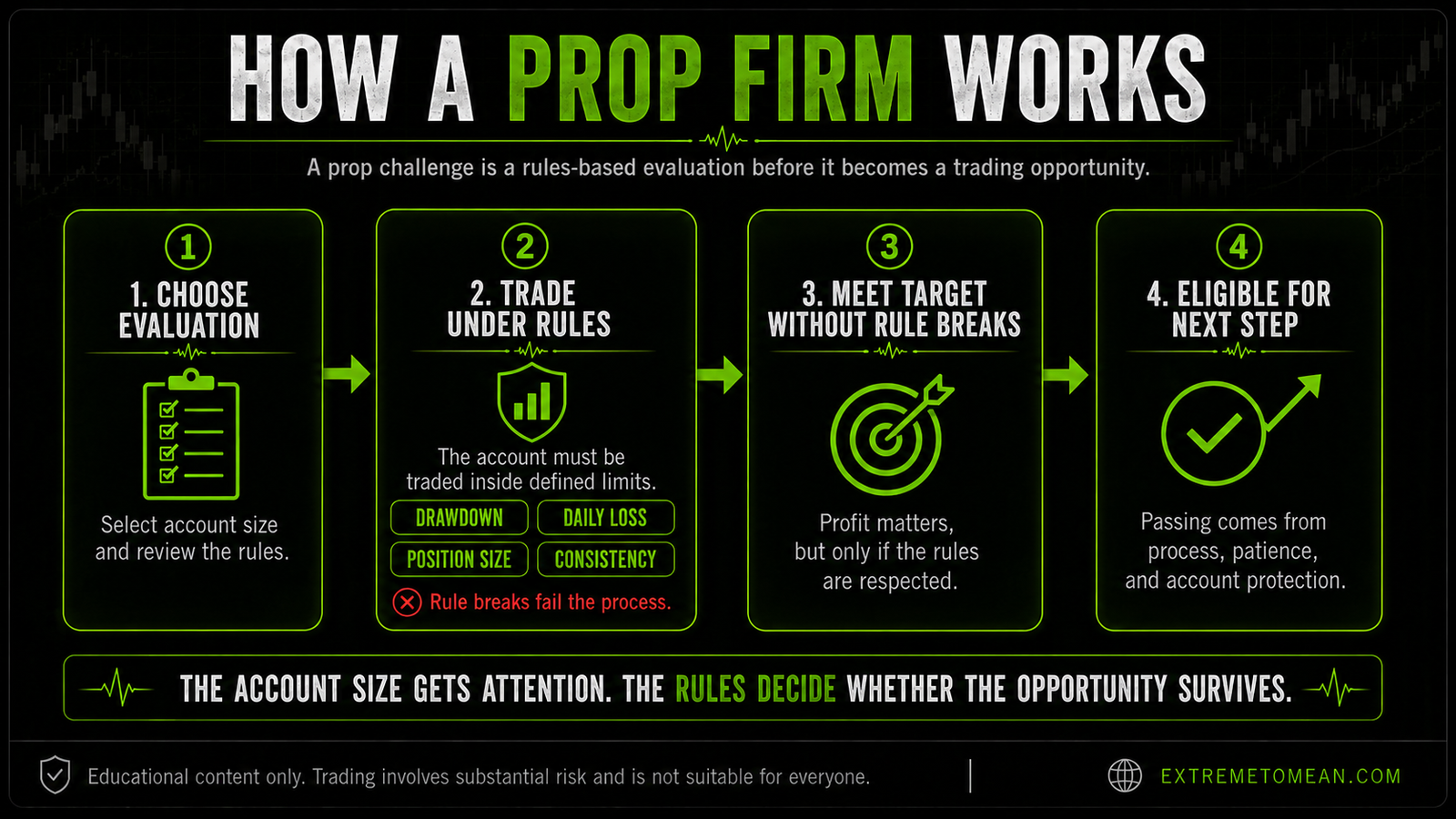
How Challenges and Evaluations Work
Most beginner-friendly prop firm programs start with some kind of evaluation. The trader pays for an account size or challenge level and then tries to meet the firm’s requirements. If the trader reaches the profit target without breaking the rules, they may become eligible for the next step in that firm’s process.
That sounds straightforward, but the difficulty is usually not the profit target alone. The hard part is reaching the target while staying inside the risk limits. A trader who makes money too aggressively can still fail if they break a drawdown rule, exceed a daily loss limit, trade too many contracts, or violate a consistency requirement.
This is where many beginners get surprised. They think the challenge is asking, “Can you make the target?” The better question is, “Can you trade in a way that protects the account while giving yourself a chance to reach the target?”
That question changes the entire approach. Instead of asking how fast you can pass, you start asking how cleanly you can trade. Instead of trying to catch every move, you focus on avoiding bad trades. Instead of increasing size because you are close to the target, you protect the progress you already made.
A prop evaluation is a pressure environment. The rules create structure, but they also create emotional tension. The trader knows the target. The trader knows the limit. That awareness can make every trade feel more important than it should. This is why a calm process matters so much. Without one, the challenge becomes less about trading and more about managing urgency.
Why Traders Use Prop Firms
Traders use prop firms for several reasons. The most obvious reason is access. A trader may not have enough personal capital to trade the account size they want. A prop firm can provide a structured way to attempt access to a larger account opportunity without putting up the full account amount personally.
Another reason is accountability. A prop firm challenge forces the trader to operate within rules. That can be useful for traders who need structure. The account has boundaries, and those boundaries make certain behaviors impossible to ignore. If you overtrade, oversize, or ignore risk, the account rules will expose it quickly.
Prop firms also give traders a defined goal. Instead of vaguely trying to “trade better,” the trader has a clear framework: protect the account, follow the rules, and work toward the evaluation requirements. That structure can help, but only if the trader respects it.
The danger is that beginners often focus on the upside of prop trading while underestimating the discipline required. They imagine what could happen if they pass. They think about payouts before they have proven they can manage risk. They look at the account size instead of the account rules.
That is backwards. The account size is not the opportunity by itself. The opportunity only matters if the trader can survive inside the rules long enough to use it. A larger account with tight rules is not freedom. It is responsibility.
Where Beginners Usually Get in Trouble
The biggest mistake beginners make with prop firms is treating the challenge like a race. They want to pass quickly. They calculate how many points or trades it would take to hit the target. They start thinking in terms of speed instead of process.
That mindset creates problems. A trader who wants to pass fast is more likely to force trades, increase size too early, take marginal setups, or trade after frustration. A single emotional trade can create a drawdown hole that changes the entire evaluation. Once the trader feels behind, the pressure increases, and FOMO becomes the tax you pay for chasing.
Another common mistake is not understanding drawdown. Drawdown is the amount the account can decline before the trader violates the rules. Some drawdown rules are fixed. Others trail the account as it grows. Some are calculated intraday. Others are based on closing balances. The details matter. A trader who does not understand the drawdown rule is trading blind inside the account.
Beginners also underestimate how different prop trading feels from trading on a demo chart with no consequences. The lesson on why behavior changes between simulation and meaningful risk explains why identical market information can produce different decisions. Even if the market is the same, the pressure is different. The trader is aware of the challenge fee, the rules, the target, and the possibility of failing. That pressure can create urgency where none belongs.
This is why prop firm trading often exposes discipline problems faster than a personal account does. The rules compress the feedback. If your process is loose, the account will show it quickly.
What a Better Beginner Should Look For
A better beginner does not start by asking, “Which prop firm can help me pass the fastest?” That question creates the wrong focus. The better starting point is, “Which rules can I realistically trade inside with my current skill level?”
That means looking at the firm’s structure before thinking about the target. How does the drawdown work? How much room does the account actually provide? What is the daily loss limit? What size can you trade without putting the account under pressure? Are there restrictions around news? Are there consistency rules? What happens after the evaluation is passed?
A beginner should also be honest about their current trading process. Your trading plan is a promise you make before the open, and a prop challenge will not create one for you. It may actually make the absence of a plan more expensive. Before starting, you should know what setups you trade, when you do not trade, how much you risk, how you stop for the day, and what conditions make your setup invalid.
The cleaner approach is to treat a prop challenge as a rule-following test first and a trading test second. The market will always be uncertain. No setup guarantees a result. But rule-following is within your control. Position size, daily limits, trade selection, and emotional restraint are all part of the process, and understanding why daily loss limits are decision limits matters even more inside a firm-imposed drawdown rule than it does in a personal account.
Patience Before Profit applies directly here. The trader who survives the evaluation is usually not the one who tries to win every move. It is the trader who can skip low-quality trades, protect the account, and wait for conditions that actually fit the plan.
A Beginner Prop Firm Decision Filter
Before starting a prop firm challenge, a trader should run through a simple filter. The dedicated prop-firm challenge readiness guide expands that preparation into account rules, platform competence, sizing, and personal risk limits. The goal is not to find the perfect firm or the perfect account. The goal is to make sure you understand the environment before you put yourself inside it.
Ask these questions:
- Do I understand every rule that can fail the account?
- Do I understand how drawdown is calculated?
- Can I trade my normal size without putting the account under pressure?
- Do I have a setup and risk plan before starting?
- Do I know when I will stop trading for the day?
- Am I trying to build skill, or am I trying to rush toward a payout?
- Would this challenge still make sense if it takes longer than I want?
The better question before starting is this: “Can I follow this account’s rules calmly, or am I already planning how to force the outcome?”
That question matters because the wrong mindset can ruin the challenge before the first trade is placed. If the plan depends on oversized trades, perfect timing, or catching one big move, the process is already fragile. A better plan gives the trader room to be wrong, room to wait, and room to protect the next decision.
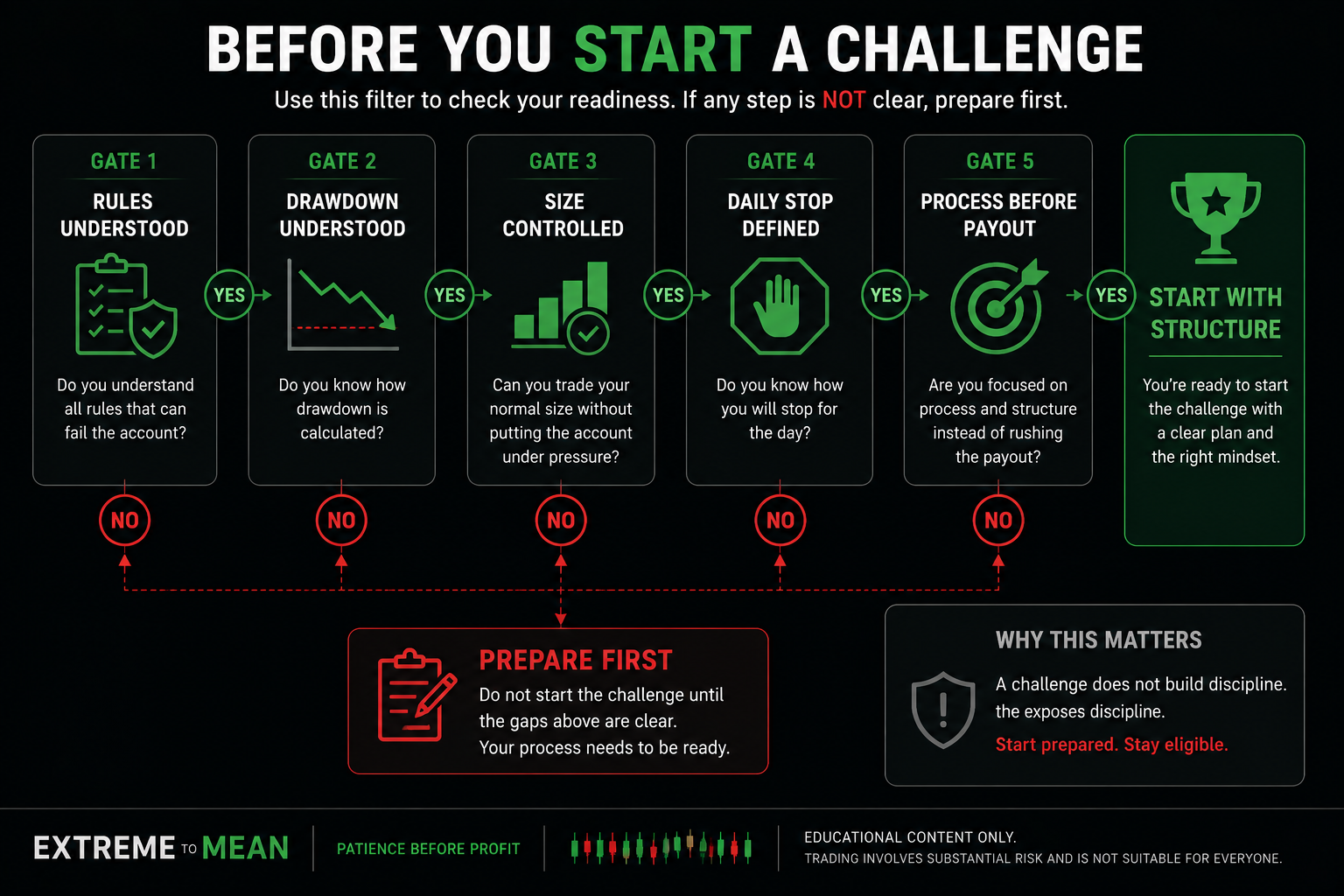
A prop firm challenge should not change your identity as a trader. It should not make you chase, force, or abandon the process. It should place your existing process inside a defined rule structure. If your process cannot survive that structure yet, the answer may not be a larger account. The answer may be more preparation, so build a rule-based process with the free tools.
Final Thought
A prop firm can be useful for traders who understand what they are entering. It can provide structure, accountability, and a pathway to trade under a larger account framework. But it is not a shortcut around discipline. It is a test of discipline.
The beginner mistake is seeing the account size first and the rules second. The professional approach is the opposite. The rules come first. The risk comes first. The process comes first. Only after that does the opportunity matter.
Your job is not to predict your way through a prop challenge. Your job is to evaluate, protect the account, respect the rules, and wait for trades that fit. A setup does not earn risk just because the target exists. The setup earns risk only when the market conditions, account rules, and trader behavior all line up clearly enough to justify the decision.
Patience Before Profit is not just a slogan for chart entries. It is the mindset that keeps a trader from turning a prop firm opportunity into another pressure trap.
Before comparing firms, it helps to understand the basic differences between stocks, ETFs, futures, and options.
It also helps to know what you are actually trading before judging the rules around it.
Many prop programs focus on futures, so newer traders should first learn what a futures contract is.
Different products create different obligations, including the rights and obligations inside an options contract.
Underneath any challenge rule, the core skill remains understanding what trading really is before trying to perform it under pressure.
Those rules make it especially important to understand why controlling exposure matters inside account rules.
Educational content only. Trading involves substantial risk and is not suitable for everyone.